Union approval near 60-year high
To observe Labor Day—the holiday invented by conservative politicians and their friends in the labor movement to draw attention away from the militant history of May Day—Gallup released a poll on public attitudes towards unions.* For the fifth consecutive year, it shows approval close to the highest levels in 60 years—68%. It’s ranged between 68% and 71% since 2021. The graph below tells the history.
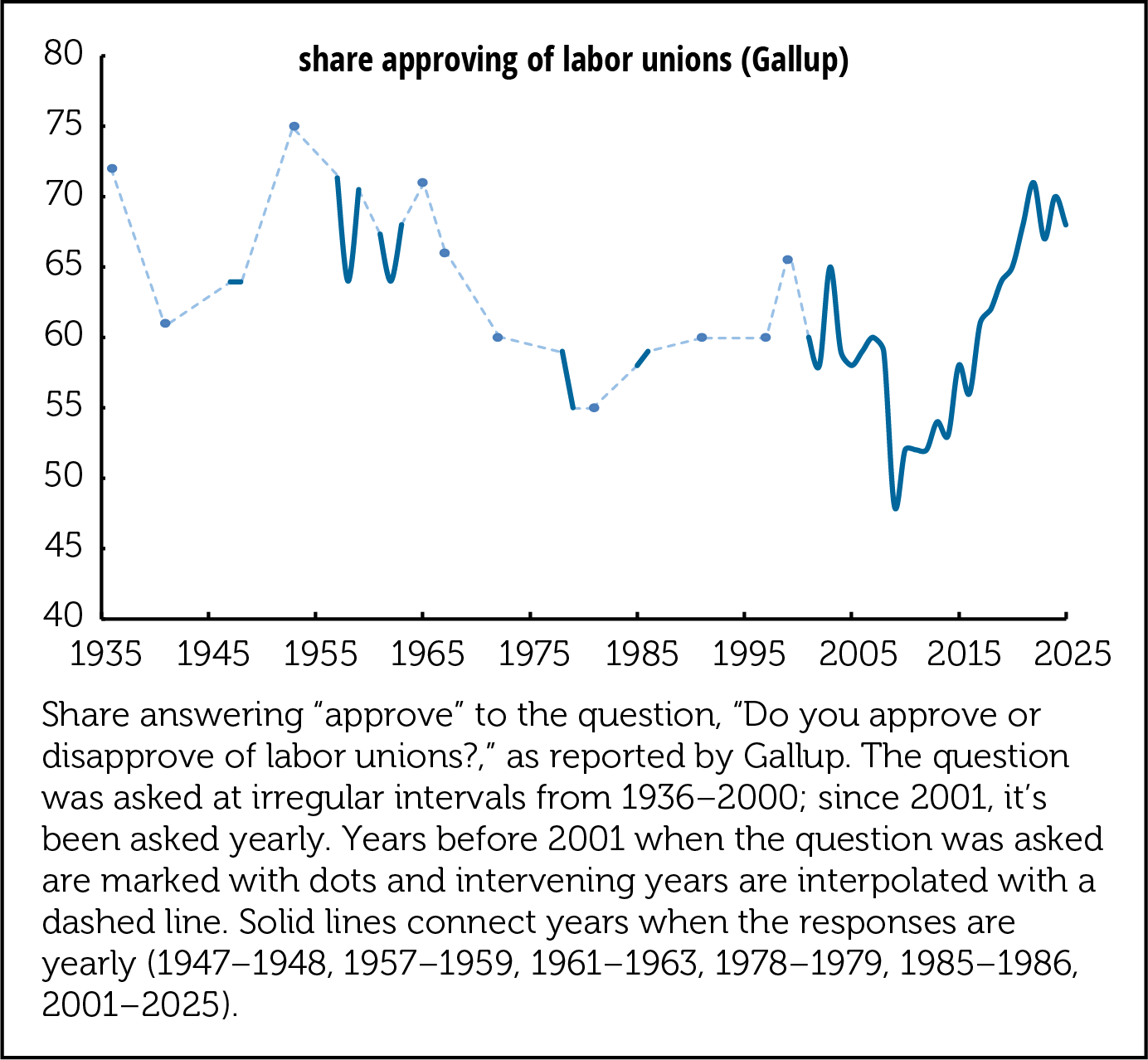
When Gallup first asked the question in 1936±the year of the Flint sit-down strike—72% approved. Positive feelings sagged some during the 1940s, but rose back above 70% in the 1950s and stayed close to that level in the 1960s. Approval fell during the inflationary years of the 1970s and the concessionary years of the 1980s, and (paradoxically) plunged during the financial crisis and Great Recession, hitting an all-time low of 48% in 2009 (the only time it fell below 50%). From that trough it’s risen steadily and has hovered around 70% or just below since 2021. You could mourn its refusal to rise further but holding just below historical peaks in what seem like reactionary times is encouraging.
Partisan differences are huge; as Gallup puts it, “90% of Democrats, 69% of independents and 41% of Republicans express approval.” Though we’ve heard a lot about how the GOP is now the workers’ party, that 41% rating is actually down from 56% in 2022, and the D–R gap is almost 20 points wider than it was in 2001. Josh Hawley may cynically show up at a picket line now and then, but his party isn’t even offering gestural support.
Gallup also finds that 8% of all respondents are in a labor union, and 13% of the employed. Just 1% of coupled households report that both members are in a union. (According to the BLS, 10% of the labor force is unionized.)
High approval ratings are marvelous, but turning those into higher union density is very hard work. Could be a lot worse though.
*In the US, May 1 is celebrated as Loyalty Day and Law Day, holidays created during the Eisenhower administration in the spirit of the Red Scare. For a comparison of Labor Day and May Day, see Olive Johnson’s 1936 pamphlet.


 LBO News from Doug Henwood