
fresh audio product: a right to housing?, the uses of un/certainty
Just added to my radio archive (click on date for link):
October 8, 2026 Sam Stein, author of A Right to Housing?, investigates that proposition skeptically • Natasha Lennard, author of Un/Certainty, talks about how doubt can be a mask for certainty
fresh audio product: the hidden rich, China and the US
Just added to my radio archive (click on date for link):
October 1, 2026 Owen Zidar, co-author of The Everywhere Millionaire, on the hidden rich • Jake Werner on US–China relations
fresh audio product: the world that right-wing Christian women made
Just added to my radio archive (click on date for link):
September 24, 2026 Kristin Kobes Du Mez, author of Live Laugh Love, on the world of right-wing evangelical Christian women
fresh audio product: vouchers, sex workers
Just added to my radio archive (click on date for link):
September 17, 2026 Jennifer Berkshire talks about the anti-school voucher backlash (articles here and here) • Heather Berg, author of Notes from the Sex Worker Left, on what that formation brings to politics
fresh audio product: AI, Zinn
Just added to my radio archive (click on date for link):
September 10, 2026 Garrison Lovely, author of Obsolete, on the terrors and possible promise of AI • Dave Zirin on Howard Zinn, the subject of his new biography
Alex Vitale imagines a postcarceral future
This interview was first broadcast on Doug Henwood’s show, Behind the News, on KPFA, Berkeley, on September 3, 2026, and circulated to the podcast universe shortly after. The full archive of BtN, going back to 2002, can be found here. Its Apple Podcasts page is here.
Doug Henwood Next, cops and jails. More precisely how to get rid of them and what a postcarceral future might look like. Here to imagine that for us is Alex Vitale. Alex is a professor of sociology and coordinator of the Policing and Social Justice Project at Brooklyn College and the CUNY Graduate Center. His book, The End of Policing, was published by Verso in 2017.
Whenever the topics of police and prison abolition come up, people love to ask gotcha questions like, “What about mass murderers? What about serial killers?” A legal maxim I learned in college long ago is that hard cases make bad law, which may not be universally applicable, but at least it has some truth to it.
So, I’m going to play the part of that questioner and ask a few of those hard questions. I hope they don’t make bad law. So first, I’d like you to expand on a point I saw you make at your DSA presentation last week. You recommended that no one ever say, “Well, I’m going to reduce poverty and that will solve the crime problem.” Instead, they should say something like, “Conventional methods don’t really make people safer,” and you have some better ideas on how to do that. So, could you elaborate on what those better ideas of how to make people safer look like?
Alex Vitale I didn’t say no one should say that. I said candidates running for office should be careful about saying that because it is not a winning argument. To the extent that we’re interested in electoral success, we need to be much more concrete about these things. Yes, in the long-term, addressing systems of exploitation, reducing inequality is the ultimate solution to lots of our problems, but there is a counter argument to that, which says that if we only focus on long-term poverty reduction, we are leaving people to live with crime disorder, insecurity, whatever, and that is going to drive them into a pro-police position. We don’t have to accept that false choice between long-term poverty solution or immediate policing. It turns out there are lots of fairly immediate non-police public safety strategies that we could lean into right now, that we could be funding and supporting massive expansions in community-based violence reductions initiatives.
We could be supporting the expansion of community-based mental health services, substance use treatment, harm reduction strategies, and these things not only will improve community conditions, these are evidence-based interventions, but they’re also consistent with a broader Liberatory, socialist, whatever analysis that is rooted in addressing problems in ways that lift people up instead of constantly punitively punish and criminalize them.
DH What does that violence reduction strategy look like?
AV Interpersonal violence in the United States is heavily concentrated in very poor areas. What we’ve seen be the most effective is often referred to as a kind of credible messenger-based model, which involves actually hiring people from the community who have a history of involvement in the community, in street life, and sometimes have done harmful things in their youth, but are known in the community, are networked in the community, and have made a personal transformation on this. To go out and work with the young people who were out on the streets at greatest risk of violence now, and to partner that with crisis stabilization services that attempt to address the most extreme vulnerabilities of these young people, being unhoused, having unaddressed past trauma, access to harm reduction strategies. These things are showing tremendously positive results all across the country. They are driving down the violence and no police are required.
DH Where has this sort of thing been tried?
AV So there’s been some really interesting, just recent reports that have come out. One was in Louisiana where New Orleans and Baton Rouge both had these sorts of nascent credible messenger programs that were not well-funded. And then they went in opposite directions. New Orleans went hard for we are going to really fund this community-based alternative. We’re going to give them a lot more resources, expand the areas they operate in. And Baton Rouge basically got rid of theirs. And violent crime rates went in opposite directions. New Orleans violent crime rates have been plummeting, and Baton Rouge’s have been going up. Newark, New Jersey, is a great example in part because they were ahead of the curve. They started doing this in 2014, and Newark went from one of the most dangerous, violent cities in the country to one of the safest. This is working. Every time we look closely at it, the results just look better and better.
It’s being done all across the country. In the last six months, I’ve visited with these programs in Detroit, in Northern California, in New Jersey, in Philadelphia, and this is happening, but it needs more support.
DH How do these play with the public? I imagine the public will say, oh, you’re going to send social workers in to deal with an armed lunatic. What are people’s reactions to these things?
AV They do actually do that. People say, “Oh, well, they can’t possibly deal with someone who’s armed or whatever.” And in fact, they routinely do. They don’t necessarily get a 911 call that says, “There’s a person shooting, you need to respond.” They’ll always just send the police. But what happens is people in the community call because these programs develop networks of people in the community who become their eyes and ears. So, they will get a call at three in the morning saying, “Yo, something is jumping off at this club, and we are trying to handle it, but we need some help.” And they will get out of bed and rush down there. And yes, sometimes there are guns involved and they intervene directly to try to calm the situation down. Talking to people, the reason they’re able to be successful is because they are from the community.
They are known people in the neighborhood who have the respect of people and are known as reliable people who are there to try to do the right thing. If the police show up in those situations, it can lead to an escalation of violence.
DH Just yesterday in Times Square, there was a woman wielding a couple of knives, threatening people. She moved towards a group of cops and a cop shot her. How would your kind of intervention deal with a situation like that?
AV This is someone who had a history of mental health issues that we’re now learning more about and who was systematically failed by our nearly non-existent community mental health system. Problems like that, which I would say is probably an instance of what we sometimes call suicide by cop, which the police are generally very happy to oblige, which is someone who’s in crisis who’s trying to provoke a violent police response. The question for me is how many opportunities were missed to help this person stabilize them before it escalated to this point?
DH The kinds of crimes that most people worry about are not really the premeditated kind like the doings of an angry ex-spouse, but the random kind, a stabbing or a stick up in the street or somebody in the subway wielding a knife or a pistol. Is your kind of intervention capable of dealing with these things? The cops are definitely not capable of dealing with these things because they don’t have foresight prescience, but how would you deal with these things?
AV One of the challenges here in the way we think about this is we tend to think of violence as one thing with one solution, send the police. When violence is actually quite complicated and has many different types of drivers, is this someone with a profound mental health issue? Is this someone who has experienced past trauma and is on a short fuse and when confronted by a situation escalates the situation? Is this driven by horrible gender dynamics? Is it driven by organized criminality? And we need solutions that are tailored to those specific drivers. We don’t just need community-based violence intervention strategies to deal with youth violence. We also need gender-based violence prevention strategies. We also need hate crimes prevention strategies. We also need robust mental health infrastructures. And together these things will drive down the violence. That doesn’t mean that there’s some magic solution that will address every potential violent situation.
Certainly, our current system doesn’t do that, but by trying to get at the heart of these things, using immediate interventions, following up with restorative practices and really addressing people’s needs, we can drive down the violence.
DH You’re very critical of the Norwegian approach of a fat welfare state and a thin carceral state. What’s your critique of that?
AV It’s not that I’m against that. It’s my view that police and prisons exist as tools of state coercion to manage resistance to regimes of exploitation. And the violence and brutality of those systems tend to increase in relationship to the degree of exploitation and inequality. So, the Nordic countries have a different social reality than the United States. In the US, our colonialism, our slavery, our everyday brutality behind those systems happened right here and it engendered a culture of violence, racism, gun carrying, and all the rest. And our society remains deeply, deeply unequal. The Nordic countries, their slavery and colonialism happened somewhere else, and their welfare state means that they do not have the level of inequality. They don’t have the level of violence, they don’t have a history of gun carrying, and so they don’t need to lean into the same level of repressive state power.
Interestingly, as those societies are becoming more unequal, as their welfare state is coming somewhat unglued, we see both increases in violent crime and increases in state violence.
DH What about somebody like Anders Brevik, the Norwegian neo-Nazi who killed 7u people in 2011? He was in a three-room suite with a computer. Is that appropriate treatment for somebody who kills 77 people?
AV Well, see, the premise of your question is that the appropriate response to harm is punishment, and this is exactly the calculation that we want to try to unwind. People say, “Well, we need punishment as a deterrent to prevent this from happening in the future,” but…
DH Well, it’s also to keep Anders Brevik off the street so he doesn’t do it again.
AV Okay. But then what difference does it matter what the conditions of confinement are? Why should we be so upset that he’s treated like a human being?
DH Oh, I’m not at all upset that he’s being treated like a human being. I’m just wondering if this kind of confinement is a humane way of approaching a problem like mass killing.
AV In a case of organized political violence, I don’t think the conditions of confinement or the degree of punishment are the issue. The issue is what is going on in their society that would produce that kind of violence and where were the mechanisms to try to identify and intervene, identify what was going on and intervene preemptively? I don’t know all the details of this case, but I know that when we look, for instance, at school shootings in the United States, the FBI found that in 90% of the cases, there were people who knew ahead of time that this was going to happen, but they didn’t know who to call or they didn’t trust anyone or they didn’t want to rat out their friend to the cops. And so, we need to create early warning systems that aren’t rooted in systems of punishment but are instead attempts to actually identify problems and resolve them.
The Parkland shooter, everyone was like, “This guy’s going to shoot the school up.” And they called the police and the police went to the house and knocked on the door and the young person said, “No, I’m not going to do that.” And they’re like, “Well, that’s all we can do because we’re police. We can only respond after someone starts shooting, which by then it’s too late.” So, it’s the wrong tool if we’re actually interested in preventing this violence.
DH What about the ubiquity of guns in the US? It seems like almost everybody’s got one and it makes us violent and paranoid. Is it a good idea to try to remove them?
AV Sure. I’m all for removing the guns and including the guns that the police use. And of course, the police have been historically a major provider of guns to American society and keep huge amounts of gun in circulation. And of course, every police show, practically every television show and movie period is some revenge fantasy involving people with guns. Our whole culture is organized around the idea that the way to solve a problem is to send someone with a gun. Just trying to incrementally get a few guns out of the circulation, I’m for it. I just don’t think that’s going to get to the root of the problem. The root of the problem is the levels of exploitation and inequality.
DH Well, the imperial war too. A lot of the people who’ve been in combat come back and become killers.
AV Well, some do.
DH Well, yes. It’s certainly a risk factor.
AV Yes. And they also commit suicide and they kill their spouse. Yes, there is some of that, and that’s true for police as well, but I don’t think that that’s the primary driver. And of course, that is itself a kind of exploitation. The way we treat people in our military, the terrible conditions, the trauma we force them to experience, the lack of support services, the poverty they often find themselves in after their service is a contributor to this.
DH Now let’s talk a bit about the so-called quality of life issue. I was in Burlington, Vermont last week taking my son up to college. There’s a lovely park downtown that was filled with homeless people, many of them with drug issues. The town is generally quite progressive, as is the mayor, and they’ve cut back on police spending and now there’s a serious backlash against this approach, Brewing. How do you deal with this problem in a world where spending on social services and new housing is scarce and beyond the means of this town of some 40,000 on its own?
AV Yeah. Well, of course, there’s nothing unique about Burlington in this story. I’ve also recently been in Burlington, but I’m also in 20 other cities a year, and this is a universal problem because it has become a central feature of American neoliberal capitalism, which is that we have made a structural decision as a society not to provide adequate housing for the bottom five, 10% of the population. Decriminalization by itself doesn’t do anything to put people in housing. At times, it’s a kind of hollow civil rights initiative that I actually described this at length in my book, City of Disorder. We have to actually have a plan to reduce the presence of these populations in public spaces in ways that are harmful and disruptive. And so we need to lean into things like housing first, sobering centers, mental health crisis stabilization centers. We have strategies that can help us address this, and we’ve seen it done in other places.
We don’t actually have a plan, including progressive mayors in liberal cities like Burlington and Berkeley and Ann Arbor. They are still committed to a market-based housing system as their primary response, and that market is incapable of addressing the problem. So we need a dramatic expansion in social housing and housing with support services. And until we get that, mass homelessness is going to continue to be a problem all across the country.
DH I remember back during the Giuliani years when Rudy was going after the squeegee guys [Rudolph Giuliani was mayor of New York City from 1994 to 2001], the journalist Alex Cockburn wrote the right-wing position was punitive, get them off the street, throw them in jail, whatever. And the liberal position was let them beg. It’s their freedom of expression. That seems to be the acceptable range of the spectrum on these issues.
AV Yeah, that’s exactly what I wrote in City of Disorder, which is about the rise of Giuliani and broken windows, quality of life policing. And basically, in addition, both the Democrats and the Republicans had essentially the same economic policy, which was neoliberal deregulation and pushing wealth up the economic ladder. So when given a choice as voters were between two candidates with essentially the same economic program, but one of them had a concrete plan to reduce the impact of this inequality on their everyday life, people went for that.
DH Now the punishment question. I’m sure some people are listening and are saying I can go with there’s no reason people convicted of nonviolent crimes should go to prison. We should seriously reduce the prison population. But what about the cold-blooded killer, the mass shooter? No prison for them?
AV The issue is not one of punishment. There may be people who need to be incapacitated, and that can be done in a lot of different ways. And yes, it will have a carceral quality to it. I understand that. This is an extremely small number of people. We do not need a massive system of policing in prisons to manage this very small number of people, most of whom, it turns out right, have been exposed to massive amounts of trauma and abuse in their own lives. They don’t just wake up one day and decide to become mass killers. They are produced by society and failed over and over and over again. Emphasis on prevention. And then yes, there may be people who we can’t figure out how to manage them in any other way, but this is a very small number of people and the management of them is not punitive.
It is preventive.
DH And finally, when I interviewed George Maher, who is a serious abolitionist, a few years ago, he said basically it’s premature to contemplate full abolition in the society we live in. It would have to be a different society for that to happen, as he put it, “a horizon that is not going to materialize tomorrow. There’s no escaping the slow process of building a different kind of world.” What do you think of that?
AV Yeah, I agree with Geo on this. We’ve discussed this. I mean, yes, there is no magic switch where if I just had enough power tomorrow, I could find the switch and turn off all the police and prisons and then we’ll just sort of see what happens. We’re up against a massive powerful state, the interests of capital, and all we can do is make incremental changes. What my work mostly focuses on is making sure that the incremental changes we are pursuing lead us in a direction that is consistent with a broader vision and our core principles. So this prevents me from making the mistake of putting a lot of political energy arguing for ridiculous things like body cameras and implicit bias training as a reform of the police and instead saying, let’s try to replace systems of punishment, coercion, humiliation, and violence with alternatives that are rooted in care, compassion, and solidarity in every way that we possibly can.
And as we do that, we assess the situation and we adjust. So, people say, “What about the murderers?” Well, we have a massive system of prison and policing now. It doesn’t work very well. They’re going to continue to do what they can to address the murders and the rapists, and there’s very little we can do about that in the short run, but we know that that is a very poorly effective, often counterproductive way to address it, and we’re going to keep trying to come up with better strategies to deal with it, some of which we already have.
DH I know I said finally, but now it’s just really finally. We’ve seen a sharp decline in crime over the last few years. New York City is on track for the lowest number of murders maybe ever in the city’s modern history. I can understand why there’s a surge in crime during the COVID years, but how do you explain this recent decline, the context of a much longer decline that went before it?
AV Exactly. It’s not a short-term phenomenon, right? It’s a 30-year phenomenon, and it is international in scope. It is not limited to New York City. It has nothing to do with something that some police chief in Eugene did or in San Diego or New York City. This is a broad-based cultural change that’s happening, and it is not well understood. We have tried to correlate it with a variety of sort of obvious things and it does not hold up. So we don’t understand it. It is real. It’s fantastic. I think that it makes left organizing more possible, and I hope it will lead to a diminishment of our reliance on police and prisons.
DH How do you feel about the political environment in the anti-woke backlash?
AV It’s very distressing that there are people who call themselves socialists but have absolutely no meaningful analysis about the role of state power as embodied by police and prisons that have historically been the front line of suppressing our movements. And I find this really incomprehensible in some ways, that it’s just incredibly naive that they think that we can just elect our way into socialism without addressing police power. And if we look at the wave of socialist electoral success a hundred years ago, we see that in many of these cities that elected socialist mayors, it was the police that became the locus of oppositional power in constantly trying to undermine their administrations. And for Mayor Mamdani in New York to just give carte blanche to the billionaire police commissioner seems to me a recipe for disaster in the long run.
fresh audio product: Trump’s Venezuela oil grab, life after cops and jails
Just added to my radio archive (click on date for link):
September 3, 2026 Alejandro Velasco on Trump’s oil grab in Venezuela • Alex Vitale on a post-carceral future
Everybody hates data centers, and they don’t even create many jobs
The president, ignoring the polls that show data centers to be enormously unpopular across the political spectrum, is pushing them because he sees them as essential to “beating” China and also as great economic stimuli. As Politico put it, “The bright spot in construction is increasingly data centers, not the factories Trump promised through his push to reshore manufacturing.” Or “let Data Reign,” as he put it, with his unique capitalization practice. As one former administration official told the outlet, “Trump is married to data centers no matter what because it’s the only real job creator.” You might not be surprised to learn that this isn’t true.
Yes, the sector looks to be creating some jobs, but not in size. (See graph below.) For the year ending in June 2026 (the most recent month available), industrial construction overall—the building of factories, office buildings, and the like—grew by just 2,000. Nonresidential specialty trades, another subsector of the construction business, where data center electricians and the like are employed (along with many other specialists who do the finishing work, as opposed to the people who put up buildings), showed more robust growth, 78,000, but the subsector accounts for just 1.8% of total employment, little more than it did two years ago, and less than it did in 2001. In percentage terms, it’s doing better than total employment, but that’s a low bar lately (heavy line below).
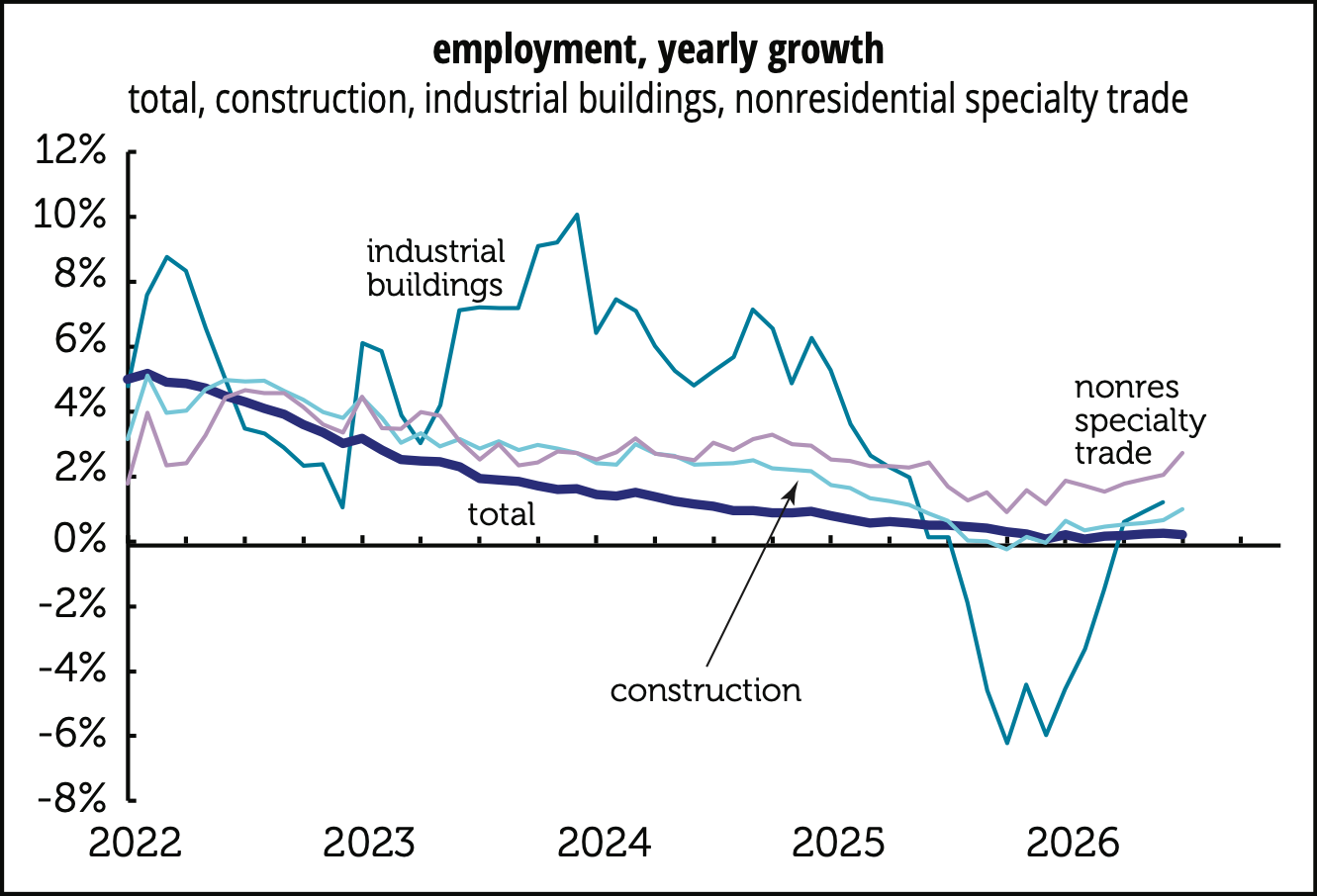
Nonresidential specialty trades look strong on the post-2022 graph above, but August’s yearly gain, 2.7%, is well below earlier peaks in 2006, 2015, 2019, and even 2023. As the longer-term graph below shows, it’s a volatile sector, subject to big swings between gains and losses, and its recent performance in a long-term context is hardly a barn burner.
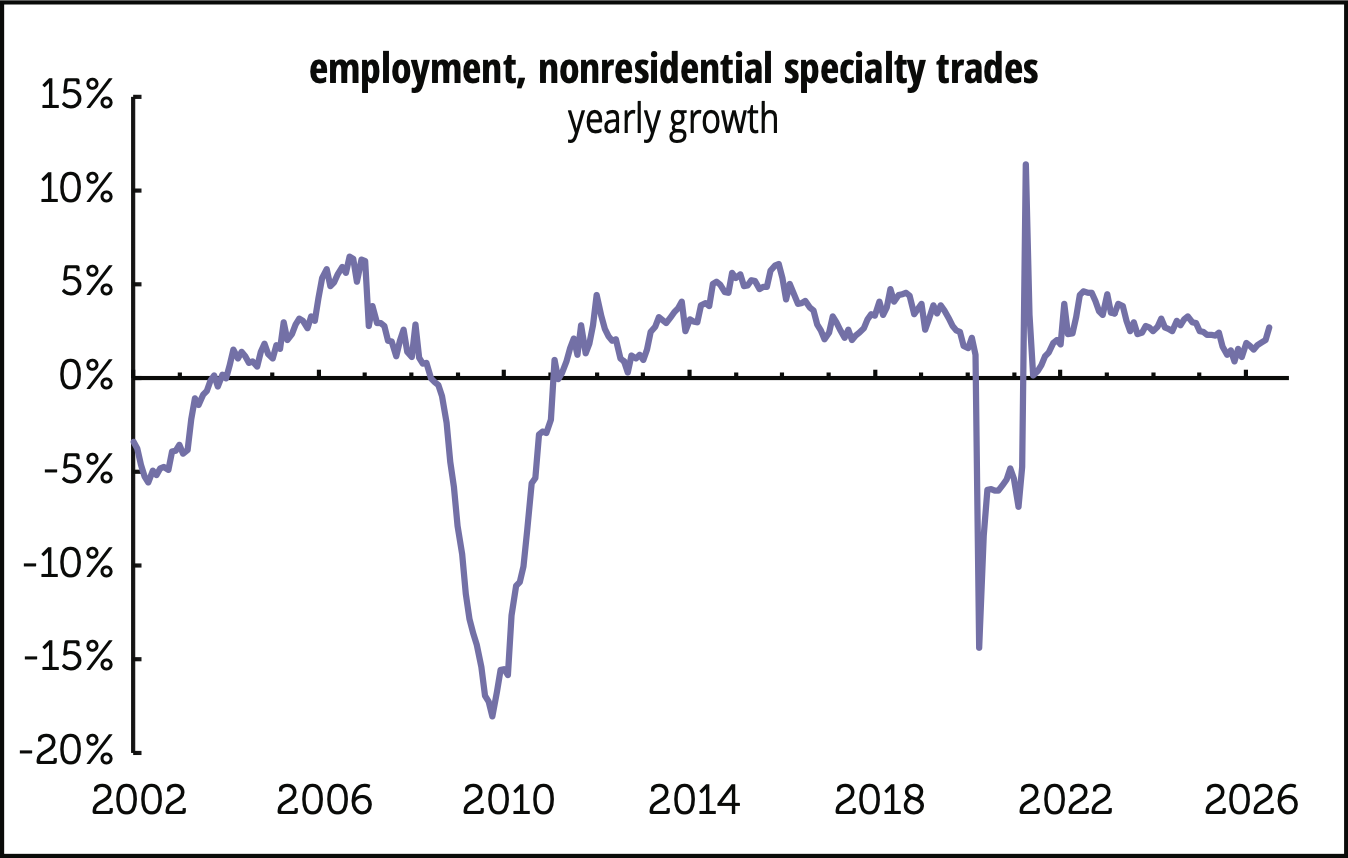
Sadly we don’t have any more detailed info on data center construction workers, but what we have is not inspiring.
Given all the investment spending being thrown at the sector, accompanied by large servings of hype, data center employment is remarkably underwhelming. And it’s been shrinking, not growing, at least by our proxy. (See graph below. The BLS classification, Sector 518 in the North American Industrial Classification System, “Computing infrastructure providers, data processing, web hosting, and related services,” is considerably larger than data centers alone, but no finer detail is available. So, as with data center electricians, this is all the data we’ve got.) In July, employment in the sector was 464,000, down 17,000, or 3.4%. That level is the same as June 2022. Then, it was 0.31% of total employment; in July, it was 0.29%. While small, it’s a high-paying sector, with an average hourly wage of $59.72, 59% above the national average, but the sector’s advantage has barely changed in five years. You’d think allegedly surging demand would boost earnings, but not so far.
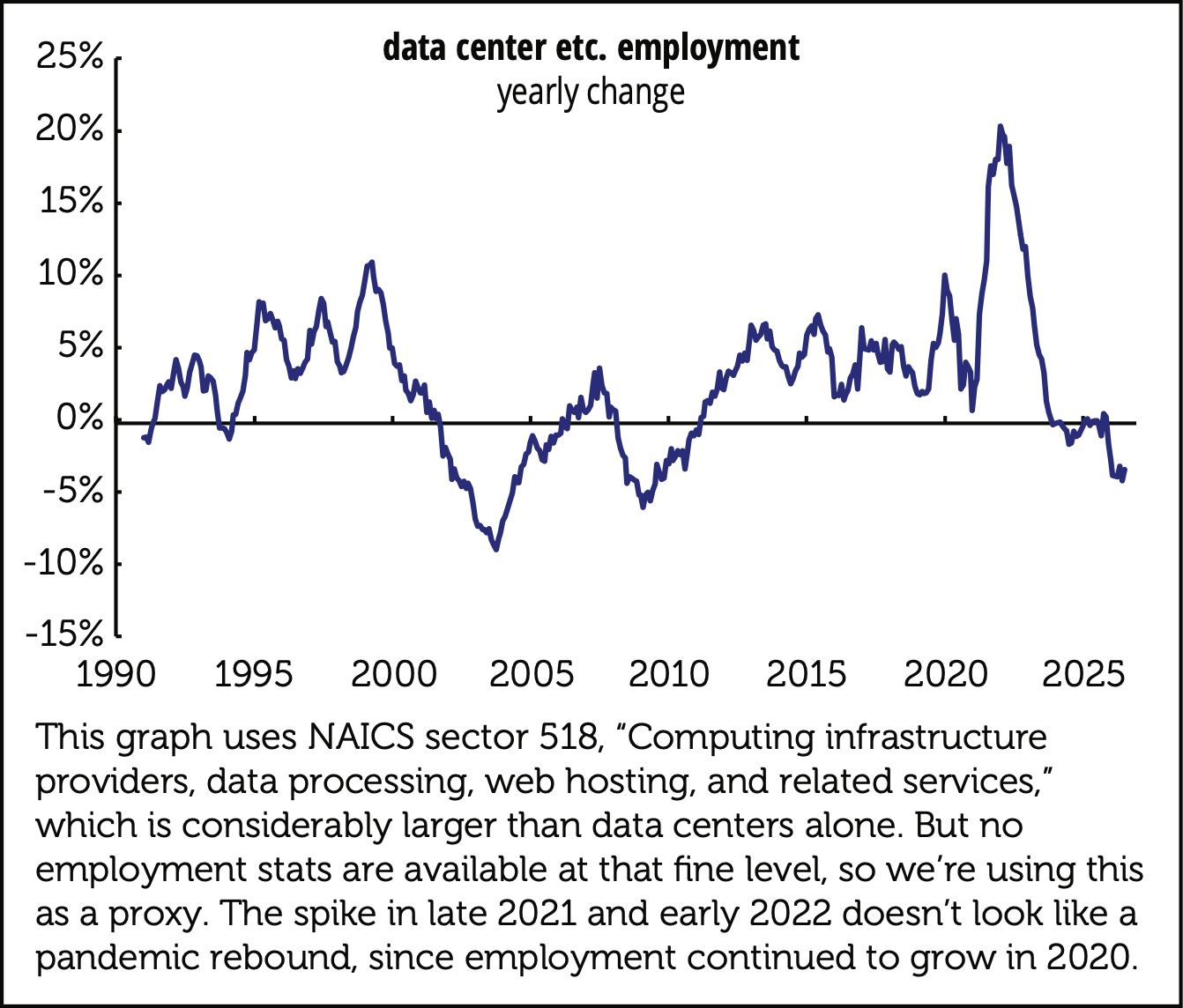
Despite the off-the-charts spending on data centers, it’s not like all that investment and the accompanying heavy seasonings of hype are likely to produce many new permanent jobs after the electricians et al. move on to their next construction sites. According to the Virginia Economic Development Partnership, in 2025 and so far in 2026, there were eight data center projects announced in the state (a major hotbed of data centerdom). Together, they accounted for $26.5 billion in investment, a sum that is supposed to create all of 305 jobs—which works out to $87 million per job. By contrast, a vegan skincare products factory to be built in Roanoke by the Austrian firm RINGANA is slated to produce 435 jobs for just $85 million in investment, or $195,402 per job.
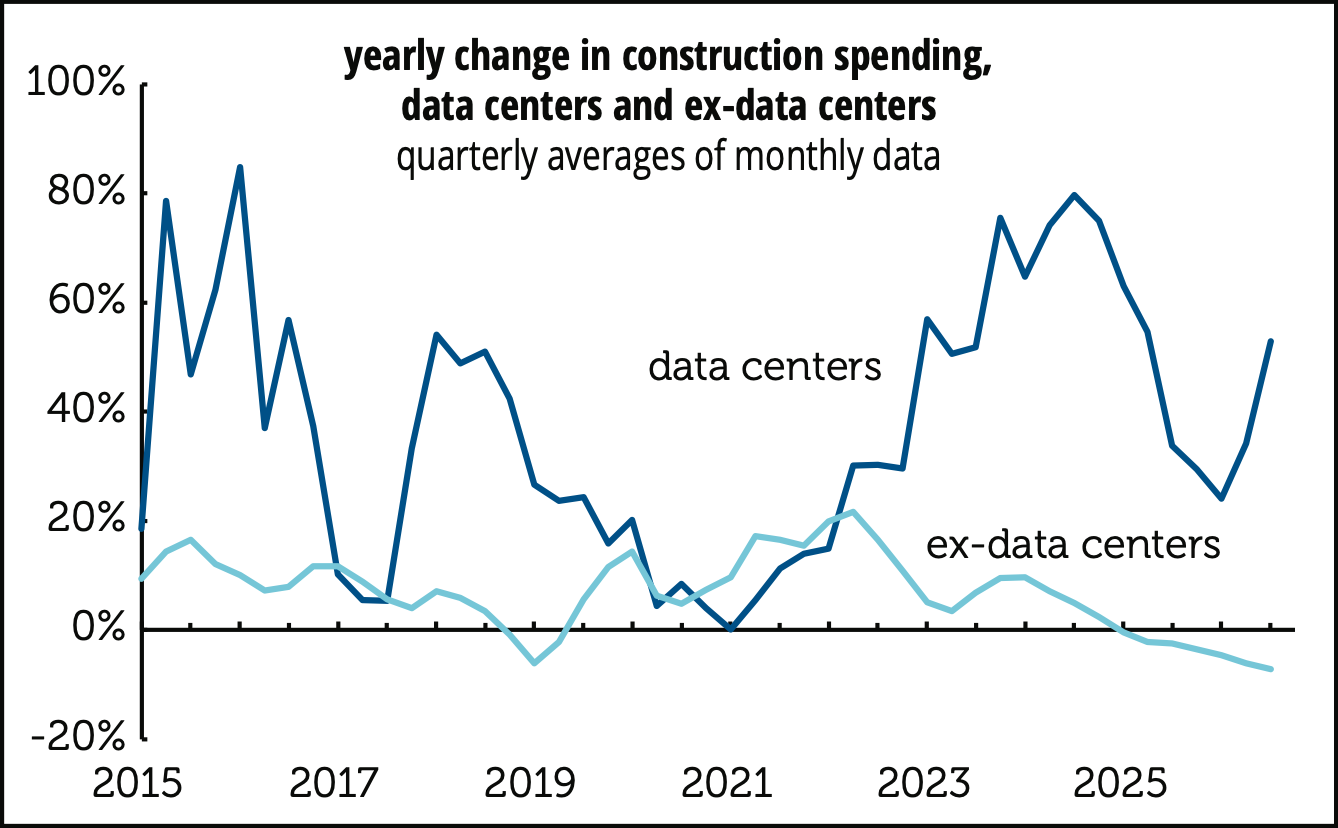
As the graph below shows, construction outside data centers is falling, down 7.1% for the year ending in July. (We used quarterly averages in the graph to smooth out the month-to-month volatility. Data for the third quarter of 2026 is July only.) But data centers are booming, if not quite as much as in 2024—up 53.8% between July 2025 and July 2026. Before we get carried away with the impressive magnitude of that number, though, a couple of reminders: it’s under 5% of total construction spending, and just 0.2% of GDP. And based on the Virginia relationships, July’s level of spending is likely to produce all of 864 permanent jobs, not quite twice as much as that vegan skin care operation—despite 884 times the expenditure.
fresh audio product: slavery, postcarbon
Just added to my radio archive (click on date for link):
August 27, 2026 David McNally, author of Slavery and Capitalism, on the political economy of the institution • Billy Fleming, author of Building Postcarbon Futures, on how to get from here to there
fresh audio product: Israel’s war on Lebanon; nonstandard forms of service work
Just added to my radio archive (click on date for link):
August 20, 2026 Aurélie Daher on the destruction Israel is visiting upon southern Lebanon • Annie McClanahan, author of Beneath the Wage, on nonstandard forms of work and compensation
Fresh audio product: AI, Ukraine
Just added to my radio archive (click on date for link):
August 13, 2026 Jodi Dean, who has a new Substack on the issue, on why AI is so terrible • Anatol Lieven on the bloody stalemate that is the Russia–Ukraine war (Sidecar piece here)
fresh audio product:
Just added to my radio archive (click on date for link):
August 6, 2026 Aditya Nigam on the Cockroach movement in India • Gerald Epstein and Juliet Schor on a detailed set of proposals to transform the US economy (papers here)


