
Fresh audio product: Italian politics, union finances
Just added to my radio archive (click on date for link):
July 28, 2022 Paolo Gerbaudo on the failure of technocracy and the imminence of right-wing rule in Italy • Chris Bohner on the huge stash unions have but aren’t spending (report here, Jacobin summary here)
Fresh audio product: the right’s war on education, the political economy of Ukraine
Just added to my radio archive (click on date for link):
July 21, 2022 Jennifer Berkshire on Pete Hegseth, Christopher Rufo, and the right’s latest fronts in their war on public education • Peter Korotaev looks at the political economy of Ukraine, before, during, and after the war
Fresh audio product: post-leftism, Afropessimism
Just added to my radio archive (click on date for link):
July 14, 2022 Erik Baker, author of this piece, takes another look at a recent BtN obsession: post-leftism • José Sanchez, author of this critique of Afropessimism, looks at the school of thought and its contradictions
Fresh audio product: abortion and Nazis
Just added to my radio archive (click on date for link):
July 7, 2022 Jenny Brown of National Women’s Liberation (and author of Without Apology and Birth Strike) on the early struggle for abortion rights that led to Roe and what we can learn from it for today • journalist David De Jong, author of Nazi Billionaires, on how respectable German businessmen became loyal Nazis
Fresh audio product: reining in the cops, the limits to sensitive money management
Just added to my radio archive (click on date for link):
June 30, 2022 George Maher, author of A World Without Police, on the movement to defund and eventually abolish the cops • Tariq Fancy, author of this series of articles, on the (severe) limits to using finance to fix the climate
Fresh audio product: middle classness, transness
Just added to my radio archive (click on date for link):
June 23, 2022 David Roediger, author of The Sinking Middle Class, on the uses of that term in US politics • Paisley Currah, author of Sex Is as Sex Does, on trans politics
Fresh audio product: racial wealth gap, Jack Welch
Just added to my radio archive (click on date for link):
June 16, 2022 Ellora Derenoncourt, co-author of this paper, on the racial wealth gap, 1860–2020 • David Gelles, author of The Man Who Broke Capitalism, on Jack Welch, CEO of GE from 1981–2001
Fresh audio product: Colombia, elite capture
Just added to my radio archive (click on date for link):
June 2, 2022 Forrest Hylton on the first round of the Colombian presidential election, which was bad news for the leftist Petro • Olúfẹ́mi Táíwò, author of Elite Capture, on how the ruling class has debased identity politics, and how we could reconstitute it
Fresh audio product: porn work and styles of economics
Just added to my radio archive (click on date for link, and apologies for the late posting):
May 26, 2022 Heather Berg, author of Porn Work, on relations of production in sex work • Kevin Young and Leonard Seabrooke, co-authors of this paper, on the contrasting collegial styles of the Chicago and Charles River schools of economics
Americans’ class ID shifts down
The USA is the country where everyone feels middle-class, right? No.
Gallup is out with the latest edition of a question it’s asked ten times over the last twenty years: “If you were asked to use one of these five names for your social class, which would you say you belong in?” When they did the survey in April, the largest set of respondents said “middle,” 38%—but that’s not much more than a third. Almost as many, 35%, said “working” (a term that has often been pronounced obsolete).
Here’s some more detail:
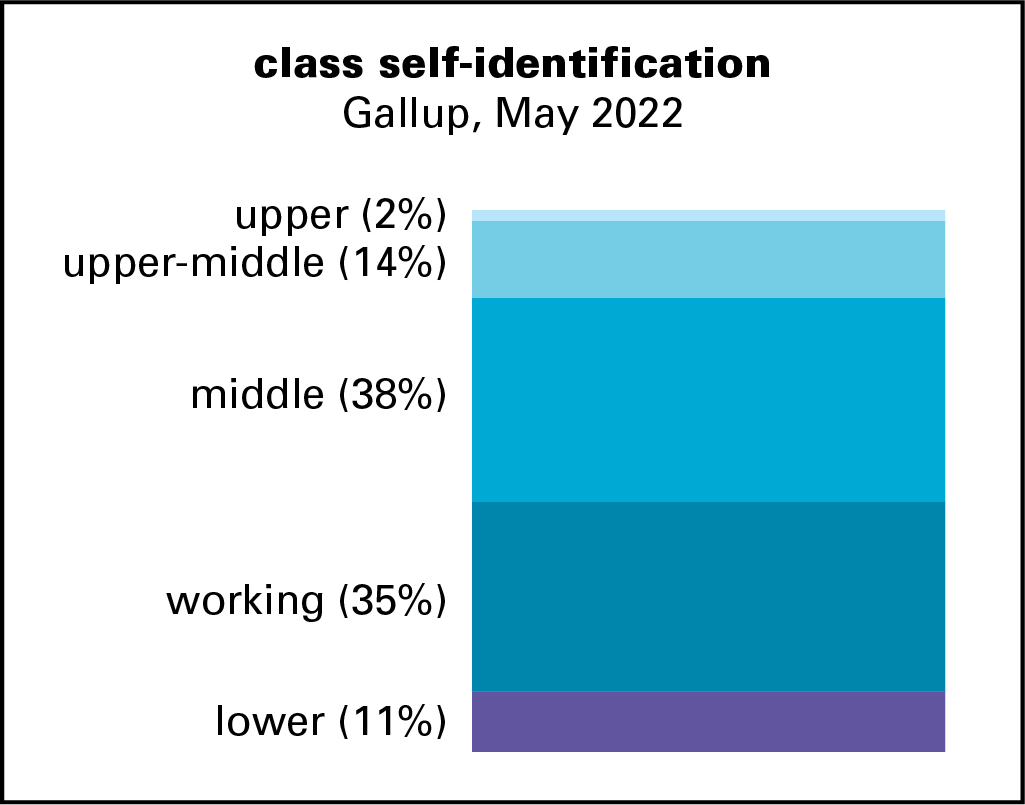
A striking thing about the chart is its upward skew. The midpoint is just 4 points into the “middle” category, and “upper-middle” is nowhere near that midpoint—it begins about 5/6 of the way to the top. Still, it’s remarkable that in a country of alleged universal middle classness, almost half the population identifies as sub-middle.
Over the last 20 years, upper-middle and middle have declined by 8 percentage points and working and lower have risen by 9. If you start the clock in 2005, the peak of the housing bubble, the “middle” share has fallen by 9 points, with most going into “working.” The Great Recession that followed the bursting of that bubble has a lot to do with that trend, but ten years of expansion following that miserable downturn did nothing to change middle-class self-identification.

Before one gets encouraged by these stats into thinking proletarian class-consciousness is on the rise, a caveat: more Republicans (38%) are likely to identify as working class than Democrats (30%). But to conclude on a more encouraging note: 49% of those aged 18–34 call themselves working class, twice the share of the over-55s. Nice to see that clarity in the young.
Fresh audio product: crypto, white power
Just added to my radio archive (click on date for link):
May 19, 2022 Molly White, keeper of the Web3 Is Going Just Great blog, on the pointless and scam-ridden world of cryptocurrencies • Kathleen Belew, a scholar of white power, on that movement’s obsessions and unusual organization
Fresh audio product: climate and abortion
Just added to my radio archive (click on date for link):
May 12, 2022 Matthew Huber, author of Climate Change as Class War, explains why the environmental movement needs to take class and production more seriously • Adam Kotsko explores why evangelicals are so obsessed with abortion
Fresh audio product: the IMF and debt, Asian Americans
Just added to my radio archive (click on date for link):
April 28, 2022 David Adler of the Progressive International on an impending debt crisis, with an emphasis on the role of the IMF (Guardian article here). • Sudip Bhattacharya on the Asian American population: its diversity, its unity, its politics


 LBO News from Doug Henwood