
Deporting immigrants kills native jobs too
As Trump and his ICE Sturmabteilung troop stormingly about the country deporting people, there’s an important fact that’s being overlooked: deporting undocumented workers destroys domestic jobs as well. Of course, their nativist campaign is grotesque and revolting in itself, and would be were no native-born bystanders injured by the expulsions. But we should be clear on what damage we’re doing to ourselves as well.
As Ben Zipperer shows in work for the Economic Policy Institute, almost as many native-born workers could lose their jobs as deported immigrants. Using data from the experience of the Secure Communities Program (SCP), a deportation effort launched by the Bush administration in 2008 and expanded under Obama, he finds that the far more ambitious Trump program will hammer native-born employment almost as much as it does foreign-born.
The SCP was small potatoes next to the current program. It resulted in the deportation of more than 450,000 people—not a small number, but only a fraction of what Trump & Co. have in mind. They’re looking to expel a million people a year, roughly three times the immediate pre-Trump rate. But the experience is a useful basis for predicting what might happen over the next three-and-a-half years.
Based on the effects of SCP deportations, Zipperer estimates that over that period, 3.3 million jobs held by immigrants will disappear, plus another 2.6 million held by native-born, for a total of 5.9 million—almost 4% of current total employment. In other words, for every 1,000 immigrants who lose their jobs, almost 800 natives will as well.
It’a not just jobs that will be lost. Zipperer draws on earlier work by, among several others, Troup Howard, Mengqi Wang, and Dayin Zhang that looked at the effects of the SCP on the construction industry. Since the program was too large to implement nationally all at once, it was rolled out in staggered form across the country, allowing comparisons between counties where deportations were well underway to those where it wasn’t introduced yet. They found that counties where the program was introduced exhibited “large and persistent reductions in construction workforce, residential homebuilding, and increases in home prices.” Contrary to the hopes of deporters, native-born workers did not replace the deported foreign-born, nor did native wages rise significantly.
Deporters also claim that immigrants have been raising housing costs and reducing supply for natives. Howard et al.’s work suggests otherwise. While reducing immigrant demand for housing reduced costs briefly, after that brief dip, the hit to new construction led to higher prices and reduced availability over the longer term. As they put it, immigrant labor and native labor are complementary, not in opposition to each other.
According to Zipperer, the effects will be highly concentrated by sector, with 42% of the losses occurring in construction (19% of that sector’s employment), with almost 40% of those job losses hitting natives. As he puts it, “when there are fewer immigrant roofers and framers to build the basic structure of homes, there will be less work available for U.S.-born electricians and plumbers.”
Another sector taking a big hit will be childcare. Though much smaller than construction, deportations could take out 15% of the sector’s jobs—bad news for parents already struggling to find someone to take care of their kids while they work, not to mention for the deportees.
And although job losses are likely to hit every state—nationally, losses will be just over half as large as those between 2008 and 2010, the Great Recession—the effects will be concentrated in a few, notably California, Texas, Florida, New Jersey, Nevada, and New York. (Map below.) For three states—Texas, New York, and Massachusetts—projected job losses will be larger than they were in the Great Recession.

We’re already seeing early signs of job loss in California. Using Current Population Survey data, researchers at the University of California Merced found the number of people reporting for private sector work was down 3.1% from May 11 to June 8—with citizens down more than noncitizens. Deportations intensified after June 6, so things were just getting going by the closing date of the UC Merced study. The didn’t find similar developments in other states, but California has been a deportation headliner and may be a taste of things to come.
And we’re already seeing early signs of a hit to construction nationally. As the graph below shows, job growth in construction was running well ahead of overall growth from 2022 (when the job market began to stabilize after the covid shock) into late 2024. Since the election, and especially since the inauguration, construction’s advantage has disappeared, and is now running behind overall growth. Of course, with Trump purging the Bureau of Labor Statistics, we may not have data like this in the coming months.

Can we take all this winning?
Fresh audio product: Zohran and the cops, the lies of AI
Just added to my radio archive (click on date for link):
July 31, 2025 Alex Vitale on Zohran Mamdani, the NYPD, and policing generally (Nation article here) • Dwayne Monroe on the AI mania
Fresh audio product: Trump’s world, a tour d’horizon; checks and balances and elites
Just added to my radio archive (click on date for link):
July 24, 2025 Anatol Lieven looks at US relations with the world under the Trump regime, specifically Russia–Ukraine, Israel–Palestine, and US self-evisceration • Samuel Moyn, author of this article, on checks & balances and the need for better elites
Fresh audio product: Trump, Trump, never enough Trump
July 17, 2025 Adam Gaffney, co-author of this article, on Trump & Co.’s cuts to health care and research • Alan Beattie tries to make sense of Trump’s nonsensical trade policy
fresh audio product: less work please
July 10, 2025 Juliet Schor, author of Four Days a Week, on experiments in reducing the workweek • Katherine Moos and Noé Martin Wiener, authors of this paper, on overwork among teachers
fresh audio product: NATO summit, private equity
Just added to my radio archive (click on date for link):
July 3, 2025 Lily Lynch, author of this report, on the NATO summit • Megan Greenwell, author of Bad Company, on the depredations of private equity
Fresh audio product: Iran, fake work
Just added to my radio archive (click on date for link):
June 26, 2025 Sohrab Ahmari, US editor of UnHerd, on Iran, Israel, and the US • Leigh Claire La Berge, author of Fake Work, on the ludicrous side of capitalism
NYC fiscal crisis: canonizing Felix once again
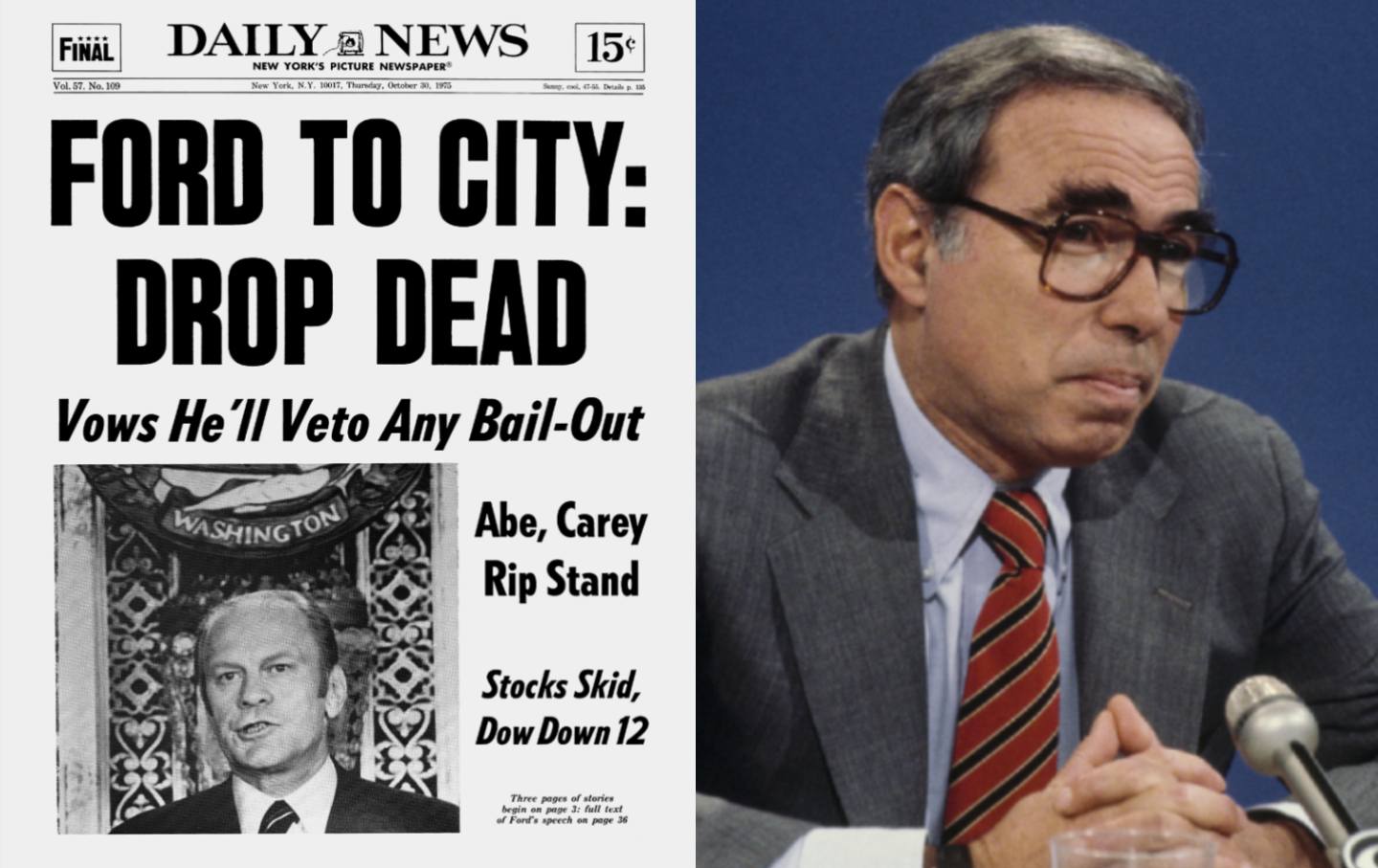
I’ve got a review on The Nation‘s site of a new documentary on the NYC fiscal crisis, co-directed and -produced by Michael Rohatyn, son of the chief imposer of austerity 50 years ago, Felix Rohatyn. It was one of the opening battles of the class war from above, and the role of liberals like Felix in engineering it should never be forgotten.
Fresh audio product: Israel’s war on Iran
Just added to my radio archive (click on date for link):
June 19, 2025 Two perspectives on Israel’s war on Iran: Mouin Rabbani on the regional/global context and Joel Schalit on Israeli society and politics
Fresh audio product: The rise of BYD, Marx in America
Just added to my radio archive (click on date for link):
June 12, 2025 Paolo Gerbaudo on the Chinese electric vehicle maker BYD’s rise (articles here and here) • Andrew Hartman, author of Karl Marx in America, on the bearded one’s reception in the US
Fresh audio product: war & industry, China overtaking the US
Just added to my radio archive (click on date for link):
June 5, 2025 Laleh Khalili, author of this review, on the long relationship between the US military and industry • Kyle Chan, author of this article, on how China is surpassing the US
Fresh audio product: Israel, Gaza, and Trump
Just added to my radio archive (click on date for link):
May 22, 2025 Mouin Rabbani on Israeli politics, the fate of the Palestinians, and Trump’s fundraising tour of the Middle East • Meron Rapoport, co-author of this article, on Israel’s strategy of destruction in Gaza
Fresh audio product: the dollar • why is the US always at war?
Just added to my radio archive (click on date for link):
May 15, 2025 Barry Eichengreen on why the gyrations in the value of the US dollar matter • Courtney Rawlings and Alex Jordan, hosts of Always at War, on why the US is always buying more weapons and bombing people


 LBO News from Doug Henwood