
My chat with Adam Davidson
My latest radio show, a long chat with Adam Davidson, is up in my radio archives:
June 9, 2012 Adam Davidson, host of NPR’s Planet Money and columnist for the New York Times Magazine, on finance, innovation, bourgeois ideology, journalism, and being mean on the Internet (a conversation that was prompted by this piece of mine) [Davidson columns discussed include: Wall Street, Bain dude, Honduras]
•
full conversation (unedited, except to remove some patter at the beginning and to suppress several volume spikes) is here
Sam Gindin comments…
The excellent Sam Gindin, who spent many years with the Canadian Auto Workers as an economist/advisor (and who cannot be dismissed as some armchair pointy-head), writes in response to my recent stuff on Wisconsin:
Very good response; I think you are right on re labour. The one thing I’d add, and I think it is very significant, is that this crisis in labour overlaps with the crisis on the left. I’m convinced that any renewal in labour won’t happen until there is an organized left with feet inside and outside labour—and even then it would have to be a left of a particularly creative kind. Which raises the unavoidable question of what we do to create such a left if neither the unions nor the democratic party are sites to make this happen and the notion of this happening through the old Leninist structures seems no less of a dead-end. THIS is the challenge that needs taking on….
I like this very much, and I don’t think it’s just because I’m flattered. I love the bit about an organized left that’s both inside and outside labor.
Incentivize labor leaders’ pay
Paging through the salary listings for top labor leaders reminded me of an idea that Liza Featherstone and I came up with a while back: tie their pay to performance. It’s a scandal that these characters, who’ve presided over years of shrinkage in membership and political power, are nonetheless paid well into the six figures (putting them securely in the 1%, in other words). To take one egregious example, the president of the Laborers Union is paid almost $600,000 even though membership is down almost 30% over the last decade.
So why not cut their pay to, say, two or three times the level of their highest-paid worker (not too radical, really) and then offer bonuses based on wage gains for the membership and genuine expansion in the number of members? Real, organic growth in membership through organizing, that is, and not SEIU-style growth through merger and gimmickry.
Wisconsin follow-up
Follow-up to yesterday’s post on the Wisconsin recall (“Walker’s victory, un-sugar-coated”).
I’ve been amazed at some of the tendentious misreadings of the piece that have made the rounds, mainly from left labor people. My favorite is that I just wasn’t aware of all the door-knocking and retail campaigning that union forces were doing over the last few months. Two points about that. One, months isn’t enough. I’m talking about years of education, organization, occupying. Face-to-face talk, direct action, all manner of things. And two, all that actually existing door-knocking was subsumed to a stupid electoral campaign—one whose defeat has only elevated Walker’s status and power. All those resources are now doubtless going into the Obama campaign—Obama, who did no more than tweet support for Barrett at the last minute!
Which reminds me of another thing—a pervasive, macho tendency in union culture to dismiss anyone who isn’t “in the trenches” as a pansy or an out-of-touch pointy-head. Outside analysts just don’t know all the great work they’re doing! Well, you know, it’s not really working out so well. Maybe all that time in the trenches just leaves you with a mouthful of dirt.
Another reaction was to think I don’t care about workplace issues. Of course I do. Workers, especially in private companies (though the post office isn’t much better) live under an authoritarian regime that offends their dignity every day. Unions can be a crucial defense against that. But the heavy emphasis on the contract and the workplace has led to a narrowing of vision, and to a perception among the 88% of the workforce that’s not unionized that unions don’t give a damn about them.
In other countries, unions are about more than contracts, and have done a lot better job fighting for broad public benefits, like pensions and health care. Our unions look too much like they’re fighting to defend their own private welfare states and not fighting to expand the public ones. They look like that because they all too often are. There’s no more disgraceful instance of this than the behavior of the Service Employees International Union around health care. SEIU’s former president, Andy Stern, dismissed single-payer as a Canadian import—while making common cause with then-Walmart CEO Lee Scott to try to craft a more distinctively “American” scheme. As one SEIU staffer told Liza Featherstone (“Labor Head Andy Stern Has Some Unusual Corporate Bedfellows”) [disclosure alert: she’s my wife], Stern “doesn’t hold social democracy in high regard.” Also, as Bob Fitch argued, unions typically take their cue on political matters from their employers. SEIU represents a lot of health care workers—and health care providers would hate single-payer.
The Wisconsin results overshadowed voter approval—by wide margins—of public sector pension cuts in San Diego and San Jose. Sad to say there’s not much of a sense of solidarity in America these days. Seeing generous retirement and pension provisions, the masses don’t say, “I want those too!” Instead, they say, “They can’t have them either!” It’s not clear that pouring more resources into fights to defend pensions will yield any good results against a 65–70% consensus on that.
Regardless of what I think about contracts and benefits, though, the old model is dead. Private sector unions are virtually gone, and those that remain are negotiating concessions. Public sector unions were safe for a long time, but now they’re on the chopping block. Dems will chop more slowly than Reps, but they will chop nonetheless. A lot of what I hear from even good union people amounts to an intensified dedication to the status quo. But that won’t work. Unions have to shift their focus from the workplace to the community at large, from private benefits enjoyed by a few to public benefits enjoyed by everyone, or they’re doomed.
Walker’s victory, un-sugar-coated
Democrats and labor types are coming up with a lot of excuses for Scott Walker’s victory in Wisconsin. Not all are worthless. But the excuse-making impulse should be beaten down with heavy sticks.
Yes, money mattered. Enormous amounts of cash poured in, mainly from right-wing tycoons, to support Walker’s effort to snuff public employee unions. While these sorts of tycoons—outside the Wall Street/Fortune 500 establishment—have long been the funding base for right-wing politics, they seem to have grown in wealth, number, consciousness, and mobilization since their days funding the John Birch Society and the Goldwater movement in the 1950s and 1960s.
But lingering too long on the money explanation is too easy. Several issues must be stared down. One is the horrible mistake of channelling a popular uprising into electoral politics. As I wrote almost a year ago (Wisconsin: game over?):
It’s the same damn story over and over. The state AFL-CIO chooses litigation and electoral politics over popular action, which dissolves everything into mush. Meanwhile, the right is vicious, crafty, and uncompromising. Guess who wins that sort of confrontation?
Please prove me wrong someday, you sad American “left.”
At this point, few things would make me happier to say than I’d been proven wrong. But I wasn’t.
There were several things wrong with the electoral strategy (beyond, that is, the weakness of electoral strategies to begin with). Barrett was an extremely weak candidate who’d already once lost to Walker (though by a slightly narrower margin than this time). Potentially stronger candidates like Russ Feingold refused to run, probably out of fear of these results. And the bar was very high for a recall. Only 19 states have recall provisions, and Walker was just the third governor to face one. Well over half of Wisconsin voters think that recalls should be reserved only for misconduct—and less than a third approve of recalls for any reason other than misconduct (Wisconsin recall: Should there be a recall at all?).
Suppose instead that the unions had supported a popular campaign—media, door knocking, phone calling—to agitate, educate, and organize on the importance of the labor movement to the maintenance of living standards? If they’d made an argument, broadly and repeatedly, that Walker’s agenda was an attack on the wages and benefits of the majority of the population? That it was designed to remove organized opposition to the power of right-wing money in politics? That would have been more fruitful than this major defeat.
It is a defeat. It is not, as that idiot Ed Schultz said on MSNBC last night, an opportunity for regroupment. (Didn’t hear it myself, but it was reported by a reliable source on the Twitter.) Because in the wise and deservedly famous words of Ralph Waldo Emerson, “When you strike at a king, you must kill him.” When you don’t, you look like a fool if you’re lucky. More likely, you’ll find your head in a noose.
And as much as it hurts to admit this, labor unions just aren’t very popular. In Gallup’s annual poll on confidence in institutions, unions score close to the bottom of the list, barely above big business and HMOs but behind banks. More Americans—42%—would like to see unions have less influence, and just 25% would like to see them have more. Despite a massive financial crisis and a dismal job market, approval of unions is close to an all-time low in the 75 years Gallup has been asking the question. A major reason for this is that twice as many people (68%) think that unions help mostly their members as think they help the broader population (34%). Amazingly, in Wisconsin, while only about 30% of union members voted for Walker, nearly half of those living in union households but not themselves union members voted for him (Union voters ≠ union households). In other words, apparently union members aren’t even able to convince their spouses that the things are worth all that much.
A major reason for the perception that unions mostly help insiders is that it’s true. Though unions sometimes help out in living wage campaigns, they’re too interested in their own wages and benefits and not the needs of the broader working class. Public sector workers rarely make common cause with the consumers of public services, be they schools, health care, or transit.
Since 2000, unions have given over $700 million to Democrats—$45 million of it this year alone (Labor: Long-Term Contribution Trends). What do they have to show for it? Imagine if they’d spent that sort of money, say, lobbying for single-payer day-in, day-out, everywhere.
So what now? Most labor people, including some fairly radical ones, detest Bob Fitch’s analysis of labor’s torpor. By all means, read his book Solidarity for Sale for the full analysis. But a taste of it can be gotten here, from his interview with Michael Yates of Monthly Review. A choice excerpt:
Essentially, the American labor movement consists of 20,000 semi-autonomous local unions. Like feudal vassals, local leaders get their exclusive jurisdiction from a higher level organization and pass on a share of their dues. The ordinary members are like the serfs who pay compulsory dues and come with the territory. The union bosses control jobs—staff jobs or hiring hall jobs—the coin of the political realm. Those who get the jobs—the clients—give back their unconditional loyalty. The politics of loyalty produces, systematically, poles of corruption and apathy. The privileged minority who turn the union into their personal business. And the vast majority who ignore the union as none of their business.
Bob thought that the whole model of American unionism, in which unions were given exclusive rights to bargain over contracts in closed shops, was a major long-term source of weakness. I find it persuasive; many don’t. But whatever you think of that analysis of the past is rapidly becoming irrelevant. Collective bargaining has mostly disappeared in the private sector, and now looks doomed in the public sector. There are something like 23 states with Republican governors and legislative majorities ready to imitate Walker who will be emboldened by his victory. And there are a lot of Dems ready to do a Walker Lite. If they don’t disappear, public sector unions will soon become powerless.
That means that if unions ever want to turn things around—and I’m old-fashioned enough to believe that we’ll never have a better society without a reborn labor movement—they have to learn to operate in this new reality. Which means learning to act politically, to agitate on behalf of the entire working class and not just a privileged subset with membership cards.
Fitch lecture video up
I could never bear to watch myself, but in case there’s someone else who might, the video of my Bob Fitch memorial lecture (Explaining what goes on in the world: in memory of Bob Fitch) is up here.
New York Fed: lower payments = lower default rate!
The New York Fed is out with a new paper (“Payment Changes and Default Risk: The Impact of Refinancing on Expected Credit Losses”) that shows that reducing monthly mortgage payments “significantly” reduces future default risks. (Abstract follows.) The details of the paper strike me as less interesting than the fact that this basilica of High Finance is arguing that some degree of debt reduction is prudent—bolder than anything that a mainstream politician would ever say. Remember, these are the folks who had David Graeber in recently to talk about debt (and debt forgiveness).
Payment Changes and Default Risk: The Impact of Refinancing on Expected Credit Losses
June 2012 Number 562
JEL classification: G21, G18, R51Authors: Joseph Tracy and Joshua Wright
This paper analyzes the relationship between changes in borrowers’ monthly mortgage payments and future credit performance. This relationship is important for the design of an internal refinance program such as the Home Affordable Refinance Program (HARP). We use a competing risk model to estimate the sensitivity of default risk to downward adjustments of borrowers’ monthly mortgage payments for a large sample of prime adjustable-rate mortgages. Applying a 26 percent average monthly payment reduction that we estimate would result from refinancing under HARP, we find that the cumulative five-year default rate on prime conforming adjustable-rate mortgages with loan-to-value ratios above 80 percent declines by 3.8 percentage points. If we assume an average loss given default of 35.2 percent, this lower default risk implies reduced credit losses of 134 basis points per dollar of balance for mortgages that refinance under HARP
Airline dereg: more a failure than Matt Yglesias says
Years ago, I wrote a piece on deregulation of all kinds and developed a mini-obsession about the absurdity of the airline sort. It had produced bankruptices, savage wage-cutting, union-busting, awful service, and the abandonment of marginal cities while not producing any improvement in affordability. It’s hard to get people to believe this, but it’s true.
Matt Yglesias is out with a post (“Passenger Aviation in the United States: 40 Years of Failure”) on how the airline industry is a “stunning business failure.” Is it ever. But he doesn’t mention deregulation.
The industry was deregulated in 1979. Though it’s forgotten now, dereg—even though it’s destroyed unions—was a project of Democrats. Their initial base was in Teddy Kennedy’s office (as a wit once remarked, this shows Kennedy’s merchant origins, since merchants—bootleggers in the case of the Kennedy family—always want to reduce transport costs). Dereg’s intellectual guru was Alfred Kahn of Cornell, an advisor to Jimmy Carter, who signed dereg into law as president. Route and fare regulation was replaced by a free-for-all. The result has been disastrous.
A few numbers to make the point. Good stats on the industry (Annual Results: U.S. Airlines) begin in 1948. These tell us that the entire industry has cumulatively lost money since then. Add up all the gains and losses between then and 2011, and you get $37.7 billion in total losses. Adjust that for inflation, and you get $12.9 billion in total losses (2011 dollars). But what a difference deregulation has made. Between 1948 and 1978, the industry made $5.5 billion in total (or $28.7 billion in 2011 dollars). Between 1979 and 2011, it lost $37.7 billion (or $41.6 billion in 2011 dollars). Of course, I’m not here to defend corporate profits, but it’s hard to see how an industry can survive under capitalism in a chronic state of loss.
Ah, but fares are down and ridership has grown faster, right? No.
First prices. Between 1963 (when the figures begin) and 1979, the airfare subindex of the CPI grew 25% more slowly than the overall CPI. Since 1979, it’s growth 2.4 times as fast as overall inflation. A major reason for this is that there are many fewer nonstop flights than in the regulated days, and far tighter advance purchase restrictions. To the Bureau of Labor Statistics, which computes the CPI, such quality decreases are the same as price increases. (This is the opposite of the logic prevailing in computers, where rapidly increasing power is the same as a price decline.)
And then ridership. Between 1948 and 1978, annual passenger miles flown grew 12% a year; since then, they’ve grown less than 4%.
And, man, are flights ever more crowded. From 1948 to 1978, planes were an average of 57% full. Since 1979, they’ve averaged 68% full. Over the last three years, they’ve averaged 82% full.
But almost no one respectable will ever say airline dereg has been a failure. You read it here not quite first (because if you’d been subscribing to LBO in 1989 you would have read it there), but it’s not too likely you’ve seen it elswhere.
Fresh audio product
These shows have been up on the server for a while, and available to podcast subscribers (e.g., iTunes – Podcasts – Behind the News with Doug Henwood), but I’ve finally gotten around to updating the web page. Here are three recent shows:
June 2, 2012 DH on Bob Fitch (an abbreviated aural rendition of this) • Ben Jacobs on the Wisconsin recall • Stan Collender on the fiscal cliff
May 26, 2012 Vijay Prashad, author of Arab Spring, Libyan Winter, on the topics implied by the book title • Mark Dery, author of I Must Not Think Bad Thoughts, on pop culture, beheading, David Bowie
May 19, 2012 Chase Madar, author of The Passion of Bradley Manning, on Manning, WikiLeaks, secrecy, and mass solitary confinement (truncated fundraiser edition: pleasecontribute to KPFA and keep these shows coming!)
Raid the Pentagon budget, do good works
A friend posted an item to Facebook, pointing out that it would cost C$5 billion a year to provide free university to all Canadians, a fraction of the country’s $24 billion military budget. I thought translating this into American would be a useful exercise. Here goes:
Translating this in to American: We spend about $845 billion on the military, and personal expenditures on higher ed are about $165 billion. So for 20% of the military budget we could make higher ed free to individuals.
But that’s not all. The old rule of thumb for Canadian/American equivalence is to multiply Canadian numbers by 10. So if the U.S. had a Canadian-sized military, we’d be spending $240 billion, less than a third what we do spend. The difference could fund, along with the free higher ed ($165 billion), universal child care (about $75 billion/yr)—and we’d still have $345 billion left over. We could bring the officially poor up to the poverty line for another $150 billion or so, leaving almost $200 billion for, oh, I don’t know, clean energy R&D, high-speed rail, and public installations of beauty.
I didn’t mention health care, since that’s a story to itself. Public health spending alone (via Medicare, Medicaid, etc.) in the U.S. is on a par with the entire health budget, public plus private, in many countries with more sane systems. If you combine public and private spending in the U.S. and convert to a single-payer system, we could provide platinum-plated universal care to everyone.
Student debt up, all other kinds down
The New York Fed is out with its credit report for the first quarter of 2012. It shows student debt bucking the trend (“Student Loan Debt Continues to Grow”), rising while all other kinds of debt fell from the end of last year. Student debt, at $904 billion (not yet the much-advertised trillion), is now considerably larger than credit card and auto debt. A decade ago, student debt was a less than half credit cards and autos.
(By the way, it’s interesting that the New York Fed has begun publishing rigorous student debt estimates, which were previously unavailable. Mark Kantrowitz’ estimate of over $1 trillion on his Student Loan Debt Clock is widely cited, but he doesn’t disclose his methods, even when asked. The New York Fed contracted with Equifax, the credit-rating agency, to get good numbers. The central bankers recently had David Graeber, author of Debt: The First 5,000 Years, down to talk to them, where he told them about the need for debt relief. He reports that they were very receptive to his message, fearing another economic crisis if nothing is done, though they probably wouldn’t go as far as his call for a Jubilee-style writeoff. It is utterly fascinating that this Vatican of capital called a prominent anarchist intellectual in for a consultation.)
For the quarter, student debt rose by $30 billion, or 3.4%, while all other kinds of debt fell by $131 billion, or 1.2%. Of the other major categories, only auto debt was up (but just 0.3%); mortgages (-1.0%), credit cards (-3.6%), and home equity lines (-2.4%) all fell. Debt has broadly been falling for almost four years, but student debt continues to rise. Nonstudent debt is down 13% from its 2008 peak—but student debt makes a new peak every quarter.
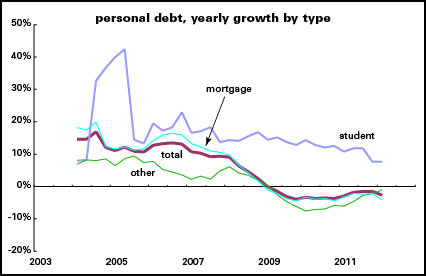
The best way to measure personal debt burdens over time is by comparing them to after-tax incomes. As the graph shows, most forms of debt rose steadily from 2003 (when the New York Fed data begins) through a peak at the end of 2007, and have fallen dramatically since. But not student debt. In fact, the ratio of nonstudent debt to income is only a little higher than it was in 2003—but the student debt ratio has more than doubled (from 2.9% to 7.9%). And that’s relative to aggregate incomes. Student debtors skew young, and their cohort’s incomes are well below average (even more so these days), meaning that the relative burden has risen more sharply than it looks.

As the student debt burden rises, it’s harder for debtors to pay. Delinquency rates, though down from their 2010 peaks, are well above all other kinds of debt. And student debt was the only category to show an increase in delinquencies last quarter. (Funny word, “delinquency.”) Officially, 8.7% of student loans are delinquent, but since many debtors are still in grace periods, they’re not expected to pay. Of those that are, the New York Fed earlier estimated that 27% of debtors were behind on their payments, when the official number was lower than last quarter’s. (See my earlier write-up of this topic for more.) This is an extraordinary level of financial distress.
As I’ve said elsewhere (“How much does college cost, and why?”), it would be fairly easy to make higher ed completely free in the U.S. But that’s not the way we do things here. Debt is too useful as social discipline.
Bain actually loves Dems
All good Democrats are busily hating on Bain Capital right now. What they’re forgetting is how many Bain-affiliated political contributions have gone to Democrats.
Plug the words “Bain Capital” into an OpenSecrets.org search and you learn that while Bain people have lovingly contributed to their former CEO’s presidential campaign, almost 3/4 of their contributions to other candidates, 72% to be precise, have gone to Democrats. That’s a higher percentage to Dems than the AFL-CIO!
And among the top recipients are Dem headliners like Al Franken, Claire McCaskill, John Kerry, Mark Udall, Nancy Pelosi, and Sherrod Brown. They were also major contributors to the Democratic National Committee and the national Democratic party. There are very few Republican candidates on the OpenSecrets list, and no major gifts to the GOP itself.
So Cory Booker’s defense of private equity (PE) against attacks by the Obama campaign has a very materialist explanation: PE titans like Bain have been funding Dems for ages—including Booker himself (e.g., “Cory Booker’s Bain Capital money”). It was just a few years ago that hedge fund (HF) hotshot Paul Tudor Jones held a 500-guest fundraiser for Obama, back when “the whole of Greenwich” (an epicenter of the industry) was behind him (“Another top hedge fund chief backs Obama”). Then he hurt their feelings with one intemperate use of the term “fatcats.” But it’s not like Obama is about to expropriate the PE and HF types.
Explaining what goes on in the world: in memory of Bob Fitch
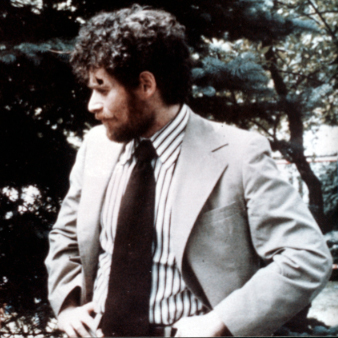
[This is the text of a talk I gave at LaGuardia College, Long Island City, Queens, in memory of Bob Fitch, who died on March 4, 2011, from complications of a fall he suffered when returning home from teaching at LaGuardia. My short remembrance, written for The Nation, is here. Thanks to Jane LaTour for the two photos of Bob reproduced here. Video by Prudence Katze and Will Lehman is here.]
I want to start by saying how honored I am to be giving this, the first Bob Fitch memorial lecture. I dearly hope there will be a second and many more after that, and it’s up to some of us in this room to make that happen. I admired Bob tremendously. I can’t think of anyone I’ve known personally who’s influenced me as much. He was remarkably erudite—read deeply in many areas and wonderfully cultured in an almost old-fashioned way. I called him once when he was listening to Schubert. We got to talking about the greatness of much bourgeois culture, and he criticized today’s bourgeoisie for taking such poor care of its class inheritance. That task had fallen to Marxists, I guess.
He was also a warm, generous, and very funny guy. It breaks my heart that I’d lost touch with him in recent years. I’d been resolving to change that, but then it got too late. I never got to talk to him about Bloomberg or Obama. I’m ashamed, actually.
I met Bob in the late 1980s—I can’t remember exactly when. He was just resurfacing after several years underground. A major publisher had given him a big advance to write a book about New York City, and he found it impossible to deliver. Bob delisted his phone number, gave up writing for union organizing, and tried to keep the forces of the bourgeois system at bay. When the coast cleared, he started writing for the Village Voice. His editor there, and mine, Don Guttenplan, introduced me to him.
On Don’s recommendation, I’d just read Bob’s fantastic 1976 essay “Planning New York,” which was adapted for The Assassination of New York 20 years later. It was about the 1929 plan for New York City drawn up by the Regional Plan Association. It laid out the outline for an auto-centered metropolitan region, including the highway system that would later be attributed to Robert Moses. It developed and formalized an old upper class desire to deindustrialize the urban center. The essay made it impressively clear just how precisely planned by elites over the very long term the physical and social evolution of New York City has been. One’s casual impression of the city may be that it’s unplanned and chaotic, but it’s long been anything but that. It’s been guided by the careful hand of the FIRE sector—finance, insurance, real estate—and the elite nonprofits and experts that think for it.
Bob and I became good friends after I read the essay. We saw each other from time to time but a lot of our friendship was on the phone, many hours a week. Bob talked to me a lot about the ideas that led to The Assassination of New York. I’d been living in the city for about ten years when I met Bob, and until then I never really understood how the place works. I had only the vaguest idea of how people like Felix Rohatyn and firms like his Lazard Frères shaped the city—including shaping the LaGuardia campus where we are right now.
I’m not really up to analyzing the present from the perspective of Bob Fitch, but I’d like to talk about some of the things he shaped my thinking on. At least three come to mind. One is the city, ruled by a true plutocrat—though it’s not like Bill Thompson or Christine Quinn would be much different. (Speaking of Christine Quinn, I was once sitting with Bob in a diner in downtown Manhattan when she walked by outside. She waved enthusiastically at him and he waved back. She’s changed a lot.)
Another is the state of the labor movement. When I was first asked for a title for this talk, I thought of something like, “The labor movement survived Bob Fitch, but barely.” The spectacle of Trumka endorsing Obama, months before he really had to, reminded you that institutions, like economic stats, can come in under expectations, even when expectations are already low. Back in 1995, when many on the labor left were excited over the ascension of John Sweeney to leadership of the AFL-CIO, Bob dismissed it as delusional. (I’d forgotten until just now that among the 11 union presidents who gathered to push Lane Kirkland aside was Arthur Coia, the leader of the Laborers Union who was driven out for corruption and criminal ties.) Later, when the labor left got all giddy over Andy Stern, Bob stabbed holes in those illusions too.
And then there are the Democrats, in whom organized labor is incorporated in a vassal-like relation. Though a lot of liberals moaned some about Obama last year, this year re-electing him is a task of world-historical proportions. Personally, I’d like to see Obama re-elected because it’s better for radicals when Dems are in power; it makes it clear how the suckiness is systemic, and not a matter of personnel or party. But that’s not the prevailing view. The urgency to support the Dems, as it often is, is driven by the awfulness of the right. If Romney wins, the Tea Party will move into the Executive Office Building. Can the brownshirts be far behind?
Obama and friendly FIRE
I recently came across the text of a talk that Bob gave to the Harlem Tenants Council, ten days after Obama was elected. After acknowledging his considerable talents and powers of enchantment, and the pride that African Americans felt over his election, Bob wondered just what was his political philosophy and just what interests did he represent? His political philosophy, said Bob, was Third Way-ish and communitarian, meaning that he dismissed any idea that there are real conflicts in society because we can all just reason together and do what’s best for all of us. But by saying that, they’re really just siding with the powers that be, because there are real conflicts in society and there can be no Best for Everyone happy ending.
Following that is a dazzling analysis of Obama’s roots in Chicago society—one of those Fitchian moments in which the world makes a lot more sense after you’ve gone through it. Many of us are familiar with the way that Obama was groomed for excellence by power from his early days. Beloved of elite schools and foundations, Obama—who’s poked fun at his mother’s “position-paper liberalism”—had a charmed rise on the status ladder of American society. When he arrived at the Senate, after not all that much experience in the Illinois legislature, he would have none of the gladhanding necessary to get along in that dismal body. So Harry Reid called him in after about a year and a half and told him that he had no aptitude for the Senate and he should run for president instead. Reid & Co were terrified that Hillary Clinton would get the nomination and lose disastrously, so Obama was their hope. Yet they were so afraid of Hillary’s vengefulness that they promoted his candidacy secretly at first. (The story is told in John Heilemann and Mark Halperin’s Game Change.) Obama proved himself up to the challenge. But that this guy was any kind of outsider, that he was anything but wired to the center of the Democratic branch of the power structure, well, it was remarkable what people believed in 2007 and 2008.
But Bob’s great contribution was to trace Obama’s roots in Chicago property relations. Over the last two decades, he reported, there’s been a concerted plan to gentrify the South Side of the city, home to the largest black population in the country, many of them rather poor. (Among the country’s ten-biggest cities, Chicago has the third-highest poverty rate, and the highest black poverty rate.) In the 1950s, the policy was urban renewal, meaning razing low-rise housing and moving black Chicagoans en masse into high-rise public housing. It did not work well. So in the 1990s, Democratic urban planners decided it was time to “spatially deconcentrate”—meaning knock down the high-rises and move people back into dispersed private housing. This was touted as an anti-poverty measure: since poverty is considered to be a communicable disease, scattering the poor about town will reduce their exposure to each other, thereby reducing the spread of the illness.
In Chicago, Daley’s administration cleverly brought black developers into the heart of the scheme. They would build and rehab the new units the displaced poor would move into. Since much of this happened in Obama’s state senate district, he knew the principal players very well. As Bob put it, there was a constellation of interests around Obama in Chicago—the typical FIRE sector, personified by big Chicago families like the Pritzkers and the Crowns, but also what Bob called “friendly FIRE,” the liberal foundations and nonprofit developers who try to synthesize an aura of community uplift around gentrification. A lot of what is called community organizing in this country quickly devolves into high-minded real estate development, typically with the assistance of the Ford Foundation—which by a not very stunning coincidence, employed Obama’s mother in Indonesia.
And though almost all of the people displaced by friendly FIRE are poor and black, they’re often displaced by a black financier/developer class that serves a rising black middle class. For the portion of the left that trades on a one-dimensional race analysis of social life, this is very confusing. But this is how Obama the “community organizer” could, just a few years later, praise Jamie Dimon of JP Morgan and Lloyd Blankfein of Goldman Sachs as savvy businessmen. And so it was hardly surprising that Obama brought in William Daley, brother of former Chicago mayor Richard Daley—by virtue of office, the chief executive of the South Side gentrification schemes—to be his chief of staff after Rahm Emanuel went off…to become mayor of Chicago. Oh, and it just happened that William Daley was the head of Midwest operations for JP Morgan Chase and chair of its foundation, which Bob called “the core of friendly FIRE.”
It doesn’t take anything away from Bob’s genius to say that these are not the kinds of facts that you need to spend years in obscure archives or filing a ream of freedom of information act requests to discover. (He did lots of that over the years, too, but not for this talk.) Most of the secrets of American political life are, like Poe’s purloined letter, hidden in plain sight. It’s just that many people don’t want to think about them. Certainly not all those people suffering from Obamamania in 2008, when Bob gave that talk, or even the mildly disillusioned liberals of 2010—and certainly not all those enthusiasts suffering from a relapse of their 2008 enchantment in 2012. Years divisible by 4 produce such predictable delusions.
planning New York
I’d like to spend some time with “Planning New York,” my introduction to Bob Fitch’s work. It was incorporated into The Assassination of New York but I still like the old version for sentimental reasons. It appeared in a collection, The Fiscal Crisis of American Cities, mostly though not entirely about New York, that was edited by Roger Alcaly and David Mermelstein. Alcaly, by the way, left radical economics to run a hedge fund, and then wrote cheerful articles about the New Economy of the late 1990s for The New York Review of Books.
Bob’s piece was about the Regional Plan Association’s 1929 plan for New York. The RPA is a classic elite outfit—a FIRE-dominated think tank, founded in 1922, which according to its own ad copy is all about improving the quality of life in the metropolitan area. Its idea of quality of life becomes quickly apparent on the front page of its website, which just the other day featured a study on how to make large real estate projects, which contribute so much to that quality of life, work. The RPA’s board consists of developers and financiers—including one guy who runs a hedge fund called Dialectic Capital Management. You have to wonder what his personal history is—but whatever, it got him a $5 million house in Brooklyn Heights.
New York has a habit of producing these long-term plans right around stock market peaks. There was another in 1968, just as the rot of the 1970s was to set in; another in 1987, just before the stock market crash; and another in 2007, just as the Great Recession was about to hit. That’s good for a chuckle—the bourgeoisie can be so silly—but still, the plans do basically come true. The local FIRE elite is capable of thinking beyond the business cycle—more than their national counterparts, it seems. When your fortune is tied to real estate, you can’t easily up and leave; you’re forced to care about the long term.
One reason for the appearance of grand plans at major market tops might be that during the boom that precedes them, FIRE accumulates vast wealth and power that they can then translate into long-term political gains. As Bob pointed out, the financial and real estate boom of the 1920s allowed FIRE to rise to local dominance, and though much of that wealth evaporated in the crash, the long-term plans remained intact. Similar things could be said about the later iterations.
 In The Assassination of New York, much of it written during the early 90s slump after the ’87 crash, Bob was skeptical that the grandiose plans could be fulfilled. But there were two more booms to come—the stock mania of the late 1990s and the housing bubble of the mid-2000s, both of which fattened Wall Street and allowed for more office buildings and fresh frontiers of gentrification (though it didn’t hurt that 9/11 took 12 million square feet of office space off the market, depressing the vacancy rate as the economy was about to recover from the 2001 recession).
Again, it’s amazing how much of this scheming is hidden in the open. But it provokes no interest from mainstream journalists. I once talked with a New York Times reporter who’d been freshly posted to the metro desk. She was wondering what to write about. I suggested land use stuff—how apparently random real estate deals actually fit in with these long-term schemes. She wondered what the news value of this is. I said, the city is carefully planned and no one ever talks about that. (I had my doubts that the Times would ever publish such stories, but still I thought it was worth a try.) She found it completely uninteresting—there would only be a story if “some politician is getting rich off it.” Of course that’s been known to happen, but that’s not the most important thing. How a small elite shapes the economic, social, and physical environment we live in strikes me as a very important story, but it has no news value to a mainstream journalist.
As Bob put it, the influence of the 1929 plan can be seen in the division of the region into Slab City—the high-rises of Manhattan—and Spread City, the suburbs that surround the city center. This was enabled by the building of a set of highways that made it possible to travel to and from the city, or comfortably around it if you were traveling elsewhere. The network of highways typically attributed to Robert Moses were actually laid out in the RPA plan: as Bob put it, all Moses had to do was pour concrete on the dotted line.
The central idea was to concentrate high-end activities in the city center—finance and other service businesses that could afford high rents—and move the noxious stuff out to Jersey. Bankers with a taste for the country life would find it easier to get back and forth from Long Island or Westchester, and those that liked the urban life wouldn’t have to compete with the working class for housing and retail, or have to look at them on the sidewalk.
As Bob argued, Slab City requires high levels of public spending on physical infrastructure. This need is at the basis of a lot of Democratic politics—developers (and their bankers) contribute to politicians who then reward them with appropriate projects. It’s amazing how pervasive this relationship is over time, whether it was Harry Truman and his Kansas City patron, political boss Tom Pendergast, who just happened to own a cement plant, or Obama’s relationship with his Chicago patrons.
Truman, though, was old-style, the product of an urban machine. Much preferred by the FIRE elite are cap-P Progressive or cap-R Reform politicians, technocrats who are supposedly above the petty corruption of Tammany-style politics. As Bob put it, the major difference between those two tendencies can be seen most clearly in the municipal budget: Tammany types stoke the expense budget with patronage schemes, but the Reform types love the capital budget, with its infrastructure schemes. In fact, Bob argued that it was the borrowing to fund capital spending on transit and middle-income housing that got New York City into debt trouble in the 1970s, not the alleged generosity of the social services budget, as mainstream hacks like to claim.
Back to the ’29 plan. It was passionately devoted to getting manufacturing out of Manhattan. Though garment makers liked to be close to retailers, real estate interests didn’t like that. Rag shops took up space that could be far more profitably rented to bankers, lawyers, and admen. Too many garment workers—many of them unpleasantly Jewish—were clogging the sidewalks and scaring the wives of the better sorts away from high-end shops. Instead, the city should be reconfigured in line with this rough hierarchy: 1) financial business, 2) fancy retail, 3) fancy residential, 4) inferior retail, 5) wholesalers, and, at the bottom of the list, 6) industry and working-class housing. The ultimate goal was to turn the city into one of the commandingest peaks at the commanding heights of global economic activity: finance, senior management, and the consciousness industry.
Of course, the poor would not go away, even if their housing was demolished in the name of urban renewal and slum clearance. Instead, they’d be rendered structurally unemployed as industry was driven out to the suburbs or beyond. White flight, deindustrialization, and all the other familiar phenomena of post-World War II America didn’t just happened. The RPA et al. made it happen.
These themes are developed further, into the Dinkins years, in The Assassination of New York. But it’s amazing how much of the long-term urban strategy was established in the 1929 plan and continued even into the present. The planners did face a challenge in recovering from the trend that culminated in the crisis of the 1970s: there had been too much decentralization. It was essential to do some recentering—to get more high-end service activity in Manhattan and more rich people living there. It worked.
more recent history
And as Manhattan upscaled, so too did Brooklyn. But that, too, was no accident. Starting in the late 1960s, with the able assistance of Pratt Institute—named after its founder, Charles Pratt, a great property owner and Rockefeller partner—city planners pushed industry out of Brooklyn and began the gentrification of working-class neighborhoods. (I live in a former shoe factory at the eastern edge of Clinton Hill, just blocks from Pratt, that was turned into condos in 2005.) More recently, the Atlantic Yards project—heavily supported by city funds and with the massive power of eminent domain (New York has the most developer-friendly eminent domain laws in the U.S.)—are a perfect example of the use of public infrastructure projects as a gentrification strategy. The scheme extended the strategy of turning downtown Brooklyn into an office park and surrounding neighborhoods into elite residential space.
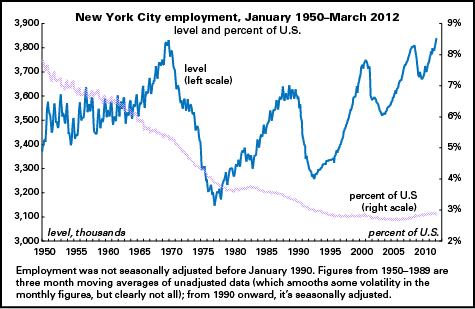
You can read the outlines of more recent planning in the 1987 volume, New York Ascendant: The Report of the Commission on the Year 2000, led by Robert “Bobby” Wagner, Jr., son of the three-term mayor. The report projected that city employment in 2000 would approach 3.8 million, matching the late-1960s peak, about 300,000 above where it was when it was published. But the stock market crash, and the bust that followed it, actually knocked nearly that much off city employment, leading Bob, writing in the early 1990s, to be very skeptical of the Wagner commission’s ambitions. This is a further reminder that radicals should always be careful of underestimating capital’s powers of self-renewal—something we should do even today, when it looks like the whole system has busted a gasket.
As it turned out, the Commission was right on target. City employment peaked at 3.8 million in December 2000, coming within a hair of the 1969 peak. (The city’s population was about 300,000 lower in 1969 than it was in 2000, meaning that a smaller share of the population was working. That’s structural unemployment for you.) And, by the way, we matched that level again in 2008, and are now above it after having lost fewer than 200,000 jobs in the Great Recession. FIRE’s recovery from the 2008 crisis has been very impressive, even if the recovery of the economy and the debtor class has been a lot less so.
And what was the development strategy outlined in New York Ascendant? Surprise, surprise: being a world capital of what economists call the tertiary sector. The primary sector is basic stuff like farming and mining; the secondary, manufacturing and construction; and the tertiary, elite services like finance, lawyering, and advertising, and less elite services like retail and restaurants. There’s more money to be had in the elite services, but bankers do like to eat well and wear snazzy clothes, and their kids do need nannies, so the tertiary city is notorious for a barbell-shaped income distribution: a legion of low-paid service workers tending to the high-paid service workers but with not so many people in the middle. This is, as the vulgar Marxists used to say, no accident. And, as Bob Fitch liked to say, vulgar Marxism explains 90% of what goes on in the world.
New York Ascendant did allow for a smallish manufacturing sector—a specialized one, tied to dominant industries, like “very high-end fashion,” serving the local design talent, and costume making for the theater. It also sought to retain low-end clerical work for the finance sector and to encourage the development of the information sector. To retain the back office stuff would require the extension of the central business district (CBD) across the East River into new beachheads in downtown Brooklyn and Long Island City. That has happened. That’s why we have MetroTech in downtown Brooklyn, populated among others by Chase (the old Rockefeller family bank) and NYU. And it’s not just the extension of the CBD: we see the Bloomberg administration pushing a high-tech campus on Roosevelt Island and pressing the residential development of Hunters Point just south of Long Island City, squeezing out the industrial uses that used to dominate the neighborhood.
And that scheme also explains how the campus we’re on now, LaGuardia College, evolved—though that was not the planners’ original intention. In accordance with elite scheming, Lazard Realty, an arm of the investment bank that employed the mighty Felix Rohatyn for many years, developed several buildings along Thomson Ave. in the late 1980s, with the hope of filling them with clerical workers. Rohatyn, while often portrayed as the “savior” of New York City, was the leader of the bankers’ coup during the fiscal crisis of the mid-1970s. He and his comrades displaced the elected government and imposed what could only be described as the dress rehearsal for the neoliberal agenda that would transform the world from the 1980s onward: austerity for the masses and largesse for the overprivileged. Of particular interest to CUNY people was Rohatyn’s insistence that the policy of free tuition, first established by municipal referendum in 1847, come to end—not so much for its fiscal importance, he said, but for its shock value. No more something for nothing in the era of lowered expectations.
Lazard Realty’s plans for the stretch of this road that it called Thompson Place proved ill-timed. The buildings were ready for occupancy just as the stock market crashed and the 1980s boom was turning to bust. But CUNY came to Lazard’s rescue, as LaGuardia College bought one of the buildings in 1988. No shock value, no lowered expectations for Lazard!
And another building was filled by the School Construction Authority, created by the New York State legislature in, yes, 1988. And, curiously, one of the prime advocates for the creation of the School Construction Authority—an independent authority to handle building and renovation tasks formerly handled by the Board of Education—was none other than Felix Rohatyn. Construction is a bondable activity, and investment bankers love floating bonds. But, as Bob frequently underscored, elites love the capital budget far more than the expense budget. Creating the SCA was just right for Felix’s personal and professional interests. And the timing was just right to take a problem property off Lazard’s hands.
I found all that out back in the early 1990s, when I was writing about the political economy of New York for the Village Voice—very much under Bob’s tutelage. I really miss doing that. I’ve lost track of what’s going on, and I can’t think of many prominent outlets for that sort of investigation. I’d really love to know what to make of Bloomberg’s plan for the year 2030, which includes more of the same, of course, with an emphasis on a green agenda. I love bike lanes, alternative energy, greenhouse gas reduction, and restrictions on auto use as much as any other red–green hybrid, but Bob taught me to be skeptical of this sort of thing, because it typically had a real-estate angle. Elites have loved parks because they take land off the market, thereby boosting the value of the remainder, and because they create hypervaluable parkside locations. But we love parks too. And we do want to save the earth, and short of a revolution that seems not to be imminent, we need enlightened bourgeois politicians to embrace a green agenda. I wish Bob were here to help us think straight about this era in which the richest man in town, a titan of the FIRE sector and not its mere servant, is in his third term as mayor.
the unions
Bob’s death severely reduces the ranks of people who study the political economy of New York City seriously. It also reduced the ranks of those who want to do something better with the substantial resources we have here. It was brought home to me how few of us there are about 20 years ago, during the Dinkins years, when we tried to put together a little think tank to come up with some alternative redevelopment schemes, centering around rebuilding the port and restoring the rail link to the mainland, both of which would encourage the development of manufacturing (and, incidentally, clean the air considerably, since almost everything that comes into town has to come by truck—something like 90% of it over the George Washington Bridge).
 We managed to put together a handful of people, but there was no interest from the unions. To them, Bob was radioactive, as was the agenda. (Here’s a measure of how radioactive. Bob thanked a union staffer in a footnote to an article he’d written for an obscure journal. When the journal came out, the staffer called him, livid and terrified for being publicly associated with him. He feared reprisals from his bosses.) Nor was there any interest from some of the better politicians. Ruth Messinger, then the borough president of Manhattan and publicly identified as a member of Democratic Socialists of America, let it be known that not only did she want nothing to do with the group or its agenda, she didn’t want us talking about how low the wages were for a good bit of the city’s workforce. Without support, the people’s think tank, our RPA for the masses, quickly evaporated.
The chilly reaction of the unions, aside from CWA Local 1180, which gave us meeting space, was a reminder of one of Bob’s more profound observations: on major political questions, unions take their cue from their employers. Obvious after you hear it, but not before. We saw that most consequentially in the hostility of Andy Stern’s SEIU to a single-payer health care system, which he scornfully dismissed as a Canadian import. Of course, the employers of SEIU labor, the hospitals and nursing homes with whom he’d made so many noxious secret deals, didn’t want a single-payer system. And so, rather than traffic in Canadian imports, Stern chose instead to make common cause on the issue with Wal-Mart CEO Lee Scott.
Ah, the unions. Bob’s work on New York City alienated the liberal politicians, whose complicity with the FIRE sector threatened their claims to high-mindedness, and the elite foundations, who bankroll so many high-minded intellectuals. Many otherwise decent people need grants from Ford and Rockefeller and are scared to death to say anything about how philanthropists constrain political discourse. Many formerly decent people fall under the philanthropists’ sway and think they’re fighting for justice when they’re really engaging in upper-class charity work that ultimately sustains rather than challenges the social hierarchy.
 Bob’s relentless criticisms of the labor movement, for being made up of corrupt and ossified feudal structures, made him very few friends. He went too far even for some on the left wing of the labor movement, who just didn’t want to hear what he had to say. It might be ok to criticize labor for having lost its fighting spirit to bureaucratization, but as Bob liked to say, it’s wrong to call the labor movement bureaucratized, because bureaucracies are effective. The rot was much deeper, and more structural.
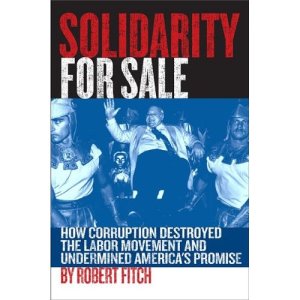
Bob offered a nice summary of the thesis of his last book, Solidarity for Sale, in an interview with Michael Yates of Monthly Review:
Essentially, the American labor movement consists of 20,000 semi-autonomous local unions. Like feudal vassals, local leaders get their exclusive jurisdiction from a higher level organization and pass on a share of their dues. The ordinary members are like the serfs who pay compulsory dues and come with the territory. The union bosses control jobs—staff jobs or hiring hall jobs—the coin of the political realm. Those who get the jobs—the clients—give back their unconditional loyalty. The politics of loyalty produces, systematically, poles of corruption and apathy. The privileged minority who turn the union into their personal business. And the vast majority who ignore the union as none of their business.
Few things annoyed progressive union types as much as Bob’s critique of Andy Stern’s SEIU. As Bob pointed out, much of the growth in SEIU’s ranks came from very questionable sources. One was home care workers, who got union recognition in California and Illinois. This was accomplished by large contributions to gubernatorial campaigns (including that of the notorious Rod Blagojevich, now federal prisoner number 40892-424); the victorious governors said thank you by granting SEIU recognition to represent them. Many of these home care workers are people who are reimbursed for their efforts in taking care of sick relatives. This sort of union growth has nothing to do with organizing against the will of hostile employers. And SEIU did little or nothing to raise their dismal rates of pay. For pointing this out, Bob was accused of devaluing the home care workers, when instead he was showing how meaningless Stern’s claims of vigorous growth were.
And then there were the sweetheart deals with nursing home operators, in which SEIU was granted the right of representing workers at some homes in return for ceasing organizing efforts at others—and for agreeing to lobby on behalf of the operators’ political agenda, which included defeating a bill of rights for nursing home residents, and forbidding workers to agitate on behalf of the residents. That boosted the membership rolls, but gains to the working class are hard to measure.
Intellectuals loved Stern, because he was an Ivy League guy who talked like them and cultivated them. It didn’t hurt that he wrote checks to support their journals and websites, either. And so Bob’s critiques were dismissed with great scorn. I’d like to say that Bob was vindicated when Stern retired, his union aflame in civil war and something like $100 million in debt, but I’m afraid few opinion shapers see it that way.
coda
Bob wasn’t perfect, dare I say? But some of his vices were inseparable from his virtues. He sometimes leapt to conclusions—but he was usually right, but it always gave the nitpickers some nits to pick. He was interested in a million things—early on, he wrote a book about Ghana. He’d studied Chinese. That breadth of interest sometimes devolved into an undisciplined lack of focus. He started many things he never finished. Marty Gottlieb, the former editor of the Village Voice now at the New York Times (and who, despite that career trajectory is a very fine man) who helped him write Solidarity for Sale, told me that Bob was very difficult to work with—too often all over the place. But that’s part of what made him so great and lovable. His mind never stopped working, at an almost sublime level of ambition.
As I’m bringing this to a close, I thought it would be nice to quote two people who knew and worked with Bob. First, Mike Tomasky, now in exile in Washington:
I was writing about New York politics and power at the time, and thinking I was doing a pretty good job of it; then I read The Assassination of New York, which just made me feel embarrassed and even humiliated about all the things I hadn’t known. I learned so much from that book—and from and from my many memorable conversations with its brilliant, gentle, intense, and utterly incorruptible author.
And then Don Guttenplan, the man who introduced me to Bob, now in London, which is a much better place to be than DC:
[It’s a] scandal that they scrape the barrel to give these so-called genius grants to third-rate conventional fakers when Bob Fitch, a man who did his own thinking and his own research, and who came up with truly original insights about some pretty important topics—urban planning, organized labor, critical journalism—had to live like a luftmensch.
Alexander Cockburn once said the mission of the bourgeois pundit is “to fire volley after volley of cliché into the densely packed prejudices of his readers.” Left media often do the same, whether it’s lionizing Andy Stern or cataloging the terrors of the Tea Party (which of course make it essential that we get all fired up for the current Democrat). Bob would have none of that. Though he had an excellent circle of passionately devoted friends and fans, he alienated a lot of people who could have made his life materially easier. But as Mike Tomasky said, he was utterly incorruptible.
I have a six-year-old son who gets upset when people believe in fictions. He’s not against fiction as fiction—his problem arises when people actually believe stories of their own creation. He wouldn’t agree with Wallace Stevens that “The final belief is to believe in a fiction, which you know to be a fiction, there being nothing else.” So when kids talk about the Tooth Fairy, he indignantly tells them there’s no such thing. The same with Santa Claus. He seems pretty sound on the God question, too. I think he might have inherited this some from me. I want to tell him it won’t make you popular, but I stop myself, because we need all the people like that we can get.
Me talking about Fitch, Monday
I’m giving the Bob Fitch memorial lecture on Monday evening, 5-7 PM, LaGuardia College, 31-10 Thomson Avenue, Long Island City, Room E-500.
New York city, unions, Democrats, stuff like that.
Map:
http://maps.google.com/maps?f=q&source=s_q&hl=en&geocode=&q=LaGuardia+College,+31-10+Thomson+Avenue,+Long+Island+City&aq=&sll=40.686987,-73.961261&sspn=0.012464,0.023389&ie=UTF8&hq=&hnear=29-10+Thomson+Ave,+Queens,+New+York+11101&t=m&z=14&iwloc=A&ll=40.744257,-73.937931&output=embed
View Larger Map


 LBO News from Doug Henwood
4 Comments
Posted on June 3, 2012 by Doug Henwood
Radio commentary: compulsory patriotism, saggy job report
[I haven’t been posting my radio commentaries for while, for no particular reason. Here’s one from yesterday’s show. Audio soon to follow….]
rituals of compulsory patriotism
I’ll get to the May employment report in a moment, but first I wanted to say something about the Chris Hayes controversy from Memorial Day weekend. On his MSNBC show on the Sunday of that weekend, Hayes filed some objections to the use of the word “heroes” to refer to our soldiers, saying among other things that the designation was a way to sell unpopular wars. For this he was fried by the usual idiots, which is to be expected. [For a review, see here.] But then in a disappointing move on Monday, Hayes walked it back, as they say in DC, basically apologizing for having told the truth.
Hayes told me that no one asked him to do this. But this is one of those things that you don’t have to be asked to do—it’s how hegemony works. If you want to keep your TV show, you can’t be seen as criticizing the military in any way. Several times over the years, I’ve had the wonderful feminist scholar Cynthia Enloe on this show (e.g.: July 1, 2010) to talk about the military, one of her major topics of interest. I tried to get her on this week, but couldn’t get hold of her. So I’ll do the next best thing and channel her: there is no other country that calls itself a democracy, Israel excepted, that has so militarized daily life. There’s also no other putative democracy that has so many and frequent compulsory rituals of patriotism. Why do we sing the national anthem at sporting events? Why are we expected to pledge allegiance to the flag? There is no other democracy that has a pledge of allegiance like ours. And back in the 1950s, Eisenhower turned May Day into Law Day and Loyalty Day, thereby turning what was originally an American holiday to celebrate the working class and its radical potential into formal professions of obedience.
I am very sad that Chris Hayes felt like he had to apolgize. But this isn’t about him. In fact, he’s a good guy, admirable in many ways. It’s about our curious notions of freedom, which require constant genuflection to flag, army, and church. With this kind of ingrained deference, who needs fascism?
saggy job market in May
And now onto the May U.S. employment report. It was another saggy report, and revisions to the previous two months data make recent history even saggier than we initially thought. For a while it looked like some weather mischief was distorting the figures—activity normally undertaken in spring could have been brought forward into January and February, which came in stronger than anticipated. But that interpretation longer looks supportable: there’s a real slowdown underway—and the question is now whether we’ve reached the dangerous stage of “stall speed,” on which more in a moment.
Employers added just 69,000 to their payrolls in May, less than a third the long-term monthly average. That’s the lowest gain in a year. The average gain for the last three months is just 96,000, compared with 252,000 for the previous three. Just three sectors—transportation & warehousing, health care, and wholesale trade—together accounted for more than the entire private sector gain, since many other sectors were flat or down. Manufacturing wsa up decently. But construction was down hard, and the once-strong leisure and hospitality sector was also off. Government employment continues its long decline—a real anomaly for a recovery period by historical standards. For all the moaning by the right, government spending and employment has been a drag on recovery, not the usual stimulus. If getting government out of the way was the way to economic health, we’d be bounding about now instead of scraping along the bottom.
The length of the average workweek fell, and average hourly earnings were barely changed. As a result, the total number of hours worked throughout the economy fell, as did the total earnings of the mass of workers. It is impossible to sustain an economy on trends like these over the longer term.
The figures I’ve been quoting come from a survey of 300,000 employers. The simultaneous survey of about 60,000 households looked somewhat better, but not all that much. The share of the adult population working rose by 0.2 point, but that only reversed the decline of the previous two months. And while the household measure of employment showed good gains, they were more than entirely accounted for by gains in part-time employment (much of it among people who’d prefer full-time work). The number of full-time employed fell by over quarter of a million.
The unemployment rate rose a tenth of a point, as an uncommonly large number of people entered a workforce that was unable to accommodate them. But the problem of long-term unemployment, which had gotten a little better for a few months, got worse again in May. The average unemployed person has been out for work for nearly 40 weeks, one of the longest spells on record. And that’s almost three years into an economic recovery.
While this report hardly qualifies as a disaster, it does confirm that there’s a real slowdown underway, and not just some weather-related quirks. The question now is is this just a return to the post-financial crisis norm of weak gains, or a stall-speed transition to something worse? There’s good historical evidence that the U.S. economy just can’t live with slow growth. (And yes, before anyone emails me, I know that growth is not ecologically sound. But until we underake some serious structural reforms, it’s the only game in town.) So if growth gets much slower than it is now, we’re quite likely to fall back into recession. Add the worsening Eurotroubles, and it’s looking to us like the Federal Reserve will begin dusting off the Extraordinary Measures playbook very soon. Because god knows that neither the president nor Congress will do anything of the sort.
Share this: