
America: the rot goes on

It’s been a while since I looked at one of the major reasons for the pervasive sense of rot about the US: the low level of investment—investment in real things, that is, not crypto. It’s barely keeping up with the forces of decay. If you’re wondering why nothing works and everything seems to be falling apart, here are some explanations.
First a definition: investment is spending by businesses, governments, and individuals on long-lived physical assets like buildings and machinery. Gross investment is the dollar value of such spending; net is what remains after deducting depreciation, aka wear and tear. That’s not an easy process to put a dollar value on, but it’s all we’ve got. And besides, these are numbers the capitalist state produces to understand its economy, so why not take them seriously, even if the bourgeoisie seems unalarmed about them?
Graphed below is the average value of net public and private investment as a percentage of GDP by decade. Civilian public investment means expenditures on long-lived assets like schools and roads, but excluding the military. (To anticipate a question I sometimes get: yes, prisons are in there too, but they don’t count for much; almost all the costs of maintaining the carceral state come from day-to-day operations.) Private investment consists of purchases of buildings, equipment, and intellectual property (IP) by businesses and. Not shown on this first graph: residential investment, the purchase of housing by individuals and improvements to that housing.
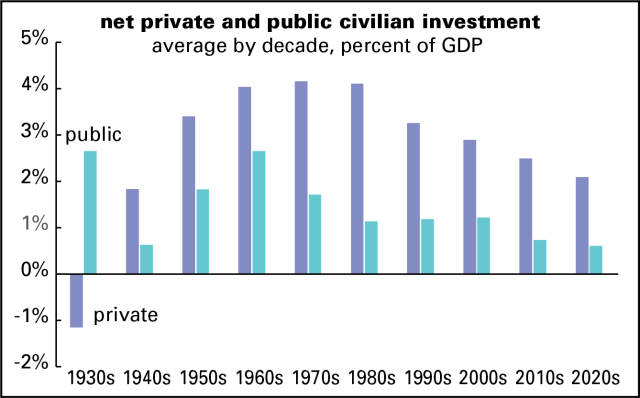
Averages for the 1930s reflect the extraordinary circumstances of the Great Depression: private investment collapsed and New Deal-driven public investment soared. Those high levels of public investment gave us an infrastructure that we still use today—schools, post offices, and parks. (For a catalog of those projects, check out the Living New Deal.) Public investment sagged during the 1940s, reflecting World War II, but rose in the 1950s and 1960s, matching the 1930s level as the public sector expanded. It was not to last: austerity and privatization consciousness took over, and now net public investment is at a record low.
Private investment rose in the decades after World War II, peaking in the 1970s. But the Wall Street-driven imperatives of profit maximization that got the upper hand via the Shareholder Revolution of the 1980s, which transformed corporate practices, put the squeeze on investment. Investing too large a share of corporate profits in things came to be seen as wasteful—better instead to hand the cash over to the shareholders, via stock buybacks and traditional dividends.
Here’s a yearly view of the trajectory of decline, a path traced by the dotted trendlines. The graphs begin in 1950 because the extremes of the 1930s and 1940s would have distorted the scale.
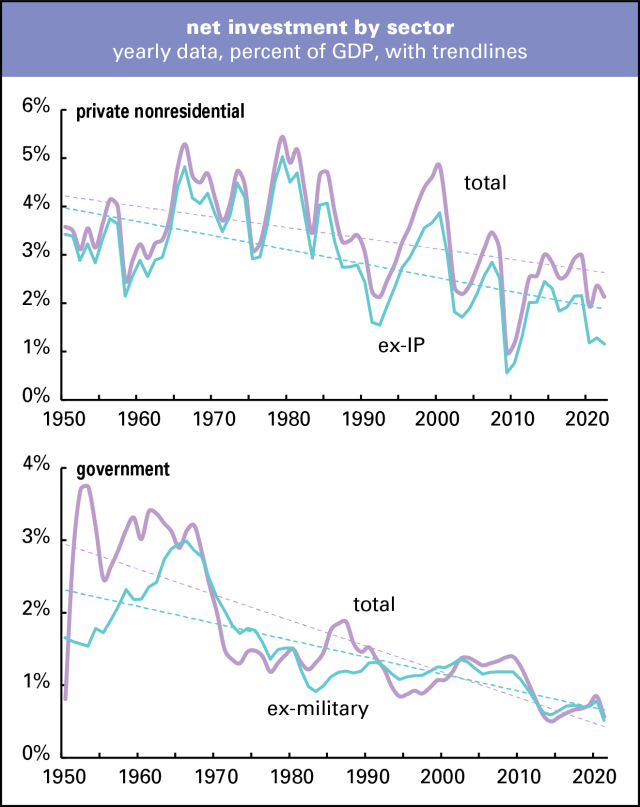
These graphs show a relative stability in net private investment from the late 1950s through the early 1980s, when Wall Street’s grip on corporate cash flow tightened. There was a surge in the late 1990s, the period of the New Economy mania and the early commercial internet—an enthusiasm which was at least backed up with investment in the technology that was supposed to bring about the future. We haven’t seen much of that in the latest iteration of tech mania, the era of Uber and Airbnb.
Here’s a look at some components of private investment. The equipment and especially the structures trendlines show a persistent downward path. Against that, IP’s rise stands out—to the point where it’s surpassed investment in buildings and is rivaling equipment. Both equipment and structures used to be several times IP. Capitalists are spending less money on things that are supposed to promote general prosperity and more on legal arrangements that protect theirs.
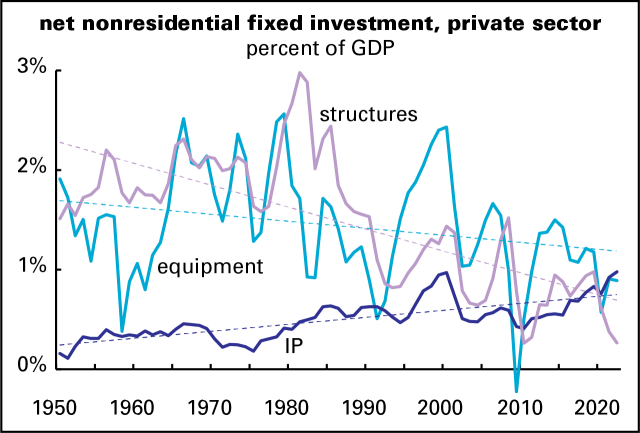
Low levels of net private investment aren’t driven by declines in gross investment, which has been pretty stable. Instead, the major reasons for the decline are a shift towards shorter-lived equipment and the immateriality of intellectual property (IP) and a shift away from buildings. From 1950–1999, net fixed private investment averaged 32% of gross; since 2000, it’s averaged 20%—and 16% since 2020. Every asset category has seen that shift—even buildings.
Intellectual property investment, whose share of business investment grew from 8% in 1950 to 40% today, adds another layer of fleetingness to the story. Business ideologues love to tout IP as a stimulant to innovation; who’d invent anything if they couldn’t patent it? Lots of people would, actually. That aside, most basic innovation in sectors like computing and pharmaceuticals have been funded by public entities, not private companies, who then appropriate those innovations to make profits from research they didn’t pay for. Instead of supporting innovations, a lot of IP investment is about trying to establish monopolies, be it in the latest variation on an antidepressant or a Disney cartoon character. But even here the trend towards shorter-lived assets is visible: net IP investment went from 27% of gross in the 1950s and 1960s to 16% since.
For the public sector, the decline in net investment has been more dramatic, falling from around 2% of GDP in the early decades on the graph to 0.4% since 2020. (It’s 0.3% so far in 2022.) Like the private sector, we’ve seen a shift towards shorter-lived assets, but unlike the private sector, we’ve also seen a decline in gross investment, which fell by almost half between the 1960s and 2020s. Net public investment as a percentage of gross went from 67% in the 1950s and 1960s to 27% in the 2020s. Net federal civilian investment is just 0.1% of GDP so far this decade, a third its 1950–1999 average. State and local investment has fallen harder, down by almost three quarters from that 50-year average to 0.5% in the 2020s (0.3% so far this year).
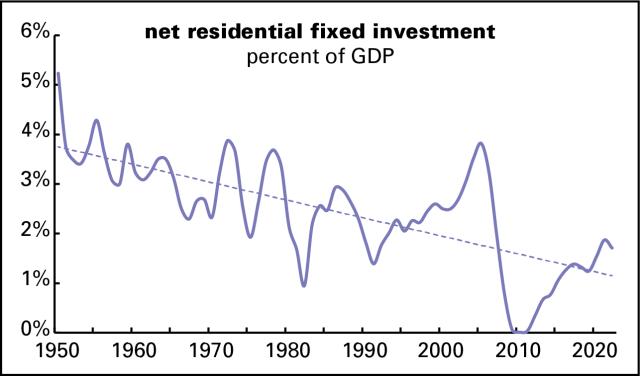
And as the graph above shows, residential net investment isn’t doing too great either: it went from an average of 2.8% of GDP from 1950 to 1999 to 1.7% in the 2020s. Unlike the mid-2000s housing bubble, which took net residential investment up to 3.8%, the highest since the early post-World War II years, the latest bubble took net housing investment up to just 1.9% of GDP last year. It’s fallen back to 1.4% in 2022. That’s not the way to meet a housing deficit estimated by Freddie Mac at 3.8 million units.
The burst of net private investment in the late 1990s gave us a major productivity acceleration, but it was not to last. And the burst in civilian public investment from the early 1950s through the late 1960s gave us interstate highways, schools, and state university systems. The long declines in net investment, both private and public, have given us stagnant productivity growth and a collapsing infrastructure.
As I put it when I wrote about net investment five years ago, “If I were a debased purveyor of clickbait, I’d call this “Everything that’s wrong with America in two charts.” But I’m not, so I won’t. But still….”
More true than ever.
Photo is by me, of the 7th Ave stop on the G line of the New York City subway.
Fresh audio product: Italian politics, union finances
Just added to my radio archive (click on date for link):
July 28, 2022 Paolo Gerbaudo on the failure of technocracy and the imminence of right-wing rule in Italy • Chris Bohner on the huge stash unions have but aren’t spending (report here, Jacobin summary here)
Fresh audio product: the right’s war on education, the political economy of Ukraine
Just added to my radio archive (click on date for link):
July 21, 2022 Jennifer Berkshire on Pete Hegseth, Christopher Rufo, and the right’s latest fronts in their war on public education • Peter Korotaev looks at the political economy of Ukraine, before, during, and after the war
Fresh audio product: post-leftism, Afropessimism
Just added to my radio archive (click on date for link):
July 14, 2022 Erik Baker, author of this piece, takes another look at a recent BtN obsession: post-leftism • José Sanchez, author of this critique of Afropessimism, looks at the school of thought and its contradictions
Fresh audio product: abortion and Nazis
Just added to my radio archive (click on date for link):
July 7, 2022 Jenny Brown of National Women’s Liberation (and author of Without Apology and Birth Strike) on the early struggle for abortion rights that led to Roe and what we can learn from it for today • journalist David De Jong, author of Nazi Billionaires, on how respectable German businessmen became loyal Nazis
Fresh audio product: reining in the cops, the limits to sensitive money management
Just added to my radio archive (click on date for link):
June 30, 2022 George Maher, author of A World Without Police, on the movement to defund and eventually abolish the cops • Tariq Fancy, author of this series of articles, on the (severe) limits to using finance to fix the climate
Fresh audio product: middle classness, transness
Just added to my radio archive (click on date for link):
June 23, 2022 David Roediger, author of The Sinking Middle Class, on the uses of that term in US politics • Paisley Currah, author of Sex Is as Sex Does, on trans politics
Fresh audio product: racial wealth gap, Jack Welch
Just added to my radio archive (click on date for link):
June 16, 2022 Ellora Derenoncourt, co-author of this paper, on the racial wealth gap, 1860–2020 • David Gelles, author of The Man Who Broke Capitalism, on Jack Welch, CEO of GE from 1981–2001
Fresh audio product: Colombia, elite capture
Just added to my radio archive (click on date for link):
June 2, 2022 Forrest Hylton on the first round of the Colombian presidential election, which was bad news for the leftist Petro • Olúfẹ́mi Táíwò, author of Elite Capture, on how the ruling class has debased identity politics, and how we could reconstitute it
Fresh audio product: porn work and styles of economics
Just added to my radio archive (click on date for link, and apologies for the late posting):
May 26, 2022 Heather Berg, author of Porn Work, on relations of production in sex work • Kevin Young and Leonard Seabrooke, co-authors of this paper, on the contrasting collegial styles of the Chicago and Charles River schools of economics
Americans’ class ID shifts down
The USA is the country where everyone feels middle-class, right? No.
Gallup is out with the latest edition of a question it’s asked ten times over the last twenty years: “If you were asked to use one of these five names for your social class, which would you say you belong in?” When they did the survey in April, the largest set of respondents said “middle,” 38%—but that’s not much more than a third. Almost as many, 35%, said “working” (a term that has often been pronounced obsolete).
Here’s some more detail:
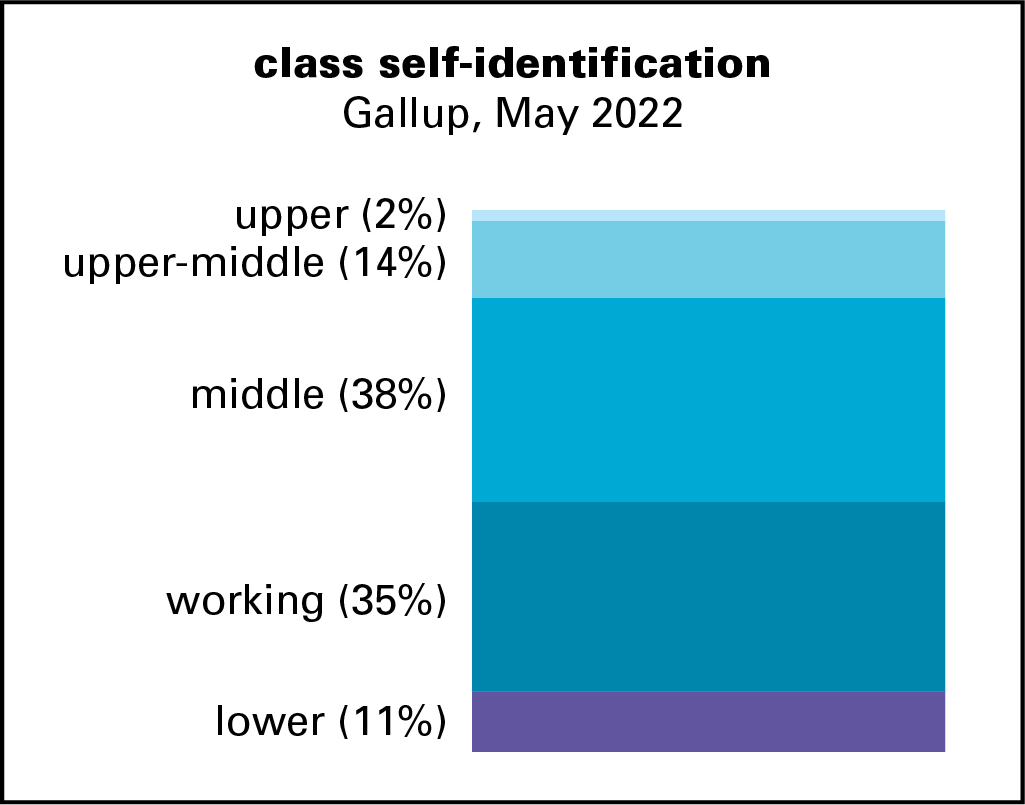
A striking thing about the chart is its upward skew. The midpoint is just 4 points into the “middle” category, and “upper-middle” is nowhere near that midpoint—it begins about 5/6 of the way to the top. Still, it’s remarkable that in a country of alleged universal middle classness, almost half the population identifies as sub-middle.
Over the last 20 years, upper-middle and middle have declined by 8 percentage points and working and lower have risen by 9. If you start the clock in 2005, the peak of the housing bubble, the “middle” share has fallen by 9 points, with most going into “working.” The Great Recession that followed the bursting of that bubble has a lot to do with that trend, but ten years of expansion following that miserable downturn did nothing to change middle-class self-identification.

Before one gets encouraged by these stats into thinking proletarian class-consciousness is on the rise, a caveat: more Republicans (38%) are likely to identify as working class than Democrats (30%). But to conclude on a more encouraging note: 49% of those aged 18–34 call themselves working class, twice the share of the over-55s. Nice to see that clarity in the young.
Fresh audio product: crypto, white power
Just added to my radio archive (click on date for link):
May 19, 2022 Molly White, keeper of the Web3 Is Going Just Great blog, on the pointless and scam-ridden world of cryptocurrencies • Kathleen Belew, a scholar of white power, on that movement’s obsessions and unusual organization
Fresh audio product: climate and abortion
Just added to my radio archive (click on date for link):
May 12, 2022 Matthew Huber, author of Climate Change as Class War, explains why the environmental movement needs to take class and production more seriously • Adam Kotsko explores why evangelicals are so obsessed with abortion


 LBO News from Doug Henwood