
Fresh audio product
Just added to my radio archive (click on date for link):
November 5, 2020 Vijay Prashad and Jodi Dean (separately) on the election’s long-term meaning: where Trump(ism), came from and why it’s probably here to stay, especially if weaklings like Biden are the opposition
Fresh audio product
Just added to my radio archive (click on date for link):
October 29, 2020 Kat Pecore, a public defender in NYC, on the injustice of sex offender registries • Antonia Atria, a student and socialist activist, on Chile’s vote to rewrite its Pinochet-era constitution
Fresh audio product
Just added to my radio archive (click on date for link):
October 8, 2020 Kathleen Belew, author of Bring the War Home, on the history of the white power movement • Billy Fleming and AL McCullough on The 2100 Project: An Atlas for the Green New Deal
Fresh audio product
Just added to my radio archive (click on date for link):
October 1, 2020 Max Sawicky, author of this report, on the postal service’s problems and what could be done about them • Kelly Grotke on college endowments and selective austerity (janitors lose, portfolio managers win)
Fresh audio product
Just added to my radio archive (click on date for link):
September 10, 2020 Samuel Moyn, author of this article, on why calling Trump a “fascist” is neither accurate nor helpful • Juliet Schor, author of After the Gig, on the sharing economy and how to get beyond it
Fresh audio product
Just added to my radio archive (click on date for link):
September 3, 2020 Mike German on cops and white supremacists (Guardian article; Brennan paper) • Hadas Thier, author of A People’s Guide to Capitalism, on Marx’s economics
Fresh audio product
Just added to my radio archive (click on date for link):
August 27, 2020 Laleh Khalili, author of Sinews of War and Trade, on the role of shipping in the development of capitalism in the Arabian Peninsula • Kayla Popuchet on what’s been going on in Belarus
Fresh audio product
Just added to my radio archive (click on date for link):
August 20, 2020 Christian Parenti, author of Radical Hamilton, on appropriating the state-led developmentalism of the Founding Father for the left
Blank email?
For some reason, the email WordPress sent out about my latest radio show posting was blank. Let’s see if this one is too.
You can see the post at https://lbo-news.com/2020/08/13/fresh-audio-product-230/.
Fresh audio product
Just added to my radio archive (click on date for link):
August 13, 2020 Elizabeth Wrigley-Field on race and mortality: years lost to police violence and how many white people would have to die of COVID-19 to equal a “normal” year of black death? (paper here, NYT article here) • Tom Philpott, author of Perilous Bounty, on the ecological crises facing US agriculture
Fresh audio product
Just added to my radio archive (click on date for link):
August 6, 2020 Edwin Ackerman on Mexican president AMLO • Marcia Chatelain, author of Franchise, on the impact and role of black McDonald’s franchisees
Fresh audio product
Just added to my radio archive (click on date for link):
July 30, 2020 Tobita Chow on the roots and dangers of Sinophobia in the US • Donna Murch, author of Living for the City, on the emergence of the Black Panther Party out of early 1960s campus study groups
Miserable numbers
Even non-connoisseurs are reeling from the miserable second quarter GDP numbers released this morning. Between the first and second quarters of this year, GDP was off 33% after adjustment for inflation. That’s by far the biggest decline since quarterly numbers begin in 1947.
That 33% figure is at an annualized rate, meaning GDP would be off by a third if it declined at the second-quarter rate for a full year. The US is unusual in annualizing the data; most other countries report the quarter-to-quarter change without annualizing it. If we did that, it would have been off a mere 9.5%. But no matter how you slice it, it’s awful: more than three times as bad as the previous record, the first quarter of 1958 (a recession that helped elect JFK), and four times as bad as the worst quarter of the 2008–2009 recession, the fourth of 2008.
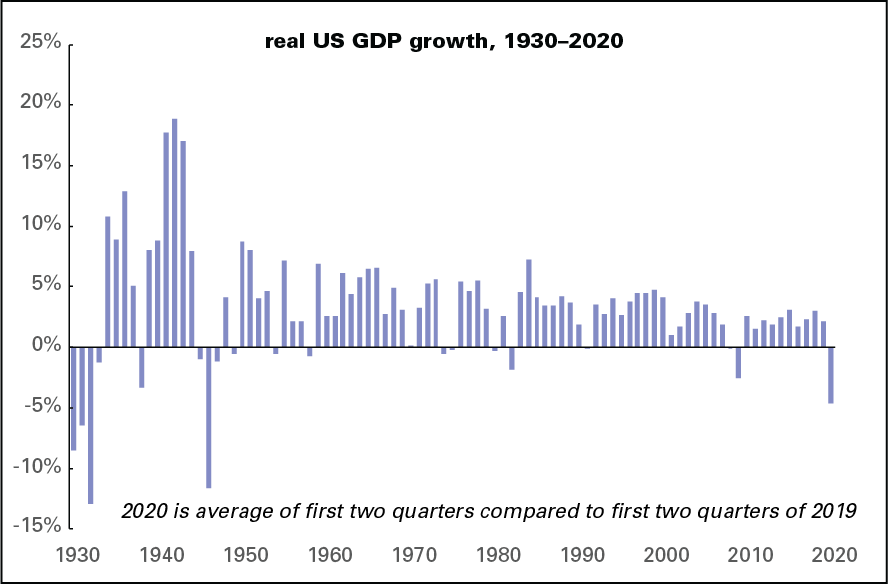
If you average the first two quarters of this year and compare them to the first two of last year, as the graph below does, you get by far the worst number since 1946, when the US was demobilizing after World War II. Aside from that, you’d have to go back to the Great Depression for bigger negative numbers.
As I’ve pointed out elsewhere, we never really recovered from the 2008 recession. Quoting that to save some keystrokes:
Had the economy continued to grow in line with its 1970–2007 trend, GDP would be about 20% higher than it is now. GDP is a deeply flawed measure; it says little about distribution or quality of life, but it is what the capitalist system runs on. Listen to any pundit or propagandist, and growth is what the whole set-up is all about. And by this most conventional of measures, American capitalism is failing badly on its own terms.
But that 20% shortfall was based on first quarter numbers; the second quarter took it close to 30%, as the graph below shows.
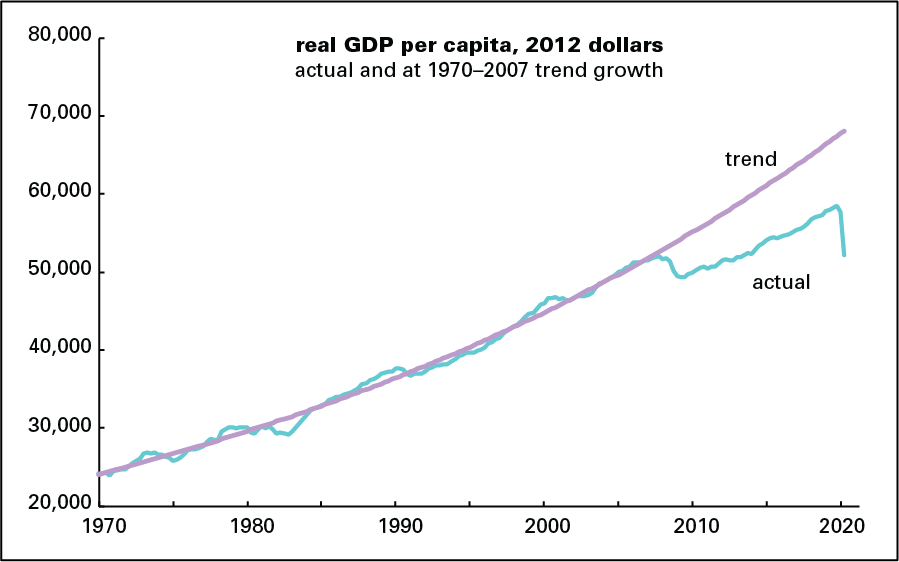
A near-30% shortfall works out to just over $18,000 per person. That’s an aggregate number; it doesn’t mean that we’d each be $18,000 richer had growth held to the old trend. There are things in GDP like investment and government spending that don’t translate into personal income—and since the rich have hogged most GDP growth over the last several decades, the average person would see little of that $18,000. But it is a measure of how much poorer we are as a society because of the economic troubles of the last decade.
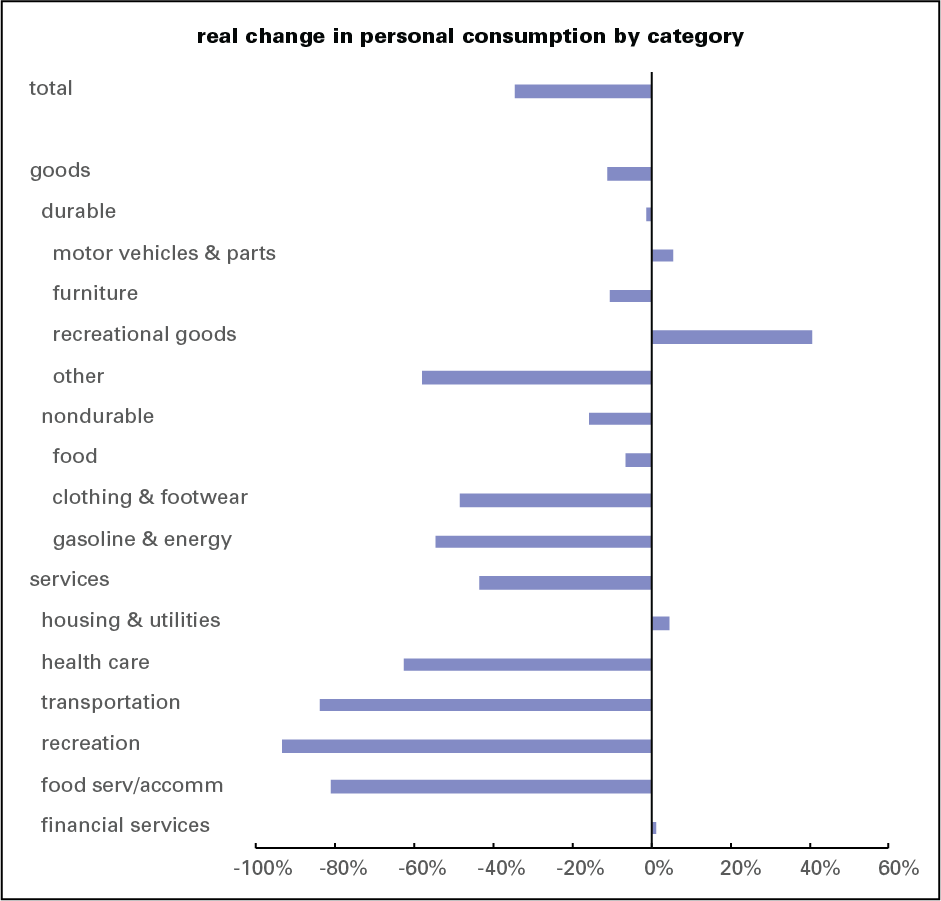
Of the 33% annualized decline in GDP, 25 points came from personal consumption, three times the previous worst quarter (the fourth of 1950). That decline in spending came despite the huge boost to personal income provided by the $1,200 stimulus checks and expanded unemployment benefits; it looks like those who could saved their money out of fear it would soon be in very short supply. As the graph below shows, spending on recreation led the way down, off 94%; close behind were transportation, off 84%, and food services and accommodation, off 81%. Spending on clothing & footwear and gasoline & energy were also down hard. Amazingly, spending on health care was down 63%, as people postponed routine care out of fear of catching the virus.
The third quarter is unlikely to be this dire. According to the Federal Reserve Bank of New York’s GDP tracker, the third quarter is likely to see a sharp rebound—though that’s based largely on early July data. Things look to have slowed as the month progressed—and with the $600 supplemental unemployment benefits gone, at least for now, we could just flatline for a few months. Even if we see some recovery, the long-term damage—people disemployed, businesses shuttered, confidence hammered—will be substantial and lingering.
What a terrible time to be governed by callous morons.


 LBO News from Doug Henwood