
Fresh audio product
Just posted to my radio archive (with a few days’ delay—sorry!). Click on date for link:
May 3, 2018 Alejandro Velasco on Venezuela • Jessica Blatt, author of Race and the Making of American Political Science, on the racist origins of the discipline
Fresh audio product
Just added to my radio archive (click on date for link):
April 26, 2018 Corey Pein, author of Live Work Work Work Die, on the dark side of the Silicon Valley • an anonymous sex worker on the legal dangers of SESTA/FOSTA
Fresh audio product
Just added to my radio archive (click on date for link):
April 5, 2018 Sean Jacobs, founder of Africa Is A Country, on Winnie Mandela’s legacy • Forrest Hylton on Colombian politics in the run-up to May’s presidential election
Fresh audio product
Just added to my radio archive (click on date for link):
March 29, 2018 Sean Guillory, host of the Sean’s Russia Blog Podcast, on Putin and Russophobia • Alex Vitale, author of The End of Policing, on school shootings and what (not) to do about them (and why it’s bad to label school shooters as terrorists)
Fresh audio product
Just added to my radio archive (click on date for link):
March 22, 2018 Jennifer Berkshire, host of Have You Heard?, on teachers’ strikes, WV and beyond • Stan Collender on fiscal follies in DC
The wit and wisdom of Larry Kudlow
News that Larry Kudlow will become Trump’s top economic advisor reminded me of my experience with him when we were Left vs. Right guests on a WNYC-TV show in the early 1990s. WNYC’s studios were then in the Municipal Building in lower Manhattan. A producer met us in the lobby to take us upstairs, and proudly noted that the building had just been renovated. Larry’s response: “They should have just let it fall down.”
In an effort to democratize the form, WNYC had placed remote cameras in a few dwellings around the city, so citizens could ask questions and make comments to the guests. Larry had unsurprisingly spent much of the show mourning the passing of Reaganomics and prescribing it as the cure for all our ills. One of the remote questioners was a black man in East New York (a Brooklyn neighborhood that was then and still is one of the poorest in the city). He told Larry that they didn’t see any of that Reagan magic in his neighborhood. Larry dismissed his testimony, saying “the Reagan years were a Golden Age of black entrepreneurship.”
When it was all over and the cameras were turned off, Larry asked us “Where the hell is East New York?”
Fresh audio product
Just added to my radio archive (click on date for link):
March 15, 2018 John Clarke of the Ontario Coalition Against Poverty on what’s wrong with a Universal Basic Income • Isabel Hilton on Xi Jinping’s becoming China’s president for life
Fresh audio product
Just added to my radio archive (click on date for link):
March 8, 2018 Jason Wilson on dwindling numbers on the far right • Tim Shorrock on the relations among the two Koreas and the U.S.
Fresh audio product
Just added to my radio archive (click on date for link):
February 22, 2018 Marcie Smith, adjunct econ professor at John Jay College (CUNY), on the recently departed Gene Sharp, revered but problematic theorist of nonviolence and friend of the intelligence services
Smaller strikes also in decline
Several readers responded to the recent post on strikes by asking if the BLS stats, which cover stoppages involving 1,000 or more workers, are missing smaller-scale actions. (And I should say that I’m being imprecise by calling all stoppages “strikes,” since the figures also include lockouts.) Alas, no.
The Federal Mediation and Conciliation Service publishes data on all work stoppages, regardless of the number of workers involved. The numbers from 1984 through 2016 are graphed below.
Smaller strikes peaked at 1,142 in 1985, which looks big by recent standards. If the trajectory is anything like larger strikes, then 1985 was probably a major comedown from the 1950s through the 1970s; the average that year was down 82% from the 1950–1979 average. Even so, 2016’s total of 88 was down 92% from 31 years earlier.
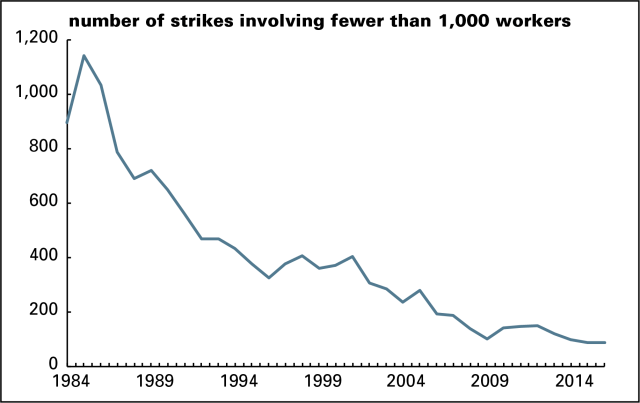
The 2017 data runs only through the third quarter. There were only 39 strikes in the first months of the last year; if you annualize that, you get 52 strikes, 41% fewer than 2016, and 97% fewer than in 1985.
If you look at days of “idleness,” as they say, the decline is even starker: 93% from the 1984 peak (yes, different peak year, and not a typo for “1985”). If you annualize the days of idleness for 2017, you get a 99% decline.
So there’s not much striking going on under the radar either.
Fresh audio product
Just added to my radio archive (click on date for link):
February 15, 2018 Max Sawicky on Trump’s budget • Edward Luce, Financial Times columnist and author of The Retreat of Western Liberalism, on the crisis of the American class system
The disappearing strike
According to Bureau of Labor Statistics figures released this morning, last year saw the second-smallest number of major strikes in recorded history: seven. This is close to the record low set in 2009, five—in the depths of the Great Recession, when the unemployment rate was approaching 10%. Last year’s average unemployment rate was less than half that, 4.3%.
Here’s the grim history of the decline of labor’s most powerful weapon in two graphs:
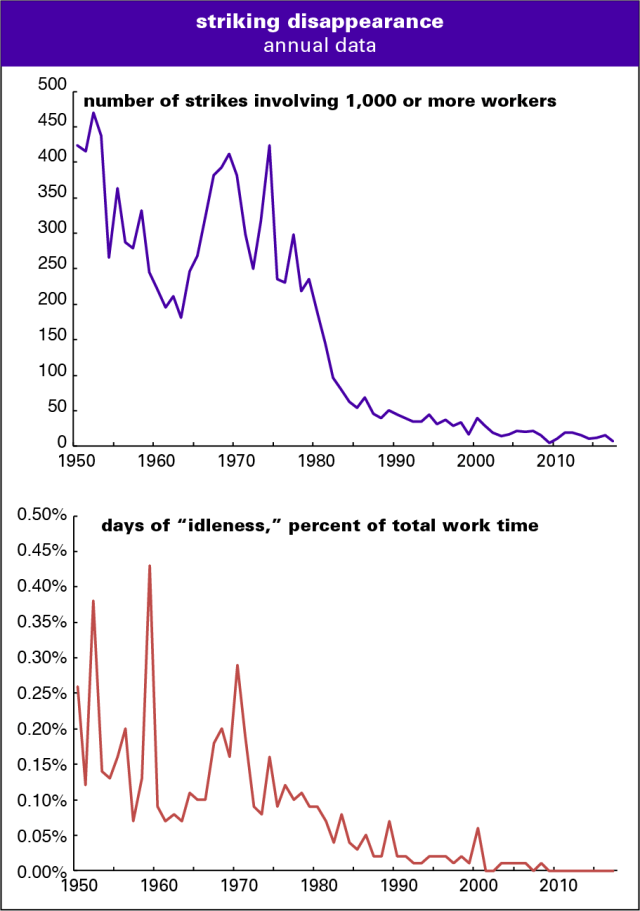
The number of days of “idleness”—a curiously moralizing word for an instrument of class struggle—wasn’t as close to a record low. There were four years in which this measure (the number of workers involved times the length of the strike) was lower—all recent years (2009, 2010, 2013, 2014).
Between 1947 and 1979, there were an average of 303 “major” strikes (involving 1,000 or more workers) every year; since 2010, the average has been fourteen. The average number of days of “idleness” went from almost 24,550,000 in the first period to 708,000, a decline of 97%. This decline just might have something to do with stagnant wages, greater job instability, and disappearing benefits, though of course turning it around is a lot harder than writing an exhortatory blog post.
Most of those days off the job, 79% of them, came from just one strike, the IBEW‘s against Charter Communications, which is in its 318th day as I’m typing this. Just two other strikes were against private-sector employers (AT&T and car dealers in Chicago). One was against a university hospital system (Tufts—see Jane McAlevey’s article on that strike, one of the few inspiring stories in this bleak landscape, here). And three were against government employers, all in California (Riverside County, the City of Oakland, and the University of California). Private employers have absolutely no reason to worry about a strike, and haven’t for more than a decade. And when the Supreme Court hands down its decision in the Janus case, which will almost certainly eviscerate public sector unions, government employers are likely to feel the same way.
McAlevey’s mentor, Jerry Brown (the former president of 1199–New England, not the California politician), used to say the strike was like a muscle: if workers didn’t exercise it regularly, it would atrophy. It’s atrophied.
Fresh audio product
Just posted to my radio archive (click on date for link):
February 8, 2018 DH on stock market madness (longer version is here) • Yasha Levine, author of Surveillance Valley, on the military/intelligence roots of the internet, which live on today (hi NSA!)


 LBO News from Doug Henwood