
How unpopular is Trump?
Trump’s low approval ratings have gotten notice, but the closer you look the worse they are. At the risk of engaging in wild psychoanalysis, this must be very hard on a pathological narcissist, assuming he’s been fully briefed on the issue.
Here’s a graph of the history of Gallup’s presidential approval question. They started asking the question—“Do you approve or disapprove of the way X is handling his job as president?”—in 1942. But timing was patchy at first, and didn’t approach a monthly schedule until around 1950. Polling has been daily since Obama took office (who, by the way, spent almost all of his time below the average line).
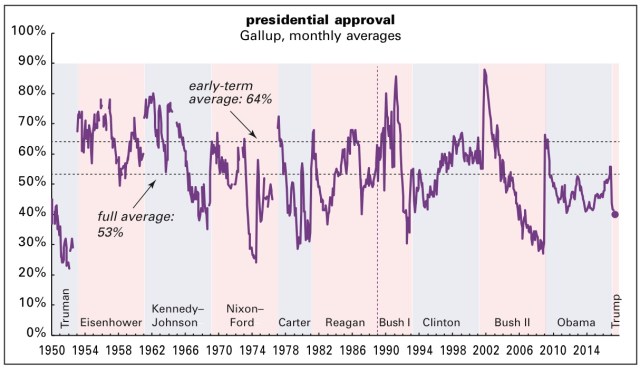
Trump was at 40% on March 21, up from a low of 37% three days earlier. (That’s the dot on the right end of the graph. Daily updates here.) His average for March so far, 41%, is at the 13th percentile of monthly readings since 1950 (meaning that in only 13% of all months since January 1950 has a president’s approval rating been lower). It’s 12 points below the average of the 67-year history shown.
More remarkably, March is only Trump’s second full month in office. The average for his predecessors’ ratings for their first two full months in office is 64%; Trump is 24 points below that average, and 15 points below the previous basement-dweller, Bill Clinton. Trump is well-practiced at the art of the honeymoon, but that experience isn’t carrying over to the presidency.
As satisfying as this information is, it’s not clear what can be done with it. It’s sometimes said that approval ratings affect a president’s ability to get things through Congress, but Trump is an unusual president and Congress is controlled by reactionary loons. Together the two branches don’t yet look like a well-oiled machine. Perhaps that will change. But Trump’s unpopularity does argue against reading him as the true expression of a toxic American inner essence. We’ve got problems, but we’re not quite that bad.
Fresh audio product
Just posted to my radio archive:
March 16, 2017 Steffie Woolhandler of Physicians for a National Health Program on Ryancare, Obamacare, and the prospects for single-payer • Cinzia Arruzza on the women’s strike
Fresh audio product
Just added to my radio archive:
March 9, 2017 Yanis Varoufakis back on BtN for the first time in over two years! He discusses the interminable eurocrisis, austerity, Brexit, the nationalist international (Trump, Le Pen, etc.), and DiEM25, among other things. The full Varoufakis–Ali–et al. debate is here.
The version of this show that ran on KPFA was truncated because the station is fundraising. Please donate and keep this worthy enterprise going. If you do, please mention Behind the News!
Fresh audio product
Just added to my radio archive:
March 2, 2017 Mark Blyth on neoliberalism and global Trumpism (the Guardian/Observer article on Mercer and Cambridge Analytica he talks about is here)
The version of this show that ran on KPFA was truncated because the station is fundraising. Please donate and keep this worthy enterprise going. If you do, please mention Behind the News!
Fresh audio product
Just added to my radio archive:
February 23, 2017 Angela Nagle, author of this and the forthcoming Kill All Normies, on the alt-right • Laleh Khalili on Lt. Gen. H.R. McMaster, Trump’s new national security advisor
This show didn’t run on KPFA because the station is fundraising. Please donate and keep this worthy enterprise going. If you do, please mention Behind the News!
Fresh audio product
Just added to my radio archive:
February 16, 2017 Sean Guillory (author of this) on the rich history of Western Russophobia • Larry Bartels, co-author of Democracy for Realists, on the prospects for democracy with a detached, ill-informed electorate
Fresh audio product
Just added to my radio archive:
February 9, 2017 John Ackerman on Trump and Mexico • Art Goldhammer surveys the French political landscape as a presidential election approaches
Strikes?
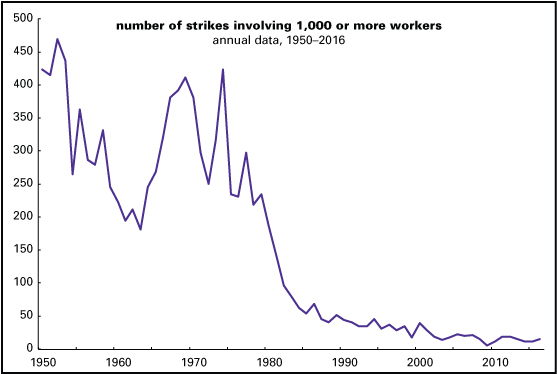
The strike—labor’s most powerful weapon against capital, except maybe sabotage—is disappearing even more rapidly than unions, which is saying a lot. The Bureau of Labor Statistics reported this morning that there were 15 work stoppages involving 1,000 or more workers in 2016. That’s 1 above the average of the past five years, and down 96% from the average of the late 1940 and 1950s.
(Stoppages include both strikes and lockouts—the data series doesn’t distinguish between the two. The overwhelming majority are strikes. Notable exceptions in recent years have been in professional sports, but in a bizarrely hostile and destructive move, Long Island University locked out its employees in September 2016. From here on, I’m using the word “strike” rather than stoppage because it sounds far better with only a minor loss of accuracy.)
As the graph below shows, the collapse in the strike began in the late 1970s, and accelerated during the Reagan years, a time of massive union-busting. It’s continued to drift lower as it approaches the zero line. The last time we saw over 50 strikes was 1989. The last time we saw over 20 was 2008.
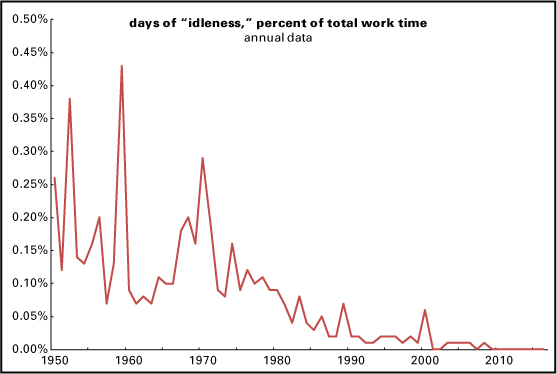
This decline is even more impressive—or distressing, if you prefer—when you consider that employment has more than tripled since 1950. That is brought out by another series from the BLS, days of “idleness” (a nicely Victorian word, as if striking was a leisure activity) as a percent of total working time. (See graph below.) Even at its peak in 1959, at a mere 0.43%, idleness was never that big a thing, but in every year since 2009, it’s been statistically indistinguishable from 0.
It’s wonderful to hear people talking lately about a general strike and a women’s strike. It would also be good to see some of the old-fashioned kind too. Employers hate them, because they disrupt production, raise wages, cut into profits, and remind them of the potential power of labor. When I wrote up the 2013 data in April 2014, I ended the post with this:
Jane McAlevey, the ace labor organizer and author of Raising Expectations (And Raising Hell)…says that her mentor, Jerry Brown of 1199 New England, used to say that workers should strike at least once every two years just to remind them of their power. Those were the days.
With the labor movement about to face an unprecedented attack by every level of Republican-dominated government (not that the Dems have been all that supportive, but this is going to be a whole new kind of hell), it’s alarming to see the working class so out of practice at deploying its most potent weapon.
Fresh audio product
Just added to my radio archive:
February 2, 2017 Mae Ngai and Avi Chomsky(separately) on Trump’s immigration decree • Joel Whitney, author of Finks, on the CIA, the cultural Cold War, and particularly the Paris Review
Unions continue to fade
After four years of relative stability, union membership resumed its decline in 2016, with overall and private sector membership at record lows, and public sector membership continuing to tumble. The glum story is told by the graph below.
Stats released Thursday by the Bureau of Labor Statistics (BLS) show that 10.7% of wage and salary workers were union members in 2016, down 0.4 point from 2015. Union density (the term of art) fell 0.3 point to 6.4% in the private sector, and 0.8 in the public, to 34.4%.
Overall density is the lowest ever, as is private sector density, which is less than half its 1930 level, before the great organizing drives of that decade got going. And thanks to the likes of Wisconsin Gov. Scott Walker, public sector density, down four of the last five years, is back to where it was almost 40 years ago.
Perhaps I’m old-fashioned, but I find it hard to imagine a better society without better unions to help lead the way. With AFL-CIO president Richard Trumka and a bunch of union presidents genuflecting towards Donald Trump, even as a federal assault on organized labor in the coming years looks inevitable, it looks like they’re helping legitimate a far worse one.
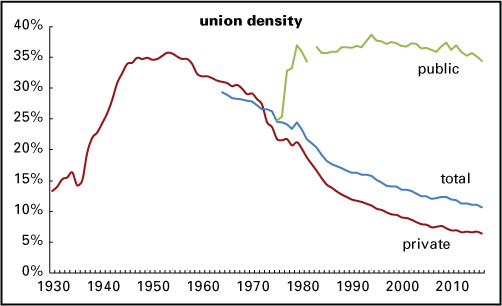
sources: 1930–1999, Barry T. Hirsch and David A. Macpherson; 2000–2016, BLS
Fresh audio product
Just added to my radio archive (date is link to show):
January 26, 2017 Asad Haider, author of this, on the problems of “white privilege” discourse • Lucinda Rosenfeld, author of the new novel Class, on race and class in the world of Brooklyn public schools
Federal employment is already frozen
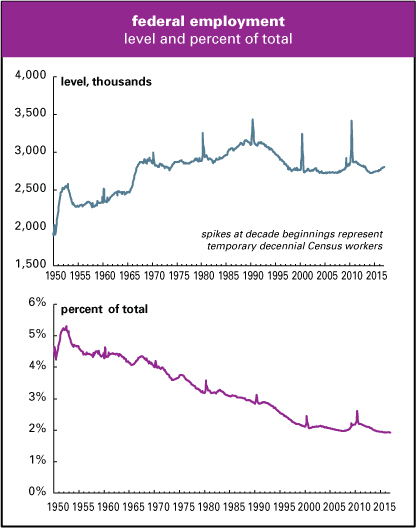
This morning, chief bloviator Donald Trump issued an executive order freezing federal hiring. Such a move probably appeals to those who think that the growth of government is “out of control.” That might be true in some senses—surveillance and the warfare state certainly qualify, but Trump only wants accelerate their growth. But one thing that doesn’t qualify is the subject of the order: federal employment.
Graphed below are federal employment in thousands and as a percentage of total employment, from the Bureau of Labor Statistics’ monthly survey of employers. The absolute number of federal employees at the end of 2016 (2.804 million) is actually slightly below what it was 20 years earlier (2.839 million) and 40 years earlier (2.850 million). During the Obama years, federal employment grew by a whopping 29,000 workers. Measured as a percentage of overall employment, the federal sector has been in a steady decline, from a peak of 5.3% in 1952 to 1.9% now. It was 2.1% when Obama took office.
No doubt this will matter little to the bloviators. But it’s true.
Fresh audio product
Just added to my radio archive (date is link to shows):
January 19, 2017 Yasha Levine on the politics of encryption • Elayne Tobin on celebrity (bibliography here)
Fresh audio product
Just added to my radio archive (dates are links to shows):
January 12, 2017 Nancy Fraser on “progressive neoliberalism,” feminism, Trump, and a way out of all this (see here, here, here, and here for more)
December 29, 2016 Zahra Billoo on Donald Trump, the Muslim registry, and how to resist it • Andrew Cockburn on Russophobia
December 22, 2016 Rania Khalek on Syria (new material) • George Joseph, author of this article, on Teach for America going global (rebroadcast of an interview that first ran in July)
On “working with” Julian Assange
A tendentious hack named Casey Michel slimes me in The Daily Beast for “maintain[ing] a professional relationship” with Julian Assange:
Another Nation staple, contributing editor Doug Henwood, has maintained a professional relationship with WikiLeaks founder Julian Assange, yet is apparently very tetchy about the collaboration, as I also discovered when I engaged him.
Henwood had planned to work with Assange on putting out a book about Hillary Clinton’s Goldman Sachs speeches – Henwood annotating, Assange writing the forward—transcripts of which were of course originally hacked by Russian intelligence and disseminated through WikiLeaks, at least according to 17 different U.S. intelligence agencies, two of which concluded that this was done with the express purpose of helping Trump get elected. When I brought up this pending project, as detailed both on the book publisher’s website and in multiple articles, Henwood called me a “fucking idiot.” (Henwood’s publisher, when contacted for this story, noted that Henwood was no longer affiliated with the endeavor, saying that he had now grown “weary of chronicling Hillary Clinton’s boundless political shortcomings.”)
It’s all here: the guiding hand of the evil Putin on behalf of Trump—confirmed by 17 intelligence agencies!—abetted by silly leftists who just don’t know they were being played. Except, you know, that all the leaked material was authentic, and revealed just how empty and cynical the Hillary Clinton campaign was. And that my “collaboration” with Assange was quite minimal. The full tweet in which I called Michel a fucking idiot:
You fucking idiot. I never worked with Assange. He was going to write a brief foreword to a book I never wrote. https://t.co/Yi2kOUg3hX
— Doug Henwood (@DougHenwood) December 29, 2016
I stand by my characterization.
This isn’t surprising, though. The center–left, now in the midst of a global crisis, is desperate. In the U.S., they’re trying to smear their leftist critics—who’ve been right all along about the bankruptcy of their worldview—as tools of Putin. Anything but looking in the mirror and confronting their failure. At this rate, there won’t be a Democratic party by the time of Chelsea Clinton’s 40th birthday.
PS: It’s “foreword,” not “forward.”


 LBO News from Doug Henwood