
NYC: more unequal than Brazil
The New York City Independent Budget Office is just out with an analysis (pdf )of income distribution in the city. It’s no surprise that it’s very unequal. The surprise is that it’s far more unequal than Brazil’s.
Full details are available in the letter—which was in response to a request from City Council member James Oddo—but here are some highlights:
- The poorest tenth (decile) of the city’s population has an average income of $988, and claim 0.1% of the city’s total income. Since the source of this data is tax returns, the very poor no doubt have hidden sources of income. Taxable income doesn’t include many social benefits, like public housing or Food Stamps. Even allowing for that, my god.
- The bottom half of the city’s income distribution has 9% of total income; the bottom 80%, 29%. Comparable figures for the U.S. are 19% for the bottom half and 44% for the bottom four-fifths.
- The richest 10% of New Yorkers have 58% of total income, and the richest 5%, 49%. The national average is 42% for the top 10%, and 32% for the top 5%
- And here’s where the action is, the proverbial 1%: it has 34% of total income, compared with 19% for the U.S. as a whole.
Some dollar amounts to make those percentages more concrete:
- The average income of the poorest 30% is $6,373, on a par with Egypt and about $1,200 below China’s (computed on a purchasing power parity basis, which attempts to adjust for price differences across countries).
- The city’s median income—the level at which half the population is richer and half is poorer—is $28,213. That’s roughly the level of Greece.
- The average income of the top 10% (a category that begins at $105,368) is $387,259.
- The average income of the top 1% (a category that begins at $493,439) is $2,247,515. These are the people that Andrew Cuomo was very reluctant to tax.
How does the city’s income distribution compare with that of Brazil, a country with a worldwide reputation for stunning inequality?
- The income of the top 20% of New Yorkers is 64 times that of the bottom 20%. In Brazil, that ratio is 17 times.
- The income of the top 10% of New Yorkers is 582 times that of the poorest 10%. In Brazil, that ratio is 35 times.
The New York and Brazilian comparisons are pretty rough, since the Brazilian figures are based on survey data reported by the World Bank. Rich people don’t answer surveys, so the incomes of rich Brazlians are probably way underestimated by that data. But if you look a little down the scale, to the second-richest quintile (20% slice) of Brazilians, they have incomes about 6 times the poorest quintile. In New York, the comparable ratio is 14 times.
So there you have it: New York City makes Brazil look almost like Sweden!
Credit union update
An update to my earlier skepticism about the transformative power of moving your money from a bank to a credit union (“Moving money (revisited)”).
The Federal Reserve is out with the flow of funds accounts for the third quarter, its periodic detailed view of the movements of money by instrument and sector. Credit union assets rose 0.9% (not adjusted for inflation) between the second and third quarters. Consumer credit (like credit cards and auto loans) extended to members rose 0.9%, and mortgages by 0.2%. Holdings of federal agency securities, meaning mortgage-backed securities like Ginnie Maes and Freddie Macs, were up almost 2%. Far greater increases were recorded in bank deposits, with checking accounts up by almost 50%, and savings accounts and the like up by almost 5%.
Over the last year, assets are up almost 5%, with mortgages flat and consumer credit down almost 1%. But holdings of Treasury bonds are up 95%, and of mortgage securities, 28%. Checking accounts are up 21%, and savings deposits, 9%.
Since the recession began at the end of 2007, credit union assets are up by 25%. About a quarter of that increase went to home mortgage loans—but over half (55%) went to mortgage-backed securities and 15% to savings deposits elsewhere.
In other words, the credit union is acting as a middle man for unknown banks, and to a lesser extent greasing the conventional mortgage markets. Lending to members is flat to mildly down.
Of course, all this predates the alleged CU boom inspired by Occupy Wall Street. But given their recent behavior, if the hard numbers bear out all the anecdotal supports of billions moved, then the lion’s share of the intake went to Ginnie Mae’s and bank deposits.
You may like the lower fees and more personal service of a credit union, but you’re not really doing anything dramatically political by banking there.
The boom in Food Stamps
One area where the languishing U.S. economy is breaking records these days is in need. One measure: more than one in seven Americans is now on Food Stamps, an all-time record.
Here’s a graph of the share of the U.S. population drawing benefits from what used to be called the Food Stamp program, and is now known as the Supplemental Nutrition Assistance Program, or SNAP, which is no doubt some bureaucrat’s idea of catchy.
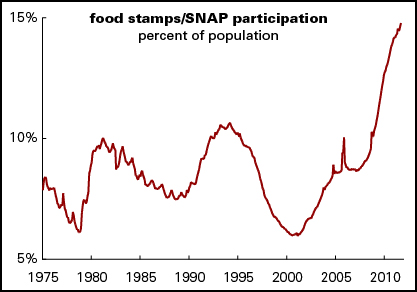
As of September, the latest month available (data here), over 46 million people, or almost 22 million households, were drawing SNAP benefits. That’s 14.8% of the population. That’s almost 5 points above the previous records. Note that the line kept rising during most of the weak Bush-era expansion, unlike the declines seen in the expansions of the 1980s and 1990s. There was a brief decline in 2006 and 2007, but that was quickly and savagely reversed with the onset of the Great Recession—and it’s continued to rise despite two-and-a-half years of official recovery.
Benefits are remarkably low. The average SNAP recipient gets $134 a month in assistance, which works out to $4.40 a day. That’s 10% less than the U.S. Department of Agriculture’s “thrifty” meal budget, and about half its “moderate” budget. (See here.) The thrifty plan is a descendant of the USDA’s old “emergency” standard (which was used to set the original poverty line). The Department claims that the current version (report here) meets most dietary minimums, though it falls short on a few.
For your average well-fed American, living on a daily ratio of less than $5 for food prepared at home would be hard to imagine. But without SNAP benefits, 46 million people would be in a state of anguish rather than just scraping by.
New radio product
Just uploaded to my radio archives:
December 3, 2011 Michael Dorsey, professor of environmental studies at Dartmouth, on the Durban climate summit • Bélen Fernández, author of The Imperial Messenger, on that egregious blowhard Thomas Friedman
November 26, 2011 Greg Graffin, lead singer of Bad Religion and author of Anarchy Evolution, on evolution and punk rock • Jeffrey Sachs, the economist formerly known as Dr Shock, on the mess that is the USA, a topic he explores in The Price of Civilization (see my review of his last book here)
Clarifying executive power
Peter Frase is right (“Are CEOs workers, and should we care?”) that talking only about ratios of CEO to worker pay ignores positions in the M-C-M’ circuit. The pay of CEOs and other top executives is almost entirely a return on capital. Perhaps there’s some reward to skilled labor there, but nothing approaching $11 million. Unlike workers, who live under harsh labor discipline, your average CEO is lightly supervised by a board. It’s a rare day when a bad CEO gets fired. The CEO class enjoys an esprit de corps; they sit on each other’s boards where they endorse large pay packages. Workers are barely allowed unions. And CEOs have enormous social power. They help run the government and the prestigious cultural institutions. They’re major players in the ruling class. I regret not having mentioned all this the first time around.
The CEO as humble worker
For some reason—pathological liberalism? being in the pay of the Washington Post?—Matthew Yglesias wants to blur the distinction between worker and boss. In a strange post at his new Slate playpen (“CEO Pay Drives Inequality”), Yglesias declares the old “rhetoric about ‘workers’ is really a legacy of an outdated time.” Why, you might ask, when class distinctions have a salience not only in fact but in discourse that they haven’t seen in many decades? Because unlike the rentiers of old, today’s rich work hard.
Really, Matt, the point isn’t how hard you work, it’s what you take home. In 2010, the average big-company CEO pulled down $11.4 million. If you assume these “well-compensated wage slaves,” in Yglesias’ phrase, put in 3,000 hours a year, that works out to $3,800 an hour. Last month, the average nonsupervisory worker in the U.S. earned $19.54 an hour, or 0.5% as much as the CEO. That average not-so-well-compensated wage slave would have to work 292 years to match the boss’s paycheck (assuming a more conventional 2,000 hour workyear).
Seth Ackerman, from whom I learned of Yglesias’ curious epiphany, offers up this quote from Andrew Carnegie for historical perspective:
Working people have my full sympathy, and I always extend a helping hand. I am a workingman and in my young days worked in a cotton mill and ran an engine. In all my life I suppose I have done more work than any employee I have ever had.
At least Carnegie gave us a few libraries to remember him by. You have to wonder what today’s crop of CEOs will bequeath us as their legacy.
David Brooks: making stuff up, again
Ah, the charmed life of a New York Times columnist: you can say anything you want, true or not.
David Brooks has a long history of, shall we say, careless use of evidence. Back in 2004, Sasha Issenberg did a masterful fact-checking of his earlier work: “Boo-Boos in Paradise.” Our serial fictioneer is at it again. In today’s column, he defends Germany’s stubborn insistence on austerity for the so-called PIIGS (Portugal, Ireland, Italy, Greece, and Spain) as a defense of “a simple moral formula: effort should lead to reward as often as possible,” an “ethos” this is being “undermined from all directions.” In the case of the eurocrisis, Germans “are being asked to bail out nations with vast public sectors.”
Good thing for Brooks that he didn’t offer any evidence of this claim, because the numbers don’t support his sermonizing. Here’s what the OECD says:
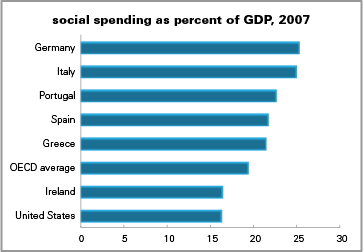
German social spending is almost 6 percentage points above the OECD average—and 9 points above the U.S. It’s higher than every one of the PIIGS. Ireland’s is almost 3 points below the average.
But, hey, it’s always fun to moralize!
Me on money in NYC
Me and (one hopes) a bunch of other people talking about money, tonight at 7, 60 Wall St atrium. More here: Money: What is it? | The Public School
From the archives: the small business myth
This is a piece I wrote years ago for the mostly right-wing Canadian paper The National Post. Though more than a decade old, it’s still mostly true and relevant. Sorry—no links to sources and such.
National Post (Canada)—September 23, 2000
SMALL IS NOT BEAUTIFUL Forget the romantic view of small business: for employees, big firms are less nasty places to work Doug Henwood
Everybody loves small business. Well, maybe Fortune 500 CEOs and the investment bankers who serve them don’t, but practically everyone else does. Across the political spectrum, it’s celebrated for its authenticity, pluck, and copious powers of job creation. On the right, the needs of small business are used to counter proposed regulations or minimum wage increases, as if the virtues of small business were self-evident. On parts of the left, small business is positioned as local and human-scaled, in contrast with globe-striding behemoths.
This is a mass infatuation badly in need of some fact-checking.
Small business creates jobs, yes, but it also destroys them in large numbers, since small firms go under so frequently.
Small business pays less, innovates less, and does more physical damage to nature and workers than the big guys.
You often hear it said that small business creates most new jobs. That’s a half-truth. Most people work for firms employing under 500 workers, the semi-official definition of a small business, so it’s not surprising that such firms should be responsible for the bulk of job growth. The real question is whether small business creates more than its share of new jobs. And there the answer is no.
Firms employing fewer than 500 people accounted for 78% of U.S. workers in 1980, 80% in 1990 and 80% in 1996 — in other words, the share was essentially unchanged over nearly two decades.
Some people might think that businesses with hundreds of employees aren’t so small, but the numbers for really small operations are quite underwhelming: firms employing fewer than 20 people accounted for 26% of workers in 1980, 26% in 1990 and 26% in 1996 (that repetition is no typo). If small firms, no matter how defined, were really the prodigious job machines they’re supposed to be (and if big firms were as relentlessly downsizing as the headlines would lead you to believe), then their share of total employment should have increased dramatically over the course of 16 years.
That underwhelming performance of really small business is worth a bit more attention because, despite these numbers, it’s still often claimed that that’s where all the real job action is. The claim is ultimately traceable to 1980s work by the consultant David Birch, who once famously said that 88% of the new U.S. jobs created in the first half of the 1980s were in firms employing fewer than 20 workers. That factoid was repeated by pundits and politicians, and has since made its way around the world. But it’s not true.
Mr. Birch came up with this nugget by playing with some computer tapes from the credit rating and business information firm Dun & Bradstreet. But a closer examination conducted some years later showed the D&B tapes to be full of errors, at odds not only with official unemployment insurance registration info, but even with the phone book. Firms were classed as being born and dying when they merely changed hands. And Mr. Birch’s methodology was pretty idiosyncratic, to put it kindly.
For example, firms that started in the very small category — fewer than 20 workers — were categorized for all time as staying there, even if they’d grown beyond the small category. Or, more wackily, if a firm with 600 employees had a bad year and canned 200 of them, this would show up as a gain of 400 jobs for the small business sector. Not that Mr. Birch ever fully disclosed his techniques, like most serious researchers would; he did, however, tell the Wall Street Journal in 1988 that his figures were “silly,” and that “I can change that number at will by changing the starting point or the interval. Anybody can make it come out any way they want.” Despite that confession, Mr. Birch is still taken seriously by the U.S. press.
More rigorous work than Mr. Birch’s shows that the job creation story is far from simple. For example, a detailed study of 40,000 U.S. manufacturing firms between 1972 and 1988 by Steven Davis, John Haltiwanger and Scott Schuh found that “large, mature plants and firms account for most newly created (and newly destroyed) jobs.”
Smaller employers generated plenty of jobs, but they also destroyed them in great quantities; new jobs were more likely to persist at larger employers than smaller. They concluded that “in a nutshell, net job creation…exhibits no strong or simple relationship to employer size.”
What about job quality? Let’s start with pay. A study by the U.S. Bureau of Labor Statistics (BLS) for 1995 showed little variation in pay for professionals and managers by establishment size, with small operations (those with fewer than 500 workers) paying 1% below the national average, and larger ones (1,000 workers or more) paying 2 to 3% above average.
At finer levels of occupational classification, the differences were occasionally a bit wider, but not profoundly so. Differentials widen, though, as you move down the status hierarchy. Data entry clerks in small establishments earned 7% below the national average, while those in large firms earned 20% above. Gaps for janitors were wider, and those for labourers were wider still. (Though this is mainly a story about private business, similar patterns were visible among government workers; in small jurisdictions, workers in “protective services”—like cops and prison guards—earned 18% below the national average, while those in large ones pulled in 11% more. This sheds new light on the passion in the United States for small government.)
These are pretty broad-brush patterns, and there may be simple reasons why pay increases with employer size. Maybe big firms have “better” workers—more educated, more experienced—and are more likely to be unionized. But there is now a large literature in economics showing that worker “quality”—I keep putting these things in quotes because, while conventional economists use phrases like this, I find it offensive to talk about people as if they were consumer durables ranked in some kind of buyers’ guide—explains some of the pay differential, it hardly explains all. In a phrase, size matters, and quite a lot—and there’s good evidence that the advantage has been growing over time.
Though the relation was first noted as early as 1911, a classic modern study in the field is a 1989 paper in the Journal of Political Economy by Charles Brown and James Medoff. They crunch data from several different surveys, and all tell pretty much the same story: while bigger firms (and bigger plants or offices within firms) do have “better” workers, that accounts for roughly half their pay advantage. Larger outfits pay more for similar work done by similar workers than do smaller ones. Using standard statistical techniques, this fact of economic life persists regardless of occupation, industrial sector, education, experience, geographical location, union status. The disparities remain whether workers are paid an hourly rate, a piece rate or a salary. Workers who move from small employers to large and presumably carry with them the same set of skills they had on their old job, generally get a significant raise (roughly equivalent to going from a nonunion job to a union one)—and the reverse is true as well.
As with pay, so with benefits. As of the mid-1990s, just 62% of full-time workers in small independent establishments (what the U.S. BLS calls plants and offices with fewer than 100 employees not owned by a larger entity) were covered by health insurance, compared with 77% of those working in larger operations; 42% of those in the small shops had a retirement plan of any kind, compared with 80% of those in larger ones. And as with pay and benefits, so with worker safety.
In a recent report for the International Labour Organization, U.S. economist Peter Dorman wrote that “size and risk are inversely correlated at all levels of scale.”
Most of what I’ve cited so far is based on U.S. data, but studies of other countries, including Britain, Japan, Germany and Canada, come up with pretty much the same results.
A 1998 paper by two Statistics Canada economists, Marie Drolet and René Morissette, shows that even after controlling for the usual factors—like worker education and experience, industry, occupation, and union status—large firms pay 15 to 20% more than small ones, a relation that has persisted over time. Pension coverage is at least four times higher in large firms. Despite the disadvantage in pay, workers in small firms are more likely to work more than five days a week. Small doesn’t seem so beautiful after all.
Why does size matter? Here the answers are a bit harder to come by, though there’s no shortage of suggestions. It’s nicer to work for small firms—fewer rules, less hierarchy—so they can get away with paying less (though large firms have lower quit rates than smaller ones). Large firms are more vulnerable to unionization, so they pay more to keep workers happy and organizers away (though the fact that the size effect prevails even among union workers calls this one into question).
Small firms have less market power, so profit margins are thinner and they’re under greater pressure to keep down costs. It’s harder to supervise a large group of workers, so higher pay is an incentive for them to behave without the boss keeping an eye on them every minute of the workday (though the persistence of the size effect even for workers paid piece rates, where the wage is a direct function of productivity, calls this into question).
Collecting a large number of workers under one roof——literally, in the case of a big plant or office, or figuratively in the case of a big business with lots of locations—results in all kinds of organizational and intellectual synergies that elude small firms, making them more efficient, innovative and profitable. Smaller firms have less snazzy capital equipment, duller managers and less sophisticated work structures, making them less efficient, innovative and profitable.
Workers in large firms may have “subtler virtues” (in Brown and Medoff’s charming phrase) that can’t be measured or statistically modeled, which might be responsible for the pay differential. As plausible as these explanations appear, economists have been unable to decide for sure whether they’re accurate or not (and the parenthetical remarks cast serious doubt on some of them).
I said at the beginning of this piece that small business often serves an ideological purpose. On the right, it’s deployed to resist any political impulses to regulate business or push up wages. That implicitly concedes that smaller firms are nastier to work for, but it’s also a bit devious, since McDonald’s probably would suffer at least as much from a minimum wage increase as Mom’s Burger Shack would. Here, small business becomes a virtuous stand-in for business as a whole, since small business probably has a better public image than the big, no matter how ill-deserved. Even if this is a devious move, it’s not much of a surprise.
What I find more surprising, and disturbing, is the tendency of some folks on the left to embrace small business with some passion. This is particularly true in the unfortunately named anti-globalization movement—as if internationalization itself were the problem rather than the way it’s carried out. Their anti-globalism is connected to a desire to “relocalize” economies, and with them to reorient production on a much smaller scale. These aims seem more motivated by nostalgia—and, in many cases, by a nostalgia for something that never existed—than any serious analysis.
Larger firms are also far more productive than smaller ones. Small-is-beautiful advocates rarely tell us how tiny enterprises would produce locomotives, computers or telephones; maybe they’d prefer to do away with these things and revive a hunter–gatherer society. But if that’s what they intend to do they should tell us.
And people who presumably care about workers should also rethink their passion for tininess: the experience of actually existing small businesses show that they’re not great employers, with poor pay, cheesier benefits and more dangerous workplaces. Bigger firms are easier to regulate, more open to public scrutiny, friendlier to affirmative action programs and more vulnerable to union organizing.
A progressive case for bigness is rare and unpopular these days, but somebody has to make it.
Doug Henwood is editor of the Left Business Observer newsletter, and author of the book Wall Street.
Introduction to Jeffrey Sachs
When I announced via Facebook that I had just recorded an interview with Jeffrey Sachs, and that I was rather soft on him, a little firestormlette ensued. Should I have given him a hard time, demanding penance for the harsh deflationary advice that he gave to Bolivia, Eastern Europe, and Russia, or should I let is slide because he’s doing pretty good stuff now. I went for the latter, but filed my reservations in the introduction to the interview. Here’s what I said. For more, see my review of his 2005 book.
My next guest is the economist Jeffrey Sachs. Sachs teaches at Columbia University, where he directs The Earth Institute, a multidisciplinary center that gathers together social and natural scientists and policy wonks to devise approaches to poverty, environmental degradation, and disease.
Sachs is a problematic guy. He rocketed to fame in the mid-1980s, when he helped engineer the shock therapy—a term he hates—that took Bolivia’s inflation from 20,000% to 0%, while leaving Bolivia a very poor country. As the 1980s turned into the 1990s, he advised governments in Eastern Europe and Russia on how to turn capitalist practically overnight. The changes caused enormous dislocation and impoverishment. Sachs denies any responsibility for those bad outcomes—in fact, when I interviewed him ten years ago, he blamed the Russians for not following his advice. Many people who worked with him at the time regarded him as an arrogant, know-it-all outsider who applied textbook economists to societies he didn’t understand.

But over the last 10 years, Sachs has changed. (He denies that he changed, but most outsiders think he did.) He has become more and more critical of economic orthodoxy, both in the poorer parts of the world and now increasingly in the U.S. As you will hear, he’s extremely critical of the oligarchy that’s run the U.S. into the ground—in terms not unfamiliar to listeners to this show. (For an in-depth look at Sachs’s evolution, see my review of his previous book.)
So what are we to make of this? Some of my friends and colleagues think that Sachs should do penance for his past before we applaud his current work; others think that acting as a high-profile critic of orthodoxy is penance in itself. I thought I’d lay out the dilemma before playing the interview. We report, you decide.
New radio product
Freshly posted to my radio archives:
November 19, 2011 Frances Fox Piven of the CUNY grad center—whose greatest hits are collected in Who’s Afraid of Frances Fox Piven?—on the history of social movements and Occupy Wall Street
Fleshing out the corporate person
This is my contribution to n+1’s OWS Gazette #2. You can download the PDF here. It’s full of terrific stuff.
There was a witticism circulating—it embarrasses me a bit to say—on Facebook recently that went something like: “I’ll believe that coporations are people when Texas executes one.” Though I’m no fan of capital punishment, but that was the best argument in favor of corporate personhood I’ve ever heard. Because while corporations have the rights of actual living people—more, maybe—they have none of the responsibilities. Corporations routinely get away with murder. Is the problem that they’re legally persons, or that they’re not consistently treated as such?
I first came across the critique of corporate personhood almost 20 years ago, when Richard Grossman and Frank Adams published their snazzy little pamphlet, Taking Care of Business: Citizenship and the Charter of Incorporation. (Snazzy as in nicely designed. The web version isn’t, alas.) At the time, I was struck by the legalism of the approach. Grossman and Adams showed little or no interest in the economic reasons for the corporate form—why, for example, industrial development made the sole proprietorships and small partnerships that dominated the pre-Civil War landscape so unwieldy and unstable.
Making complicated stuff requires organizational stability across time and space; a single capitalist, or even a small gaggle of capitalists, all very mortal, couldn’t run a transcontinental railroad that was expected to last decades. The late 19th century was a time of tremendous economic volatility, with wild booms and busts. Almost half of its last three decades were spent in depression. One reason was that small firms didn’t have the resilience to stand up to shocks. (Another was the absence of a central bank, about which see my contribution to the previous Gazette.) I recall meeting Grossman shortly after the pamphlet was published and bringing these issues up with him. He didn’t seem very interested in the economic arguments.
I’m getting similar feelings now that corporate personhood has exploded onto the scene—first in the wake of the Citizens United decision, and more recently with OWS. There’s a fixation on the legal status of the corporation at the expense of some other, more important things.
Back in a moment to the economic angle, but Citizens United deserves a few words on its own. Basically, the reasoning is this: corporations are people. Money is a form of speech. So restrictions on corporate political spending are unconsittutional restrictions on political speech.
Which is the more serious problem with that chain of reasoning? That corporations are people, or that money is a form of speech? I’m uncomfortable with the urge to treat the Koch brothers as the focus of evil in the modern world, to steal a phrase from Ronald Reagan, but they could spend tons of their personal money spreading their poison and the issue of corporate personhood wouldn’t figure at all. Rich people have a long history in this country of buying elections and politicians. They didn’t, and still don’t, need the dodge of corporate personhood to do that nasty work.
Back to the economic argument. Critiques of corporate personhood tend to blur into critiques of bigness as an evil in itself. There is a great nostalgia for some kind of soft-focus version of the old days when enterprises were small and local. But there’s no way that small, local enterprises could make computers or high-speed rail equipment. Those things require both size and durability, things that the corporate form allows. Who’d buy complex, long-lasting equipment from a small firm that could die with its proprietor the day after tomorrow? How could such a firm design and build a train that does 350 mph while consuming minimal energy?
Of course, there may be some opponents of corporate personhood who don’t want a society that builds computers and fast trains. If so, they should tell us that explicitly.
All this doesn’t mean that we have to make peace with the status quo, however. In one of his more optimistic moments, Marx declared the modern corporation, owned by outside shareholders and run by their hired hands, “the abolition of the capitalist mode of production within the capitalist mode of production itself, and hence a self-abolishing contradiction” (Capital, vol.3, chapter 27.) That is, there’s no reason why such an enterprise has to be run for the benefit of its shareholders, and not by and for its workers, neighbors, and customers. It is now, but it doesn’t have to be that way forever. Of course, getting there from here isn’t one of those self-evident truths, but it’s a very enticing prospect to think about.
That panel? I’m out.
I just sent this note to the organizers of Wednesday’s Platypus “Crisis of the Left” panel:
On reflection, I’ve decided to withdraw from Wednesday’s panel. I’ve had my reservations about the whole Platypus project for a long time, but in re-reading some of your material, which put words like “imperialism” and “antiwar” in scare quotes, those reservations deepened. But Chris Cutrone’s comment on Facebook that “Platypus aims more at ideological diversity in our events than race/gender/sexuality diversity” was the last straw. If you’re holding a panel on the crisis of the left, then it’d be far more useful and relevant to have a feminist and a smart identitarian in the mix than a vile character like Paul Berman and a party hack from a Maoist cult. I see no point in spending an evening on this. I’d much rather spend the time with my kid.
I’d like to thank Lou Proyect for reminding me of just how terrible the Platypoids can be. I’d recommend checking out his writeup of them. The pic of Chris Cutrone that Lou uses to illustrate the piece—this one

—reminds me of my old comrades in the Party of the Right. For more on that experience, see “I Was a Teen-Age Reactionary” and “Partying on the Right.”
So, no thanks. If anyone goes, I’d love a report!
New radio product
Just added to my radio archives (click on date to get right to link, or other links to get more info about guests):
November 12, 2011 Yanis Varoufakis on the latest developments in the Eurocrisis • Ramsey Kanaan, co-founder of PM Press, on the theory and practice of anarchism


 LBO News from Doug Henwood
Leave a Comment
Posted on November 26, 2011 by Doug Henwood
Radio commentary, November 26, 2011
eurocrisis infecting core
The European situation spun more deeply into crisis this week. Interest rates on 10-year Italian government bonds crossed the spooky 7% barrier, yielding 5 points more than comparable German bonds. A year ago, Italian bonds yielded 4.3%, less than 2 points above German rates. In the jargon of the markets, this blowout in Italian spreads is a sign of investor panic.
On paper, Italy shouldn’t be so bad off. Its budget is in decent shape, and Italians have plenty of domestic savings, more than enough to cover the government’s financing needs. (The joke is that Italians don’t pay taxes—they buy government bonds instead.) Sure, the Italian economy isn’t German in its mightiness, but in more normal circumstances, it would be able to continue to put one foot in front of another. But these are not normal circs, of course. Italy is the third-largest economy in the eurozone, the eighth-largest in the world—in other words, a major problem should it blow up, financially speaking. If capital flees Italy and it’s unable to service its debts, then the euro will certainly fall apart. That might not be unreasonable in the long term, but in the short, it would mean more turmoil and more recession. And if banks get scared and stop lending to each other, well, it’s 2008 all over again.
And, as I’m recording this, news came in that Belgium’s debt had just been downgraded by Standard & Poor’s, deepening the anxieties. Belgium is a heavily indebted, ethnically divided country that can’t put together a government, so the downgrade isn’t exactly a surprise—and it does remain at AA+—but the markdown underscores the fact that the crisis is moving from the periphery towards the core of Europe.
Further evidence that the crisis is moving towards the core is that Germany had a rocky bond auction earlier in the week—meaning weak demand for its debt. Though not a failure, it was unnerving that even the Teutonic core is shaking. The silver lining of this is that Germany might finally wake up to the fact that it needs to so some leadership and cobble together some sort of bailout—meaning orchestrated debt writeoffs with German financial assistance—or face total meltdown in the Old World.
good riddance, Supercommittee
Meanwhile, the U.S. deficit supercommission collapsed, unable to come up with anything. Dems were willing to cut Social Security and Medicare, but Republicans wouldn’t agree to tax increases. This is basically good news. It will keep austerity at bay for a little while longer. We do have to worry about the automatic spending cuts that this failure is supposed to trigger—though it’s hard to imagine Congress sitting back and letting those happen. But they would shield Social Security and Medicare and take a reasonable slice out of the Pentagon. That, plus the likely expiration of the Bush tax cuts, would yield a somewhat more progressive result than what this committee was likely to come up with.
But despite the groans of deficit hawks over the supercommittee’s failure, the bond market yawned on the news. In fact, because of the euro crisis, U.S. Treasury bonds now yield less than comparable German bonds. A month ago, the U.S. Treasury had to pay more than its German counterpart. If the so-called bond market vigilantes—remember them?—were really worried about fiscal ruin in the U.S., we’d be seeing our interest rates rise somewhere between gently and dramatically. But they’re not. Nervous capital is fleeing Europe—and not just the periphery, but apparently Germany too—and seeking refuge in Treasuries. So much for the U.S. = Greece scenario.
More on all this next week.
Share this: