Everybody hates data centers, and they don’t even create many jobs
The president, ignoring the polls that show data centers to be enormously unpopular across the political spectrum, is pushing them because he sees them as essential to “beating” China and also as great economic stimuli. As Politico put it, “The bright spot in construction is increasingly data centers, not the factories Trump promised through his push to reshore manufacturing.” Or “let Data Reign,” as he put it, with his unique capitalization practice. As one former administration official told the outlet, “Trump is married to data centers no matter what because it’s the only real job creator.” You might not be surprised to learn that this isn’t true.
Yes, the sector looks to be creating some jobs, but not in size. (See graph below.) For the year ending in June 2026 (the most recent month available), industrial construction overall—the building of factories, office buildings, and the like—grew by just 2,000. Nonresidential specialty trades, another subsector of the construction business, where data center electricians and the like are employed (along with many other specialists who do the finishing work, as opposed to the people who put up buildings), showed more robust growth, 78,000, but the subsector accounts for just 1.8% of total employment, little more than it did two years ago, and less than it did in 2001. In percentage terms, it’s doing better than total employment, but that’s a low bar lately (heavy line below).
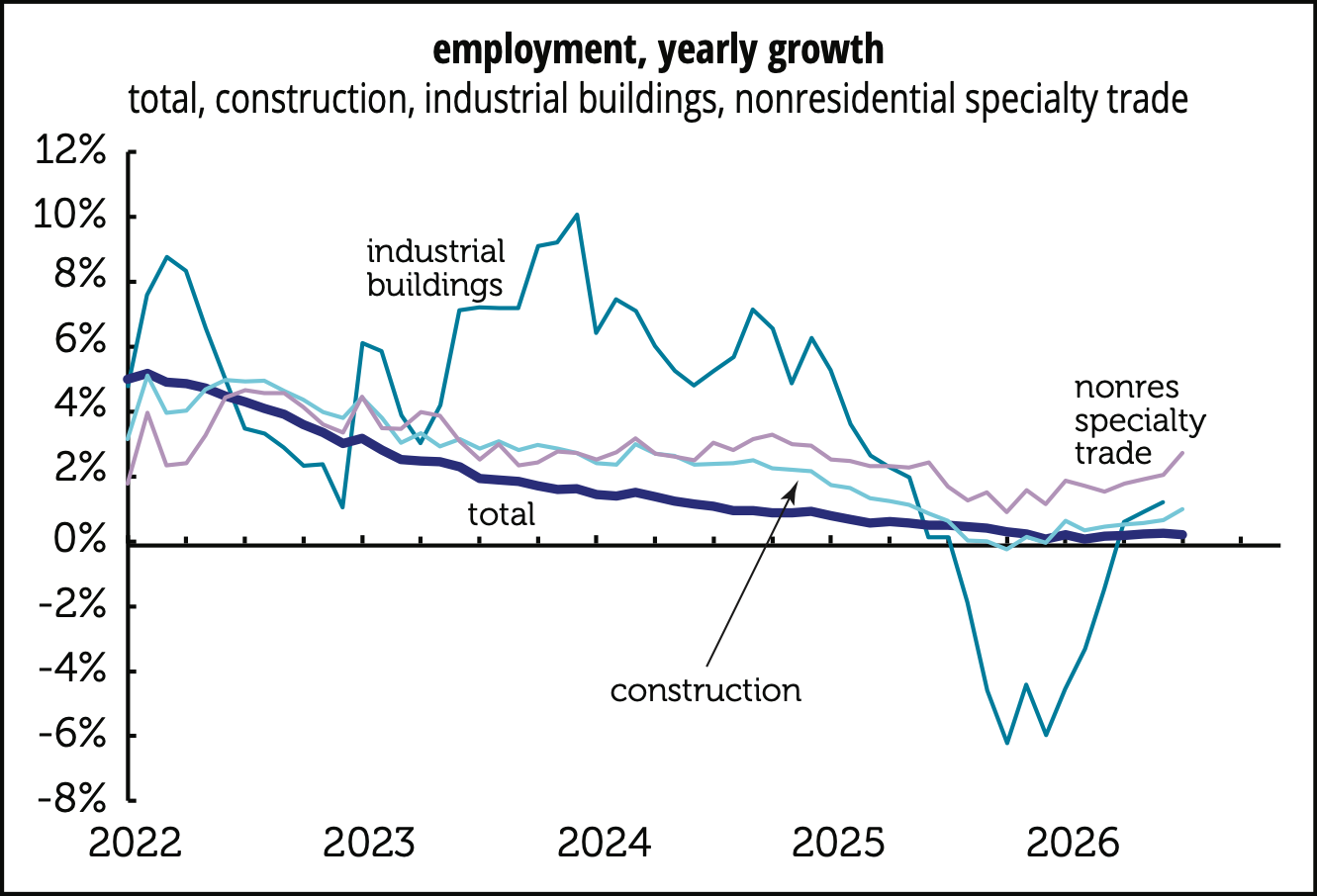
Nonresidential specialty trades look strong on the post-2022 graph above, but August’s yearly gain, 2.7%, is well below earlier peaks in 2006, 2015, 2019, and even 2023. As the longer-term graph below shows, it’s a volatile sector, subject to big swings between gains and losses, and its recent performance in a long-term context is hardly a barn burner.
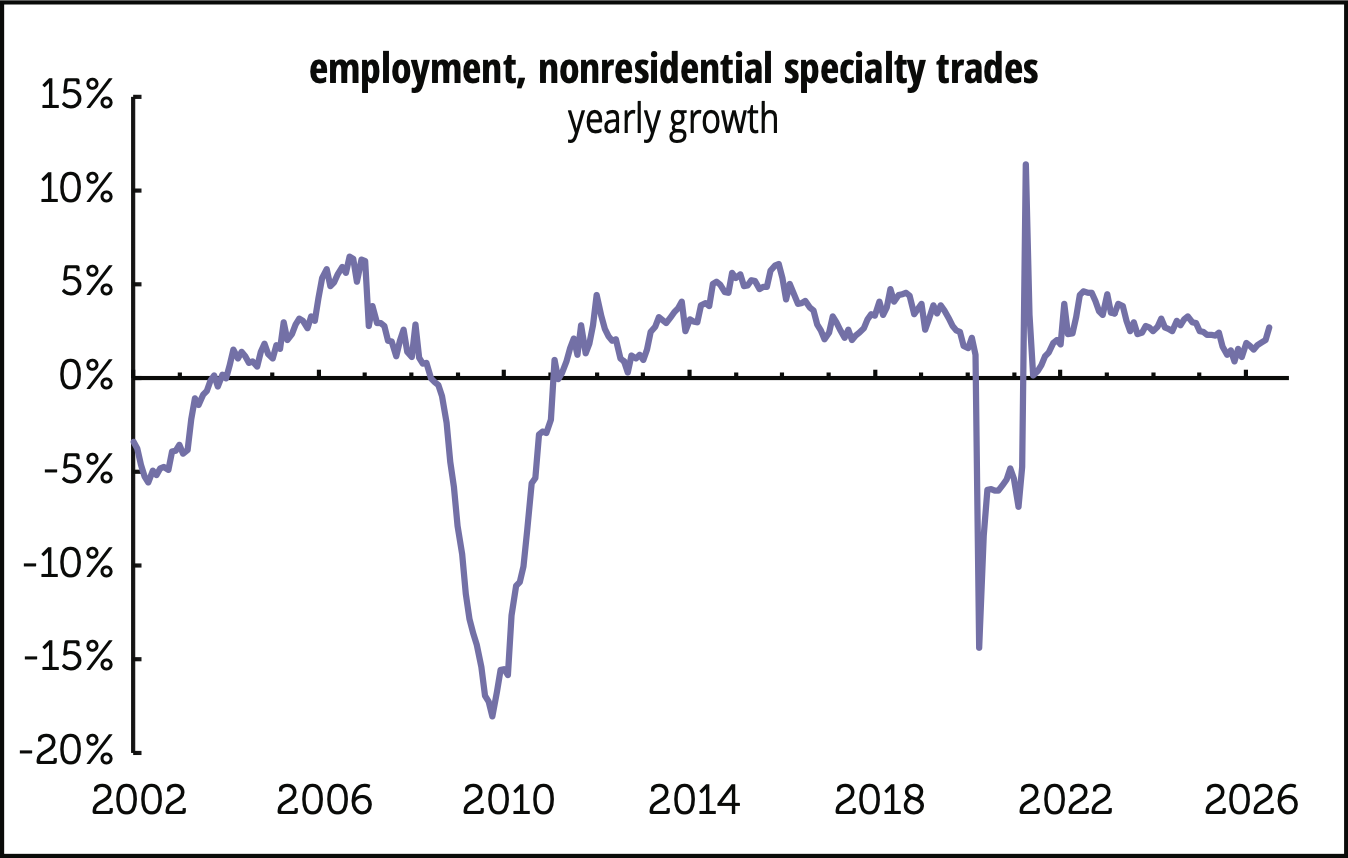
Sadly we don’t have any more detailed info on data center construction workers, but what we have is not inspiring.
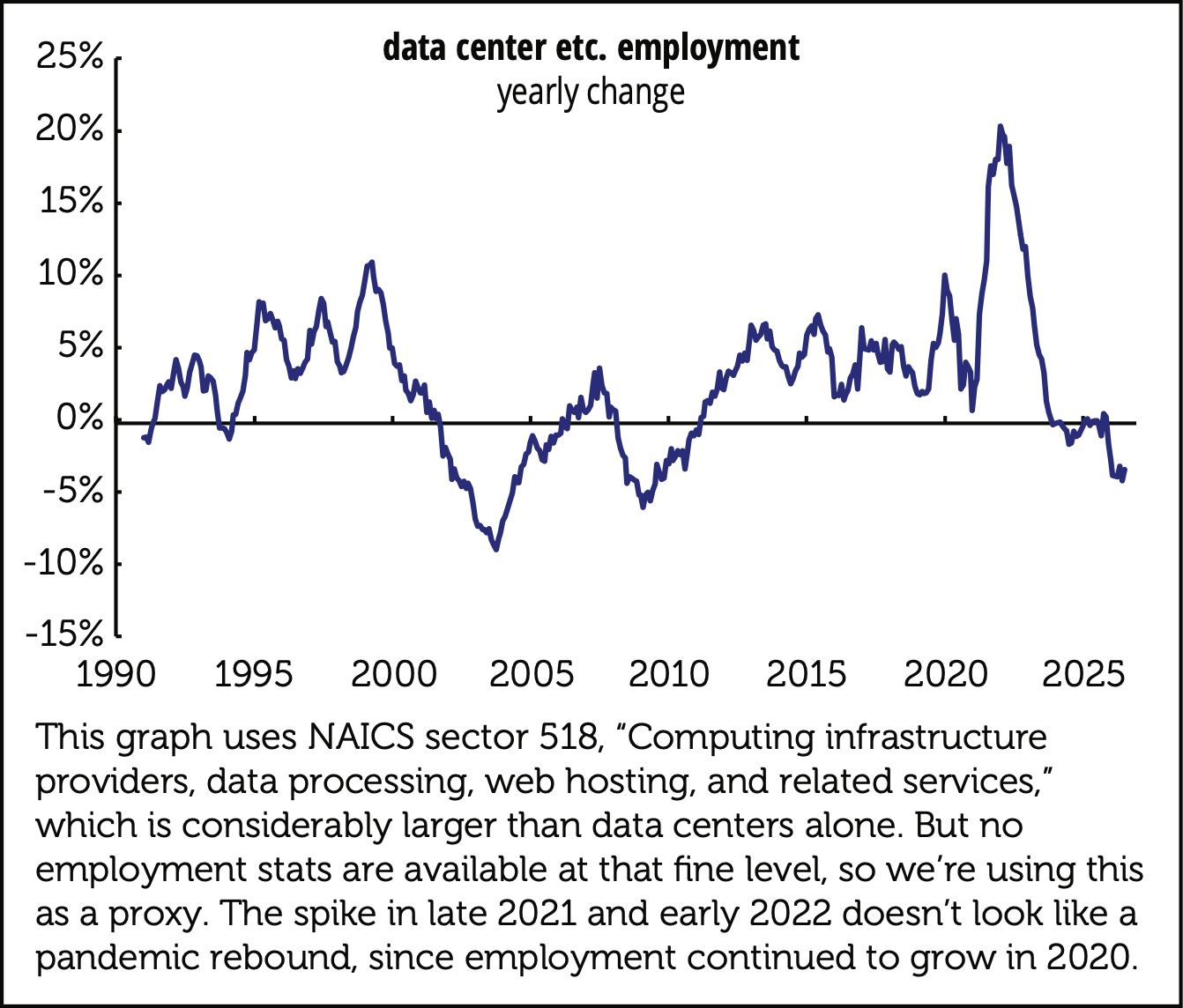
Given all the investment spending being thrown at the sector, accompanied by large servings of hype, data center employment is remarkably underwhelming. And it’s been shrinking, not growing, at least by our proxy. (See graph below. The BLS classification, Sector 518 in the North American Industrial Classification System, “Computing infrastructure providers, data processing, web hosting, and related services,” is considerably larger than data centers alone, but no finer detail is available. So, as with data center electricians, this is all the data we’ve got.) In July, employment in the sector was 464,000, down 17,000, or 3.4%. That level is the same as June 2022. Then, it was 0.31% of total employment; in July, it was 0.29%. While small, it’s a high-paying sector, with an average hourly wage of $59.72, 59% above the national average, but the sector’s advantage has barely changed in five years. You’d think allegedly surging demand would boost earnings, but not so far.
Despite the off-the-charts spending on data centers, it’s not like all that investment and the accompanying heavy seasonings of hype are likely to produce many new permanent jobs after the electricians et al. move on to their next construction sites. According to the Virginia Economic Development Partnership, in 2025 and so far in 2026, there were eight data center projects announced in the state (a major hotbed of data centerdom). Together, they accounted for $26.5 billion in investment, a sum that is supposed to create all of 305 jobs—which works out to $87 million per job. By contrast, a vegan skincare products factory to be built in Roanoke by the Austrian firm RINGANA is slated to produce 435 jobs for just $85 million in investment, or $195,402 per job.
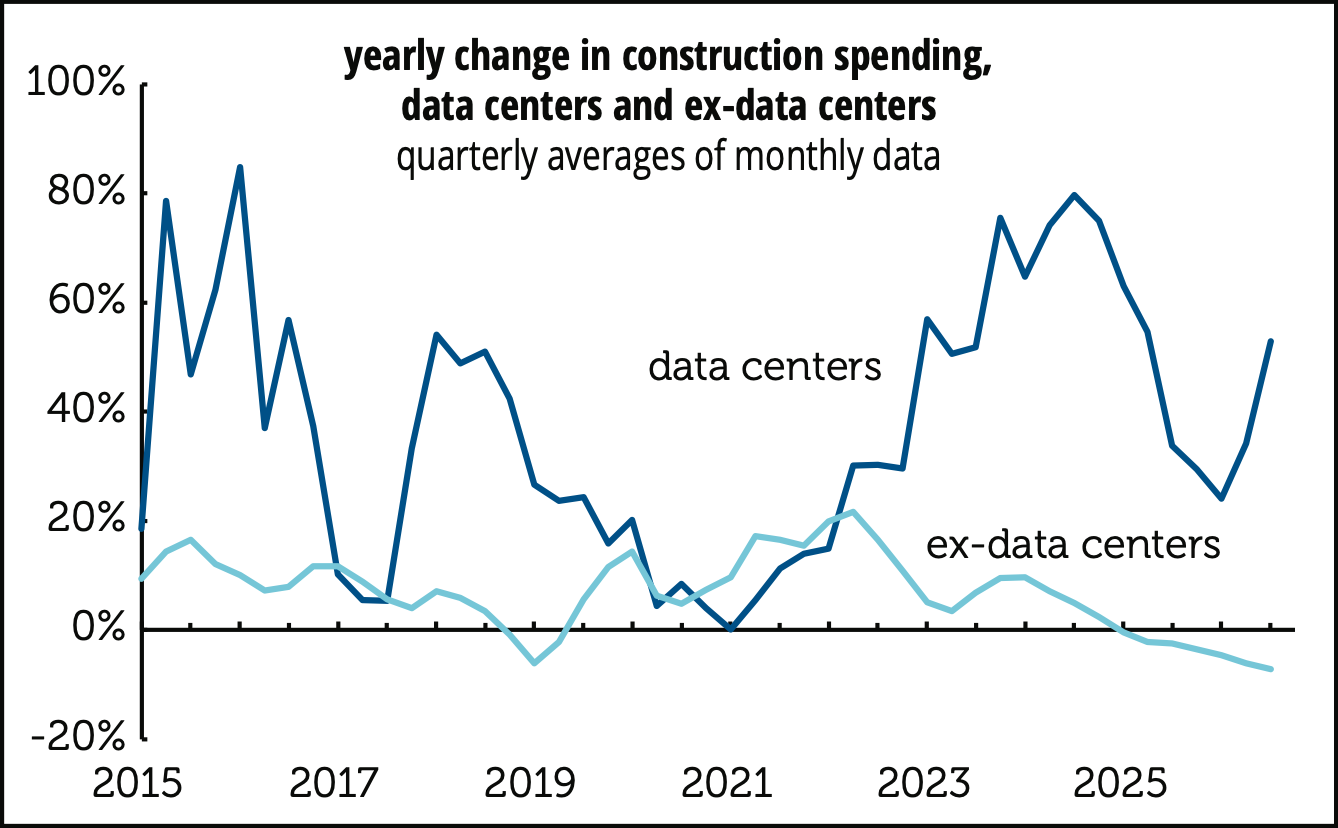
As the graph below shows, construction outside data centers is falling, down 7.1% for the year ending in July. (We used quarterly averages in the graph to smooth out the month-to-month volatility. Data for the third quarter of 2026 is July only.) But data centers are booming, if not quite as much as in 2024—up 53.8% between July 2025 and July 2026. Before we get carried away with the impressive magnitude of that number, though, a couple of reminders: it’s under 5% of total construction spending, and just 0.2% of GDP. And based on the Virginia relationships, July’s level of spending is likely to produce all of 864 permanent jobs, not quite twice as much as that vegan skin care operation—despite 884 times the expenditure.