
Liberal suffering
Dahlia Lithwick had a cri de coeur in Slate the other day, worrying that the faith she’d placed in Robert Mueller & Co. to deliver us from Trump may be misplaced. It might have been good news had this paradigmatic liberal realized that trusting prosecutors and the national security state to perform good works might not be such a great idea after all. But, no, Lithwick’s concern is that Trump and his cronies have no respect for the rule of law.
This faith in the rule of law is touching—though, as Corey Robin often points out, many of the worst things in American history, from Indian genocide and slavery through Jim Crow and the McCarthy purges and onto ICE raids on immigrants, with multiple imperial wars along the way, have all been entirely legal. But what’s most striking about Lithwick’s argument is its lack of a politics. There is a buried mention of taking to the streets, but it sits weirdly, like an undigested morsel, with the legalism–moralism of the rest of the essay, when it should be the screaming centerpiece.
Another recent cri from the liberal wing: Katha Pollitt’s reflections on her efforts at anger management in the year since Trump’s election. Actually, the piece reads more like anger nurturing, but let’s bracket that. Bracket too her thinly veiled attack on me and my wife, Liza Featherstone:
I hate everyone who thought there was no “real” difference between the candidates because Hillary was a neoliberal and a faux feminist and Trump was not so bad. I hate people who spent the whole election season bashing Hillary in books and articles and Facebook posts and tweets, and then painfully, reluctantly dragged themselves out to vote for her, as if their one little, last-minute ballot cancelled out all the discouraging and dissuading they’d spent six months inflicting on people.
Part of my argument against Hillary all along was that she was a terrible candidate and her supporters may come to regret their support for her. I was right, but having Trump as president does interfere with my self-satisfaction.
Pollitt has forgotten that, a bit over twenty years ago, she wrote a brutal review of HRC’s It Takes A Village, that includes these lines, which are a reminder of how sharp and witty a writer she once was:
The First Lady is thus a kind of center-liberal version of Arianna Huffington, who claims that “spirituality” and volunteerism can replace the welfare state. For H.R.C. the state itself becomes a kind of pilot project, full of innovation but short on cash, and ever on the lookout for spongers.
And these words, on the Bill Clinton’s signing of welfare reform:
Liberalism is the idea that the good people close to power can solve the problems of those beneath them in the social order. Its tools are studies and sermons and campaign contributions and press conferences. The trouble is, the political forces they call on are not interested anymore — and this is true not just in the United States. In country after country, social benefits are being slashed and the working class’s standard of living lowered, and the major parties, including the ones that call themselves Labor or Socialist or Democratic, accept this process as a given.
Now that she’s embraced the politics she scorned two decades ago, she’s left with little but anger. As with Lithwick’s column, there can be no thinking about the bankruptcy of center–left politics, which is collapsing worldwide—precisely because of its embrace of the attack on the working class’s standard of living. No anger can be directed at Hillary Clinton for running a dismal campaign—no acknowledgment of the disasters reported, from rather different perspectives, by Jonathan Allen and Amie Parnes in Shattered or Donna Brazile in Hacks. Allen and Parnes describe the dilemmas of HRC’s speechwriters, unable to come up with a rationale for her candidacy or distill her agenda into anything remotely inspiring. Brazile describes a campaign driven by data, also lacking in anything like a moving agenda—and one run largely by arrogant white men, all its pretenses of diversity to the contrary.
Lithwick and Pollitt can’t think about these things, because they would undermine their entire worldview, perfectly described by the 1996 Pollitt as the use of “studies and sermons and campaign contributions” by “good people close to power.” (In her anger screed, she takes herself to task for not having contributed enough and written more.) They’re not interested in organizing popular movements, because that’s messy and involves working with people “beneath them on the social order.” For example, the reproductive rights movement has relied almost exclusively on litigation and lobbying; unlike the Christian right, it’s done little to mobilize a large and passionate constituency. Nor are our progressive neoliberals interested in stepping on the toes of the powerful, even in pursuit of a modest social democratic agenda like that of the Sanders campaign. It’s telling that most of Pollitt’s hate is directed not at elites but the masses and the left. And it’s also telling that Lithwick is looking to prosecutors and cops to deliver her from Trump (and into the hands of Mike Pence) and not anything emerging from political agitation.
It’s looking like the GOP is going to get some sort of horrid tax bill passed. (There is the hurdle of the conference committee, which will have to resolve discrepancies between the House and Senate versions, so it’s not a done deal.) So far, the passivity of the Democratic leadership in the face of this abomination has been striking—it’s as if they expect it, in combination with Mueller and the Russia obsession (which is starting to look like a psychiatric disorder), will deliver them an effortless landslide in the 2018 elections. The contrast with the right’s tireless fervor is striking, but that fervor can be explained by the fact that they believe in something more potent than mild tweaks to the status quo.
It may not be impossible to beat something with nothing, but it’s pretty damn hard.
Fresh audio product
Just added to my radio archive (click on date for link):
November 30 2017 Corey Robin, whose The Reactionary Mind has just been issued in an updated edition, on the right from Burke to Trump
Fresh audio product
Just added to my radio archive (click on date for link):
November 23, 2017 Kristen Ghodsee, author of Red Hangover, on the traumas of post-Communist life in Eastern Europe
Fresh audio product
Just added to my radio archive (click on date for link):
November 9, 2017 Ryan Grim on the GOP and its issues • Rachel Sherman, author of Uneasy Street, on the consciousness of the rich
Fresh audio product
Just added to my radio archive (click data for link):
November 2, 2017 Kate Wagner of McMansion Hell on those abominable things • Donna Minkowitz, author of this article, reports on her visit to the genteel white supremacists of AmRen
Fresh audio product
Just added to my radio archives:
October 26, 2017 Benjamin Opratko on the rise of the far right in Austria (his Jacobin articles) • Steven Teles, author of The Captured Economy, launches a hybrid liberalitarian attack on rent-seeking
Fresh audio product
Just added to my radio archive (click on date for link):
October 19, 2017 Isabel Hilton on the Chinese Communist Party Congress • Alex Vitale, author of The End of Policing, on how to cure ourselves of the cop sickness
Haiti, Puerto Rico, and the Clintons
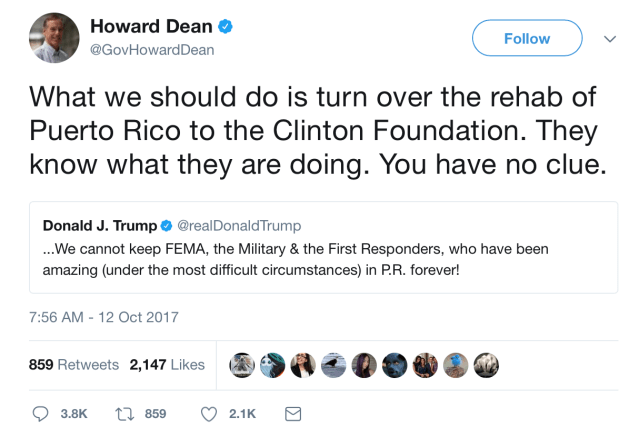
Howard Dean, who for a brief period long ago wasn’t a shill for the medical-industrial complex, recommended on Twitter that Trump turn over Puerto Rican rehab operations to the Clinton Foundation. Either Dean doesn’t know the first thing about how the Foundation operated in Haiti, an excellent case study on how they do disaster relief, or he’s more depraved than we realized. Their behavior, in collaboration with Hillary’s State Department, was appalling.
Here’s the Haiti section from my widely under-bought, under-read, and under-promoted book My Turn: Hillary Clinton Targets the Presidency. Formatting the footnotes for the web requires far more ambition than I have; I’ve attached the book pages as a PDF at the bottom. And apologies for not superscripting the footnotes; similar reason.
No review of Hillary’s diplomatic career would be complete without an examination of her work in Haiti. Bill and Hillary have a rich shared history with the country, one of the poorest in the world. (Its per capita annual income is equal to about twelve seconds of their standard speaking fee.)150 During Hillary’s Secretaryship, she and Bill were, as a Politico headline put it, “The King and Queen of Haiti.”151
Their history with Haiti began with a 1975 trip—a leg of an extended honeymoon—to Port-au-Prince that was financed by David Edwards, an old friend of Bill’s who was working for Citibank and who had some business to transact in the country. 152 In his memoir, Bill claimed that Edwards used his frequent-flyer miles to pay for the trip, but frequent-flyer programs didn’t begin until airline deregulation hit in 1979 and the junket looks like the first of many sponsored journeys to come. You have to hand it to them: their first date involved crossing a picket line, and their honeymoon was a banker-financed trip to the Caribbean.
On that first trip, the newlyweds and Edwards went to a voodoo ceremony conducted by a Sorbonne alum, during which a man walked across burning coals and a woman bit the head off a live chicken. In his strangely abrupt accounting of the sequence in his memoirs, Bill, fresh from an electoral defeat, emerged from the experience resolving to run for attorney general back in Arkansas, because of something the ceremony taught him about how “the Lord works in mysterious ways.”153
Many years later, early in his presidency, Bill engineered the return to office of Jean-Bertrand Aristide, who had been elected as president of Haiti in 1990 as a serious progressive reformer and was promptly overthrown in a coup. The army’s subsequent rule was predictably brutal, but the Bush administration was fine with the arrangement, since it saw eye-to-eye with the rapacious Haitian elite. Bill was troubled, however, and when he took office he began maneuvering for a restoration of Aristide. A UN resolution in 1994 authorized a U.S.-led military force to restore Aristide to office, earning Bill plaudits as a friend of democracy. But the restoration was conditional on the acceptance of an IMF-written austerity and privatization program, which largely eviscerated Aristide’s reformist agenda.154 You could consider this an early instance of the left wing of neoliberalism, with the Bush position representing its right. Either way you get rule by a moneyed elite, but the left variety is more attentive to optics.
On becoming Secretary of State, Hillary resolved to make Haiti a foreign policy priority. It was to be a prime example of a new development strategy that would, as Jonathan Katz put it in a detailed history of the couple’s relationship with the country, put “business at its center: Aid would be replaced by investment, the growth of which would in turn benefit the United States.”155
Promoting foreign investment often requires keeping wages low, which is precisely what Hillary’s State Department successfully helped engineer, as a series of WikiLeaks cables published by The Nation and Haïti Liberté revealed. When the Haitian parliament unanimously passed an increase in the minimum wage to $5 a day—an amount that Hillary earned in about 0.07 seconds at her standard speaking fee—U.S. business interests on the island mobilized. President René Préval, who had replaced Aristide, then engineered a two-tiered compromise minimum. The U.S. Embassy was not pleased, dismissing the president’s move as a “populist measure aimed at appealing to ‘the unemployed and underpaid masses.’”156 Rising to the defense of this brutal reasoning, Adam Davidson, host of NPR’s Planet Money—who portrayed himself in an interview with me as having grown up in a bohemian West Village culture, and who cultivates the image that he’s cooler than his econobeat would suggest—explained that to earn $5 a day, Haitians would simply have to develop the skills to perform complex tasks.157
The WikiLeaks cables also showed the U.S. State Department collaborating in 2009 with other Western Hemisphere ambassadors to push ahead with corrupt elections from which the country’s largest party, Aristide’s Fanmi Lavalas (FL), was excluded. The elections were delayed by the January 2010 earthquake. When they were eventually held, they were a disgrace, with fraud rampant, and a 23% turnout.158 Michel “Sweet Micky” Martelly, a singer and supporter of the second coup against Aristide (mounted in 2004), was proclaimed the winner by the Organization of American States, with Hillary Clinton presiding.
The cynicism around the election was perfectly captured in an email from Hillary’s longtime aide Cheryl Mills, who wrote this to the Port-au-Prince embassy staff on March 20, 2011, the night of the runoff that delivered Martelly his victory:
Nice job. Nice job all. You do great elections. And make us all look good. I am so very grateful for all you have done. Dinner on me in Haiti next trip. [And we can discuss how the counting is going! Just kidding. Kinda. :)]159
Evidently the counting was no straightforward affair; official results weren’t announced until a month later, on April 21. They were greeted with protests across the country. In an account of Hillary’s history with Haiti, New York Times reporter Yamiche Alicindor quoted Mills’ email, adding, with the paper’s characteristic patronizing tone, that “it has fed a suspicion among Haitians, if lacking in proof, that the United States rigged the election to install a puppet president.”160 Those Haitians will believe anything.
Soon after his selection, Martelly appointed Bill Clinton to an advisory board to encourage foreign investment in the country.161 There wasn’t a single election in Haiti for four years after Martelly took office; his rule was bloody, authoritarian, and corrupt.162 When, in August 2015, a vote for parliament was finally allowed, the campaign and balloting were full of violent disruptions, including firefights, several deaths, and vandalized polling stations. The turnout was a risible 15%.163 A presidential election, held in October 2015, featured 54 candidates for president. Martelly’s chosen successor, a previously obscure banana exporter, came in first amid widespread reports of massive fraud; run-off elections were scheduled for December but were postponed until April 2016. Martelly left office in February 2016 without a successor.164
On January 12, 2010, Haiti was hammered by a massive earthquake that killed at least 100,000, rendered a quarter-million homeless, and destroyed much of the country’s feeble infrastructure. Within days, Barack Obama appointed two of his predecessors, Bill Clinton and George H.W. Bush, as co-czars of the relief effort. On the same day of the appointment, Hillary flew in to meet with President Préval. Four days after the earthquake, she expressed confidence that Haiti would “come back even stronger and better in the future.”165 She said the goal was to “build back better.”166
From the first, the United States was to be the dominant force in Haiti relief and reconstruction—a point quickly made by the arrival of the 82nd Airborne. The Clintons, one as philanthropist and one as diplomat, were the dominant forces in the U.S. effort. As Jonathan Katz put it in Politico, “The hardest thing about evaluating the Clintons’ work in Haiti is that there is so much of it.” The Foundation spent scores of millions and raised much more, and the Secretary of State, aside from strong personal involvement, had the embassy and USAID through which to channel help. (Amusingly, both Bill’s brother, Roger, and Hillary’s brother Hugh tried to work their connections into business deals in Haiti, but only Roger succeeded.)167 But the enormous effort ended largely in failure. The rubble was cleared, and most people were moved out of refugee camps, but Haiti remains one of the most deeply poor parts of the world. Though there are doubtless some decent things that the Foundation sponsors in Haiti, the overwhelming effect of its interventions lies somewhere between disappointment and disaster.
The U.S. Agency for International Development (USAID), an independent agency that operates under the strategic guidance of the State Department, supervised a lot of the reconstruction efforts.168 USAID’s relief efforts relied heavily on private contractors, who performed poorly despite their high fees. Like any major business sector, the contractors formed a trade association, which hired a PR firm co-founded by the ubiquitous John Podesta.169
The marquee project of the Clinton-led reconstruction was the Caracol Industrial Park, which, as Hillary told a roomful of investors at its October 2012 opening, was the sort of thing that would mean “more than providing aid.” Rather, it was the kind of investment that “would help the Haitian people achieve their own dreams.”170 It follows a long-standing Clinton model, the public–private partnership of the sort that allows some to do well by doing some kind of good. So far, Caracol has fallen well short of its objectives, producing a mere 6,200 jobs, a tenth of the number promised initially.
The Caracol scheme was also responsible for some dreadful housing. USAID commissioned bids on a plan to build worker housing around Caracol. The scheme was described in an architectural peer review by Greg Higgins as “substandard, inadequate.” This was putting it mildly. The houses were tiny, crowded closely together, and lacked running water. They were without flush toilets; occupants would have to make do with a hole in the floor placed right next to the kitchen, which was to be outfitted with little more than a hot plate. The metal roofing proposed for the houses was incapable of standing up to the hurricanes that frequent the region, and could get as hot as 185°F in the summer. Drainage trenches were to run just a few feet from front doors and the sole access to running water for the entire complex was just one half-inch pipe. No provision was made for drainage in an area known to flood.171 Higgins sent his review to the State Department for investigation, but received little more than a “thank you.” According to Higgins, the execution of the plan was as bad as the design—he described the construction as “horrible.”172
The Clinton Foundation also promised to build “hurricane-proof…emergency shelters that can also serve as schools”—one of which was to be located in the coastal city of Léogâne. The buildings were to have electricity and plumbing. When Nation correspondents Isabel Macdonald and Isabeau Doucet visited the Léogâne site they found the project consisted of “twenty imported prefab trailers beset by a host of problems, from mold to sweltering heat to shoddy construction.” The units were made by Clayton Homes, a company owned by the billionaire Warren Buffett, a Foundation member and contributor to Hillary’s 2008 campaign whose reputation for decency seems inexplicable. Air samples from the Haitian trailers detected “worrying levels” of the same toxin found in the trailers deployed by FEMA in the wake of Hurricane Katrina, also manufactured by Clayton Holmes. A sixth-grader in one of the trailer schools reported recurring sickening headaches and vision problems. Similar stories came out of the Katrina trailers, but apparently no one at the Clinton Foundation heard them. And Clayton apparently hadn’t learned much either: the Haitian trailers were a fresh design, not a simple rehash of the New Orleans models.
The schools never got the plumbing—not even a latrine. According to a wind scientist quoted by Macdonald and Doucet, it seemed unlikely that trailers could be made hurricane-proof, an opinion seconded by a structural engineer who looked at them. When the mayor of Léogâne was told that the Clayton trailers were similar to those provided after Katrina, he said, “It would be humiliating to us, and we’ll take this as a black thing.”173
On another visit to Haiti, in September 2011, Greg Higgins tried to find the trailers, but learned that they’d been removed. The contractor who did the job showed him pictures on his cell phone, but wouldn’t say what happened to them.
Clinton interests did, however, succeed in building two new luxury hotels around Port-au-Prince. The Foundation put $2 million of its own money into the Royal Oasis hotel in a suburb of the capital; it’s today reported to be largely empty. And Bill was instrumental in getting a Marriott built in the center of the city, introducing its developer—his friend and major donor, the Irish telecoms mogul Denis O’Brien—to Marriott execs. The grand opening in February 2015 featured not only Bill, but Sean Penn as well.174 Both hotels provided some jobs, of course, but to the many Haitains without housing and short of food, the provision of luxury hotels must have seemed a secondary priority.
In another scheme to accommodate non-Haitians, Hillary’s State Department commissioned snazzy housing for the U.S. embassy staff in Port-au-Prince—LEED certified, with a pool and basketball and tennis courts. According to a write-up in the architectural trade press, “The inspiration for the design is derived from the local Haitian culture and is modeled after the Cubist forms of the ‘Bidonvilles’ (clustered houses hugging the hillside).”175 Bidon is French for “tin”; reflecting the corrugated metal from which the houses are often made. The term translates as “shanty towns.” The design is literally slumming.
The proposed budget was around $100 million for about 100 townhouse units, or about $1 million a unit. Meanwhile, as Higgins pointed out, the budget for building 900 houses for the displaced after the earthquake was around $25 million, about $28,000 a unit. Hillary said that Haiti would be a model for a new kind of economic development, but this doesn’t really look like one.176
Hillary’s people launched a big PR campaign to paint their disastrous Haitian operation as a success, and her emails show that she was very pleased with the results. “A new model of engagement with our own people,” she declared, urging her staff to press “Onward!” But as she was writing those celebratory words, daughter Chelsea, on a secret mission to the country, was blunt about the disaster: “the incompetence is mind numbing,” she reported. She noted that Haitians were doing a remarkable job of self-organization, with very limited resources—and the outsiders who were supposed to help weren’t up to the task. But instead of deferring to the locals—people about whom Bill constantly complained, according to Jonathan Katz— Chelsea urged her father to take even more direct control of the relief efforts: “The Office of Special Envoy—i.e., you Dad—needs authority over the UN and all its myriad parts…”
Of course, Bill and Hillary were already mostly in charge, and their priorities were ass-backward. Katz writes: “The new email tranche shows how quickly the construction of low-wage garment factories and prioritizing exports to the U.S. market came to the center of the U.S.-led response in Haiti.” They installed a former Liz Claiborne exec to accelerate the garment strategy.177 Haitians’ needs for food and housing would just have to wait.
For footnotes, click here
Fresh audio product
Just added to my radio archive (click on date for link):
October 12, 2017 Yanis Varoufakis on his new book, Adults in the Room, the story of his surreal negotiations with Greece’s creditors
Fresh audio product
Just added to my radio archive (click on date for link):
September 28, 2017 Lukas Hermsmeier on German politics after the election (and AfD’s breakthrough) • Margaret Corvid on the UK Labour Party conference
My review of HRC’s book
My review of Hillary’s What Happened has just been posted on Washington Babylon.
Fresh audio product
Just posted to my radio archive (click on date for link):
September 21, 2017 Michael Lighty of CNA/NNU on Republican efforts to repeal Obamacare, and on Sanders’ single-payer bill • Natasha Lennard, author of this article, on felony prosecution of Standing Rock protesters
Fresh audio product
Just added to my radio archive (click on date for link):
September 15, 2017 Andrew Cockburn, author of this article, on the Saudi involvement in 9/11 • Asad Haider, author of this article, on identity, Mark Lilla, and Ta-Nehisi Coates
Fresh audio product
Just posted to my radio archive (click on date for link):
September 7, 2017 Christo Sims, author of Disruptive Fixation, on school reform and techno-fetishism • Christian Parenti, author of this article, on climate change and the threat to coastal cities


