
Fresh audio product
Just added to my radio archive:
March 9, 2017 Yanis Varoufakis back on BtN for the first time in over two years! He discusses the interminable eurocrisis, austerity, Brexit, the nationalist international (Trump, Le Pen, etc.), and DiEM25, among other things. The full Varoufakis–Ali–et al. debate is here.
The version of this show that ran on KPFA was truncated because the station is fundraising. Please donate and keep this worthy enterprise going. If you do, please mention Behind the News!
Fresh audio product
Just added to my radio archive:
March 2, 2017 Mark Blyth on neoliberalism and global Trumpism (the Guardian/Observer article on Mercer and Cambridge Analytica he talks about is here)
The version of this show that ran on KPFA was truncated because the station is fundraising. Please donate and keep this worthy enterprise going. If you do, please mention Behind the News!
Fresh audio product
Just added to my radio archive:
February 23, 2017 Angela Nagle, author of this and the forthcoming Kill All Normies, on the alt-right • Laleh Khalili on Lt. Gen. H.R. McMaster, Trump’s new national security advisor
This show didn’t run on KPFA because the station is fundraising. Please donate and keep this worthy enterprise going. If you do, please mention Behind the News!
Fresh audio product
Just added to my radio archive:
February 16, 2017 Sean Guillory (author of this) on the rich history of Western Russophobia • Larry Bartels, co-author of Democracy for Realists, on the prospects for democracy with a detached, ill-informed electorate
Fresh audio product
Just added to my radio archive:
February 9, 2017 John Ackerman on Trump and Mexico • Art Goldhammer surveys the French political landscape as a presidential election approaches
Strikes?
The strike—labor’s most powerful weapon against capital, except maybe sabotage—is disappearing even more rapidly than unions, which is saying a lot. The Bureau of Labor Statistics reported this morning that there were 15 work stoppages involving 1,000 or more workers in 2016. That’s 1 above the average of the past five years, and down 96% from the average of the late 1940 and 1950s.
(Stoppages include both strikes and lockouts—the data series doesn’t distinguish between the two. The overwhelming majority are strikes. Notable exceptions in recent years have been in professional sports, but in a bizarrely hostile and destructive move, Long Island University locked out its employees in September 2016. From here on, I’m using the word “strike” rather than stoppage because it sounds far better with only a minor loss of accuracy.)
As the graph below shows, the collapse in the strike began in the late 1970s, and accelerated during the Reagan years, a time of massive union-busting. It’s continued to drift lower as it approaches the zero line. The last time we saw over 50 strikes was 1989. The last time we saw over 20 was 2008.
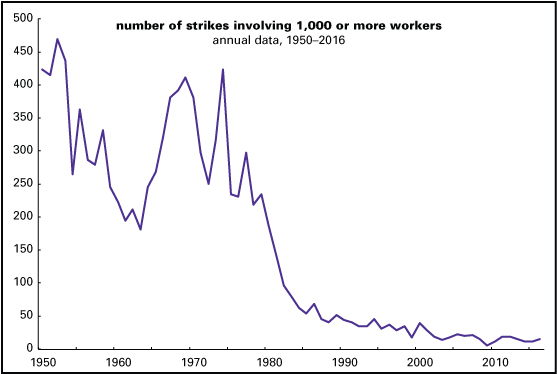
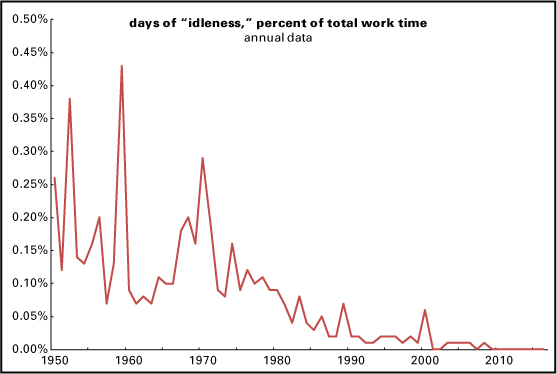
This decline is even more impressive—or distressing, if you prefer—when you consider that employment has more than tripled since 1950. That is brought out by another series from the BLS, days of “idleness” (a nicely Victorian word, as if striking was a leisure activity) as a percent of total working time. (See graph below.) Even at its peak in 1959, at a mere 0.43%, idleness was never that big a thing, but in every year since 2009, it’s been statistically indistinguishable from 0.
It’s wonderful to hear people talking lately about a general strike and a women’s strike. It would also be good to see some of the old-fashioned kind too. Employers hate them, because they disrupt production, raise wages, cut into profits, and remind them of the potential power of labor. When I wrote up the 2013 data in April 2014, I ended the post with this:
Jane McAlevey, the ace labor organizer and author of Raising Expectations (And Raising Hell)…says that her mentor, Jerry Brown of 1199 New England, used to say that workers should strike at least once every two years just to remind them of their power. Those were the days.
With the labor movement about to face an unprecedented attack by every level of Republican-dominated government (not that the Dems have been all that supportive, but this is going to be a whole new kind of hell), it’s alarming to see the working class so out of practice at deploying its most potent weapon.
Fresh audio product
Just added to my radio archive:
February 2, 2017 Mae Ngai and Avi Chomsky(separately) on Trump’s immigration decree • Joel Whitney, author of Finks, on the CIA, the cultural Cold War, and particularly the Paris Review
Unions continue to fade
After four years of relative stability, union membership resumed its decline in 2016, with overall and private sector membership at record lows, and public sector membership continuing to tumble. The glum story is told by the graph below.
Stats released Thursday by the Bureau of Labor Statistics (BLS) show that 10.7% of wage and salary workers were union members in 2016, down 0.4 point from 2015. Union density (the term of art) fell 0.3 point to 6.4% in the private sector, and 0.8 in the public, to 34.4%.
Overall density is the lowest ever, as is private sector density, which is less than half its 1930 level, before the great organizing drives of that decade got going. And thanks to the likes of Wisconsin Gov. Scott Walker, public sector density, down four of the last five years, is back to where it was almost 40 years ago.
Perhaps I’m old-fashioned, but I find it hard to imagine a better society without better unions to help lead the way. With AFL-CIO president Richard Trumka and a bunch of union presidents genuflecting towards Donald Trump, even as a federal assault on organized labor in the coming years looks inevitable, it looks like they’re helping legitimate a far worse one.
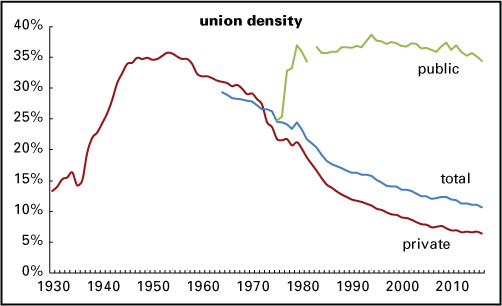
sources: 1930–1999, Barry T. Hirsch and David A. Macpherson; 2000–2016, BLS
Fresh audio product
Just added to my radio archive (date is link to show):
January 26, 2017 Asad Haider, author of this, on the problems of “white privilege” discourse • Lucinda Rosenfeld, author of the new novel Class, on race and class in the world of Brooklyn public schools
Federal employment is already frozen
This morning, chief bloviator Donald Trump issued an executive order freezing federal hiring. Such a move probably appeals to those who think that the growth of government is “out of control.” That might be true in some senses—surveillance and the warfare state certainly qualify, but Trump only wants accelerate their growth. But one thing that doesn’t qualify is the subject of the order: federal employment.
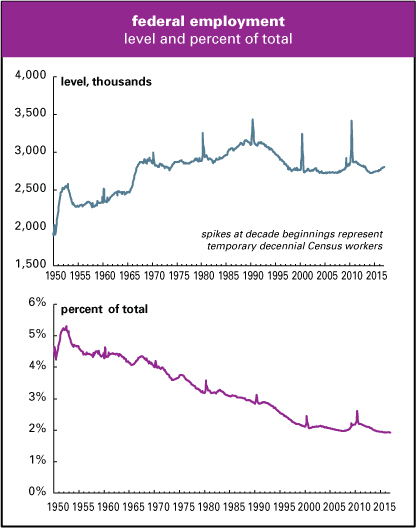
Graphed below are federal employment in thousands and as a percentage of total employment, from the Bureau of Labor Statistics’ monthly survey of employers. The absolute number of federal employees at the end of 2016 (2.804 million) is actually slightly below what it was 20 years earlier (2.839 million) and 40 years earlier (2.850 million). During the Obama years, federal employment grew by a whopping 29,000 workers. Measured as a percentage of overall employment, the federal sector has been in a steady decline, from a peak of 5.3% in 1952 to 1.9% now. It was 2.1% when Obama took office.
No doubt this will matter little to the bloviators. But it’s true.
Fresh audio product
Just added to my radio archive (date is link to shows):
January 19, 2017 Yasha Levine on the politics of encryption • Elayne Tobin on celebrity (bibliography here)
Fresh audio product
Just added to my radio archive (dates are links to shows):
January 12, 2017 Nancy Fraser on “progressive neoliberalism,” feminism, Trump, and a way out of all this (see here, here, here, and here for more)
December 29, 2016 Zahra Billoo on Donald Trump, the Muslim registry, and how to resist it • Andrew Cockburn on Russophobia
December 22, 2016 Rania Khalek on Syria (new material) • George Joseph, author of this article, on Teach for America going global (rebroadcast of an interview that first ran in July)
On “working with” Julian Assange
A tendentious hack named Casey Michel slimes me in The Daily Beast for “maintain[ing] a professional relationship” with Julian Assange:
Another Nation staple, contributing editor Doug Henwood, has maintained a professional relationship with WikiLeaks founder Julian Assange, yet is apparently very tetchy about the collaboration, as I also discovered when I engaged him.
Henwood had planned to work with Assange on putting out a book about Hillary Clinton’s Goldman Sachs speeches – Henwood annotating, Assange writing the forward—transcripts of which were of course originally hacked by Russian intelligence and disseminated through WikiLeaks, at least according to 17 different U.S. intelligence agencies, two of which concluded that this was done with the express purpose of helping Trump get elected. When I brought up this pending project, as detailed both on the book publisher’s website and in multiple articles, Henwood called me a “fucking idiot.” (Henwood’s publisher, when contacted for this story, noted that Henwood was no longer affiliated with the endeavor, saying that he had now grown “weary of chronicling Hillary Clinton’s boundless political shortcomings.”)
It’s all here: the guiding hand of the evil Putin on behalf of Trump—confirmed by 17 intelligence agencies!—abetted by silly leftists who just don’t know they were being played. Except, you know, that all the leaked material was authentic, and revealed just how empty and cynical the Hillary Clinton campaign was. And that my “collaboration” with Assange was quite minimal. The full tweet in which I called Michel a fucking idiot:
You fucking idiot. I never worked with Assange. He was going to write a brief foreword to a book I never wrote. https://t.co/Yi2kOUg3hX
— Doug Henwood (@DougHenwood) December 29, 2016
I stand by my characterization.
This isn’t surprising, though. The center–left, now in the midst of a global crisis, is desperate. In the U.S., they’re trying to smear their leftist critics—who’ve been right all along about the bankruptcy of their worldview—as tools of Putin. Anything but looking in the mirror and confronting their failure. At this rate, there won’t be a Democratic party by the time of Chelsea Clinton’s 40th birthday.
PS: It’s “foreword,” not “forward.”
Normalizing Trump
Matt Yglesias, whom I don’t always find myself agreeing with, argued yesterday that we shouldn’t listen to the advice not to “normalize” Donald Trump. He’s right.
Normalization, in this context, is typically cast as a form of complicity with Trump in which the highest possible premium is placed on maintaining a rigid state of alert and warning people that he is not just another politician whom you may or may not agree with on the issues.
Hillary Clinton ran her campaign on this. Her team rooted for Trump as nominee, because they were certain his outréness would make him easy to beat (a strategy endorsed by Jonathan Chait in one of the low points of his career, which is saying something). When they got their wish, they ran against Trump by separating him from “normal” Republicans, hoping to peel off moderate suburbanites grossed out by his odiousness. Those suburbanites voted for Trump.
Under cover of his Twitter provocations, Trump is skillfully assembling a horrifying cabinet of right-wing ghouls. He’s already appointed lots of skilled, well-connected people with dreadful agendas, starting with his vice president. They carry with them their party’s thinking on surveillance, torture, deportation, foreign policy, and making the lives of the poor more miserable (with many in the middle likely to suffer as collateral damage). With Congress under Republican control, it’s hard to see any obstacle to much of it being realized, and quickly.
Trump is forming a government that looks a lot like the one that Ted Cruz or a half-dozen other GOP candidates would have. It also looks to be the most plutocratic ever. As a Washington Post analysis pointed out, Commerce appointee Wilbur Ross’s net worth of $2.5 billion is ten times the combined value of George W. Bush’s first cabinet, deemed the cabinet of millionaires at the time. During what was probably an interview for the job of Agriculture Secretary, former Georgia Governor Sonny Purdue mentioned that he traded commodities. According to Purdue, Trump “lit up” at the news. He’s named the top lobbyist for Quicken Loans the head of his HUD transition team. It’s the direct injection of the business consciousness into governance without the slightest pretense of civilized mediation.
For a taste of the horrors on offer, take Medicaid. Trump has appointed Seema Verma, a consultant with close ties to VP Mike Pence, to head the Centers for Medicare and Medicaid Services. She helped Governor Pence get approval for the Indiana version

Seema Verma
of the Obamacare Medicaid expansion. Recipients can’t get full services unless they pay a premium. Failure to pay can result in getting kicked off the program for six months. Excessive use of the ER is subject to fines. As New York Times reporter Margot Sanger-Katz put it, using the paper’s house euphemizing style: “Ms. Verma’s appointment will probably usher in a new era of state flexibility in health care.” The word “flexibility” is almost always attached to policies that will hurt people.
Verma’s ideas for Medicaid, which she worked out with Pence, look quite similar to the House Republicans’ scheme to overhaul the program. They would convert the current federal Medicaid program into block grants to the states, and cut the amount spent over time. Over the next ten years, the Center for Budget and Policy Priorities estimates, Medicaid spending would be cut by 33% relative to what it would be were current law left untouched. One of the plan’s architects, House Budget Chair Tom Price, has been nominated for Health and Human Services by Trump. Unlike Medicare, which has a lot of friends in middle and even upper income brackets, Medicaid is an easy target because it’s for poor people, and Vermacaid could glide through Congress and into law.
This is far more important than Trump’s antics about flag burning. But being repeatedly shocked by them appears to be the standard reaction of liberal elites confronted by a Trump-style challenge. These “populist” figures are often bombastically clownish, deeply ignorant, and easily mocked. That treatment, however, further endears them to their base; the demagogue’s image as a man of the people, scorned (like them) by elites, is reinforced. It seems liberals always take the bait.
One can sympathize with them to some degree: given the configuration of forces in two, and probably soon three, branches of government, there’s no imaginable way to resist the Trump agenda. But you also have to wonder how vigorous their resistance will be through their favored organ, the Democratic party. In an excellent piece working out the parallels between Trump and Italy’s Silvio Berlusconi—another clownish, vulgar, pseudo-populist billionaire—Cinzia Arruzza notes the complicity of the center–left in promoting his agenda:
Mainstream Italian anti-Berlusconism has always suffered from a grave form of selective amnesia. The effects of six years of harsh austerity policies and virtually no significant social opposition have never been taken into consideration as a decisive causal factor in the consolidation of Berlusconi’s power. Nor has mainstream anti-Berlusconism ever shown any willingness to admit the substantial continuity between Berlusconi’s second government’s austerity policies and those of the center-left.
Berlusconi had three terms in office, May 1994–January 1995, June 2001–May 2006, and May 2008–November 2011. His time in office was one of frequent sexual and financial scandal. (A Wikipedia article on Berlusconi’s legal travails lists 22 completed trials, three ongoing proceedings, and two live investigations.) Despite the volatility of his time in office, however, he ended as one of the longest-serving prime ministers in Italian history.
The first term was brief because of a massive mobilization against his proposed pension reforms (i.e., cuts). A general strike in October 1994 brought three million into the streets of 90 cities; a month later, a million turned out in Rome. Berlusconi fell in a matter of months. He was succeeded by a series of technocratic and center–left regimes, which imposed even more severe pension cuts, austerity, and attacks on job security. (Over the next five years, fiscal policy was tightened by a savage 7% of GDP.) The unions and center–left went along with it all in the name of preventing a return of Berlusconi. Unemployment hovered between 10% and 11% for six years. Discontent brought Berlusconi back in the seventh.
Arruzza writes:
Mainstream anti-Berlusconism has indeed always preferred to deal in perceptions and impressions, rather than actual facts.
In the anti-Berlusconian imaginary, Berlusconi’s rule lasted twenty long years rather than nine, Berlusconi was a fascist, Italian democracy was in danger, the radical left helped consolidate Berlusconi’s power because of its sectarianism and unwillingness to cooperate with the center-left, Berlusconi’s voters were all racist and misogynistic uneducated losers, the country was constitutively right wing and that was the reason why even moderate Keynesian policies were impossible and why the Left needed to ally with all kinds of neoliberal technocrats, in the name of preventing Berlusconi’s return to power at all costs.
Does this sound familiar?
Very familiar. And it was, to use a favorite Trump word, a disaster.
Berlusconi was toppled the first time by popular action, something that unsettles mainstream liberals, who are terrified of the mob. Of course, a government can fall in a parliamentary system and not ours. But popular action is all we’ve got. It won’t be long before Chuck Schumer and Steve Mnuchin sit down and make some deals. Faced with profound defeat at every level of government, all the Dems seem able to do is re-elect Nancy Pelosi and dream of Cory Booker as their 2020 savior. Booker, who made his political debut at a lunch thrown by the right-wing Manhattan Institute, served on the same school reform board as Education Secretary-designate Betsy Devos, who wouldn’t mind destroying the public school system. These are dire times, and it’s hard to imagine resistance that doesn’t feature millions in the streets.


