
Complacency of the Dems
According to the Iowa Electronic Market (IEM), Hillary has an almost-90% chance of winning the Democratic nomination. Anything can happen of course, but I wouldn’t put much money on the other side of that bet.
So what about November? As I write this, the IEM has Trump ahead of Rubio by 45–37. That may underestimate Trump’s chances, as people have been doing all along. Leaving that aside for now, I think that Dems are way too overconfident that Hillary can beat Trump in November. People are pissed and don’t want another president from Goldman Sachs.
Trump is a master taunter. It was amazing to watch him destroy Jeb (who was none too mighty to start with). Trump knows how to get under people’s skin, and could break Hillary psychologically. She’s brittle and has many potential lines of cleavage, personal and political. She’s a nervous, error-prone campaigner who prefers sticking to a script (which is why she hasn’t had a press conference or an informal chat with reporters in over two months). Trump could go after her emails and the shady business of the Clinton Foundation in ways that Sanders never has, for fear of starring in a GOP ad in the fall.
Trump is relentlessly vicious. As he said in his South Carolina victory speech, “There’s nothing easy about running for president, I can tell you. It’s tough, it’s nasty, it’s mean, it’s vicious, it’s beautiful.” A debate between the two of them could be a remarkable spectacle, though it would hold glum prospects for humanity.
Fresh audio product
Just uploaded to my radio archive:
February 11, 2016 Tim Shorrock on panic over North Korea (Nation author page) • Robert Fatton on the mess in Haiti on the departure of Sweet Micky from the presidency
February 4, 2016 Matt Karp on the demographics of Sanders’ support (Jacobin author page) • Jasson Perez on the Black Youth Project 100 (full agenda here)
Blaming Hillary for Bill
Hillary apologists insist that one shouldn’t hold her responsible for abominations perpetrated by her husband, like the crime bill and the end of welfare. There’s some truth to that; she wasn’t the one with executive power. But she did praise both, extensively. Not only was there her calling ”welfare recipients “deadbeats”—there’s this chilling demand to bring “superpredator” youth “to heel.”
Holding her not responsible for Bill also undermines a good bit of the argument for her “experience”—that quality we’re supposed to admire but not examine. As I write in My Turn (pp. 22–25), she was very much Bill’s partner in the invention of the New Democrat ideology—tough on crime, hard on the poor, and happy to go to war. She co-wrote his keynote speech to the 1991 conference of the Democratic Leadership Conferece, the New Dems’ trade association. She ran his campaign to impugn the reputation of Arkansas teachers and their union, a strategy that would become neoliberal standard fare.
And then there’s this memory, reported by Gail Sheehy in Hillary’s Choice:
“[Hillary] decided [Bill] lacked the discipline and toughness,” observes Dick Morris. “He was too idealistic. His head was in the clouds. He wasn’t a pragmatist. He needed a tough-as-nails manager.” Morris saw Hillary make a bold choice: “In 1978, they were a two-career couple; in 1981, Hillary became the manager of their joint political career.”
Of course, Hillaryites will dismiss Morris as an unreliable source, even though he was in the Clintons’ employ for 20 years.
Sheehy supported Morris’ analysis with this quote from Hillary: “If I didn’t kick his ass every morning, he’d never amount to anything.” Their old friend Susan McDougal—who served 18 months in prison, 8 of them in solitary, for refusing to answer questions in the Whitewater investigation—glossed Hillary’s quote by saying, “You always knew that Hillary was about the business end of it, and Bill was about being loved.”
From the time more than 25 years ago when they first became famous, they advertised themselves as a two-fer. If you’re going to tout experience, you can’t be so selective about evaluating it.
Fresh audio product
Just uploaded to my radio archive:
January 28, 2016 Shane Bauer on his imprisonment in Iran and how Hillary Clinton made it worse (with some remarks about solitary in the U.S.) • Jennifer Mittelstadt, author of The Rise of the Military Welfare State, on that, and its privatization from Clinton onwards
Katha Pollitt, 1996 vs. 2016
[What a difference 20 years can make. Here’s the full text of column that Katha Pollitt wrote for The Nation as welfare was being repealed. It’s full of sharp criticism of the Clinton administration, the awfulness of the Dems, the treachery of lesser-evil politics, the limits of elite advocacy—and even a little mockery of Supreme Court fetishism. Today, Katha is a big fan of Hillary Clinton and has forgotten all this. Too bad, because this is very good.]
The Nation — August 26-September 2,1996
The Strange Death of Liberal America
Katha Pollitt
I woke up this morning to the voice of Linda Chavez-Thompson-first and only female, first and only minority executive vice president of the supposedly revitalized, supposedly reprogressified A.F.L.-C.I.O.-telling National Public Radio how thrilled she was with the Democratic Party platform. That’s the one that claims as a party triumph the Republican-authored welfare bill that will push countless children into poverty, deprive legal immigrants of a wide array of benefits and force millions of poor mothers into minimum- or even subminimum-wage jobs that do not, so far as we know, exist. “I love this platform!” announced Dennis Archer, Mayor of Detroit, where 67 percent of children are on public assistance. Did I mention that the platform this year omits the usual lip service to the ongoing urban crisis?
The passage of the welfare reform bill signifies more than the end of welfare as we know it; it signifies the end of a certain kind of liberalism too. Plenty of solid liberal Democrats voted for the act in the Senate: Russell Feingold, Bob Graham and Barbara Mikulski, who wasn’t even up for re-election. The House vote included yeas from Nita Lowey, who is co-chair of the Congressional Caucus for Women’s Issues; Elizabeth Furse; Jane Harmon; and Lynn Rivers. I’m ashamed to say I actually contributed to the campaigns of some of these people, through EMILY’S List and other supposedly feminist PACs. Maybe you did too.
“Sometimes you’re in a position in which you have to make a decision,” Representative Lowey told me. “The system is so broken,” Is it? Lowey asserted that 25 percent of those on welfare are third-generation recipients, a figure she revised later in our talk as 25 percent on welfare for ten years or more — “that’s two generations.” Maybe she was thinking of horses on welfare? (Actually, only about 6 percent of recipients have been on welfare continuously for that long, and only 9 percent grew up in house- holds that frequently received welfare.) It was unnerving but strangely enlightening to hear the head of the Congressional women’s caucus defending her vote with numbers plucked out of the air and Orwellian tributes to “the dignity of work,” while simultaneously professing herself “concerned” about the actual content of the bill — the free hand given to states with atrocious records, the cutoffs of legal immigrants, food stamp limits, etc. When the Democrats retake Congress we’ll be monitoring those things, she assured me. So now we’re supposed to vote for the Democrats so they can undo their own votes! Talk about triangulation.
Well, why single out Nita Lowey? Elizabeth Furse’s press aide wanted me to believe that Furse voted for the bill in order to protect Oregon’s “wonderful” programs. (Hello? There are forty-nine other states out here? Full of women you asked for campaign contributions?) The picture from the world of Beltway advocacy is not much brighter. Marian Wright Edelman threw away the last, best chance to organize popular resistance to punitive welfare reform and convened a giant Stand for Children that attracted 200,000 people to.. stand for children. A.F.S.C.M.E. finally decided to use its phone banks to organize callers to urge a White House veto — on the very day Clinton announced he would sign the bill.
NOW (which, to its credit, is refusing to endorse or support legislators who voted for the bill) is mounting a daily vigil at the White House with a coalition of progressive groups. Patricia Ireland and other NOW staffers are on a hunger strike.
All this is good, but why so little? Why so late? This bill has been moving toward passage for months, and welfare reform has been a major political issue for four years. It’s because these liberal groups are caught up in mainstream electoral politics, which in practice means clinging to Clinton and the Democratic Party, waiting and hoping and beseeching, working on the inside, faxing and phoning and producing yet another study or poll. Meanwhile they preach the gospel of the lesser of two evils, that ever-downward spiral that has brought us to this pass and that will doubtless end with liberals in hell organizing votes for Satan because Beelzebub would be even worse — think of the Supreme Court!
They really didn’t think he’d sign it, one welfare expert told me when I asked why protests were so lackluster as the bill moved toward passage. That was a miscalculation that goes way beyond the President’s character — it applies to a whole mode of political action. Liberalism is the idea that the good people close to power can solve the problems of those beneath them in the social order. Its tools are studies and sermons and campaign contributions and press conferences. The trouble is, the political forces they call on are not interested anymore — and this is true not just in the United States. In country after country, social benefits are being slashed and the working class’s standard of living lowered, and the major parties, including the ones that call themselves Labor or Socialist or Democratic, accept this process as a given. Of course, there will always be a few noble oddballs like Paul Wellstone, the only Democratic senator up for re-election who voted against the welfare bill. But the general direction of government in the age of globalized corporate power is clear.
Advocacy politics can’t turn this around, because advocacy is based on speaking for people rather than those people acting on their own behalf. Enormous demonstrations around the country, with strikes by S.E.I.U. and A.F.S.C.M.E., sit-downs in welfare offices and 100,000 homeless people camping out on the capital Mall might have affected the debate. Marian Wright Edelman issuing a press release no longer can. Indeed, the media didn’t even pick up the most recent one, eloquent as it was. The Women’s Committee of 100is suggesting that people return fundraising letters from party organizations, PACs and anti-welfare politicians with a note saying that you’re now sending your disposable dollars to social welfare organizations. Why not take it a step further and fund direct action? The National Union of the Homeless (246 Arch Street, Philadelphia, PA 19106) has great politics and no money. The Democratic Party cannot make the same claim.
Fresh audio product
Just added to my radio archive:
January 21, 2016 Adolph Reed on reparations to black Americans (a reaction to this Ta-Nehisi Coates piece; Reed’s 2000 piece on reparations is here) • Steffie Woolhandler of Physicians for a National Health Program on single-payer, Sanders, and Clinton Inc.’s lies
January 14, 2016 Isabel Hilton on the Chinese financial melodrama • Chris Maisano (author of this article) on legal challenges to public sector unions
January 7, 2016 Jason Williams reports from Oregon on the rancher occupation • Toby Jones on Saudi Arabia
Pollitt responds to my response
Katha Pollitt is out with a response to my response to her review of My Turn. Once again, it’s largely free of any engagement with Hillary Clinton’s political history. It’s a short book, but there is a healthy amount of detail about some rather terrible things she’s done over her four decades in public life. Katha touches briefly on a few, but the blows are merely glancing.
I understand why she might not want to engage, since those terrible things undermine some of Hillary’s supporters’ most cherished claims about her, notably all the work she’s done on behalf of women. She did give that famous and frequently quoted speech in Beijing in 1995 (not 1985, as Katha wrote) in which she said that “women’s rights are human rights.” I thoroughly agree that they are. But it’s not clear how Hillary put that assertion into actual practice.
Hillary’s material actions have often been decidedly less woman-friendly, starting with the war on teachers—disproportionately black women—she conducted in Arkansas; running through her service on the board of Walmart, a notoriously sexist operation, about which she said nothing; and continuing through her support of welfare reform, an abomination that deserves more than a grudging sentence of concession for having driven millions of women and children into poverty. (She called welfare recipients “deadbeats,” for God’s sake. See here for that and several other luscious quotes on the topic.) And Haitian garment workers, mostly women, might not feel so warm towards her State Department’s opposition to an increase in that country’s minimum wage, which a U.S. Embassy official denounced as “a populist measure aimed at appealing to ‘the unemployed and underpaid masses.’” That quote, by the way, comes from Katha’s magazine, The Nation.
Much has been made of Hillary’s work for women while Secretary of State. I don’t doubt that Hillary meant to do something, but just what did she do?
Before considering that, it’s essential to point out that she was probably the most bellicose member of Obama’s cabinet, and war is notoriously bad for women. And she’s continued in that mode since leaving Foggy Bottom, waving her saber at Syria and Iran. Hasn’t feminism historically been characterized by a significant pacifist strain?
That rather large matter aside, just what did Hillary do to “elevat[e] women and girls as Secretary of State,” as Katha puts it? There’s a rather sympathetic book—so sympathetic that the foreword is written by someone who declares a twenty-plus-year friendship with Hillary—on the topic by Valerie Hudson and Patricia Leidl, The Hillary Doctrine: Sex & American Foreign Policy, which is rather long on citing directives and rather short on citing accomplishments.
On the accomplishments front, Hudson and Leidl quote Peter Van Buren, a career foreign service officer who ran a provincial reconstruction team (PRT) in Iraq. They were told to “do women’s programming.” What did that mean? Van Buren recalls:
We were told, “Do women’s stuff!” But we were not really given any guidance…. My PRT stumbled upon “widows”—we were going to “help widows….” Okay, what were we going to do for widows…? We already had a beekeeping operation in place, and so we said we’d limit it to widows, which is how our “Bees for Widows” program was born. It was hard to find widows, because we had no access to society because we weren’t trusted. So individuals emerged who could “provide widows.” Widow brokers! We filled up our project, and sent photos back to the embassy of hijab’d women doing things…. We got very creative in telling these stories, so for example about the beekeeping, we’d say something like, “This empowered the women and helped change attitudes so that they will participate in the democratic process.” The embassy really liked these…. I find it difficult to cite any way that we helped women….
In Iraq, two large things bumped—Clinton’s sincere desires to help women and Iraqi conservative culture. Neither gave ground. And what was between them—the embassy—wanted Clinton to be happy and feel her goals were being accomplished. But there was incredible turnover and so no coherent plan was possible. My boss changed three times in twelve months. Washington, D.C., has a short attention span. Clinton’s in Burma, then she’s in China. There’s no time to stop and say, is it really happening here? … She didn’t know, but maybe she didn’t care to know. Secretaries of state can’t proclaim failure.
But their publicists are free to proclaim success.
To be fair to Hillary—see, I can do it! I can! I can!—she was up against a lot: a stubborn, mostly male bureaucracy working in often deeply sexist societies. But please don’t claim triumphs where there were very few. There may be “no time to stop and say, is it really happening here?”—curiously, people who praise Hillary’s tenure at State cite the million miles she traveled as an achievement—but there’s also no incentive to do so if you’re more concerned with PR than reality.
A couple of other points:
“What Doug gives us is so partial—he mentions every negative (even her supposed breaking of a lamp in a fight with Bill)—he turns her into a cartoon.” Why does Katha think that I find her throwing a lamp at Bill is all that negative? She’d recently learned of his Oval Office blowjob and was rightly pissed off at him for putting his presidency at risk and humiliating his family. And why a cartoon? It’s all true, and fully documented.
“If he’s going to attack her for botching healthcare reform, Doug should at least have mentioned her role in establishing the SCHIP program, which gave healthcare to millions of low-income children.” Hillary’s role in establishing SCHIP is debated. The measure was sponsored by Ted Kennedy (D-Mass.) and Orrin Hatch (R-Utah), and they did most of the work getting it enacted, but Hillary reportedly lobbied her husband to support it. The best summary may be from former New York Times reporter and Kennedy biographer Adam Clymer, who said: “Kennedy and Hatch deserve most of the credit, but Hillary helped.” Ok, partial credit given. And while it’s nothing but good that poor kids got health coverage almost 20 years ago, I’d rather that Hillary (and Chelsea) stop lying now about Sanders’ single-payer plan, claiming, surreally, that he’d take health insurance away from people who now have it, and sounding like Paul Ryan with their accusation of him being a budget-buster.
“Her excellent record on reproductive rights.” Yes, she can be very good on reproductive rights. But it’s not an unblemished record. Whether it’s her inner moralist emerging, or just her triangulating cynic, she’s conceded too much to the Christian right. Her repeated statement that abortion should be “safe, legal, and rare” participates in stigmatizing abortion. Abortion should be safe, legal, and offered whenever a pregnant woman wants it. In a 2005 speech to a reproductive rights rally, she said that abortion is “sad, even tragic choice to many, many women.” Many women may feel that way, but it doesn’t help for a reproductive rights advocate to frame it like that. And, according to a New York Times account of the event, after a defense of Roe v. Wade, “she quickly shifted gears, offering warm words to opponents of legalized abortion and praising the influence of ‘religious and moral values’ on delaying teenage girls from becoming sexually active.” That is pernicious nonsense.
“Without her marriage—which Doug cites as a black mark against her—she surely would not be the first woman ever to make a serious run for the White House.” I’d like to know where I cite her marriage as a black mark against her. On the contrary, I repeatedly characterize their relationship as a partnership from the first, and write on p. 101, “[T]heir skills are powerfully complementary; neither would have gotten this far alone.”
“Perhaps he can’t see these good things she’s done, because they’re good for women.” The antecedents of “these good things” are “SCHIP, her excellent record on reproductive rights, on women’s rights, her elevation of women and girls as secretary of state, her speech at the 1985 UN conference on Women in Beijing.” I’ve dealt with most of those above; there’s less there there than Katha & Co. like to say. (And the beneficiaries of SCHIP are mostly children, not women.) But the last part is a cheap shot. As I wrote in My Turn (p. xiv): “The side of feminism I’ve studied and admired for decades has been about moving towards that ideal [of a more peaceful, more egalitarian society], and not merely placing women into high places while leaving the overall hierarchy of power largely unchanged. It’s distressing to see feminism pressed into service to promote the career of a thoroughly orthodox politician—and the charge of sexism used to deflect critiques of her.”
But it’s looking more and more like that dishonest charge of sexism is the main defensive weapon Hillaryites have left. Although Katha touts Hillary’s alleged electability as one of her major virtues, she’s looking less mighty on that score with each passing day. Lots of people just don’t like her, and not all of them for sexist reasons. The email and Clinton Foundation money problems could explode disastrously any day. In other words, she’s extremely vulnerable.
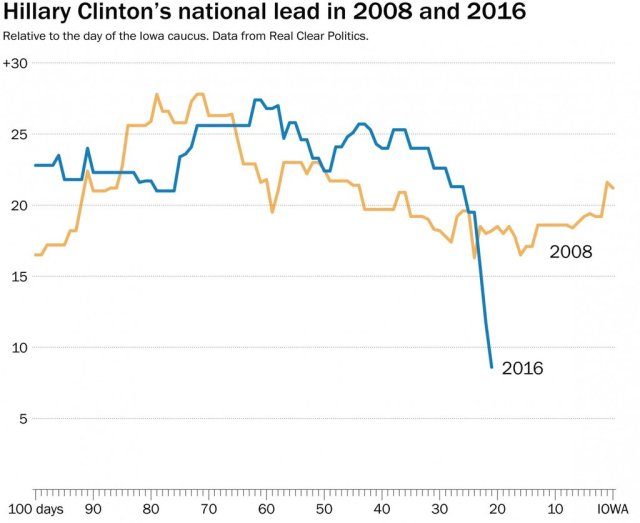
The graph below, which the Washington Post ran yesterday, has to strike fear into the hearts of Hillary supporters everywhere: her lead has been evaporating at a faster rate than it did in 2008. Of course that could change as the primary season begins, but the vulnerabilities will remain even if she wins the nomination. It’s not good for those (rightly) terrified of a President Trump or Cruz to deny those vulnerabilities.
SOTU for 9th graders
Back in 2013, I old-fartishly complained about the declining complexity of State of the Union Addresses:
Obama is a highly literate and thoughtful guy, yet this speech adhered to the depressingly low standards of American public discourse. It was written at a 10th grade level, slightly below the 11th grade level of his 2009 speech, and even more below the 12th grade level of Clinton’s 1993 state of the union. At least it was above George W’s 9th grade level speech in 2001. (See here for the texts of all State of the Union addresses; see here for the grade level analyzer.) Remember, 87% of Americans over the age of 25 have a high school diploma or more, and over 30% have college degrees (Census source), so the president isn’t addressing a nation of dropouts.
How we’ve come down in our expectations. As recently as 1961, when only 41% of Americans had completed high school, John F. Kennedy’s address was at a reading level associated with a year of college. Back in 1934, a time when fewer than 20% had completed high school, FDR’s first state of the union was at a level associated with three years of college. In 1861, when 20% of the population was illiterate, Lincoln’s first State of the Union (which admittedly was written and not spoken) was composed at a level comparable to a college graduate’s.
And what about Obama’s last night? Down to a 9th-grade level (9.4 to be exact)—back to W territory. God bless America.
Katha Pollitt on My Turn
Katha Pollitt reviews My Turn in the January 25 issue of The Nation. I suppose it’s undignified for an author to take issue with a reviewer, but I’m confident that I can transcend such petty concerns.
I should say right away that Katha is a friend; not only am I very fond of her personally, I’ve admired her writing (both prose and poetry) for more years than either of us would probably like to count. But she got some things wrong, which I will enumerate politely.
It’s funny how often defenses of Hillary Clinton begin with confessing a soft spot for Bernie Sanders. But this rhetorical move is always a prelude to a dismissal: while he may have sentimental appeal, he just not a serious candidate. (“Businessmen are serious. Movie/producers are serious. Everybody’s serious but me.”) And this review is no exception. Why isn’t he serious? He’s upended the Democratic race and forced Clinton into a temporary, primary-season populism that no doubt will be junked come the general, should she win the nomination. (We already see signs of that in her accusing Sanders of being some sort of tax-and-spend fanatic.)
But as is also typical of the genre, Pollitt makes no serious political case for Clinton’s candidacy. Nor does she really try to rebut my critique of her 40-year record. As someone—I wish I could remember who, sorry—pointed out on Twitter, Hillary’s fans always tout her experience but don’t welcome any scrutiny of her record. Here it is in a sentence: she represented corporate Arkansas in Little Rock (often in cases involving the state of which her husband was governor), screwed up health care reform as First Lady, was a mediocre Senator, ran a terrible campaign in 2008, and was an unmemorable but bellicose Secretary of State. There’s plenty of detail on all this in the book, as well as on her penchant for secrecy and duplicity. It’d be a pleasant surprise if some of her defenders would engage with this history.
On to some specific points of dispute:
- I’m not interested in “Hillary’s marriage and its compromises.” Unlike Ed Klein, I have no idea what her marriage is like. But I wrote extensively about how Hill and Bill’s 40-year partnership redounded to the benefit of both of them—how their personalities and styles of thought complemented each other powerfully.
- “He ignores as well the curious fact that the person he regards as an enthusiastic tool of corporate capitalism and seller-out of other women (cf. welfare reform) is regarded as a radical socialist feminist by much of the country.” The first part of this sentence is irrefutably true—she’s pledged public allegiance to capitalism (“I represented Wall Street as a Senator”) and praised welfare reform years after her husband left the White House. (She also called welfare recipients “deadbeats”—how very feminist.) But how is it anything resembling a refutation of those truths to invoke crazy right-wing caricatures of her politics?
- “ But when he does weigh in on Hillary the person, he’s snarky: She swears (imagine even noticing that about a man)…” What I wrote: “Hillary apparently often swears like a longshoreman, one of the more endearing things about her.” You’ve got to admire someone who can say this to Joseph Califano: “You sold out, you motherfucker, you sold out.” Of course, she did the same herself just a few years later.
- “His run-through of her imbroglios, from Whitewater to that private e-mail server, is terse and straightforward—the only time he seems really angry is when he charges the Clinton Foundation with bungling its rebuilding efforts in post-earthquake Haiti. (At the time, only Bill was at the helm of the foundation, but Henwood argues that Hillary, as secretary of state, urged investment in reconstruction projects that fell far short of what was needed.)” This bears little resemblance to what I wrote about the Clintons’ doings in Haiti, which were truly grotesque, and very much a joint project of the two of them. Their history with that country—a country whose annual per capita income is equal to about twelve seconds of her standard speaking fee—goes back to their 1975 honeymoon there. As Secretary of State, she and her underlings enabled a deeply corrupt election, worked to suppress an increase in the minimum wage (of concern to women garment workers, something you’d think feminists would care about), and seriously botched reconstruction after the 2010 earthquake. USAID, an agency under State Department supervision, build horrid housing and deployed toxic trailers to accommodate the displaced—at the same time the embassy in Port-au-Prince commissioned snazzy housing for its staff. What both Clintons did in Haiti deserves serious scrutiny, not this sort of dismissal. If I say so myself, the Haiti passages of the book are almost alone worth the price of admission.
- Although I use a highly critical 2003 quote from Brad DeLong, which includes the declaration that “Hillary Rodham Clinton needs to be kept very far away from the White House for the rest of her life” as my epigraph, DeLong now endorses her. Perhaps I’m being cynical, but perhaps the reason that DeLong took down his blog from that era (thank God for the Wayback Machine!) and now disowns the statement is that he’d like a job in a Hillary Clinton administration, probably better than the one he had in Bill’s. But Hillary, who compiled an enemies list after the 2008 primary, can read the Wayback Machine too.
- “After all, the sins he finds so damning in Hillary are those of a multitude of successful male Democratic politicians, who similarly cozy up to the rich, accept huge speaking fees, have books ghost-written for them, and worse.” I say as much several times in the book—she’s an utterly orthodox political figure, not the great progressive feminist her supporters make her out to be. On p. 7, I say: “Although this is a polemic directed at a prominent figure, I also want to make clear from the first that Hillary is not the Problem. (I should also say, because most truths are not self-evident, that all the misogynist attacks on her are grotesque.)” I’m not sure that many other politicians, however, command the kind of speaking fees that Hillary did—and I don’t know of any others who tried to stiff their ghostwriters out of their fee, as she did with the unacknowledged author of It Takes a Village.
- “John Kerry, for example, voted for welfare “reform” and the Iraq War, but Henwood endorsed him in 2004.” Yes, I’ve sometimes voted for the lesser evil; I voted for Obama in 2008 too. And other times I haven’t; I’ve also voted Green and Socialist. Very close to the end of the book I say: “If people want to tell me that Hillary would be a less horrid option than whatever profound ghastliness the Republicans throw up, I’ll listen to them respectfully. If they try to tell me there’s something inspiring or transformative about her, I’ll have to wonder what planet they’re on.” Some of my more militant friends have expressed disapproval of this position. But it would have been nice had Pollitt acknowledged my concession to “realism,” one that earned me a volley brickbats from my Trotskyist and Green friends.
But I would like to thank Katha Pollitt for writing about the book, which is something that no other liberal feminists have done yet.
Glum job prospects, say officials
On December 8, the Bureau of Labor Statistics (BLS) released its employment projections for the next decade (or 2014–2024 to be precise). They don’t make for happy reading.
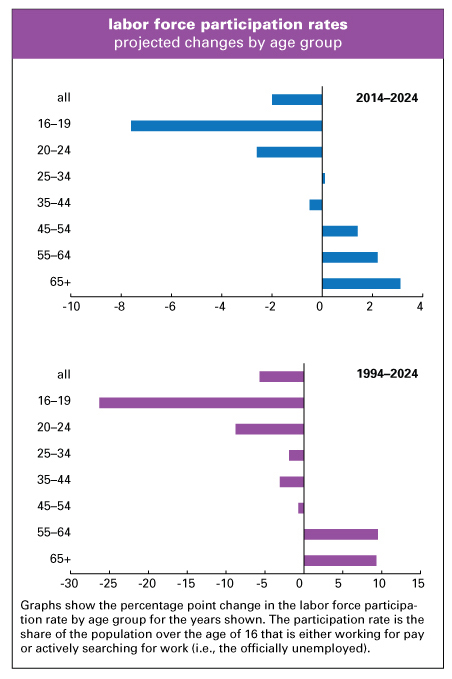
The Bureau projects GDP growth of 2.2% a year over the decade, well under the 3.6% average that prevailed from 1950–2000, and lower even than the 2.4% average from 2000–2007, a period that contained a recession and the weakest expansion in U.S. history. And they also project that labor force participation (the sum of the employed and those actively looking for work, aka the officially unemployed), which has been frustratingly stagnant in this expansion, will decline by 2 percentage points over the decade. This is partly the result of an aging population—the median age of the labor force, which was 37.7 in 1994, and was 41.9 in 2014, will rise to 42.4 in 2024. In other words, job growth will go from roughly matching population growth to lagging it.
But, as the graphs below show, the aging population is far from the whole story. As the top graph shows, participation for the two youngest categories is slated to decline from current levels, and remain essentially unchanged for 25–44 year olds. The only categories projected to rise are those over the age of 45, with the over-65s in the lead. As the bottom graph shows, comparisons over the 30-year interval are even more striking, with all but the over-55 categories declining. The decline among teen workers is the most striking; one presumes they’re getting more schooling, and the early-20s cohort as well, but as we’ll see in a moment, the labor market might not welcome them generously when they graduate. But the decline in prime-aged workers, the 25–54 set, is forecast to be 2.2 percentage points from 1994 levels. The 55–64 and 65+ groups are projected to rise by over 9 points from 1994 levels. So while the aging population explains some of the overall decline, you’d never know it by just looking at the geezerly skew of tomorrow’s labor force.
And while we hear a lot about the importance of education for jobs of the future, these projections don’t offer much support for that point of view. The box below is a list of the 15 fastest-growing occupations over the next decade (accounting for over a third of employment growth); they don’t look like the stuff of college recruitment brochures. Just four of the fifteen require a bachelor’s degree or more for entry, and none require an advanced degree. Eight require “no formal educational credential,” and just one a high school diploma. Just three have an above-median annual wage.

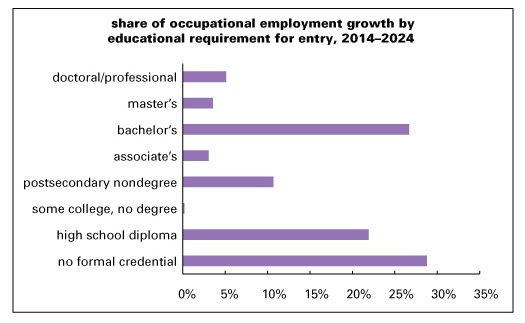
Graphed below is the educational distribution for the decade’s projected occupational growth. Just over half, 51%, require no more than a high school diploma for entry, and another 14% some post-high school education short of a bachelor’s. Just 35% require a bachelor’s, and 9% an advanced degree. The educational distribution of the workforce will change little from today. For example, 25.6% of today’s jobs require a bachelor’s or more for entry; in a decade, that will rise 0.6 point to a dizzying 26.2%. Today, 63.6% of jobs require no more than a high school diploma; in 2024, that will plummet by 0.8 point to 62.8%.
So while politicians and pundits love to talk up the need for getting more people into (and through) college—liberals prominent among them—you have to wonder what sort of job market awaits them.
Of course, these are projections. They could be wrong. But these are nonetheless the official projections of the U.S. government. If they think things are this glum, shouldn’t we be talking about it some more? Maybe talking about how they’re a good part of the reason behind attacks on non-elite higher education and the intensified disciplinary model of primary and secondary education for the bottom half of the distribution? And how an economy that promises only a modest supply of new jobs, many of them shitty, is in need of a major overhaul?
Making collective guilt palatable to liberals
Michael Tomasky, whom I’ve known over 20 years—sparring with him much of that time but liking him anyway—just wrote an awful piece which apparently aims to legitimate for liberals assertions of collective Muslim responsibility. Following the lead of the president, himself no stranger to rampant paranoia about Muslims, Tomasky basically tells Muslims to shape up or face Donald Trump.
To counter accusations of tendentious paraphrase, let me quote a few choice bits:
[Obama] used the usual liberal language about how most Muslims are great, but he also said that religious fundamentalism is “a real problem that Muslims must confront, without excuse.”… This is the first time Obama has issued this challenge…. It says to Muslim Americans that the rights you have as Americans have to be earned, fought for…. [I]f other Americans had some sense that Muslim Americans as a group were really working to ferret out the radicalism, then this stalemate might be broken.
If anything Obama should have been more emphatic about this. He should now go around to Muslim communities…and give a speech that tells them: If you want to be treated with less suspicion, then you have to make that happen…. It’s ultimately a humane gesture to make toward a struggling immigrant group, to explain to them in ways they may not have thought about before what American citizenship means…. I do believe…this president can take steps to bring Muslim Americans more fully into our culture and society. That doesn’t mean just reading them their rights. It also means reading them their responsibilities.
This is addressed to all Muslim Americans, and makes two odious assumptions. The first is that Muslims have a collective responsibility for the behavior of other Muslims. Would a liberal say that about, say, Jews? And second, that citizenship rights have to be earned and don’t automatically apply to citizens. And this is coming from the editor of a journal called Democracy, of all things. (It’s impossible to resist pointing out that its publisher, Bernard Schwartz, is a weapons magnate, and its advisory board is laced with national security types.)
Tomasky’s argument—which he has the nerve to call “humane”—looks like an attempt to set a left boundary on acceptable discourse, and to write out any principled critique of the treatment of Muslim Americans—and Muslims, really—as an undifferentiated mass. It makes it far harder to fight the incendiary hatred of people like Trump, and then presumes to offer itself as the only realistic alternative to fulminating evil. I suppose liberalism has often played this role—see Truman and loyalty oaths—but it’s depressing and enraging to see it enacted before your eyes.
Fresh audio product
Just added to my radio archive:
December 3, 2015 Benjamin Page, co-author of this paper, on the politics of the top 1% • Alfredo Saad Filho on the political and economic crisis in Brazil
My anti-Hillary book is shipping!
Have I mentioned yet that my critique of the presumed frontrunner, My Turn: Hillary Clinton Targets the Presidency, is shipping? Order it now on the OR Books website and it will be in your mailbox in about a week.
My main thought after reading @DougHenwood’s My Turn is that this is the book that all Hillary supporters need to own, because it compiles all the credible criticisms of Hillary in one place, without mixing in a load of right wing dreck. So if something isn’t in Doug’s book, it can probably be safely ignored. If it is in the book, it needs to be taken seriously & some defence prepared. That’s extremely useful. I don’t think many HC supporters will understand this though, as they seem very committed to ignoring the fact that their preferred candidate comes with more historical baggage than any other in generations. Which is odd.
—Daniel Davies on Twitter (translated from five tweets into prose)

Fresh audio product
Just added to my radio archive:
November 26, 2015 Jason Moore, author of Capitalism in the Web of Life, criticizes the idea that humans and nature are separate entities • Jennifer Doyle, author of Campus Sex/Campus Security, talks about security, paranoia, sex, and the large public university


Leave a Comment
Posted on December 7, 2015 by Doug Henwood
Comment on foundations
There were a couple of calls on Twitter for a transcript of what I said on last week’s radio show, following my interview with Benjamin Page. Page had said in the interview that he couldn’t find any foundations interested in funding research by him and his collaborators into the opinions of the top 1%. I’ve added a link to the Leah Gordon interview, which has a link to her book. I’ve expanded a bit on the original in this version.
It’s interesting that the foundations don’t want to support research into the opinions of the upper classes. Page, of course, is too careful a scholar to put it bluntly, but I’m not inhibited by those sorts of constraints. Foundations, almost without exception, exist to put a friendly face on plutocracy, and the last thing that plutocrats want is scrutiny of themselves. They’re interested in melioration but quite opposed to anything too structurally radical. Their role in shaping social science research is profound: recall my interview with Leah Gordon last June about how elite foundations shifted the emphasis in research on race relations away from structural issues towards individual psychology, “from power to prejudice,” as the title of her book put it. Questions interest them far more than answers.
Philanthropy doesn’t get anywhere near the critical attention it deserves, in large part because the kinds of intellectuals who could do that work are dependent on those philanthropies for funding. (I don’t blame the grantees—it’s hard to get by in this world.) I’m not dependent on their generosity, so I’m doing my best to fill in that gap.
Share this: