
Fresh audio product
Just added to my radio archive:
November 26, 2015 Jason Moore, author of Capitalism in the Web of Life, criticizes the idea that humans and nature are separate entities • Jennifer Doyle, author of Campus Sex/Campus Security, talks about security, paranoia, sex, and the large public university
Fresh audio product
Just added to my radio archive:
November 19, 2015 Yezid Sayigh on ISIS • Kali Akuno of Cooperation Jackson on efforts to bring sustainability and worker power to the Mississippi economy
Fresh audio product
Just added to my radio archive:
November 12, 2015 Raquel Varela updates her report of two weeks ago, as the right-wing Portuguese government is replaced by a center-left one • Mark Oppenheimer, author of this article, on the culture of Yale and its impact on campus racial politics • Max Geller on why Renoir Sucks at Painting
November 5, 2015 Sungur Savran, editor of Red Med, on the Turkish election • Christian Parenti, author of this article, on what the climate movement can learn from the developmental state
October 29, 2015 William “Sandy” Darity on the racial wealth gap (links to papers here) • Raquel Varela on the Portuguese elections
Fresh audio product
I’ve been very delinquent about posting radio shows to the archive—sorry. Here’s a batch. There’s a break in the middle for KPFA fundraising (three weeks) and my racing to finish my book on Hillary Clinton (one week).
Speaking of KPFA fundraising, this Behind the News would not exist were it not for that excellent radio station. Please contribute (and mention BtN if you do).
October 15, 2015 Greg Grandin, author of Kissinger’s Shadow, on the ghoulish diplomat’s five-decade rampage
October 8, 2015 David Bloomfield talks edu-policy as Arne Duncan leaves • Elizabeth Bruenig, both journalist and Catholic (and author of this), on papal politics
September 10, 2015 Megan Marcelin, author of this and this, puts the post-Katrina gentrification of New Orleans into historical and theoretical perspective • Josh Bivens, co-author of this, on the gap between productivity and pay
August 27, 2015 DH on the China gyrations • Roger Lancaster on mass incarceration in the U.S.
August 20, 2015 Steve Horn on how Hillary Clinton’s State Department worked to open up the Mexican oil industry to U.S. interests • Isabel Hilton gives the rundown on law, politics, and economics in China
POR in the news
I feel guilty about using the tragedy of the Party of the Right threesome gone very wrong to promote my own work, but here are two memoirs of my time in and around the POR.
“I was a teen-age reactionary” (Bad Subjects)
“Partying on the right” (The Nation)

Me in the late 1990s, photographed by Joel Schalit in San Francisco
Unicorns
I’ve got a piece on The Nation’s website about the tech bubble.
Funnily, Vanity Fair features many of the disruptive stars of that bubble, and of the sharing economy I wrote about for The Nation earlier this year, in their latest New Establishment list. How 2015 it all seems.
Does Chicago need a Katrina? Adolph Reed responds.
[Guest post by Adolph Reed, in response to Kristen McQueary’s column in the Chicago Tribune on how Chicago could use a Hurricane Katrina.]
Kristen McQueary’s attempt to walk back from her scurrilous column of last Thursday extolling the wonderful changes that the devastation of Katrina brought to New Orleans is basically an unpology—and an even more empty, uninformed word salad than the original. The issue isn’t what she was feeling when she wrote what she wrote; it’s what she wrote.
The initial column was wrong on basic, yet important particulars. New Orleanians did not “overthrow a corrupt government.” They actually re-elected Mayor Nagin, who then served his complete second term. He did not and could not by charter seek a third term. Mitch Landrieu did not replace him. Public housing did not get rebuilt; projects were demolished at the moment of the city’s greatest shortage of affordable housing to make way for upscale redevelopment and thereby further intensify that shortage.
I don’t know what governments she believes were consolidated, but the “slashed budget, forced unpaid furloughs, cut positions, detonated labor contracts” all actually began under Nagin. More to the point, however, what world does McQueary live in such that she imagines that those moves, which necessarily meant slashed public services and redoubled economic hardship for those workers and their families already reeling from the dislocation and loss associated with the flood of the city, sound like such cool ideas, even accomplishments? Sprinkling in empty references to “leaner and more efficient” tells us nothing; they’re only croutons in the standard free-market word salad.
And what notion of democratic government does she operate with such that Paul Vallas’s having been freed from “restrictive mandates from the city or the state” seems like something to be applauded? He may have “created the nation’s first free-market education system” (can someone pass the salad dressing?), but, if McQueary could imagine doing the most superficial research instead of merely exuberantly rehearsing press releases, she’d have learned that that system has not, even by the the education “reformers’” very dubious metric of standardized testing, improved educational performance overall and certainly has undermined educational quality for many students in the city. And what notion of education does she operate with such that teachers are not only least competent to organize conducting it but are somehow its enemies, though a random “entrepreneur” with no expertise is the one — actually The One — to whom that vital public service should be entrusted? God help us if McQueary starts thinking about how to organize the fire department.
There is much more that is wrong-headed and shallow about McQueary’s perspective. Considering Chicago, for instance, for all her recitation of the babble associated with the pose of tough-minded fiscal probity, it’s interesting that she never bothers to consider where the budget crisis came from, whose actions—and which actions—produced it, including the role of the City’s years of dereliction in not making its mandated pension payments or, on the other side of the ledger, the billions of dollars of revenue foregone for corporate tax giveaways and other forms of corporate welfare. It’s clear that McQueary can’t imagine herself as falling among the ranks of those who could wind up on the wrong side of the retrenchment that she airily touts with such blithe detachment, as though it were all a version of “Game of Thrones.”
I could go on, but I’ll conclude by saying that I certainly understand how anyone with connections to New Orleans and the devastating impact of that travesty wrought by decades of bad government would be appalled and outraged by her flippant statements like “Hurricane Katrina gave a great American city a rebirth.” I understand so well because I’m one of those people. But one doesn’t have to have that personal connection to recognize the truly breathtaking, perhaps clinical, lack of capacity for empathy with strangers that such statements undeniably reveal. The problem is not that one might think that she “would be gunning for actual death and destruction” but that what she is “gunning for” in wanting in effect to destroy the public interest by marketizing it is a society in which such “death and destruction” would become normal life.
The greatest irony of her original stupid article and the backtracking unapology is that she can’t recognize that it’s precisely the sort of arrangements she enthusiastically touts as the utopian possibilities opened by the horrors of Katrina that created that disaster in the first place. She’s right; it was man-made, but, if she were a little less smugly shallow and ideological, she might have asked how it was man-made. It was the product of decades of the sorts of policies, pursued at every level from Orleans Parish to the White House and by corporate Democrats as well as Republicans, she rhapsodizes about—privatization, retrenchment, corporate welfare paid for by cutting vital public services and pasting the moves over with fairy tales about “efficiency” and “lean management” and “doing more with less” and hoping to avoid the day of reckoning.
So, I’ll give this much to McQueary; she’s right that Katrina has a lesson for us. It’s a lesson about what happens when you follow the sorts of destructive approaches to public policy that McQueary shills for.
Fresh audio product
Finally, after an unpardonable delay, four shows freshly uploaded to my radio archive:
August 13, 2015 William Darity on discrimination, a job guarantee, and baby bonds • R.L. Stephens II, founding editor of Orchestrated Pulse and author of this essay, talks about Black Lives Matter and the creation of a leadership class
August 6, 2015 [vacation encore] Ian Bone, author of Bash the Rich, on anarchism (first broadcast March 2007) • Bethany Moreton, author of To Serve God and Wal-Mart, on Christian free enterprise and the Behemoth of Bentonville
July 23, 2015 James Galbraith and Leo Panitch (the article that launched a thousand righteous polemics) on Greece
July 16, 2015 Jane McAlevey, author of Raising Expectations (and Raising Hell), on Alinsky, power, and organizing (her article on the topic in Politics and Society is behind a paywall, breachable by many with university connections)
Workers: no longer needed?
Paul Mason has a breathless piece in The Guardian making grand New Economy claims that sound like recycled propaganda from the late-1990s—though he gives them a left spin: postmateriality is already liberating us. I wrote a book that was in large part about all that ideological froth, published in 2003, and so far I’ve been struck by the nonrevival of that discourse despite a new tech bubble. Uber and Snapchat don’t excite the same Utopian passions that the initial massification of the web did.
I’ll pass on refuting Mason’s article, because I already did that twelve years ago. But I do want to comment on one point that Mason makes—one that’s ubiquitous in a lot of economic commentary today: capitalists don’t need workers anymore. As he puts it:
Postcapitalism is possible because of three major changes information technology has brought about in the past 25 years. First, it has reduced the need for work, blurred the edges between work and free time and loosened the relationship between work and wages. The coming wave of automation, currently stalled because our social infrastructure cannot bear the consequences, will hugely diminish the amount of work needed – not just to subsist but to provide a decent life for all.
I can’t make sense of the “currently stalled because our social infrastructure cannot bear the consequences”—has capitalism ever skipped an innovation because of its social consequences?—but there’s no evidence that info tech is “hugely diminish[ing] the amount of work needed.” Sure, wages and benefits stink, but that’s about politics and class power, not because of the latest generation of Intel chips or something fresh out of the latest TechCrunch Disrupt.
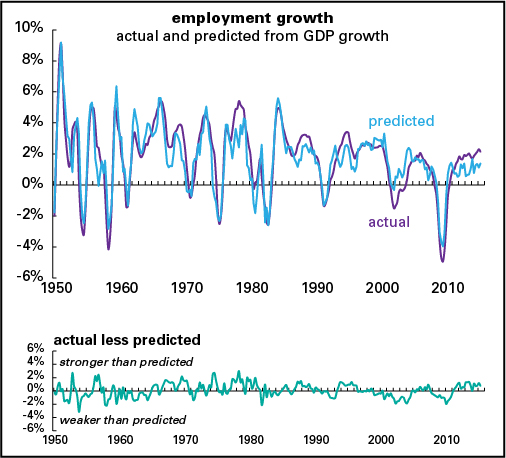
Expressing this argument in some economically quantifiable way probably means something like “the relation between GDP growth and employment growth has broken down.” If that’s what proponents mean—the presentations are usually light on precision—then it’s just not true.
Graphed below is the yearly growth in employment, and what the growth in employment “should” be based on GDP growth (lagged a quarter). Below it is the difference between the two—a measure of whether actual employment growth is stronger or weaker than the very simple model suggests. Several things stand out:
- The relationship between GDP growth and employment growth is very tight.
- It hasn’t gotten any less tight. Employment losses during the Great Recession were greater than the contraction in GDP says they should have been, but not by much, and the model tracks actual results, both down and up, remarkably well.
- Recent employment growth is stronger than the model suggests it should be. For the first quarter, average U.S. monthly employment gains during the first quarter of 2015 “should” have been 163,000, and not the 253,000 they were.
Put another way, were IT really making workers less necessary, we should be seeing more productivity growth, and not less. But less is precisely what we’re seeing—as of the first quarter of 2015, trend productivity growth was 0.4%, an all-time low since the series began in 1948, less than a fifth the 1948–2007 average of 2.3%. It’s below the levels of the lamented 1970s productivity slowdown. The only time in recent history where IT appears to have led to an acceleration in productivity growth was the late 1990s, which was the result of increased investment in high-tech equipment. I went into writing After the New Economy thinking that the productivity acceleration was a mirage, but it wasn’t. But then it fell apart, because corporations prefer shoveling out cash to their shareholders to investing it.

Fresh audio product
Just posted to my radio archive, with minimal delay!
June 18, 2015 Trudy Lieberman, author of this article (behind a paywall, but subscribe to Harper’s, it’s excellent & cheap), on the pitfalls of Obamacare • Leah Gordon, author of From Power to Prejudice, on the transformation of the study of race in the U.S. from the structural/systemic to the individual/psychological
The student debt boom (cont.)
The Federal Reserve Bank of New York is out with it latest household debt report, covering the first quarter of 2015. Its parent in DC, the Federal Reserve Board, publishes lots of similar data, but the New York Fed is the first source to publish rigorous numbers on student debt. The latest report is here; you can get the numbers behind it here.
Since the official end of the Great Recession in June 2009, households have been borrowing very cautiously (how much it’s their decision, their lenders’ decision, or a combination of the two, isn’t fully clear). The glaring exception is student debt. Here are just a few numbers to make the point:
- Overall household debt peaked in the third quarter of 2008. From that peak, it fell by 12% to a low in the second quarter of 2013 (not adjusted for inflation, like all these figures). But over the same almost-five-year period, student debt rose 63%. Take student debt out of the total, and household debt fell over the same period by 16%. Up 63% vs. down 16% is an enormous difference.
- From that 2013Q2 low to the latest quarter available, 2015Q1, overall household debt is up by a little over 6%—or 5% if you take out student debt. But student debt is up almost 20%.
- Since the New York Fed debt numbers began in the third quarter of 2006, nonstudent debt is unchanged: up (or down) exactly 0%. Student debt, however, is up 166%. It’s gone from 4% of total household debt outstanding to 10%.
- Over the last year, nonstudent debt is up 1%; student debt, 7%. The rate of growth of student debt has slowed—from about 15% a year in 2008 to 7% now. But over the same period, the rate of growth of nonstudent debt has collapsed—from almost 9% to just over 1%. (For comparison, household income is now growing about 2–3% a year.)
There’s a lot of talk about how this rampant growth in student debt is a re-run of the subprime mortgage bubble. That’s not an exact comparison, since most of the debt is ultimately owed to or guaranteed by the federal government, so massive financial collapse is probably not an issue. It is, however, exacting a huge financial and psychological toll on the debtors, who would be having a hard enough time in a rotten economy without having to worry about spending hundreds of dollars a month paying off their education debt (at a time when the pundits counsel education as the only way to survive that rotten economy).


 LBO News from Doug Henwood