
Hillary publicity update 2
This just in, from my old pal Russ Smith, publisher of New York Press in its splendid heyday.
Hillary publicity update
Updates to the Hillary publicity catalog:
- One I left out—the New York Observer
- And fresh German publicity, based on the Die Welt article
Hillary publicity roundup
Lots of nice publicity for my Hillary piece in Harper’s:
- Page Six (New York Post)
- Huffington Post Live (video)
- Salon interview with Elias Isquith
- interview by Chuck Mertz for This Is Hell (radio)
- brief mention in Wall Street Journal (10th paragraph)
- “Amerikaner, stoppt die Clinton-Dynastie,” Die Welt (German)
More, one hopes. One always hopes for more.
Minimum wage politics
I haven’t used this venue to promote my Harper’s piece on the awfulness of Hillary Clinton, but that’s about to change. First this little note, and then some bits from the cutting-room floor that wouldn’t fit next week.
Some Democrats have been saying that a Hillary presidency would almost certainly lead to a rise in the minimum wage and a Republican wouldn’t. Maybe. But here’s the recent historical record. I have to admit I was surprised by this, but here you go:
• The real value of the minimum wage rose 7.7% under George H.W. Bush (measuring from January 1989–January 1993—subsequent calculations follow the same template).
• It fell by 1.5% under Bill Clinton.
• It rose by 5.4% under George W. Bush.
• So far under Obama it’s down 1.3%
This history aside, I’m not saying that the minimum wage is more likely to rise under a Rep than a Dem, but Dems’ faith in the certainty of a minwage increase under Hillary seems misplaced.
PS: Yes, Harper’s is beyond a paywall. They also paid me well and have an excellent staff of editors and publicists. You can’t get that good stuff for free.
More companies dropping health coverage, thanks to Obamacare
Back in 2011, I argued that Obamacare would lead employers to drop existing health insurance coverage and throw employees onto the mercies of the exchanges. (See this post and links therein.) Liberals, including no less than Paul Krugman, denied this. But it’s looking like it’s happening.
Today’s Wall Street Journal reports that Wal-Mart, that paragon of the modern employer, is dropping coverage for 30,000 part-time employees. It joins Target, Home Depot, and UPS, who’ve already cut coverage. And, at the high end, the so-called “Cadillac tax” on generous insurance plans is also leading to cutbacks; JetBlue and FedEx are shifting employees into high-deductible plans.

Obamacare’s popularity
Meanwhile, Gallup finds that more Americans think the cleverly named Affordable Care Act has hurt (27%) rather than helped (16%) them—though a majority (54%) say it’s had no effect. Almost half (46%) think the ACA will make things worse over the long term, and just 15% think it will make things better.
Maybe they’re wrong. But the typical response of Democrats is basically to say they’re mistaken, and that the Act is the greatest bit of legislated social progress since Medicare. Except almost everyone loves Medicare. It’d be nice if everyone could have something like it.
SodaStream update: The boycott is a “nuisance.” And “we’re Zionists.”
An hour after I hit the “publish” button on the SodaStream post, the firm’s publicist got back to me with an answer to my question about how BDS might be affecting sales. He referred me to a September 1 JTA story, which reports that the company is thinking of closing its West Bank factory (pictured below)—but purely for “financial reasons.” Those reasons do not include the boycott, which CEO Daniel Birnbaum dismissed as a mere “nuisance.” And, in case you missed the political point, he made the company’s position very clear: “We are not giving in to the boycott. We are Zionists.”
So, they‘d close the plant for financial reasons, but its location in the West Bank has nothing to do with those. Right. Also: it’s not just a beverage—it’s a political statement.

SodaStream: is BDS hitting where it hurts?
[See company’s response here.]
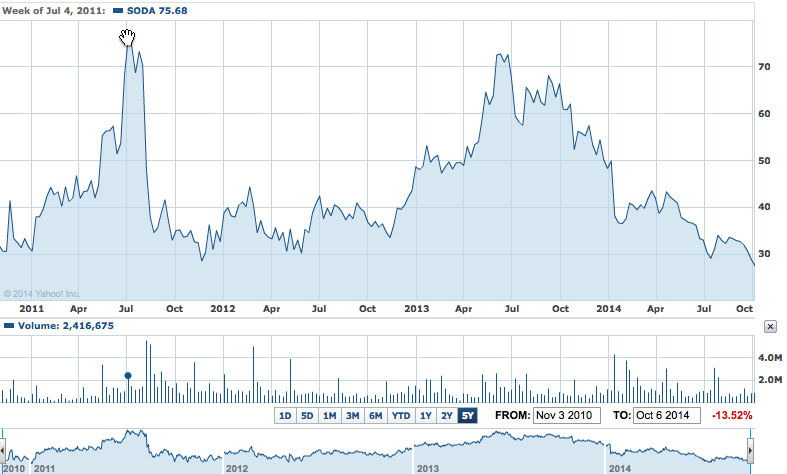
This morning, the Israeli-based fizz merchant SodaStream announced miserable preliminary financial results for the quarter ending September 30. Its stock promptly fell by over 20%, compounding losses over the last year. It’s now more than 70% off its all-time high set in July 2011, and the company may well put itself up for sale.
The company’s explanation of the glum performance was not much of an explanation at all. From their official release:
“We are very disappointed in our recent performance,” said Daniel Birnbaum, Chief Executive Officer of SodaStream. “Our U.S. business underperformed due to lower than expected demand for our soda makers and flavors which was the primary driver of the overall shortfall in the third quarter. While we were successful over the last few years in establishing a solid base of repeat users in the U.S., we have not succeeded in attracting new consumers to our home carbonation system at the rate we believe should be achieved. The third quarter results are a clear indication that we must alter our course and improve our execution across the board. We have already begun a strategic shift of the SodaStream brand towards health & wellness, primarily in the U.S., where we believe this message will resonate more strongly with consumers….”
In other words, sales were off because not enough people are buying the product.
Media reports (like this one) glossed the company’s explanation with the commonplace that Americans are losing their taste for soda. But SodaStream’s fizz-inducing systems could be used to make bubbly water (0 calories) or effervescent fruit juices. You could probably even gas up your kale juice if you wanted to, which is beyond my imagining. According to the company’s nutrition information page, its flavors have about a third the calories of comparable sodas like Coke and Sprite. So if Americans are really losing their taste for the really sweet stuff, SodaStream should already be well-positioned as a possible alternative, not a victim of these changing preferences.
Not mentioned in either the company’s release or any news report I’ve seen: the global boycott of Israeli products. SodaStream is especially vulnerable, compared to a company based in Israel itself, because its major factory is in the West Bank settlement of Ma’ale Adumim. SodaStream has factories in Israel proper and elsewhere in the world, but its presence in the Occupied Territories make it particularly vulnerable to a boycott, a risk the company acknowledged in its most recent annual report.
Earlier in the year, Scarlett Johansson was relieved of her role as her role as an “ambassador” for Oxfam, because the charity believed “that businesses that operate in settlements further the ongoing poverty and denial of rights of the Palestinian communities that we work to support.” That move attracted global attention. It may be that Johansson’s star power did more to publicize the boycott than it did the company’s products.
So is the Boycott, Divestment, Sanctions (BDS) movement against Israel costing a real-world company real money? SodaStream isn’t talking; a query to the firm’s publicist has gone unanswered, which is unusual behavior for a publicist who wants to talk. But it’s looking like the answer may well be yes.
Fresh audio product
Just added to my radio archive:
September 11, 2014 Dana Goldstein, author of Teacher Wars, on the history of education politics in the U.S. • Christian Parenti, author of this article, reclaims Hamilton for the left (and for climate politics)
Fresh audio product
Newly added to my radio archive:
September 4, 2014 Rebecca Tiger, sociologist and author of Judging Addicts, on the history of punishment in the U.S., drug courts, and the marriage of the therapeutic culture to the carceral state
Fresh audio product
Just added to my radio archives:
August 28, 2014 Naomi Murakawa, author of The First Civil Right, on the underestimated contributions of liberals to mass incarceration • Amy Binder, author of this article, on why Harvard grads flock to Wall Street
August 21, 2014 Chase Madar, author of this article, on overpolicing/overcriminalization in the USA • Jeff Smith, author of this article, on Ferguson, St Louis, and political science
Fresh audio product
Between vacation and KPFA’s fundraising, I’ve been delinquent at both producing new radio shows and updating the archive. Here’s some catch-up, freshly posted to my radio archive. The dates are links and will take you to the show’s page.
July 10, 2014 Heidi Shierholz of the Economic Policy Institute discusses the flabby, unsatisfying state of the job market • Sean Jacobs (one of the founders of Africa Is A Country) talks about the political economy of soccer.
August 14, 2014 Mark Ames on Silicon Valley wage-fixing and their selective libertarianism • Alex Vitale on broken windows and the militarization of policing
If you like this show, please support KPFA, without which it wouldn’t be possible. If you contribute—and there’s no reason you shouldn’t if you’re not broke—please mention Behind the News.
Fresh audio product
Catching up with a backlog…just posted to my radio archives:
July 3, 2014 Esther Kaplan, author of this article, on a plant closure in Tennessee and the dubious economic logic of offshoring • Alex Kane on what Israel is up to in the wake of the West Bank kidnappings
June 26, 2014 Sarah Stillman, author of this article, on the for-profit probation racket and “offender-funded justice” •Bruce Bartlett on the state of the Republican party after the Tea Party’s series of electoral defeats
June 19, 2014 Jennifer Taub, author of Other People’s Houses, on the deep history of the mortgage crisis • Margaret Gray, author of Labor and the Locavore, on the exploited workers behind the local food movement
Fresh audio product
Just added to my radio archives:
June 12, 2014 Suzanna Danuta Walters, author of The Tolerance Trap, argues against queer embourgeoisement • Tony Samara, lead author of The Rise of Renter Nation, on the affordability crisis for people who rent their dwellings
June 5, 2014 Art Goldhammer on European politics, with an accent on France • Nikil Saval, author of Cubed, on the history and sociology of the office
Plutonomy revisited
Business Insider has a write-up of a BoA Merrill Lynch report that declares that, the FT’s quibbles aside, Thomas Piketty is essentially right, and the super-rich is where the action is, so invest accordingly. (Never mind that Piketty utterly destroyed, in the most gracious manner imaginable, the newspaper’s economics editor Chris Giles’ half-assed critique.) The BoA Merrill report was written by Ajay Kapur, who is quoted by BI as saying:
When wealth and income are as concentrated as they are, and expected (a la Piketty) to get even more so, examining the ‘average’ consumer or ‘average’ investor makes little sense. Examining the fat tail – the behavior of the plutonomists, rather than that of the multitudinous many – is more advantageous to investors. Plutonomists determine and dominate spending and investment decisions and their magnitudes. Any analysis that does not tease out the skewed global income and wealth distribution, but focuses on the average is flawed from the start and is incomplete, as we step into its deeper extremes.
The word “plutonomy” rang a bell, and sure enough we’ve been here before. Back in 2005 and 2006, in the bubbly days before the financial crisis and Great Recession, Kapur wrote a series of reports for Citigroup, his then-employer, on the topic. Citi did its best to stem the circulation of the reports, demanding that websites that posted them take them down.
As a public service, lbo-news is reposting them. Evidently, the worst crisis in 80 years is not enough to keep the plutocrats down.
Here are the links (all PDFs—and I changed them since my first posting to confuse Citi’s plutonomy sniffer):
Plutonomy 1 (October 16, 2005)
Plutonomy 2 (March 5, 2006)
Plutonomy 3 (September 29, 2006)


1 Comment
Posted on October 24, 2014 by Doug Henwood
On Hillary
[I said this on my radio show yesterday as a Hillary teaser. Jane McAlevey urged me to circulate it, and I do what Jane says.]
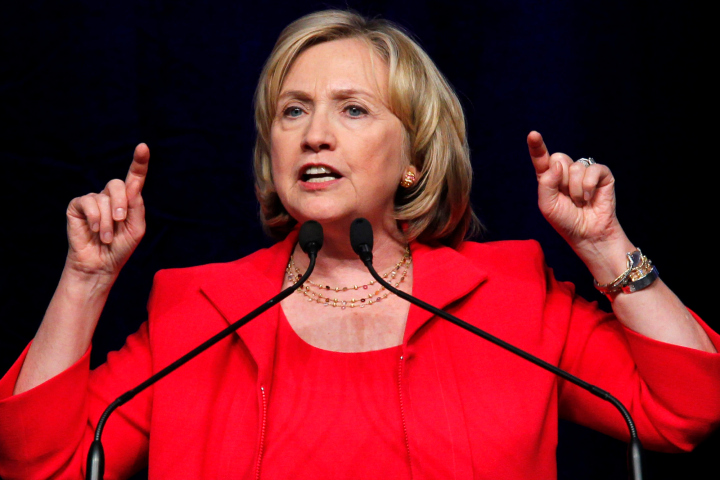
A little self-promotion. I have a cover story in this month’s Harper’s on Hillary Rodham Clinton, which the editors gave the tabloidish headline, “Stop Hillary!” (And I do mean tabloidish—it caught the attention of a New York Post reporter, who wrote it up for the paper’s Page Six gossip feature.) In it, I review Hillary’s life in a very non-friendly way, in hope of derailing her unannounced yet all-but-certain presidential campaign.
I have three major objections to Hillary (which is how she seems to brand herself these days): the dynastic, the personal, and the political.
First, after two Bushes, do we really need another Clinton?
Second, the personal. Hillary has a long record of dishonesty, ranging from making up a stories about the origin of her name (she said she was named after Sir Edmund Hillary, but he didn’t climb Mt Everest until several years after she was born) to lies about all the various Arkansas scandals she brought with her to Washington. Par for the politician course, I suppose, but her supporters like to think of her as several cuts above the ordinary, a judgment I’m sure she concurs with.
But the most important objection is political: the last thing we need is another hawkish, Wall Street-friendly Democrat in the White House. Many people—including me, when I started researching the piece—don’t appreciate how deeply involved Hillary was with creating the New Democrat paradigm, tough and business-friendly, replacing the old New Deal/Great Society model. While governor of Arkansas, Bill Clinton took a number of swipes at unions in the state as part of a campaign to shred the longstanding Democratic alliance with labor. He, with Hillary closely involved, launched an attack on the teachers union in Arkansas, a campaign with ugly racial undertones, that was a model for later edu-reform efforts. Once on the board of the Children’s Defense Fund, Hillary supported Bill’s efforts to end welfare, which is responsible for keeping millions of people, mostly women and children, in poverty now—though, of course, she likes to present herself as an advocate for women and children. That advocacy mainly takes the form of photo-ops and symbolic programs. It’s very reminiscent of her husband’s approach. I remember, back in the 1990s, taking apart his budget proposals. The prose sections always contained rhetoric about “investing in people” and “building a bridge to the 21st century,” but when you looked at the actual numbers, you had to take them out to two or three decimal places to notice any change. That’s the essence of the New Democrat paradigm.
But it isn’t new anymore—it’s more than 20 years old. It represented a consolidation of Reaganism, the conversion of what is supposed to be the popular party into a near-pure instrument of neoliberalism. To a neoliberal, the solution to a social problem should always involve a market, and if the market doesn’t exist, it must be created ex nihilo. (That’s the logic of Obamacare.)
That whole approach has lost even its novelty value now. It is not adequate to deal with climate change, polarization, and structural economic stagnation—problems that are caused by an excess of markets, not a deficiency. The marketization of everything has led to severe social fragmentation and the erosion of all notions of solidarity. Hillary sometimes evokes those notions of solidarity, but usually in photo-ops with women from poor countries in their colorful native garb, where she uplifts them by her mere presence. As for policies that might change their actual material and social status, well, they’re rather thin on the ground, because they might spoil the investment climate.
Share this: