
Fresh audio product
Just uploaded to my radio archives:
March 28, 2013 Terry Kupers on the psychological effects of prison • Haley Sweetland Edwards, author of this article, how Wall Street took over Dodd-Frank
March 21, 2013 Yanis Varoufakis on the economies of Australia, Cyprus, and Greece • Jonathan Westin of Fast Food Forward on organizing fast food workers in NYC
Fresh audio product
Just uploaded to my radio archives:
March 14, 2013 Özgür Orhangazi, author of this paper, on the economics of Venezuela under Hugo Chávez • George Ciccariello-Maher, author of the imminently forthcoming We Created Chavez, on the politics of Venezuela under Hugo Chávez
Fresh audio product
Just uploaded to my radio archives:
March 7, 2013 Robert Gordon on the end of growth (paper here) • Adolph Reed, author this review essay, on some recent “race” movies (Django Unchained, etc.)
Clarification on crappiness
I want to make it clear that my characterization of the health insurance that Stop & Shop has been providing some of its workers, which Obamacare is causing the company to want to drop, as “crappy” was entirely mine, and not Lara Shepard-Blue’s. She’s a much more responsible and measured person than I, and sorry if it looked like I was putting words in her mouth.
Give to KPFA, get this premium
If you like my radio show, Behind the News, then please give some money to KPFA, which in the closing days of a fund drive. I wouldn’t do the show if it weren’t for KPFA, and they’ve been very generous in giving me not only a show but one in a nice timeslot. For a pledge of $75, you can get a CD containing 37 interviews I’ve done since 2002. The CD is a collection of MP3 files, not an audio CD, to you can’t pop it into every CD player. But it’s a lot of stuff, and it makes me feel good to look over the list.
Pledge to KPFA here:

And here are the interviews on the CD (dates in parentheses are dates of first broadcast):
Amiri Baraka (1/11/07) poetry in New Jersey, politics in Newark
Frank Bardacke (11/29/12) Cesar Chavez and the United Farm Workers
Moustafa Bayoumi (8/14/08) being Arab in the US
Ian Bone (3/15/07) anarchist organizing and the hideousness of the rich
Dennis Brutus (12/31/09) poet and activist on South Africa (includes some poems)
Alexander Cockburn (8/27/11) on the media, the media criticism racket, and the devolution of politics
Hamid Dabashi (4/12/07) history and culture of Iran
Jodi Dean (12/18/10) the political psychology of blogging
Mark Dery (5/26/12) pop culture, beheading, David Bowie
Robert Fatton (1/21/10) on the history and politics of Haiti (includes excerpts from two 2004 interviews)
Barbara J. Fields (2/14/13) "racecraft": the ideology and practice of race and racism in the the U.S.
Cordelia Fine (11/27/10) the questionable science of gender
Robert Fitch (2/9/06) corruption and ossification in American unions
David Frum (8/9/12) partial conservative renegade on the right and his roman a clef about life in DC
Adolfo Gilly (3/13/08) Mexican history, on Latin America and his revolutionary pessimism
Melissa Gira Grant (9/13/12) sex workers and their self-appointed rescuers
David Graeber (8/13/11) money and debt
Ursula Huws (10/2/03) work today
David Cay Johnston (9/3/11) how the rich don't pay taxes
Carrie Lane (4/9/11) how unemployed tech workers see themselves
Catherine Liu (1/28/12) education, testing, anti-intellectualism, and the bogus politics of “anti-elitism”
James Livingston (4/28/12) speaks up in favor of the consumer culture as a liberatory thing
Jane McAlevey (12/6/12) how to revive organized labor
Terry Moe (5/28/11) right-wing school “reformer”
Bethany Moreton (6/6/09) religion and Walmart
Leo Panitch and Sam Gindin (9/27/12) the emergence and structure of the U.S. empire
Christian Parenti (7/2/11) climate change, state collapse, war
William Pepper (1/23/03) MLK assassination
Frances Fox Piven (11/19/11) OWS in the context of social movements
Diane Ravitch (4/8/10) the monstrosities of education reform
Adolph Reed (4/9/11) politics and race
Corey Robin (10/1/11) the conservative mind
Gary Shteyngart (9/23/10) on his novel Super Sad True Love Story, and American decline
Joseph Stiglitz (8/15/02) U.S. economy, IMF
Matt Taibbi (4/23/11) where all that Fed bailout moey went
Gore Vidal (5/16/02) war on terror
Richard Walker (11/13/10) the wreckage of California
Workers with crappy health coverage now facing none at all
My Facebook friend Lara Shepard-Blue, a union organizer in Western Massachusetts, just posted this grim bit of news:
The contract covering 42,000 Stop & Shop workers in MA, CT and RI expired last night with no agreement. The problem is the company’s Obamacare-prompted proposal to eliminate medical insurance and prescription coverage for part-timers. Because caps on coverage aren’t allowed under Obamacare and the current plan for PTers has a $20K cap, they say the cost of coverage for part-timers will increase to the same cost as for full-timers when this part of the law goes into effect.
That’s evade, not drop, though they’ll probably drop too
I wrote that last post when I was in a hurry to get out the door and pick up my kid. I said employers will “drop” coverage when Obamacare takes effect. I should have said they’ll evade the mandate by paying the penalty rather than the insurance premium. Most victims of this evasion don’t have health insurance now, so “drop” is clearly the wrong word for the set of workers that the FT article reported on.
But the original McKinsey survey was about employers who now offer health insurance who are likely to drop coverage when the scheme takes full effect next year. Quoting from my first post on the topic (Bye-bye employer health insurance): “30% of respondents to McKinsey’s survey ‘will definitely or probably stop offering ESI in the years after 2014’—but 50% of those with ‘high awareness of reform’ will do so.” Why? Because when employers without high awareness were informed of the government subsidies available for uncovered workers to buy insurance on the exchanges, they felt a lot better about dropping coverage and paying the penalty instead.
Clearly, if the mandate were to mean anything, the penalty would have to be a lot higher than $2,000. And equally clearly, a lot of costs are going to be shifted onto the government—more, it seems, than the architects of this crazy plan assumed.
Yeah, lots of employers are going to evade health coverage
Back in the summer of 2011, McKinsey released results of a survey they’d done of employers showing that many would not offer health insurance coverage when Obamacare* takes full effect. The liberal establishment united in loud criticism of the consulting firm’s report—but it’s looking like they were right. I wrote up the original report (“Bye-bye employer health insurance”) and experienced some of the loud criticisms, prompting a follow-up (“McKinsey: more right than wrong”) based on reading the full survey, something that some of the critics, including apparently Paul Krugman, hadn’t done.
Ah, vindication. Today’s Financial Times has has a front-page piece (“US business hits out at ‘Obamacare’ costs”) confirming the central point of the McKinsey survey: for many employers, it will be much cheaper to pay the penalties than cover full-time workers, and cut the hours for others so they fall under the definition of full-time and then don’t have to be covered. Retailers and fast-food chains are the most likely to do that, but there’s no reason that many other employers wouldn’t join in.
David Dillon, CEO of Kroger, put it succinctly: “If you look through the economics of the penalty the companies pay versus the cost to provide coverage, the penalty’s too low, or the cost of coverage is too high.” The penalty for not covering a worker is $2,000 a year—less than half the cost of covering a single worker ($4,664, according to the Kaiser Family Foundation), and less than a fifth the cost of covering a family ($11,429). Uncovered employees will be forced to buy coverage on the new insurance exchanges—with a government subsidy if their income is low enough—or pay the penalty themselves. You don’t need an MBA to figure out the math on that one.
As I said in my first post on the McKinsey survey: “In the short term, this could provoke a real social emergency, as scores of millions are thrown onto the private individual insurance market and forced to pay $1,000 a month for crappy coverage. But this could vastly increase the constituency for a single-payer scheme, such as Medicare for All—assuming our rulers don’t destroy Medicare first.” Still true.
__________
*Usage note: Liberals hate the term “Obamacare,” given its prominence in the right-wing playbook. But he’s the one responsible for this monstrosity. Obamacare. Obamacare. Obamacare.
The State of the Union: an old fartish complaint
[From my radio commentary this week.]
A few words on the State of the Union address. What a plodding, tedious affair—enlivened only by its unresolved contradictions. Obama spoke against austerity—“we can’t just cut our way to prosperity,” the qualifier “just” being a tipoff that a confidence trick was being perpetrated—but quickly made it clear he wanted to cut Medicare and Social Security, lest, as he put it, “our retirement programs…crowd out the investments we need for our children, and jeopardize the promise of a secure retirement for future generations.” In the euphemistic language is Washington, you see, cuts to these popular and successful programs are portrayed as “strengthening” them.
Obama approvingly dropped the names of Simpson and Bowles, the austerity-minded co-chairs of the deficit reduction commission he created and staffed. He devoted a couple of paragraphs to climate change, which almost sounded like he was taking it seriously—but then celebrated the rise in domestic oil and gas production, which means fracking. He talked about making college debt “sustainable”—but of course he’d never want to make college free, which we could easily afford. He promoted quality education for all, yet touted his Race to the Top program, which is a way to force states to adhere even more passionately to the testing agenda that both parties are in love with, despite its lack of results. And so on.
And what rhetoric. Obama is a highly literate and thoughtful guy, yet this speech adhered to the depressingly low standards of American public discourse. It was written at a 10th grade level, slightly below the 11th grade level of his 2009 speech, and even more below the 12th grade level of Clinton’s 1993 state of the union. At least it was above George W’s 9th grade level speech in 2001. (See here for the texts of all State of the Union addresses; see here for the grade level analyzer.) Remember, 87% of Americans over the age of 25 have a high school diploma or more, and over 30% have college degrees (Census source), so the president isn’t addressing a nation of dropouts.
How we’ve come down in our expectations. As recently as 1961, when only 41% of Americans had completed high school, John F. Kennedy’s address was at a reading level associated with a year of college. Back in 1934, a time when fewer than 20% had completed high school, FDR’s first state of the union was at a level associated with three years of college. In 1861, when 20% of the population was illiterate, Lincoln’s first State of the Union (which admittedly was written and not spoken) was composed at a level comparable to a college graduate’s.
As for content, a devolution there as well. Imagine a modern president saying this, as Lincoln did in his 1861 address: “Labor is prior to and independent of capital. Capital is only the fruit of labor, and could never have existed if labor had not first existed. Labor is the superior of capital, and deserves much the higher consideration.” Certainly our Kenyan socialist would never say such a thing.
Ever since Reagan, it’s become de rigeur to conclude the State of the Union with a “God bless America,” as if the nation were experiencing a recurrent sneezing fit. What a change from the conclusion of Warren Harding’s 1921 State of the Union: “A most gratifying world-accomplishment is not improbable.” No doubt that would not play well on TV.
Links fixed
Memo to self: never go out without testing the links first. The URLs for the 2013 shows I just added to my radio archives were still living in /2012/ so they came up as missing. They’re now fixed. Sorry.
Fresh audio product
Sorry, folks, it’s been way too long since I did this! But since I usually upload the audio files more promptly than I update the website, you can spare yourself the consequences of my delays by subscribing to the podcast. Instructions are on the top of my radio archives page.
To which I’ve just added the following shows:
January 31, 2013 Helaine Olen, author of Pound Foolish,on the personal financial advice racket • Heidi Shierholz of the Economic Policy Institute, co-author of this paper, on what’s driving wage polarization
January 24, 2013 Natasha Lennard, author of this article, on the Aaron Swartz case and prosecutorial abuse of power • Nikihil Goyal, fresh out of high school, on the education “reform” agenda
January 17, 2013 Leo Panitch and Sam Gindin, authors of The Making of Global Capitalism, on U.S. imperial power, etc. [rerun of September 27, 2012, show, with some music added]
January 10, 2013 Sarah Jaffe, author of this article, class angles feminism • Greg Grandin, professor of Latin American history at NYU, on Chavez, Venezuela, and social democracy in Latin America
January 3, 2013 Brad DeLong on fiscal follies (apologies for the wretched audio quality—damn cell phones) • Seth Ackerman, author of this article, on a possible socialism
December 27, 2012 Michael Dorsey on the Doha climate conference • Yanis Varoufakison the perpetual Eurocrisis, with an emphasis on Greece
Labor legend Jerry Brown responds to critics of Jane McAlevey
This was not written for this blog, but I’ve been asked to circulate it widely. It’s a response by Jerry Brown—not the governor but the long-time leader of SEIU 1199 New England—to reviews by Steve Early and Joe Burns of Jane McAlevey’s excellent book Raising Expectations (And Raising Hell), on how to revive the U.S. labor movement. Both reviews are extremely tendentious and unfair, and do not respond to Jane’s arguments at all. I am also addressing this re-post in part to all the people who’ve embraced the Early/Burns line without having read the book. My interview with Jane is here. I’ve done a little light copyediting on the piece, but nothing else.
I am writing as someone who was directly involved in the unusually effective changes led by Jane McAlevey in Local 1107, SEIU Las Vegas, and as someone who watched with real sadness the subsequent undermining and failure of that Local. I am the retired president of 1199 New England, a union of some 23,000 members with a proud history of militant rank and file activity and high standards in the public and private sector. McAlevy identifies me as one of her mentors in the labor movement and I am happy to wear that description.
I disagree with some of the examples of SEIU skullduggery recited by McAlevey—most particularly her description and demonization of Sal Rosselli and UHW under Sal’s leadership. But on most of the facts supporting her narrative, McAlevey is right on target. Yes, SEIU made private deals with national hospital chains—deals that gave away worker rights to strike and even rally. And these deals were never explained to or ratified by the members. Yes, SEIU undermined and then disrupted member activism, threatening Jane and the Local with trusteeship if it dared engage in job actions against these employers. And yes, the SEIU and the AFL-CIO failed in Florida during the 2000 presidential election and failed in any number of other crises because they did not motivate, support, or really believe in militant membership activity.
But Joe Burns and Steve Early think that somehow it is important to engage in ad hominem (I do not know the Latin for attacks on women) attacks on McAlevey rather than understanding and appreciating the unusual value added by her style of leadership. McAlevey went to Vegas to try to invigorate a moribund union in a very important growing market. She, and her staff and rank-and-file leaders were immensely successful in doing that. In an open shop state they took the dues-paying membership from 25% to over 75% in hospitals with thousands of employees. They organized numerous new units and reorganized all of the existing units. They led successful strikes and job actions, demonstrations and political campaigns. They elected hundreds of new stewards and began an intensive training program. They won a rank-and-file vote to increase the dues by a substantial amount to finance these programs and they were well on their way to consolidating and improving on these victories when they were undermined and derailed by SEIU collusion with bosses and an internal election campaign pitting holdover old guard leadership from the public sector against new, mainly Registered Nurse leadership from the private sector. The final chapter of the McAlevey work in Vegas brings no credit to her or to her opponents and the decline of the Local since then is a tragedy. But I challenge anyone to show another model of such growth and resuscitation in such a challenging open shop environment. To my knowledge such an example does not exist.
Burns and Early continually paint McAlevey as an elite stranger acting as a missionary to the working class with no real trust or belief in workers’ intelligence, initiative or courage. I observed her in Stamford, Connecticut, where she led a program that organized more than a thousand workers and developed deep and lasting ties with community leaders. Then I saw her lead a truth squad that chased Governor John Rowland all over Connecticut when we had 5,000 nursing home workers on strike and Rowland spent $30 million dollars of public money to finance scabs to try to bust our union. Then I traveled to Vegas on numerous occasions to consult with McAlevey and coach her in bargaining. I met those rank and file members. I saw their enthusiasm and drive. I saw how McAlevey and her staff treated them with profound respect. This was not top down. It was bottom up at its best. Maybe Early and Burns can’t get past the fact that McAlevey was sent to Vegas during the term of Andy Stern and therefore, in keeping with Early’s mostly correct narrative of the Stern presidency, this has to be a top down deal. The facts in this case just do not fit that narrative and if Burns and Early had approached it with an open mind they would have figured that out for themselves.
McAlevey’s book has its flaws, as most memoirs do. I have heard some critics say that the book is “all about Jane” as if a memoir should be all about someone else. I think the book is a provocative window on the labor movement and is worth a good read and a good discussion. What it does not deserve is small minded personal attacks that are not in any way grounded in reality.
I am submitting this as a review of Burns’ review of Raising Expectations and of Steve Early’s critique of McAlevey which in many ways is parroted by Burns. I served as President of 1199 New England from 1979 to November 2005. I also served as Secretary Treasurer of our National Union and then as a Vice President and Board member of SEIU. I was deeply involved in reform movements within SEIU and lost my Vice Presidency as a result. When I assumed staff leadership of 1199 in Connecticut in 1973 we had 900 members. Under my leadership and with a huge amount of help from other leaders and members we grew to 23,000 members when I retired. As a leader in our national union and in SEIU I played a role in building strong healthcare unions in Connecticut, Rhode Island, New York, Seattle, Ohio and other places around the country.
—Jerome Brown
Union density crashes as AFL-CIO dude calls for retiring The Rat
This morning, the Bureau of Labor Statistics reported (Union Membership News Release) that the percentage of U.S. wage and salary workers who were members of unions fell from 11.8% in 2011 to 11.3% in 2012. The total is substantially boosted by public sector workers (who are under heavy attack)—over a third of such workers, 35.9%, are union members (down from 37.0% in 2011), compared with just 6.6% of the private sector (down from 6.9%). In general, the younger the worker, the less likely he or she is to be represented by a union. But being a union member really matters: organized workers earn on average 21% more than nonunion ones (though the comparison is complicated by sectoral and demographic issues).
The share of private sector workers represented by unions is now at a record low since good stats began in 1929. Then, according to Barry Hirsch’s data, 12.4% of private sector workers were unionized in that fateful year, nearly twice as many as were last year. (Hirsch’s spreadsheet is on this data-rich site, featuring his and David Macpherson’s historical work.) Here’s a graph showing the decline (it begins in 1930 so the decade markers are nice round numbers).
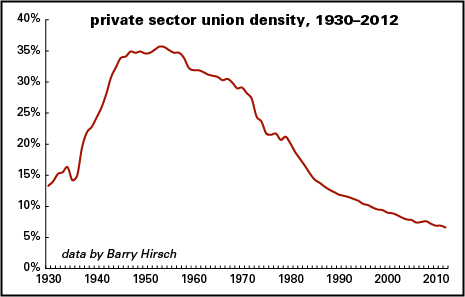
At recent rates of decline, private sector union membership won’t hit 0 until around 2201, but unions are on the verge of becoming an insignificant political and economic force, if they aren’t there already. This is very bad news to anyone who wants better politics and a more just economy. How to reverse this decline is a long conversation, but it would be good if some members of the labor establishment would act as if their movement is in crisis.
Not Sean McGarvey, head of the AFL-CIO’s building trades department, however. As it happens, just hours after the BLS released this grim data, McGarvey tweeted this recommendation that construction unions abandon their practice of exhibiting an inflatable rat at nonunion sites:
Meeting with our Presidents and state councils. Issued a call to retire the inflatable rat. It does not reflect our new value proposition.
— Sean McGarvey (@BCTDPrez) January 23, 2013
“Our new value proposition”! As Mike Elk reported, members were not consulted. This too is apparently part of the new value proposition.
Here’s a memory of Scabby, if he is indeed about to disappear.

More bogosity from Michelle Rhee
StudentsFirst, the school “reform” outfit led by the notorious Michelle Rhee, is out with a state-by-state Report Card on the nation’s schools. Grades were awarded on the basis of states’ conformity to the standard reform agenda—ease of creating charter schools, ease of firing teachers, ease of hiring teachers who aren’t certified in the traditional fashion, and testing testing testing. In the past, there’s never been any evidence that this agenda actually improves educational outcomes—and this report is no exception. Despite Rhee’s love of testing, there’s no mention of how states that do well under her criteria do on standardized tests compared to those that score poorly. That’s no surprise, really, since states that get high grades from StudentsFirst do worse on tests than those that score poorly.
Rhee’s group gave letter grades to each state, along with a GPA that allowed them to be ranked from 1 to 51. (DC counts as a state here.) No state got a grade higher than a B-, and only two states made that grade. Eleven states got an F. Tough! But do these grades mean anything?
To evaluate the StudentsFirst grades, I got 8th grade reading and math scores from the National Assessment of Educational Progress, aka NAEP, the Nation’s Report Card. Testing can be a debased pursuit when it’s used to measure individual schools and teachers (sample sizes are just too small, and there’s too much statistical noise from year to year to base anything on), but the NAEP is as good as they come for measuring broad trends.
Here are the results. StudentsFirst has Louisiana at #1 in its rankings—but the state ranks 49th in reading and 47th in math. North Dakota, which StudentsFirst ranks 51st, comes in at #14 in reading scores and #7 in math. Massachusetts, which ranks #1 in both reading and math scores (and which is also the most unionized state for teachers in the country), comes in at #14 on the Rhee scale.
Looking more rigorously at the results, the correlation coefficient on the rankings in the StudentsFirst report card with state rankings on reading scores is -0.20. (The correlation coefficient is a measure of the similarity of two sets of numbers, ranging from -1.0, completely dissimilar, to +1.0, perfect similarity.) That’s not a large number, but the negative sign means that the correlation is in the wrong direction: the higher the StudentsFirst score, the lower the NAEP reading score. The correlation on math is even worse, -0.25.
If you group the states by their StudentsFirst grades and look at the average test scores and rankings, you can understand why Rhee & Co. didn’t bother to get into outcomes. The two states that got B-’s did almost 8 points worse on math than those that got F’s, and over 9 points worse on reading. The B- states were toward the bottom of the rankings, and the F were above the middle. (And yes, 22-45 is -23, not -22, as the table suggests; the difference is a result of rounding.)
StudentsFirst grades and NAEP 2011 test results, 8th grade
         Rhee              NAEP scores           NAEP ranks
        grades          reading    math       reading    math
          B-             258.4     275.3        42        45
          C+             257.3     276.1        37        34
          C-             263.8     282.0        29        31
          D+             268.3     286.8        18        21
          D              263.5     283.3        30        26
          D-             266.2     285.0        23        24
          F              266.2     284.8        22        22

          F less B-        7.8       9.5       -20       -22
(For the full data, see this Excel spreadsheet.)
The results aren’t perfectly negative, and there’s not a perfect downward stairstep pattern in the NAEP columns on this table. But the evidence is nonetheless against Rhee. Alas, that’s the typical story of school reformers’ efforts. For a bunch of business-supported technocrats supposedly in love with metrics, there’s absolutely no empirical support for their ambitions. You might suspect that their real aim is to bust teachers unions and save money educating a population that elites have lost interest in.
Rhee herself has a rather checkered history. When she was being vetted to run the DC public schools, she claimed miraculous results in her previous work in Baltimore—but, as the Washington Post put it, “she could not produce data to support [her] statement.” That didn’t stop her from getting the job. And when she left the Washington post, an investigation by USA Today found strong evidence of cheating behind her claims of vastly improved test scores. And now she has a foundation, promoting the same agenda using data that can’t survive fact-checking. But the corporate and financial elite loves her education agenda, and when the elite loves you, there’s no blemish that can’t be overlooked.


