
Fresh audio product
Just posted to my radio archive web page:
April 28, 2012 James Livingston, author of Against Thrift, speaks up in favor of the consumer culture as a liberatory thing
April 21, 2012 Gar Lipow, author of Solving the Climate Crisis through Social Change, on the politics of averting climate change • Edward Luce, author of Time To Start Thinking, on American decline
The audio files have been there since the Friday before their broadcast on KPFA. But sometimes I take time to update the web page. Subscribe to the podcast (instructions are on the web page, or do it via iTunes here), and you won’t have to wait for my often-tardy HTML updates.
Employment laggard: the public sector
Paul Krugman notes that public sector employment has declined under Obama—a sharp contrast with his two predecessors, under whom it grew (with Republican Bush ahead of Democrat Clinton). How does recent experience stack up on a longer view?
Very unusually. Graphed below is the behavior of employment—total, private, and public—around business cycle troughs and recoveries. The darker lines are the averages of all the cycles since the end of World War II; the lighter lines, the most recent period, around the June 2009 trough. (Click on the graph for the full-sized version.)
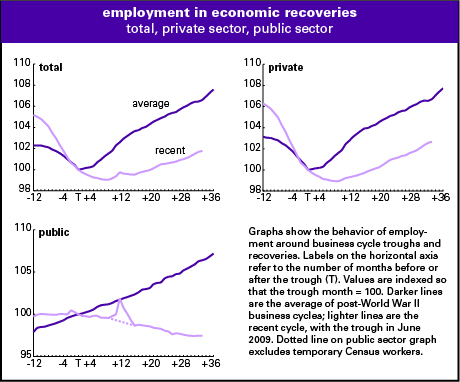
As of March, the most recent data we have, we were 33 months into the recovery/expansion. In a “normal,” or at least average, expansion, total employment would be up 6.6% (which is why the index number on the graph is 106.6). But now it’s only up 1.8%. But there’s an enormous divergence in public and private sector employment. In an average recovery, private employment would be up 6.7% and the public sector up 6.4%. This time, though, the private sector is up just 2.7% (4 points short of the average)—but the public sector is down 2.5% (almost 9 points below average).
Putting some numbers on that, total employment is 6.3 million below where it would be in an average recovery. (As the graph shows, the decline in employment was far deeper than average, and the recovery slower to kick in.) Of that shortfall, 4.3 million comes from the private sector, and 2.0 million from the public. So the public sector is responsible for about a third of the deficiency. But that’s twice its share of total employment.
No doubt yahoos will cheer the fall in public employment as a reduction in waste—though there’s no visible payoff in private sector job growth. (Of course, the yahoos don’t care about the continued deterioration in public services.) Public sector austerity is a major drag on the job market. If public employment had merely matched the anemic growth in the private sector, the unemployment rate would be more like 7.4% than 8.2%. And if it had matched its post-World War II average, the unemployment rate would be under 7%.
Propagandists love to go on about how the socialist in the White House is scaring the private sector, leading to a hiring strike. But public sector austerity—mainly at the state and local level—is a major drag on the job market. That doesn’t get anywhere the attention that it should.
Obama’s stock market: pretty good (if you care about that sort of thing)
Republicans and business interests have been relentless in their whining about how B. Hussein Obama has the “job creators” cowering under a reign of terror, what with his socialist policies and hostile rhetoric. But how have the monied been voting their approval or disapproval in one of their favorite venues, the stock market?
There, Obama’s approval rating looks even higher than Gallup’s version. Obama is now in the 40th month of his reign. Compared with the same spots in other presidential terms since 1945, Obama’s stock market is the third best, beaten only by Clinton’s second term and Eisenhower’s first. (See graph, below.) Adjusting for inflation has little effect on the rankings.
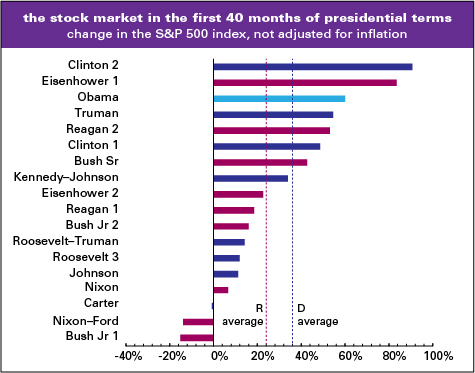
Since the beginning of Obama’s term in office in January 2009, the S&P 500 is up 60%—twice the average of all the 18 presidential terms since Roosevelt’s third. (Adjusting for inflation, Obama’s score is three times the average.) These results are not particularly surprising. The 40-month average for Democratic presidents is 36%; for Republicans, 24%. Still, Obama’s 60% is nearly twice his party’s average.
Of course, stock market returns have little to do with human welfare. In fact, you could argue that the boom in corporate profits—the fundamental reason for the strength in the stock market—has come at the expense of the working class, whose wage and salary income have gone approximately nowhere over the last three years. (Since the recession ended, profits have risen at almost eight times the rate of wages; in a “normal” recovery, they’d have risen less than three times as much.) But the notion that Obama has been “bad for business” is a hard case to make—not that it will stop it from being asserted.
New radio product
Some of these shows have been up as podcasts for a while, but I’ve just updated the web page. If you want timely delivery, subscribe to the podcast. Here’s the show’s iTunes page. If you prefer individual access, here’s some recent product:
April 7, 2012 Joel Schalit, co-editor of Souricant, on anti-minority violence in Europe 8 Saadia Toor, author of The State of Islam, on the history and politics of Pakistan
March 31, 2012 Dan Lazare on the awfulness of the Supreme Court (excerpt from a 2005 interview) • Jamie Webster ofPFC Energy, on the state of the oil market • Peter Frase, author of this, on the problem with sex work: work
March 24, 2012 Mark Weisbrot, co-director of the Center for Economic and Policy Researchon the Argentine model of default • Madhusree Mukerjee,author of Churchill’s Secret War,on Churchill, Britain, India, and famine during World War II
March 17, 2012 Alan Beattie, international economics editor of the Financial Times and author of the Kindle-only Who’s in Charge Here?, on botched policy responses to the crisis •Steingrímur Sigfússon, former finance minister and current Minister of Economic Affairs of Iceland, on that country’s unorthodox strategy towards the crisis
The Nation moves money, again
Forgive me if I’m looking obsessed, but someone has to do it. The Nation was out with an email blast this morning touting its branded affinity VISA card issued by UMB Bank in Kansas City. The magazine’s associate publisher, Peggy Randall, helpfully identifies UMB as “a small, regional bank recommended by the Move Your Money project, a project we support,” and therefore in accordance with the goals of the Occupy movement.
So who is UMB Bank, really? It’s yet another iteration of the classic Money Mover’s institution: flush with more money than it can invest locally, it loads up on securities. (Parenthetically, why should a magazine based in New York encourage doing business with a bank 1,200 miles away on localist grounds?) According to its latest annual report, 46% of UMB’s money is invested in securities, and another 6% is on deposit with other banks—which comes to over half. They don’t provide details on the securities, but they’re almost certainly a mix of Treasury bonds, mortgage bonds, and corporate bonds—utterly conventional financial market stuff. Just 37% is out in loans—and 0.8% in small-business loans, beloved of the small bank fanclub. They are big regional players in mutual funds, wealth management, and private banking, all moderately to seriously upscale stuff. And, like the big guys, they’re looking to make more money out of fees, rather than traditional deposit-taking and loan-making.
But that’s not all. UMB is big in the Health Savings Account (HSA) racket. HSAs, a snake-oil favorite of right-wingers, are tax-sheltered savings schemes that typically come with high-deductible health insurance policies attached. If you need a doctor, you can dip into the savings account, because you’re going to have to pay thousands of dollars out of your own pocket before the insurance kicks in. The philosophy behind HSAs was summarized in a recent press release (“UMB Announces 36 Percent Increase in Health Savings Account Balances”) by Dennis Triplett, CEO of UMB Healthcare Services:
We are excited to see the continued adoption and acceptance of consumer-directed health care plans by individuals looking to better manage current health care costs while saving for the future. Advantageous for the employee and the employer, consumer-directed health care empowers individuals to take personal responsibility for their health and expenses, and enables employers to better reign in rising health care costs.
Translation: if people have to pay through the nose to visit the doctor, they’re going to think twice before booking an appointment. That’s “empowerment” for you.
A number of studies (by the GAO, the Employee Benefit Research Institute, and the Commonwealth Fund) have found that while HSAs and associated high-deductible plans can save employers money, they also tend to attract the young, the healthy, the well-off, and people who think they’re unlikely to get sick. Taking the likes of those out of the broader insurance pool makes the remainder harder and more expensive to cover and does nothing for the currently uninsured. It’s an individualized, market-centered approach to the problem that is antithetical to everything The Nation stands for. But there’s nothing like the imprimatur of the Move Your Money folks to dissipate skepticism among those who wanna believe.
I don’t begrudge The Nation trying to raise money. God knows they need it (though, if truth be told, a Romney victory would probably put them deep in the black). And if an affinity credit card raises significant money for them, they should go for it. But it would be nice if they didn’t encourage political illusions about finance when shaking the cup.
On not staging a mock conversion to the right
Here’s a slightly edited version of my opening remarks at last night’s panel on the right, featuring Corey Robin and me, moderated by Christian Parenti, held at UnionDocs in Brooklyn. It was a fine event, and thanks to all who made it possible. Audio will be posted somewhere soon.
Given the day, I’d originally thought I would rue the absence of an actual right-winger on this panel, then recount my political history as a brief libertarian in my early college days, and announce my return to the fold after a long, frustrating career on the left—and ended with an April Fool’s!
I decided not to do this: 1) because it’s a cheap trick, and therefore beneath me, and 2) because my wife and counseling editrix, Liza Featherstone, pointed out that many of the critiques of the left I was going to use in my conversion narrative were critiques I’d want to use from inside the left, and by associating them with the right, I’d be discrediting the critiques. I was persuaded.
To steal a rhetorical trick from Gayatri Spivak, had I done that, I’d have said several things. One would have been to recall that during my right-wing days, Yale’s Party of the Right (for more, see here and here), to which I belonged in my undergrad days, began its meetings by reciting Charles I’s execution speech, which contains the startling revelation that affairs of government involve “nothing pertaining to” the people, because “a subject and a soveraign [sic] are clean different things.” And then his head was lopped off with an axe. This is absolutely odious stuff, and it’s amazing that an elite institution of the American right would baldly embrace something so deeply at odds with official American ideology, but the truth value I’d want to extract from it is that while we on the left often talk about democracy, the populace that’s been created by the alienating life under capitalism and the deeply antidemocratic structure of American government is full of incoherent and, to most of us in this room, often odious opinions. And that’s a problem for leftists who tout democracy.
Another point I would have made is that the left often bases itself on a sunny view of human nature, one utterly foreign to the right. Noam Chomsky, for example—and he’s certainly not alone in this—basically believes that humans are hardwired for decency and freedom, but they’re distorted by bad institutions. (For an analysis, see this essay by Joshua Cohen and Joel Rogers.) Aside from wondering how Chomsky knows this, I’d want to say that there probably is no human nature aside from the institutions that shape us, and we’re back to the problem of working with an unsatisfactory populace. It’s a lot easier to solve this problem when you’re an elitist. And on that point, had I announced my return to the right, I would have quoted for support these comments on Marxism from a liberal icon—someone admired even by some radicals, including me, John Maynard Keynes: “How can I adopt a creed which, preferring the mud to the fish, exalts the boorish proletariat above the bourgeois and the intelligentsia who, with whatever faults, are the quality in life and surely carry the seeds of all human advancement?” What an odd secret affinity between Charles I, the Party of the Right, and Anglo-American liberalism.
And, finally, and not unrelatedly, peace. For years, we had up in our apartment a poster that someone gave us for a wedding present that celebrated a Museum of Peace in Chicago, done by a German artist who’d been a Communist. It always kind of annoyed me, and I insisted we take it down the other week. I’m certainly no fan of violence, but somehow the celebration of peace seems drained of politics. And back in the days when Communists did such things, they were actually taking sides in the Cold War. There was something dishonest about using peace as a cover for a political struggle. But in a world as divided as ours, peace as an ideal seems to invoke, to use the old phrase, a premature reconciliation of contradictions—not to mention somewhat banal. Oppose every instance of American imperialism, yes—even in humanitarian guise. But if we want a better world, it’s probably not going to come without violence. In his introduction to Marx’s essay on The Civil War in France, here’s how Engels characterized the response to the earlier uprising of the French working class in 1848: “It was the first time that the bourgeoisie showed to what insane cruelties of revenge it will be goaded the moment the proletariat dares to take its stand against them as a separate class, with its own interests and demands.” We can see this reflex in modest form in the incredibly brutal police response to something as mild, so far, as the Occupy movement.
I would have said, as a pseudo-rightist, that dreams of peace are naïve; I’ll say something similar as the leftist I still am, though of course from a different perspective. And that’s no April Fool’s.
Yakking in Geneva…
…New York, not Switzerland. Not at all a disappointment, since Geneva, Switzerland, is one of the dullest major places I’ve ever been, and Geneva, New York, features the excellent Jodi Dean, who invited Liza Featherstone and me to speak at Hobart and William Smith Colleges. Jodi’s announcement:
Liza Featherstone and Doug Henwood on March 26 at 7:00 in Albright Auditorium, Hobart and William Smith Colleges, Geneva, NY
Liza Featherstone, “Occupy Schools: Education for the 99%”
A contributing writer for The Nation, Liza Featherstone is the author of Selling Women Short: The Landmark Battle for Workers’ Rights at Wal-Mart (Basic Books, 2004). Selling Women Short received an Outstanding Book award from the Gustavus Myers Center for the Study of Bigotry and Human Rights at Simmons College. Featherstone has continued to write about Wal-Mart’s employment practices, as well as other problems with its business model. Featherstone is the co-author of Students Against Sweatshops (Verso, 2002), which was named one of the best books of that year by the Madison Capital-Times. In addition to writing for the Nation, Featherstone has written for Slate, Salon, The New York Times, The Washington Post, Columbia Journalism Review, Babble, Newsday, The San Francisco Chronicle, The American Prospect, CNN.com, n+1 and many other publications. She is a frequent media guest, appearing on outlets as varied as CNBC, Fox News, the BBC, Al Jazeera English, and “Democracy Now.”
Doug Henwood, “Reflections on the Current Disorder”
Doug Henwood is the editor and publisher of Left Business Observer. The newsletter reports on the world’s financial markets and central banks, in addition to covering income distribution, poverty, energy, and politics. Henwood is a contributing editor of The Nation and hosts a weekly radio program on KFPA (Berkeley). His book, Wall Street, was published by Verso in June 1997. It is available for free download here. His book, After the New Economy, was published by The New Press in 2003.
Weirdness from EPI
Has the Economic Policy Institute been hacked, or are they undergoing a curious transformation?s just appeared on their email list:
|
![[Economic Policy Institute]](https://i0.wp.com/www.epi.org/page/-/img/epi_banner_600.gif)

Face-ripping for fun & profit
[Reading Greg Smith’s open resignation letter to Goldman Sachs in today’s New York Times, which described a systematic fleecing of clients as the institutional norm, reminded me of Frank Partnoy’s 1997 book F.I.A.S.C.O. Here’s my review, from LBO #80. If you like it, subscribe today and make sure it keeps coming.]
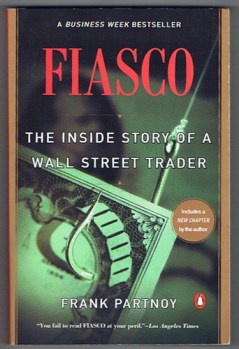
F.I.A.S.C.O., by Frank Partnoy (New York: W W Norton, 252 pp., $25).
It might be best to start a consideration of this revealing book from one of its final pages, where Frank Partnoy explains why he decided to end his brief career as a derivatives salesman at our snazziest investment bank, Morgan Stanley:
By April 1995 I had become … the most cynical person on Earth. I now believed everything was a fraud, and I had a well-founded basis for my beliefs. Derivatives were a fraud, investment banking was a fraud, the Mexican and Japanese financial systems were frauds …. The value system I had acquired in recent years included shooting at clients and blowing people up, all in the name of money …. Everyone I knew who had been an investment banker for a few years, including me, was an asshole. The fact that we were the richest assholes in the world didn’t change the fact that we were assholes. I had known this deep down since I first began working on Wall Street. Now, for some reason, it bothered me.
Of course, Partnoy and his colleagues didn’t literally shoot at clients. But they did brag about “ripping their faces off.” This was the ideal trade—one that involved unknowingly separating a client from a huge amount of money, even if the client’s actual face was left intact. According to Partnoy, the motto of his counterparts at Bankers Trust, an institution almost as prestigious as Morgan Stanley, was “lure them into the calm and totally fuck them.” Again, that was said of customers, not competitors. Remember, we’re not talking about some boiler room based in Vancouver or Fort Lauderdale, but two of the glitziest names in investment banking.
basics
Derivatives hit the headlines in 1994 and early 1995, when a bout of interest rate rises engineered by the Federal Reserve put the financial markets through a ringer and Mexico into crisis. Big companies like Procter & Gamble lost millions, big-time speculators went under, and Orange County went bankrupt. And then, thanks to our system of cultivated amnesia, derivatives largely disappeared from view. According to the most recent estimates by the Bank for International Settlements, at the beginning of 1997 there were some $35 trillion in derivatives outstanding worldwide, about twice as many as there were when Partnoy retired from the business in 1995. Unofficial estimates range from $40-60 trillion. To put those numbers in perspective, gross global product—the sum of all the world’s GDPs—is under $30 trillion.
 A derivative is a security whose price depends on—is derived from—something else. The simplest derivatives are (relatively familiar) instruments like futures and options. An option, for example, is the right to buy or sell something, like 100 shares of stock, at a given price over a given period of time. You may want to lock in a purchase or sale price today, even though you want to consummate the sale several months down the road, or you may simply wish to speculate cheaply on the price of the underlying asset. (These instruments are all explained at exhaustive, and possibly exhausting, length in Doug Henwood’s Wall Street.) But options and futures are straightforward stuff compared to the kinds of things that Partnoy once developed and sold. Instead of being traded on exchanges at prices and terms it’s pretty easy to understand, the complicated kind of derivatives are custom-tailored, usually for a specific buyer, on often obscure terms, and with little possibility of escape through sale to some other punter.
That’s all a bit theoretical, so maybe a few examples would flesh things out. Want to bet that Thai interest rates will rise and Malaysian ones will fall? An investment banker would be happy to customize a derivative for you. You may want to do this because you have some business in the two countries that put you at risk should the two national bond markets move against you—or you may just be a betting sort. Or maybe you’re a pension fund manager who isn’t allowed to borrow money to speculate in foreign currencies. Well, your investment banker can create something that looks like a government bond, and will pass regulatory scrutiny, but which is really a leveraged play on the British pound or anything else you’d like. Or maybe you’re the dimwitted treasurer of a county in Southern California, and you think interest rates will fall forever—and you’re so convinced of the fact, it’s not enough that you just buy bonds and hold them. You buy “structured notes” from Merrill Lynch and Morgan Stanley, that rise in value if interest rates fall, but in complex, incomprehensible ways. If interest rates rise, you can always file for bankruptcy. And if you’re a]apanese banker with big losses to hide, your friend at Morgan Stanley can create sham profits for you today—perfectly offset by sham losses some time in the future, but by then it’ll be somebody else’s problem; for the moment, all you want to do is deceive your shareholders and regulators. Indeed, it seems that lots of the troubles in Asia today are in part the deferred consequences of derivatives schemes concocted several years ago. Sometimes the client is the instigating party, sometimes the banker, but usually the banker has a better idea of what’s going on—not only of the risks, but of the giant fee buried in the complex details.
So, despite the textbook nostrums about derivatives existing to help society (meaning big investors) manage risk (meaning the wicked volatility in financial asset prices), derivatives are at least as much about embracing risk, evading regulatory scrutiny, and even avoiding taxes. While the financial environment is placid, derivatives will behave, delivering only routine losses, if at all but when things get nasty, as with the stock market in 1987, or Mexico in 1994, or Asia in 1997, they can blow up all over the place.
F.I.A.S.C.O. (the title comes from a drunken skeet-shooting competition called the Fixed Income Annual Sporting Clays Outing, in which the Morgan Stanley team was meant to sharpen its killer instincts) tells all these stories, and Partnoy even manages to accomplish the difficult task of explaining the derivatives themselves. He’s hardly a radical, nor does he have anything like a systematic view of how finance relates to the real world. Nor is his book as funny or as gracefully written as Michael Lewis’ classic Liar’s Poker. But as an insight into the crudity and rapaciousness of Wall Street culture, it’s the best thing in years. Even if derivatives don’t turn the next bear market into a rival of the 1929–32 disaster, or even if they don’t bring giant losses to the middle c1ass’s mutual fund investments, this book explains why the handful of people who work on Wall Street pull down so much money. It comes from ripping faces off, and sometimes the face-ripped don’t even know what’s happened to them.
Fresh audio product
Just added to my radio archives:
March 10, 2012 Vijay Prashad on Syria, Libya, and why not to give up hope on the Arab Spring • Sean Jacobs on that Kony nonsense, African reality, and imperial designs
Credit union switch fizzles
Last fall, there was a lot of buzz about moving money out of banks and into credit unions. Grand claims were made about results. I had my doubts—politically (see here) and financially (see here). One can disagree with me on the politics, but it turns out that not much money was moved.
The Federal Reserve is out with its flow of funds accounts for the fourth quarter. These are a detailed accounting of assets, liabilities, and money flows throughout the U.S. financial system. And before anyone says that the Fed is lying to defend its Wall Street constituency, consider that the main audience for these accounts is banks and bourgeois economists. You could probably count the number of radicals who study these accounts seriously without taking off your shoes.
So, here’s the verdict. In the fourth quarter of last year, credit union deposits increased by $9.9 billion, or 1.2%. In the same quarter, commercial banks increased their checking and savings deposits by $232.2 billion, or 3.5%. The increase in bank deposits (and my measure of this excludes deposits exclusively used by large financial institutions) was 23 times the increase in credit union deposits.
And what did the credit unions do with their very modest windfall? They actually reduced their consumer lending (things like credit cards and auto loans). They increased their mortgage lending, but they increased their purchases of federal agency (e.g. Freddie Mac and Ginnie Mae) and Treasury bonds considerably more. They also increased their short-term lending to commercial banks via the federal funds market—in fact, more than a quarter of their increase went there. As I’ve said before, they already have more money than they know what to do with. Put your money in a credit union and it’s more likely than not to end up in very orthodox pursuits.
Sure, we need a better financial system. We need tighter regulation of the old one and new institutions that can lend preferentially to worker co-ops and other non-capitalist enterprises. But this credit union thing won’t cut the mustard. As I’ve said before, it’s a matter of politics, not individual portfolio allocation decisions.
The February job market: not bad by recent standards
And now for the major economic news of the week, the U.S. employment report for February. It was another solid affair—the third month in a row of over 200,000 job gains, with plenty of supporting details. I do have some worries about the quality of these new jobs, not to mention their durability, but for now things are looking better than they did even a few months ago.
The headline gain of 227,000 came with upward revisions of 61,000 to the back months (41,000 to January and 20,000 to February). Gains were widespread through the economic sectors. Manufacturing extended its impressive recovery, adding a very respectable 31,000 jobs, with what the Brits call the metal-bashing industries in the lead. Mining and logging were also strong, reflecting a little-noticed (and environmentally worrisome) increase in domestic U.S. energy production. (Factoid: North Dakota has lately been producing more oil than Ecuador, a member of OPEC. Transportation and finance were modestly in the plus column.) Temp firms, bars and restaurants, and health care posted strong gains—the first two tenuous and not-well-paying sectors; health care has some good jobs and some bad jobs mixed in. Retail and construction were lost workers, among the few sectors that did. Government job losses slowed considerably—local gov was even modestly in the black.
Despite those decent job gains, it’s important to point out that they’re slightly below the long-term historical average, including recessions. It’s about a third below the rate typically seen in expansions (leaving out recessions, that is). But considering how bad things have been, modestly subpar seems exuberant.
Average hourly earnings were up a very weak 0.1% for the fourth month in a row. For the year, hourly earnings were up 1.9%. They’ve been running between 1.8% and 2.0% for more than two years now—below the rate seen during the Great Recession, and barely keeping up with inflation. This weak growth rate suggests that low-wage jobs figure disproportionately figure in the recovery.
The figures I’ve been quoting come from the monthly survey of several hundred thousand employers. The BLS also does a simultaneous survey of about 60,000 households. It’s rich with demographic detail, but the smaller sample size makes it more error-prone, especially in the short term. But the establishment survey can miss new startups, which can be especially important in times of economic recovery. So disparities between the two surveys can be analytically interesting. This month, the household survey was considerably stronger than its establishment counterpart. Employment rose 428,000—or 879,000 when adjusted to match the payroll concept. The unemployment rate was unchanged, but only because of a significant influx of new and returning workers into the labor market. The number of job losers was down for the month. And the number of people quitting jobs voluntarilty rose. Clearly the public is feeling increasing confidence in the job market. “Hidden” unemployment measures were either flat or down. Those classed as not in the labor force but wanting a job now rose trivially, and those working part time for economic reasons fell strongly. The broadest measure of unemployment, U-6, which includes unwilling part-timers as well as those who’ve given up the job search as hopeless, fell 0.2 point to 14.9%. Though that’s still tragically high, it’s still this measure’s lowest level since February 2009.
Only the extreme duration of unemployment categories saw an increase – those jobless for less than 5 weeks, and those without work for 99 or more weeks. Though down from its highs, the number of long-term unemployed remains very sticky, which is both a serious social and economic problem, as millions hang on the margins with deteriorating skills and attachment. But the rise in the number of short-term unemployed is what you’d expect as frictional unemployment—people briefly unemployed between jobs—begins to take precedence over the recessionary kind.
More on the household survey’s outperformance. On one hand, it’s encouraging, and suggests that the payroll survey may be missing some business startups, as it often does early in recovery/expansion periods. But the adjusted household survey has been outperforming since 2006. It showed fewer job losses in the recession and has staged a stronger recovery over the last two years. While the missing new establishment story no doubt figures here, it’s also likely that some serious structural issues are at play.
For example, a 2009 NBER working paper (pdf) by Katharine Abraham, John Haltiwanger, Kristin Sandusky, and James Spletzer finds that workers at the demographic extremes are most likely to be categorized as employed in the household survey but not by the establishment survey. That is, poorly educated, immigrant, and minority workers are more likely than average to be employed off the books, and highly educated, skilled workers are more likely to be employed as independent contractors. Given employers’ reluctance to make lasting commitments these days, it’s quite likely that growth in these sorts of less-than-formal employment arrangements is an important factor in the labor market recovery (and also cushioned the recession’s blows). These are jobs, but not stable ones with benefits.
So, all in all, a decent employment report. But in 2010 and 2011 we saw a run of strength early in the year, followed by a deterioration as summer arrived. There was a similar pattern in 2004, but it did not repeat in 2005, as strength was sustained beyond spring. Perhaps this pattern of growth followed by a fade is a seasonal adjustment quirk, or a more structural feature of early recoveries. But maybe 2012 will be the year when recovery finally takes hold, and we can start putting all the post-crisis wobbliness behind us. Of course, we’ve still got over 5 million jobs to recover that we lost in the Great Recession, not even allowing for population increase. We also still have all kinds of long-term structural problems, like a lack of economic dynamism, polarization, a debt overhang. But things are getting better, slowly and tenuously better.
New data on student debt from the NY Fed
The Federal Reserve Bank of New York is out with some new data on student debt (“Grading Student Loans”). Two major highlights: beware of using simple averages, and, more strikingly, more than one in four borrowers is behind on payments—more than twice the share of other forms of personal debt.
First, the debt levels. Total student debt is about $870 billion—more than credit card balances ($693 billion) and auto loans ($730 billion). That’s an enormous number, but economists have paid it little attention—surprising, considering the attention paid to household finances. And student debt continues to rise, even though most other forms of personal debt are flat or even down, as consumers engage in the process that Wall Street likes to call “deleveraging.”
About 37 million people owe student loans, or 15% of the population. But the age profile of the debtors, not surprisingly, skews young. Over 40% of people in their 20s are on the hook, and 25% of those in their 30s. But just 7% of those 40 and over have student loan balances. Two-thirds of the debt is owed by people under 40, who are not known for their high incomes.
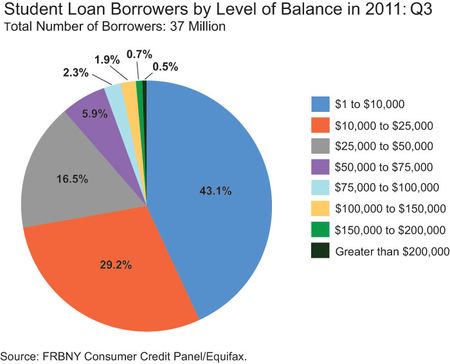
If you divide debt outstanding by the number of debtors, you get an average of $23,300. But that average is pulled upwards by a minority who are deeply in debt. The median debt is about half that mean, or $12,800. Here’s the New York Fed’s breakdown of the high-balance numbers:
About one-quarter of borrowers owe more than $28,000; about 10 percent of borrowers owe more than $54,000. The proportion of borrowers who owe more than $100,000 is 3.1 percent, and 0.45 percent of borrowers, or 167,000 people, owe more than $200,000.
Or, in a picture:
How are debtors doing in servicing the debt? On first glance, about 1 in 10 borrowers is behind on payments, which is about the same ballpark as credit cards, mortgages, and auto loans. But that first glance is very misleading because many borrowers—nearly half, in fact—are enjoying deferments until graduation and even grace periods beyond that. Adjusting for those, the New York Fed finds more than 1 in 4—27%—of borrowers at least one payment behind.
That’s an enormous level of distress—and it suggests than many more debtors are really stretching to make payments. And with debt levels rising, the level of distress isn’t likely to subside anytime soon.
As I wrote in LBO a while back (“How much does college cost, and why?”):
It would not be hard at all to make higher education completely free in the USA. It accounts for not quite 2% of GDP. The personal share, about 1% of GDP, is a third of the income of the richest 10,000 households in the U.S., or three months of Pentagon spending. It’s less than four months of what we waste on administrative costs by not having a single-payer health care finance system.
But we can’t do that—it’d be un-American.
Fresh audio content
Just posted to my radio archives:
March 3, 2012 Trudy Lieberman on health care reform so far • Yanis Varoufakis on the Greek debt deal and economic collapse
Morning again in America?
So it looks like Obama plans to sing from the Reagan songbook for his campaign—specifically from the “Morning in America” pages. In case you were too young the first time around, or now are too old to remember, the original went something like this:
The logic is this: Reagan got re-elected during the recovery after a deep recession, so Obama can do the same. Also, Reagan whipped Grenada’s ass and Obama killed Osama.
Foreign victories don’t count for much in election campaigns but economic conditions count a lot. So how bright is Obama’s morning compared to Reagan’s?
TPM took a look at this question earlier today (Is It Morning — Or Dawn — In America?), but in a very incomplete way. Here’s a broader look. And the answer is: not as bright as 1984, actually.
For most people, what matters most is the job market. And today’s job market lags 1984’s.
First, total employment.
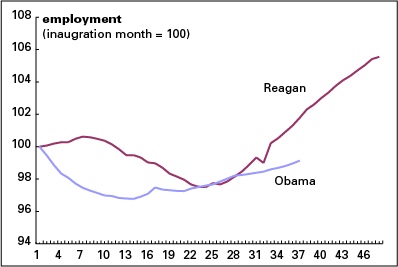
Both presidents endured sharp hits to employment (though for Obama, the declines extended those of his predecessor). Obama’s hit was earlier and deeper than Reagan’s. But Obama’s recovery has been weaker. By Reagan’s 37th month in office, employment was nearly 2% above where it was when he was inaugurated; for Obama, employment is still down almost 1%.
Now unemployment.

Reagan suffered a higher and later peak in unemployment (10.8% in month 23, compared to Obama’s 10.1% in month 10), but enjoyed a much steeper drop. As of the 37th month, Reagan’s unemployment rate was 8.0%, a decline of 2.4 points from a year earlier. Obama’s 8.3% is just 0.8 point down from a year earlier. And Obama’s unemployment rate is worse than it looks, since vast numbers of people have dropped out of the labor force and therefore aren’t counted as unemployed. In the year before Reagan’s 37th month, the participation rate—the employed plus the unemployed as a share of the adult population—rose by 0.1 point, as people were drawn into an improving job market. Obama’s, however, is off by 0.5 point, as people discouraged by job prospects give up on the search.
As LBO has shown in the past, you can explain most post-World War 2 presidential elections using a model consisting of just two variables—inflation-adjusted after-tax income per capita and presidential approval. If income is positive and approval over 50%, the incumbent or another member of his party is highly likely to win. Things are not looking so good for Obama on that score—though the model is best when run with numbers for the spring, not the late winter, so let’s hold off on predictions for a few months.
Here’s the income comparison. (Officially the measure is known as real disposable personal income [DPI] per capita.)

DPI took a much sharper hit under Obama than Reagan, and has been flat for a year-and-a-half. DPI is still 0.4% below where it was when Obama took the oath of office. The comparable figure for Reagan is up nearly 8%. DPI is an average, and can be distorted upwards by action at the high end, but it’s still a decent broad measure, and by that measure, Obama’s doing very badly. (Not that it’s his personal fault, of course.)
And how about approval? On that, Obama’s doing a little better than might be expected given those crummy income numbers—but still, Reagan was 9 points ahead of Obama (54% vs. 45%). And Reagan was up 17 points over the previous year—Obama’s down 4.
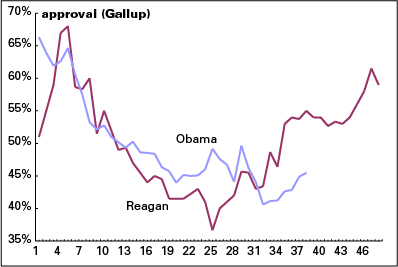
So is it morning once again in America? Not really. Predawn maybe.


 LBO News from Doug Henwood