
Fed sees a gloomier future
The Federal Reserve is just out with its latest economic projections. Since the last edition in June, they’ve turned gloomier for the short, medium, and long term. They see growth as slower, and unemployment as higher, for 2011, 2012, 2013, and for the “longer run” than they did just three months ago. For this year, they’re looking for GDP growth to average 1.6–1.7%, compared with a projection of 2.7–2.9% in June. They see unemployment as staying in its current 9.0–9.1% range, instead of falling into the high 8s. For next year, they see growth at around 2.7% instead of 3.5%, and unemployment around 8.6% instead of 8.0%. And for the long run (in which we’re all dead, of course), they’re a little gloomier than they were in early summer (I’m not quoting numbers, lest reader fatigue set in—they’re at the link). Their forecast for very modest inflation remains unchanged.
What does this all mean? One, the Fed is likely to remain very indulgent. I don’t get the complaints coming from a lot of left–liberals about they’re not doing enough. They’re doing about all they can, given the limits of monetary policy amidst such economic wreckage. They need fiscal help, and they’re not likely to get it. Two, the recovery from the economic crisis is likely to take even longer than most prognosticators prognosticated; the Fed has a pretty good track record in forecasting. And three, elite projections for the long term—not just the Fed, but the CBO as well—are quite gloomy, and popular discourse hasn’t really caught up to this fact.
Maybe they’re wrong, and a boom will take us by surprise. But even so, shouldn’t we be talking about this openly?
White people can surprise you sometimes
Here’s a fun factoid that surprised me when I discovered it: 60% of white Americans think that the best approach to lowering the crime rate is attacking social problems, not tougher law enforcement.
The exact question:
Which of the following approaches to lowering the crime rate in the United States comes closer to your own view–do you think more money and effort should go to attacking the social and economic problems that lead to crime through better education and job training or more money and effort should go to deterring crime by improving law enforcement with more prisons, police, and judges?
A fuller demographic breakdown is at the source, but here are the white/black numbers:
                   social problems            law enforcement
    white               60%                          35
    black               85                           12
Black opinion is obviously a lot more enlightened on this question than white, but a 60% majority with a 25-point gap in favor of decency is a very pleasant surprise. (The language is also not the most favorable to evoking a civilized response: “spending more money” is right out there, and it’s not easy argue with “improving.”) The results do make you wonder what the fuck people are thinking when they vote.
Angela Davis’ advice: identify with the defeated?
There are many things I admire about Angela Davis, and I have warm memories of being on a panel with her at Rethinking Marxism 2000. She was wise and very gracious. But she reportedly told the OWS gathering at Zuccotti tonight to: 1) identify with Troy Davis, and 2) study the Attica prisoners for pointers on how to become a “dangerous class.” I have two problems with this: 1) Troy Davis is dead. His execution was a crime, but as anything but a moral force, he’s dead. And 2) the Attica prisoners were utterly crushed. Many of them are either dead or still behind bars.
The American carceral state is an appalling horror, a grotesque form of social control. But most people are not in prison. There are about 70 times as many employed members of the working class as there are prisoners in the U.S. Even among African Americans, there are about 30 times as many employed as there are behind bars. There are about 6 times as many black unemployed as there are prisoners. Yet if you judged by a lot of left discourse, the modal black American is a prisoner.
Why such an emphasis on people with no social power? The working class produces everything of value, and could shut it all down tomorrow if it wanted to. I’d be the first to say that too much behavior is criminalized, there are way too many people behind bars, and our prisons are miserable places. But the only reason to have any hope for social transformation is that “we are many, they are few.” In strictly numerical terms, there are about as many prisoners as there are members of the bourgeoisie. Revolutions are not made by the most marginalized members of a society.
Don’t get me wrong…
After the previous post, on the problems of leaderlessness, I don’t want people to get the wrong impression. I feel nothing but deep admiration and gratitude for the Occupiers—in Zuccotti and elsewhere, from Tunis to Melbourne. As I stepped out into the cold rain this morning to pick up the papers—which included that Roula Khalaf piece—I thought: man, it must suck to be camping out in this. But I’m so happy there are people who do it anyway.
So when I post something like that Khalaf excerpt, I want to remind people that we have to think about how an occupation can be made truly, materially transformative. There are people who dismiss that sort of concern as old farty parade raining (actual weather aside). Some think we shouldn’t even talk about such things. But we should. It doesn’t mean I love the Zuccottians less. It means that I love them so much that I don’t want to see all their courage and tenacity become little more than an enchanting memory.
Complications of leaderlessness
From a piece in today’s Financial Times by their Middle East editor, Roula Khalaf:
Well beyond the scene of bloodshed, the mood of Cairo was transformed, from euphoria to frustration. The memories of that glorious February moment in Egyptian history were fading as people were stuck back in the grind of daily life, finding that little had changed. In Tahrir Square, I looked for a monument to the revolution and its martyrs, but could find none, as if the upheaval has not reached its conclusion. The youth movements that mesmerised the Arab world with their formidable leadership of the revolution have splintered, failing to coalesce into a political organisation that can influence the future. Many of them want to keep up the pressure, now on the army, by returning to Tahrir on Fridays. Much of the rest of the country, however, wants peace instead of more turmoil.
Israa Abdel Fattah. The blogger was one of the most prominent young activists of Tahrir Square
“The problem for us is that we prepared for the January 25 protests without knowing it would be a revolution. We made the desert fertile but we didn’t know how to plant it,” Israa Abdel Fattah, one of the most prominent young activists of Tahrir Square, told me. “We came from different ideologies and after the revolution we joined different political parties. Maybe we should not have left the square, maybe we should have chosen a few people from Tahrir to rule.”

New radio product
Freshly posted to my radio archives, ending a three-week fundraising hiatus:
October 28, 2011 sociologist Alex Vitale on cops and protest • journalist Sarah Jaffe on OWS, mostly
OWS: rising to discursive hegemony!
Well, maybe not exactly. But here’s the cover of the October 24 New Yorker:
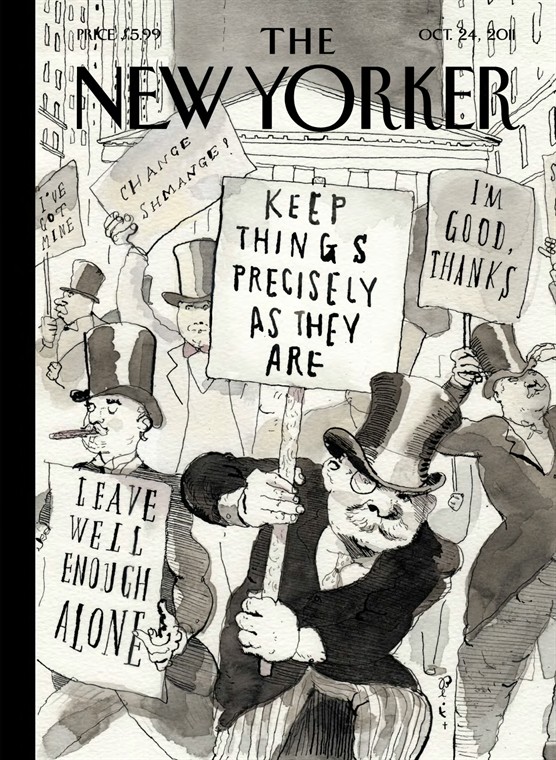
Yeah, it’s funny. Caricatured elites protesting to defend privilege. But Occupying Wall Street is setting the agenda. Bourgeois organs have to respond, if only ironically. Bush’s speechwriter Matthew Dowd used to say that if you oppose us while still using our language, we’re winning. Looks like someone different is winning, at least for now.
Civil disobedience against NYPD’s stop & frisk
It looks like OWS is giving the movement against the NYPD’s stop & frisk policies—under which literally hundreds of thousands of young males are patted down by cops—a shot in the arm. This press release just in:
For Immediate Release
Activists to shut down 73rd Precinct in Brownsville
Stop ‘Stop and Frisk’ Comes to Brooklyn
New York, NY, Oct. 28, 2011 – Nonviolent civil disobedience is on the agenda as local activists, community members and religious leaders gear up to challenge the NYPD’s controversial ‘stop and frisk’ practices at the 73rd Police Precinct in Brownsville, Brooklyn. The 73rd Precinct has the highest rate of stops-and-frisks in New York City.
The Stop Mass Incarceration Network, on Nov. 1 at 4 PM, will stage the second of a series of similar events in neighborhoods around New York City targeting to stop the repressive NYPD practice of Stop and Frisk – a policy the Center for Constitutional Rights, the New York Civil Liberties Union and other advocacy groups have challenged as illegal. On Friday, October 21, a group of more than 200 demonstrators marched on the 28th Precinct in Harlem where 34 community members, activists, and allies from Occupy Wall Street, were arrested for blocking the entrance to the police station. Among those arrested were Dr. Cornel West, Carl Dix of the Revolutionary Communist Party, Debra Sweet of World Can’t Wait, Rev. Stephen Phelps of Riverside Church, and comedian/activist Randy Credico.
During 2010 NYPD recorded more than 600,000 warrant-less stops — the vast majority Back and Latino youths — and are on pace to top 700,000 in 2011. This is up from 86,000 just ten years ago. The stop and frisk exchange, the humiliating is first step into the pipeline of mass incarceration and criminalization of minority young people. It is often a young man’s first introduction to the police in his neighborhood. It leaves an indelible stain on a young man’s self-awareness, and antagonizes and terrorizes community members. A handful of police officers have stepped forward to oppose the policy — documented by the Village Voice, and by WABC-TV News — which has been loudly supported by Commissioner Ray Kelly and Mayor Mike Bloomberg. Recent news reports of police involvement in gun smuggling, traffic ticket fixing, and the routine planting of illegal drugs on innocent persons have further added spotlight to illegal activities associated with the NYPD.
According to Dix, “mass resistance” is needed because the NYPD is “harassing and humiliating a lot of innocent people. And then we’ve also seen cases where these stops escalate to beat downs, arrests, and even people being killed….it is a burning injustice and we want to tap into what we feel is a supportive mood around resisting it, and to link in with people who are trying to deal with it on other levels, whether that’s through the courts, political, the electoral arena.”
On August 3, 2011 a Federal Judge rejected an effort by the City of New York to thwart a lawsuit filed by The Center for Constitutional Rights (CCR) that challenges the NYPD’s stop-and-frisk policy and practices. In a statement issued earlier this year CCR said that “for many children being stopped by the police on their way home from school has become a normal after school activity and that is a tragedy.”
Wednesday, October 19, 2011, Manhattan Borough President Scott Stringer and State Senator Eric Adams called for a federal probe of the policy, saying that it is “emblematic of a police culture that disregarded the civil rights of young black and Hispanic men.”
Media outlets such as the New York Times, NY1, New York Daily News, Salon, Democracy Now and the Guardian have covered the campaign to Stop “Stop and Frisk” here in New York.
Carl Dix, Rev. Phelps and other Oct. 21st arrestees are available for interviews.
-30-
—
Media Liaison Team
“Stop Mass Incarceration: We’re Better Than That!” Networkc/o P.O. Box 941 Knickerbocker StationNew York City, New York 10002-0900Phone: 973-756-7666 or 866-841-9139 x2670 * Email: stopmassincarceration@ymail.com
The “Stop Mass Incarceration: We’re Better Than That!” Network is a project of the Alliance for Global Justice, a 501c3 tax-exempt organization. Tax-deductible contributions accepted, and checks should be made payable to the “Alliance for Global Justice, with “Mass Incarceration Network” in the memo line. Other forms of contributions also accepted.
It really is about that 1%
Wow, that top 1% is doing really, really well, you’ll not be surprised to hear. Everyone else, not so well.
The Congressional Budget Office is out with some new stats on Trends in the Distribution of Income over the last three decades. Between 1979 and 2007, here’s how various slices of the population did in real (inflation-adjusted) income growth after federal taxes:
- top 1%: +275%
- next 19%: +65%
- middle 60%: +40%
- bottom 20%: +18%
Or, in graphic form:

The stairstep pattern—the higher you go up the income ladder, the stronger the growth—is remarkable.
As a result of this vastly unequal growth, the share of after tax income by population slice grew vastly more unequal:
- top 1%: 8% in 1979 to 17% in 2007, more than doubling
- next 19%: 35% in 1979, 36% in 2007, barely changed
- middle 60%: 50% in 1979, 43% in 2007, down 7 points
- poorest 20%: down 2 points, from 7% to 5%
Or, in a picture:
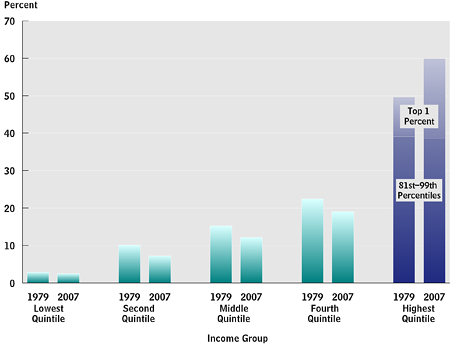
As of 2005, the share going to the top 20% surpassed the share going to the bottom 80%—though as the breakdown shows, most of this shift came from the very top. In 1979, the top 1% claimed about the same share as the bottom 20%; as of 2007, the top 1% hogged as much as the bottom 40%.
It really, really is 99 vs. 1.
Lower limits of income groups, after federal taxes and transfers (table A-1 in the full report):
lowest 20%      $      0
second 20%        18,979
middle 20%        29,759
fourth 20%        42,202
81st percentile   60,557
91st percentile   81,135
96th percentile  109,006
99th percentile  252,607
Keynes on bizmen as “domestic animals”
This is from a February 1938 letter by John Maynard Keynes to Franklin Roosevelt, expressing his alarm at the return to slump in 1937–38, and offering suggestions on how to reverse it. I’ve cleaned up a few marks and jacked up the contrast to make it more legible. The whole letter is really worth reading; it’s full of sentences like “The handling of the housing problem has been really wicked.” The bourgeoisie doesn’t make them like these two anymore. (Click on the graphic to enlarge it.)

Thanks for the pointer, Mike Konczal.
Creeps busting brooms, stealing trashbags at OWS
A startling bit of news from last night’s OWS Demands Working Group meeting. Someone from the Sanitation Committee at Zuccotti reported that they’re in desperate need of brooms, dustpans, and garbage bags. Someone—cops? freelance thugs (as opposed to the professional uniformed thugs)? pranksters?—has been sneaking in at night and breaking the broom handles and stealing the dustpans and trashbags. Since keeping the park clean is Mayor Bloomberg’s preferred excuse for a clampdown, this is ominous.
If you’d like to donate some of these goodies, please drop them by the park. The THE YIPPIE MUSEUM (9 Bleecker St) and Lucky Cheng’s (1st Ave and 1st St) are also taking donations.
The OWS Demands group meets
Last night, I went to the meeting of the OWS Demands Working Group, held in historic Tompkins Square Park, scene of many a riot and other kind of uprising in its 161-year history. There were about 75 people there, to discuss what to do with the draft set of demands that the group had passed past week.
On Friday, I wrongly reported that the OWS General Assembly had rejected the draft and disavowed the working group. In fact, the GA hasn’t even discussed the issue. According to people at last night’s meeting, whoever controls the website issued the statement of disavowal and deleted the accounts of some participants, making it impossible for them to participate in online discussions of the issue. The “whoever” is accurate: no one seems to know the identity of the website’s controllers, who nonetheless purport to speak for the organization. With such a freewheeling organization, if that’s the right word, lines of responsibility and accountability are very murky.
That statement of disavowal claimed that the Demands group does not work by consensus. From what I saw, it certainly does. Everything was extensively processed, and with hand signals as complex as those that used to prevail in the (now largely deserted) trading pits of the major futures exchanges. Perhaps the controllers of the website are scandalized that the Demands group works by “modified” consensus, meaning a 75% vote is necessary for something to pass (though as Michael Pollak reports below, they’re not alone in this). But what in this life—even the beauty of a clear blue sky on a crisp October day—could get 100% approval?
I must admit that I am not cut out for these sorts of meetings. When it started, at 6 PM, there was a discussion of whether to go to midnight, when the park closes, or try to cut it off at 9. The thought of standing outside for three hours filled me with fear, and so I left at 7:30. But my good friend Michael Pollak had the—well you can’t call it Sitzfleisch, so, Stehenfleisch maybe?—to stick it out. I admire people like that, and wish I could be more like them. Here’s Michael’s report:
There seems to be some misconception that the Demands Group is a bunch of outsiders. It is not. This is a argument within the Occupy Wall Street movement.
The Demands Group is a working group just like any other working group. Yesterday evening I spent three hours in the park taking part in their meeting, and I can attest, it was run scrupulously according to consensus procedures under experienced facilitators. And frankly it was one of the most satisfying consensus meetings I’ve taken part in. There were (a changing average of) 60 people, there were heated disagreements, and the proposals and counterproposals were modified so that they visibly came closer together while retaining what emerged as their respective most crucial points. And while each individual proposal was defeated or unable to get off the ground by itself, the final joint/modified proposal passed by a modified consensus, i.e., 75%. And it was a consensus in the real sense of the term. It was strongly supported. The opposed sides had come together. The final product was only possible because both sides had convinced each other that they would carry out their side of the bargain in good faith. And you could feel that everyone involved was palpably chuffed at the end. Tired, wired and cold, but chuffed.
The basic upshot is that there will be tons of liasing in the next few days with other occupation working groups and with community groups; there will also be teach-ins at Zuccotti Park and canvassing there; we will encourage representatives of all these groups to join us for our meeting on Thursday with their proposed amendments or concerns or questions (or support for the proposal at it stands — also an option); everyone present at the Thursday meeting will vote on amendments to the proposal that grow out of this liasing; and we will present the amended proposal to the general assembly on Sunday at 7pm, where it will be argued at length, amended as the GA sees fit, and voted on, according to consensus rules. (Important aside: switching to modified consensus when you can’t attain full consensus, and having this identified as three quarters approval—and not a person less—seems to be already SOP in many OWS working groups. It is not a new innovation invented by the Demands Group.)
The OWS General Assembly has never been made up simply of people who sleep in the park. The General Assembly has always explicitly been made out of whoever shows up for the meeting that day. This is part of its anarchist nature, and part of the whole idea of a prefigurative experience: anyone is free to take part and be transformed through transforming. (And it is just as much a part of working groups. In the Demands Group tonight, three quarters of the people there hadn’t been to prior meetings, but everyone had full talking, blocking and voting rights.) The Demands Group meeting today contained a spectrum of people from 24/7 occupiers; though people who sleep at home but participate daily; up through people who were energized to participate for the first time tonight precisely because the ideas of demands in general or these particular demands excited them.
So this isn’t an outsider group operating by principles foreign to OWS. This is the occupation operating by its own principles. It is a discussion and argument within the occupation.
And BTW, if anyone feels like a visit to OWS anytime soon, Sunday at 7pm would be a great time.
Background info for anyone wanting to get involved in the Demands Group:
The Demands Group has a listserv on Yahoo Groups: OWS Demands Working Group. (If you don’t already have a Yahoo account, you need to open one to join. You can, however, adjust it to send the messages to your normal email. It looks like there is option to do it without that step by logging in using Google or Facebook, but that is just a cruel trick. It has an acknowledged bug that leads to an endless loop. But that’s the way Yahoo works.)
The Demands Group has been meeting bi-weekly on Tue at 7 at Sun at 6 at Tompkins Square Park. Both those meetings have been changed for this week to meet the demands of liasing and presenting. The Tuesday meeting will be on Thursday this week, and it will be at 60 Wall Street, an indoor Atrium where many working groups meet. It is a similar private/public space to Zuccotti, except this one closes at 10pm, so the meeting has to end then. (This BTW, can be a great help to consensus. The meeting last night had an agreed ending time of 3hrs after starting too, and it really focussed minds at the end and helped in forging consensus.)
The Plan B meeting point for Thursday (if we can’t get the Atrium) will be Washington Square Park, not Tompkins. I’m not sure under what conditions we’d need to go to Plan B.
Washington Square Park may possibly replace Tompkins in the future.
The Sunday meeting this week that would normally happen on Oct 30 will be replaced by showing up to the General Asssembly.
For the record, a delegation from the Demands Committee will be meeting with the Facilitation Committee on Tuesday about getting on the Agenda for the General Assembly for Sunday (just in case you see that referred to in the listserv.)
Taking the measure of OWS
Pollster Doug Schoen, who’s worked for Bill Clinton and Michael Bloomberg, sent a researcher into Zuccotti Park on October 10 and 11 to take the measure of the Occupiers. Schoen wrote up his conclusions from this effort in a now-discredited op-ed in the Wall Street Journal:
Our research shows clearly that the movement doesn’t represent unemployed America and is not ideologically diverse. Rather, it comprises an unrepresentative segment of the electorate that believes in radical redistribution of wealth, civil disobedience and, in some instances, violence.
As several writers have pointed out, notably Azi Paybarah, Schoen misrepresented—to put it kindly—his own research. They’re not the radicals of his phantasmic summary.
A better overview was developed, using Schoen’s data, by John Nienstedt of Competitive Edge Research in San Diego, who posted it to the listserv of the American Association for Public Opinion Research (AAPOR), of which I’m a member. AAPOR etiquette requires members to ask permission of authors before reporting on their posts, and I’ve gotten that. Nienstedt asked me to point out that he’s totally nonpartisan and independent, which I’m happy to do, because he is.
Here’s Nienstedt’s taxonomy of the protesters:
8% Radical
4% Radical redistribution of wealth
4% Dissolution of our representative democracy/capitalist system53% Liberal
35% Influence the Democratic Party the way the Tea Party has influenced the GOP
9% Engage & mobilize Progressives
4% Single payer health care
4% Pull out of Afghanistan immediately5% Conservative
5% Overhaul of tax system: replace income tax with flat tax
27% Process-oriented (don’t neatly fit in my continuum)
11% Break the two-party duopoly
9% Promote a national conversation
7% Direct Democracy8% Not sure
In other words, more than half are liberal, Democrats even, and less than one in ten are radicals—the same share who aren’t sure of what they are.
Though it’s all we have now, we don’t really know how accurate Schoen’s polling was. But if it’s anywhere near the truth, it really makes you wonder about the governance structure of OWS. By its own representation, the gathering is run by consensus and its official statements are supposed to be approved by a general assembly. But the GA’s decisions—like purging the Demands Working Group—may not be as democratic as they claim. More on this after I visit the Demands group’s meeting tonight.
In another post to the AAPOR listserv, Mike Mokrzycki—who also asked me to emphasize that he’s totally nonpartisan, so nothing he says should be construed as taking a political position—noted that OWS may be more popular than the Tea Party. As he points out, CNN/Opinion Research apparently stopped asking people if they were “active members” of the TP because they couldn’t get more than 2% of respondents to identify themselves as such. 2%! The TP does draw the sympathy of about 25% of the population. But most surveys show that a larger share of the public has a positive view of OWS than of the Tea Party. Of course, OWS doesn’t have billionaires funding its agenda.


 LBO News from Doug Henwood