
New radio product
Just added to my radio archives (click on date to get right to link, or other links to get more info about guests):
November 12, 2011 Yanis Varoufakis on the latest developments in the Eurocrisis • Ramsey Kanaan, co-founder of PM Press, on the theory and practice of anarchism
Me and some other guys on a panel
I’m going to be on a Platypus panel on the crisis of the left. Sorry it’s an all-male cast, but I had nothing to do with it.
an international forum on the
CRISIS OF THE LEFT
Chicago*NYC*Philly*Boston*Thessaloniki, Greece
Crisis: Pathol. The point in the progress of a disease when an important development or change takes place which is decisive of recovery or death.
“…Existing strategies and theories seem inadequate in a bewildering contemporary political scene. Disparate groups have begun to show an interest in rethinking the fundamentals of Left politics…”
@New York: Wednesday, Nov. 16th, 7:00 – 9:30pm
Silver Center, Room 207
31 Washington Place, New York, NY
NYU
Speakers:
Paul Berman (nyu), Carl Dix (rcp-usa), Doug Henwood (lbo), Bertell Ollman (nyu), Marco Roth and Nikil Saval (n+1)
Many on the Left feel a sense of crisis.
Existing strategies and theories seem inadequate in a bewildering contemporary political scene. Disparate groups have begun to show an interest in rethinking the fundamentals of Left politics. The Platypus Affiliated Society seeks to make the conversation explicit, and to host a series of discussions about the crisis of the contemporary Left: its quality, causes, and significance for future reconstitution and transformation.
Across five cities worldwide, we’ve invited figures from across the Left–academics, political organizers, theorists–to answer and debate six fundamental questions. We also pose these questions to the Left as a whole and invite responses from all quarters. The questions below stem from confusion; taking nothing for granted, we hope that confronting this confusion might open up future possibilities for renewed consciousness and practice on the Left.
for more information about the Crisis of the Left series, visit our Facebook event page, or Platypus in NYC, or Crisis of the Left
More on credit unions
From a post to the lbo-talk listserv, which I moderate:
A big CU failed in South Florida a few years back. They’d been investing in subprime CDOs, actually. Another few failed in FL and out west – they had large member business ADC loan exposure to projects that stalled at the acquisition phase. Just browse the NCUA news center and marvel at the number of CUs placed into conservatorship or acquired by other CUs in NCUA-facilitated firesales
I’ve seen stats saying 2/3s of credit unions don’t have any meaningful member loans, and that the dollar majority of all CU business loans is simple syndicate participation by the very largest of CUs.
These guys largely fail on their own terms (lack of scale/competence – looking at one of these recent failures, I see it had 429 members and $1.3MM in asssets; how the hell can you even keep the lights on?) or quickly grow into facsimilies of the big boy. [See below-Ed.].
Oh, and the NCUA’s being pushed to allow greater use of derivatives to moderate interest rate risk as we speak.
A visit to the NCUA’s news pages do confirm this. For example:
- Last August, the NCUA sued Goldman Sachs over the sale of some bad mortgage securities. Earlier, they’d sued JP Morgan and RBS on similar grounds, and more suits are anticipated. The bad securities—which, according to the NCUA, the Wall Street bankers had (familiarly) claimed were blue chip—led to the failure of five wholesale CUs, which are entities that act as bankers to smaller CUs.
- On October 27, the NCUA put the Birmingham (Alabama) Financial Federal Credit Union—which had just 429 members and $1.3 million in assets—into conservatorship because of fatal losses. Unlike too big to fail, this one was too small to live.
- On September 23, the NCUA placed the Chetco Federal Credit Union, serving a region on the California–Oregon border, into conservatorship. It had bought pieces of other CU’s loans, and held $10 million in loans on foreclosed real estate. Buying pieces of other institution’s loans is what you do when you don’t have enough good options of your own.
- On July 22, the NCUA put the Saguache County (Colorado) Credit Union into conservatorship. Too many of its loans had gone bad. Its focus, reported The Denver Post, was community development in an underbanked part of the state. This is a reminder that credit is no cure for poverty and underinvestment.
And so on. All of which means that CUs are subject to the same problems as the rest of the financial system. As I said in an earlier post, you may like the friendlier service and lower fees of a credit union, but they’re no escape from the financial reality of the USA.
Moving money (revisited)
This is an edited version of comments I made in my November 5 radio show. Much of it is a rewrite of this LBO piece, though updated to reflect the current credit union thing.
Along with the Occupy Wall Street movement has grown up a Move Our Money campaign, pushed by a group calling itself the New Bottom Line. It takes off from a brainchild of that great exploiter of unpaid journalistic labor at her eponymous Post, Arianna Huffington. Ariana’s scheme, launched almost two years ago, would have those of us with money in large banks move it to small ones. This touches on foundational populist fantasy: that virtue and size are inversely related.
When Huffington unveiled her scheme, I took advantage of the gadget on her website (the Move Your Money Project) that allowed you to enter your zip code and came back with a suggested list of virtuous, meaning small, banks. I thought I’d look into some of the suggestions that emerged when I entered by home zipcode, 11238. One, the black-owned Carver Federal Savings Bank, is a major financer of the gentrification of predominantly black neighborhoods in Brooklyn and Queens. As those neighborhoods get richer, Carver boasts, it’s partnering with Merrill Lynch (a subsidiary of the Bank of America) to offer wealth management services to the flusher new residents. Another suggestion, Apple Savings Bank, has about three-quarters of its assets in securities like U.S. Treasury bonds, not local loans. They don’t come much bigger than the U.S. Treasury. And a third, New York Community Bank, which even features that precious word in its name, financed a private equity group that bought up a lot of apartment buildings in New York in the hope of squeezing out the rent-regulated tenants and replacing them with more lucrative ones paying market rents. With the real estate bust, the PE firm is having trouble servicing its debts, and the residents of its buildings are suffering as services are cut further.
There’s a fundamental problem with these small-is-beautiful schemes. One, many small banks have more money than they can profitably invest locally. As Barbara Garson showed in her wonderful book, Money Makes the World Go Around, the portion of her book advance she deposited in tiny upstate New York bank was probably lent via the fed funds market to Chase, where it entered the global circuit of capital. This is not at all uncommon. Money is fungible, protean, and highly mobile even when it looks locally rooted. That very mutability is part of what makes money so valuable: it’s the ideal form of general wealth that can instantly be turned into caviar, lodging, Swedish massage, erotic massage, or shares of Google.
The New Bottom Line people are pushing credit unions along with small banks. Many credit unions are fine little enterprises. But they too have the more money than they know what to do with problem. According to the Federal Reserve’s flow of funds accounts, 58% of their assets are in individual loans, mostly for cars and houses. The balance is invested in bank deposits and bonds. The bonds are Treasury and federal agency securities. Again, anything but small and local. And should they get an influx of money, it’s highly likely that most of it will go to these sorts of bonds. In fact, , more than half the growth in credit union assets over the last three years has gone into Treasury and federal agency securities. Less than a quarter went to mortgage loans, and consumer credit (like credit cards and auto loans) have actually declined. There’s no way they could accommodate even a small fraction of our near-$8 trillion in bank deposits without turning to bigtime securities or Merrill Lynch wealth management services.
Getting banks under control is a matter of politics, not individual portfolio allocation decisions. Sure, you may get friendlier service and lower fees from a credit union—but you’re not really doing anything politically transformative by moving the money. Move your money and it’s still money.
OWS: crackdown imminent?
I can’t vouch for this, but it seems worth getting out there.
From: xxx
Date: Thu, Nov 3, 2011 at 10:03 AM
Friends, allies, and troublemakers,
I heard through a back-channel (which I did not seek nor cultivate) from a very highly-placed person in the Mayor’s office that they are losing patience with the status quo VERY quickly. This person was rather blunt and without giving me any sort of firm timeline nonetheless made it clear that the city has a plan, the resources, and will likely mobilize very soon (tonight? early next week? I don’t exactly know) to either clear the occupation entirely, or remove 99% of the infrastructure currently in the park (all the tents, sleeping bags, etc.—the plan 3 weeks ago for Brookfield’s ‘cleaning’).
This communication from the Mayor’s office has gone to other power brokers I’m in touch with and is being echoed and affirmed by various local elected officials, as well as the Public Advocate’s office. Press are starting to hear ruminations too. It seems the letter from Assembly speaker Silver and colleagues may have brought the (political) situation to a tipping point.
At this point, the combination of various implicit and damn-near-explicit warnings has me so I wouldn’t be surprised if they came in 4am tomorrow morning. I believe we should be prepared for that.
I haven’t been well plugged into contingency planning for this nor has there been much discussion amongst this group with reports from DA affinity groups and whoever is lately working on tactical contingency planning for a raid. I would like to suggest that the discussion be brought to the fore rather urgently.
Parallel to this, I have been given the suggestion that the only way to delay the seemingly inevitable is visible, highly-touted progress on some of the basic things that have consumed too much of my and many others’ time, including:
Beyond that, we gotta just figure out how to pivot—and fast—to whatever’s next in the wake of a Liberty Square raid.
Onward.
xxx
Fed sees a gloomier future
The Federal Reserve is just out with its latest economic projections. Since the last edition in June, they’ve turned gloomier for the short, medium, and long term. They see growth as slower, and unemployment as higher, for 2011, 2012, 2013, and for the “longer run” than they did just three months ago. For this year, they’re looking for GDP growth to average 1.6–1.7%, compared with a projection of 2.7–2.9% in June. They see unemployment as staying in its current 9.0–9.1% range, instead of falling into the high 8s. For next year, they see growth at around 2.7% instead of 3.5%, and unemployment around 8.6% instead of 8.0%. And for the long run (in which we’re all dead, of course), they’re a little gloomier than they were in early summer (I’m not quoting numbers, lest reader fatigue set in—they’re at the link). Their forecast for very modest inflation remains unchanged.
What does this all mean? One, the Fed is likely to remain very indulgent. I don’t get the complaints coming from a lot of left–liberals about they’re not doing enough. They’re doing about all they can, given the limits of monetary policy amidst such economic wreckage. They need fiscal help, and they’re not likely to get it. Two, the recovery from the economic crisis is likely to take even longer than most prognosticators prognosticated; the Fed has a pretty good track record in forecasting. And three, elite projections for the long term—not just the Fed, but the CBO as well—are quite gloomy, and popular discourse hasn’t really caught up to this fact.
Maybe they’re wrong, and a boom will take us by surprise. But even so, shouldn’t we be talking about this openly?
White people can surprise you sometimes
Here’s a fun factoid that surprised me when I discovered it: 60% of white Americans think that the best approach to lowering the crime rate is attacking social problems, not tougher law enforcement.
The exact question:
Which of the following approaches to lowering the crime rate in the United States comes closer to your own view–do you think more money and effort should go to attacking the social and economic problems that lead to crime through better education and job training or more money and effort should go to deterring crime by improving law enforcement with more prisons, police, and judges?
A fuller demographic breakdown is at the source, but here are the white/black numbers:
                   social problems            law enforcement
    white               60%                          35
    black               85                           12
Black opinion is obviously a lot more enlightened on this question than white, but a 60% majority with a 25-point gap in favor of decency is a very pleasant surprise. (The language is also not the most favorable to evoking a civilized response: “spending more money” is right out there, and it’s not easy argue with “improving.”) The results do make you wonder what the fuck people are thinking when they vote.
Angela Davis’ advice: identify with the defeated?
There are many things I admire about Angela Davis, and I have warm memories of being on a panel with her at Rethinking Marxism 2000. She was wise and very gracious. But she reportedly told the OWS gathering at Zuccotti tonight to: 1) identify with Troy Davis, and 2) study the Attica prisoners for pointers on how to become a “dangerous class.” I have two problems with this: 1) Troy Davis is dead. His execution was a crime, but as anything but a moral force, he’s dead. And 2) the Attica prisoners were utterly crushed. Many of them are either dead or still behind bars.
The American carceral state is an appalling horror, a grotesque form of social control. But most people are not in prison. There are about 70 times as many employed members of the working class as there are prisoners in the U.S. Even among African Americans, there are about 30 times as many employed as there are behind bars. There are about 6 times as many black unemployed as there are prisoners. Yet if you judged by a lot of left discourse, the modal black American is a prisoner.
Why such an emphasis on people with no social power? The working class produces everything of value, and could shut it all down tomorrow if it wanted to. I’d be the first to say that too much behavior is criminalized, there are way too many people behind bars, and our prisons are miserable places. But the only reason to have any hope for social transformation is that “we are many, they are few.” In strictly numerical terms, there are about as many prisoners as there are members of the bourgeoisie. Revolutions are not made by the most marginalized members of a society.
Don’t get me wrong…
After the previous post, on the problems of leaderlessness, I don’t want people to get the wrong impression. I feel nothing but deep admiration and gratitude for the Occupiers—in Zuccotti and elsewhere, from Tunis to Melbourne. As I stepped out into the cold rain this morning to pick up the papers—which included that Roula Khalaf piece—I thought: man, it must suck to be camping out in this. But I’m so happy there are people who do it anyway.
So when I post something like that Khalaf excerpt, I want to remind people that we have to think about how an occupation can be made truly, materially transformative. There are people who dismiss that sort of concern as old farty parade raining (actual weather aside). Some think we shouldn’t even talk about such things. But we should. It doesn’t mean I love the Zuccottians less. It means that I love them so much that I don’t want to see all their courage and tenacity become little more than an enchanting memory.
Complications of leaderlessness
From a piece in today’s Financial Times by their Middle East editor, Roula Khalaf:
Well beyond the scene of bloodshed, the mood of Cairo was transformed, from euphoria to frustration. The memories of that glorious February moment in Egyptian history were fading as people were stuck back in the grind of daily life, finding that little had changed. In Tahrir Square, I looked for a monument to the revolution and its martyrs, but could find none, as if the upheaval has not reached its conclusion. The youth movements that mesmerised the Arab world with their formidable leadership of the revolution have splintered, failing to coalesce into a political organisation that can influence the future. Many of them want to keep up the pressure, now on the army, by returning to Tahrir on Fridays. Much of the rest of the country, however, wants peace instead of more turmoil.
Israa Abdel Fattah. The blogger was one of the most prominent young activists of Tahrir Square
“The problem for us is that we prepared for the January 25 protests without knowing it would be a revolution. We made the desert fertile but we didn’t know how to plant it,” Israa Abdel Fattah, one of the most prominent young activists of Tahrir Square, told me. “We came from different ideologies and after the revolution we joined different political parties. Maybe we should not have left the square, maybe we should have chosen a few people from Tahrir to rule.”

New radio product
Freshly posted to my radio archives, ending a three-week fundraising hiatus:
October 28, 2011 sociologist Alex Vitale on cops and protest • journalist Sarah Jaffe on OWS, mostly
OWS: rising to discursive hegemony!
Well, maybe not exactly. But here’s the cover of the October 24 New Yorker:
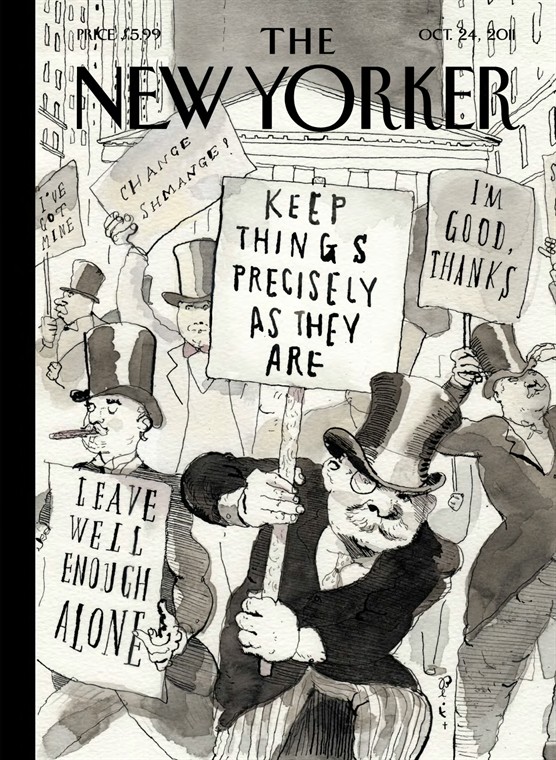
Yeah, it’s funny. Caricatured elites protesting to defend privilege. But Occupying Wall Street is setting the agenda. Bourgeois organs have to respond, if only ironically. Bush’s speechwriter Matthew Dowd used to say that if you oppose us while still using our language, we’re winning. Looks like someone different is winning, at least for now.
Civil disobedience against NYPD’s stop & frisk
It looks like OWS is giving the movement against the NYPD’s stop & frisk policies—under which literally hundreds of thousands of young males are patted down by cops—a shot in the arm. This press release just in:
For Immediate Release
Activists to shut down 73rd Precinct in Brownsville
Stop ‘Stop and Frisk’ Comes to Brooklyn
New York, NY, Oct. 28, 2011 – Nonviolent civil disobedience is on the agenda as local activists, community members and religious leaders gear up to challenge the NYPD’s controversial ‘stop and frisk’ practices at the 73rd Police Precinct in Brownsville, Brooklyn. The 73rd Precinct has the highest rate of stops-and-frisks in New York City.
The Stop Mass Incarceration Network, on Nov. 1 at 4 PM, will stage the second of a series of similar events in neighborhoods around New York City targeting to stop the repressive NYPD practice of Stop and Frisk – a policy the Center for Constitutional Rights, the New York Civil Liberties Union and other advocacy groups have challenged as illegal. On Friday, October 21, a group of more than 200 demonstrators marched on the 28th Precinct in Harlem where 34 community members, activists, and allies from Occupy Wall Street, were arrested for blocking the entrance to the police station. Among those arrested were Dr. Cornel West, Carl Dix of the Revolutionary Communist Party, Debra Sweet of World Can’t Wait, Rev. Stephen Phelps of Riverside Church, and comedian/activist Randy Credico.
During 2010 NYPD recorded more than 600,000 warrant-less stops — the vast majority Back and Latino youths — and are on pace to top 700,000 in 2011. This is up from 86,000 just ten years ago. The stop and frisk exchange, the humiliating is first step into the pipeline of mass incarceration and criminalization of minority young people. It is often a young man’s first introduction to the police in his neighborhood. It leaves an indelible stain on a young man’s self-awareness, and antagonizes and terrorizes community members. A handful of police officers have stepped forward to oppose the policy — documented by the Village Voice, and by WABC-TV News — which has been loudly supported by Commissioner Ray Kelly and Mayor Mike Bloomberg. Recent news reports of police involvement in gun smuggling, traffic ticket fixing, and the routine planting of illegal drugs on innocent persons have further added spotlight to illegal activities associated with the NYPD.
According to Dix, “mass resistance” is needed because the NYPD is “harassing and humiliating a lot of innocent people. And then we’ve also seen cases where these stops escalate to beat downs, arrests, and even people being killed….it is a burning injustice and we want to tap into what we feel is a supportive mood around resisting it, and to link in with people who are trying to deal with it on other levels, whether that’s through the courts, political, the electoral arena.”
On August 3, 2011 a Federal Judge rejected an effort by the City of New York to thwart a lawsuit filed by The Center for Constitutional Rights (CCR) that challenges the NYPD’s stop-and-frisk policy and practices. In a statement issued earlier this year CCR said that “for many children being stopped by the police on their way home from school has become a normal after school activity and that is a tragedy.”
Wednesday, October 19, 2011, Manhattan Borough President Scott Stringer and State Senator Eric Adams called for a federal probe of the policy, saying that it is “emblematic of a police culture that disregarded the civil rights of young black and Hispanic men.”
Media outlets such as the New York Times, NY1, New York Daily News, Salon, Democracy Now and the Guardian have covered the campaign to Stop “Stop and Frisk” here in New York.
Carl Dix, Rev. Phelps and other Oct. 21st arrestees are available for interviews.
-30-
—
Media Liaison Team
“Stop Mass Incarceration: We’re Better Than That!” Networkc/o P.O. Box 941 Knickerbocker StationNew York City, New York 10002-0900Phone: 973-756-7666 or 866-841-9139 x2670 * Email: stopmassincarceration@ymail.com
The “Stop Mass Incarceration: We’re Better Than That!” Network is a project of the Alliance for Global Justice, a 501c3 tax-exempt organization. Tax-deductible contributions accepted, and checks should be made payable to the “Alliance for Global Justice, with “Mass Incarceration Network” in the memo line. Other forms of contributions also accepted.
It really is about that 1%
Wow, that top 1% is doing really, really well, you’ll not be surprised to hear. Everyone else, not so well.
The Congressional Budget Office is out with some new stats on Trends in the Distribution of Income over the last three decades. Between 1979 and 2007, here’s how various slices of the population did in real (inflation-adjusted) income growth after federal taxes:
- top 1%: +275%
- next 19%: +65%
- middle 60%: +40%
- bottom 20%: +18%
Or, in graphic form:

The stairstep pattern—the higher you go up the income ladder, the stronger the growth—is remarkable.
As a result of this vastly unequal growth, the share of after tax income by population slice grew vastly more unequal:
- top 1%: 8% in 1979 to 17% in 2007, more than doubling
- next 19%: 35% in 1979, 36% in 2007, barely changed
- middle 60%: 50% in 1979, 43% in 2007, down 7 points
- poorest 20%: down 2 points, from 7% to 5%
Or, in a picture:
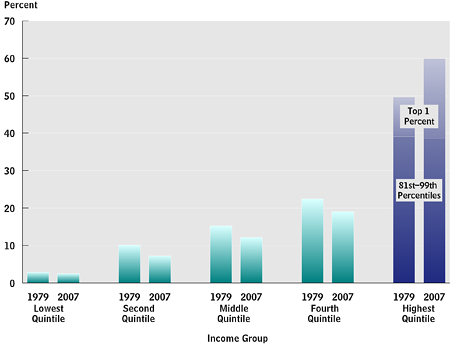
As of 2005, the share going to the top 20% surpassed the share going to the bottom 80%—though as the breakdown shows, most of this shift came from the very top. In 1979, the top 1% claimed about the same share as the bottom 20%; as of 2007, the top 1% hogged as much as the bottom 40%.
It really, really is 99 vs. 1.
Lower limits of income groups, after federal taxes and transfers (table A-1 in the full report):
lowest 20%      $      0
second 20%        18,979
middle 20%        29,759
fourth 20%        42,202
81st percentile   60,557
91st percentile   81,135
96th percentile  109,006
99th percentile  252,607


 LBO News from Doug Henwood