
Keynes on bizmen as “domestic animals”
This is from a February 1938 letter by John Maynard Keynes to Franklin Roosevelt, expressing his alarm at the return to slump in 1937–38, and offering suggestions on how to reverse it. I’ve cleaned up a few marks and jacked up the contrast to make it more legible. The whole letter is really worth reading; it’s full of sentences like “The handling of the housing problem has been really wicked.” The bourgeoisie doesn’t make them like these two anymore. (Click on the graphic to enlarge it.)

Thanks for the pointer, Mike Konczal.
Creeps busting brooms, stealing trashbags at OWS
A startling bit of news from last night’s OWS Demands Working Group meeting. Someone from the Sanitation Committee at Zuccotti reported that they’re in desperate need of brooms, dustpans, and garbage bags. Someone—cops? freelance thugs (as opposed to the professional uniformed thugs)? pranksters?—has been sneaking in at night and breaking the broom handles and stealing the dustpans and trashbags. Since keeping the park clean is Mayor Bloomberg’s preferred excuse for a clampdown, this is ominous.
If you’d like to donate some of these goodies, please drop them by the park. The THE YIPPIE MUSEUM (9 Bleecker St) and Lucky Cheng’s (1st Ave and 1st St) are also taking donations.
The OWS Demands group meets
Last night, I went to the meeting of the OWS Demands Working Group, held in historic Tompkins Square Park, scene of many a riot and other kind of uprising in its 161-year history. There were about 75 people there, to discuss what to do with the draft set of demands that the group had passed past week.
On Friday, I wrongly reported that the OWS General Assembly had rejected the draft and disavowed the working group. In fact, the GA hasn’t even discussed the issue. According to people at last night’s meeting, whoever controls the website issued the statement of disavowal and deleted the accounts of some participants, making it impossible for them to participate in online discussions of the issue. The “whoever” is accurate: no one seems to know the identity of the website’s controllers, who nonetheless purport to speak for the organization. With such a freewheeling organization, if that’s the right word, lines of responsibility and accountability are very murky.
That statement of disavowal claimed that the Demands group does not work by consensus. From what I saw, it certainly does. Everything was extensively processed, and with hand signals as complex as those that used to prevail in the (now largely deserted) trading pits of the major futures exchanges. Perhaps the controllers of the website are scandalized that the Demands group works by “modified” consensus, meaning a 75% vote is necessary for something to pass (though as Michael Pollak reports below, they’re not alone in this). But what in this life—even the beauty of a clear blue sky on a crisp October day—could get 100% approval?
I must admit that I am not cut out for these sorts of meetings. When it started, at 6 PM, there was a discussion of whether to go to midnight, when the park closes, or try to cut it off at 9. The thought of standing outside for three hours filled me with fear, and so I left at 7:30. But my good friend Michael Pollak had the—well you can’t call it Sitzfleisch, so, Stehenfleisch maybe?—to stick it out. I admire people like that, and wish I could be more like them. Here’s Michael’s report:
There seems to be some misconception that the Demands Group is a bunch of outsiders. It is not. This is a argument within the Occupy Wall Street movement.
The Demands Group is a working group just like any other working group. Yesterday evening I spent three hours in the park taking part in their meeting, and I can attest, it was run scrupulously according to consensus procedures under experienced facilitators. And frankly it was one of the most satisfying consensus meetings I’ve taken part in. There were (a changing average of) 60 people, there were heated disagreements, and the proposals and counterproposals were modified so that they visibly came closer together while retaining what emerged as their respective most crucial points. And while each individual proposal was defeated or unable to get off the ground by itself, the final joint/modified proposal passed by a modified consensus, i.e., 75%. And it was a consensus in the real sense of the term. It was strongly supported. The opposed sides had come together. The final product was only possible because both sides had convinced each other that they would carry out their side of the bargain in good faith. And you could feel that everyone involved was palpably chuffed at the end. Tired, wired and cold, but chuffed.
The basic upshot is that there will be tons of liasing in the next few days with other occupation working groups and with community groups; there will also be teach-ins at Zuccotti Park and canvassing there; we will encourage representatives of all these groups to join us for our meeting on Thursday with their proposed amendments or concerns or questions (or support for the proposal at it stands — also an option); everyone present at the Thursday meeting will vote on amendments to the proposal that grow out of this liasing; and we will present the amended proposal to the general assembly on Sunday at 7pm, where it will be argued at length, amended as the GA sees fit, and voted on, according to consensus rules. (Important aside: switching to modified consensus when you can’t attain full consensus, and having this identified as three quarters approval—and not a person less—seems to be already SOP in many OWS working groups. It is not a new innovation invented by the Demands Group.)
The OWS General Assembly has never been made up simply of people who sleep in the park. The General Assembly has always explicitly been made out of whoever shows up for the meeting that day. This is part of its anarchist nature, and part of the whole idea of a prefigurative experience: anyone is free to take part and be transformed through transforming. (And it is just as much a part of working groups. In the Demands Group tonight, three quarters of the people there hadn’t been to prior meetings, but everyone had full talking, blocking and voting rights.) The Demands Group meeting today contained a spectrum of people from 24/7 occupiers; though people who sleep at home but participate daily; up through people who were energized to participate for the first time tonight precisely because the ideas of demands in general or these particular demands excited them.
So this isn’t an outsider group operating by principles foreign to OWS. This is the occupation operating by its own principles. It is a discussion and argument within the occupation.
And BTW, if anyone feels like a visit to OWS anytime soon, Sunday at 7pm would be a great time.
Background info for anyone wanting to get involved in the Demands Group:
The Demands Group has a listserv on Yahoo Groups: OWS Demands Working Group. (If you don’t already have a Yahoo account, you need to open one to join. You can, however, adjust it to send the messages to your normal email. It looks like there is option to do it without that step by logging in using Google or Facebook, but that is just a cruel trick. It has an acknowledged bug that leads to an endless loop. But that’s the way Yahoo works.)
The Demands Group has been meeting bi-weekly on Tue at 7 at Sun at 6 at Tompkins Square Park. Both those meetings have been changed for this week to meet the demands of liasing and presenting. The Tuesday meeting will be on Thursday this week, and it will be at 60 Wall Street, an indoor Atrium where many working groups meet. It is a similar private/public space to Zuccotti, except this one closes at 10pm, so the meeting has to end then. (This BTW, can be a great help to consensus. The meeting last night had an agreed ending time of 3hrs after starting too, and it really focussed minds at the end and helped in forging consensus.)
The Plan B meeting point for Thursday (if we can’t get the Atrium) will be Washington Square Park, not Tompkins. I’m not sure under what conditions we’d need to go to Plan B.
Washington Square Park may possibly replace Tompkins in the future.
The Sunday meeting this week that would normally happen on Oct 30 will be replaced by showing up to the General Asssembly.
For the record, a delegation from the Demands Committee will be meeting with the Facilitation Committee on Tuesday about getting on the Agenda for the General Assembly for Sunday (just in case you see that referred to in the listserv.)
Taking the measure of OWS
Pollster Doug Schoen, who’s worked for Bill Clinton and Michael Bloomberg, sent a researcher into Zuccotti Park on October 10 and 11 to take the measure of the Occupiers. Schoen wrote up his conclusions from this effort in a now-discredited op-ed in the Wall Street Journal:
Our research shows clearly that the movement doesn’t represent unemployed America and is not ideologically diverse. Rather, it comprises an unrepresentative segment of the electorate that believes in radical redistribution of wealth, civil disobedience and, in some instances, violence.
As several writers have pointed out, notably Azi Paybarah, Schoen misrepresented—to put it kindly—his own research. They’re not the radicals of his phantasmic summary.
A better overview was developed, using Schoen’s data, by John Nienstedt of Competitive Edge Research in San Diego, who posted it to the listserv of the American Association for Public Opinion Research (AAPOR), of which I’m a member. AAPOR etiquette requires members to ask permission of authors before reporting on their posts, and I’ve gotten that. Nienstedt asked me to point out that he’s totally nonpartisan and independent, which I’m happy to do, because he is.
Here’s Nienstedt’s taxonomy of the protesters:
8% Radical
4% Radical redistribution of wealth
4% Dissolution of our representative democracy/capitalist system53% Liberal
35% Influence the Democratic Party the way the Tea Party has influenced the GOP
9% Engage & mobilize Progressives
4% Single payer health care
4% Pull out of Afghanistan immediately5% Conservative
5% Overhaul of tax system: replace income tax with flat tax
27% Process-oriented (don’t neatly fit in my continuum)
11% Break the two-party duopoly
9% Promote a national conversation
7% Direct Democracy8% Not sure
In other words, more than half are liberal, Democrats even, and less than one in ten are radicals—the same share who aren’t sure of what they are.
Though it’s all we have now, we don’t really know how accurate Schoen’s polling was. But if it’s anywhere near the truth, it really makes you wonder about the governance structure of OWS. By its own representation, the gathering is run by consensus and its official statements are supposed to be approved by a general assembly. But the GA’s decisions—like purging the Demands Working Group—may not be as democratic as they claim. More on this after I visit the Demands group’s meeting tonight.
In another post to the AAPOR listserv, Mike Mokrzycki—who also asked me to emphasize that he’s totally nonpartisan, so nothing he says should be construed as taking a political position—noted that OWS may be more popular than the Tea Party. As he points out, CNN/Opinion Research apparently stopped asking people if they were “active members” of the TP because they couldn’t get more than 2% of respondents to identify themselves as such. 2%! The TP does draw the sympathy of about 25% of the population. But most surveys show that a larger share of the public has a positive view of OWS than of the Tea Party. Of course, OWS doesn’t have billionaires funding its agenda.
Those demands? Forget about them!
The OWS General Assembly disavows the Demands working group, saying, in a grandiose and narcissistic fashion, “We are our demands”: Demands Working Group.
Is fame going to someone’s head?
OWS: it never stops!
Edited version of my October 22 radio commentary.
Sorry for repeating myself on Occupy Wall Street, but it seems pretty important. An acquaintance in Australia posted this to a discussion group the other day:
This is I truly hope the very beginning of the reconstruction and the rediscovery of an American Left. I keep banging on about this, but American comrades must understand how this is galvanising the world. If the Left in America re-emerges as an historical agent, then a lot will become possible.
All this, from what started as a small encampment in a small park at the narrow southern tip of an island off the coast of America, as Spalding Gray once called Manhattan.
A major controversy of the moment is whether to make demands, and if so, of what kind. The demands working group has come up with a list I find quite admirable, perhaps because it bears a lot of resemblance to things I’ve been saying all along. I’ve already posted the text here. That draft must go to the OWS general assembly for approval—approval that may be in considerable doubt.
There are objections on specifics. No mention of the prison–industrial complex. (Mass incarceration is a horror, but the role of prison labor is wildly exaggerated.) No mention of, as one critic put it, the racialized nature of poverty. I think there’s a great virtue to simplicity, instead of getting into the usual laundry list. And should by some miracle something like this be enacted, there’s no doubt that it would disproportionately benefit people of color, even as it also benefitted many people of no color.
But there are objections to the very notion of demands. Some think that “demands” are for terrorists, not peaceful assemblies. It’s a good thing that the labor movement never thought that way in its heyday. A lot of anarchists believe that demanding remedies of the state legitimizes the state. I wonder who else could mobilize the resources to meet the challenges of deprivation and environmental destruction. They also believe that jobs suck, and demanding more of them would only make things worse. I doubt that that would resonate with the 25 million un- and under-employed. To this camp, making demands are an opening to being co-opted. They might also be the way to win adherents and win something good.
The twinklers have come up with their own manifesto, the Liberty Square Blueprint . It’s remarkably vague, invoking a rambling set of principles, which they weirdly refer to as “bullet point visions.” (There’s a strange New Age Corporate cast to a lot of their language—a mix of cybertopianism and orgo-localism.) They want to “empower marginalized people to express themselves, build community, and engage systemic/cultural discrimination”? Who are the “we” that grant “them” this power? And how?
The economic planks include:
“Create an economy in harmony with nature…based on sound ethical assumptions and observed individual and market behavior through behavioral economics and econometrics.” I have no idea what that would mean in practice. Could you generate electricity that way? And econometrics? Vector autorregressions will set us free.
Also, “Implementing and improving community currencies, barter, sharing, and trade systems.” Barter is a major waste of time, and as David Graeber has been arguing, hasn’t really existed in a major way in any society known to anthropology. Community currencies are fine for haircuts, but scissors? Steel? It seems they haven’t thought through the role of economic scale at all. Perhaps their devotion to open-source software has obscured the institutional complexity required to produce the computers and networks it runs on.
And “eliminating financial/resource speculation that supports the current economy at the expense of future generations.” Who exactly would do this, if not a state?
This is hard stuff. I do worry about this movement being hijacked by Democrats for electoral purposes. I think that working for candidates would be a disastrous compromise. We don’t want to lose long-term utopian desire in the course of devising shorter-term concrete demands. The key is to pressure the powers that be without becoming their pawn—to make practical demands that are not death to passion or the imagination.
Full employment is no small demand to make. The bourgeoisie hates it, because it would strengthen the bargaining power of the working class. It, plus the other planks of an expanded welfare state mentioned in the Demands draft, would give people the confidence and freedom to think about a better world. This isn’t fictional: it happened in the 1970s, as the transformation of consciousness among middle-class college students spread into the working class. Quality of work life—in a real, not a GM sense—became a central concern in organized labor, at least among the rank and file. It was one of the things that alarmed elites, leading to the crackdown of the late 1970s and early 1980s.
Spontaneous gatherings will not replace the state any time soon, and if we want a better world, we need a better state. To use the jargon, this is extra-parlimentary pressure on the parliament. Relying on the state involves trusting an institution that has demonstrated itself to be often violent, corrupt, and oppressive. But I see no alternative to the state.
This is a very important discussion to have, and one of the great things about OWS is that we’re having it.
OWS demands working group: Jobs for All!
The anarchists are not happy about this, and are trying to block its adoption by the General Assembly. If you like it, please attend, agitate, comment, circulate, whatever. If you don’t like it, please reflect on the size of the potential constituency for this agenda compared with that for your own.
TEACH-IN: DEMANDS WORKING GROUP PANEL
Saturday 3:00-5:00 PM
66 W 12th St Rm 407
Part of Day-long Teach-in sponsored by the New School Senate
What’s the story about the proposed
Jobs for All Demand?
The Demands Working Group of Occupy Wall Street unanimously endorsed and is circulating for discussion the following demand, which will be submitted to the General Assembly of OWS:
“Jobs for ALL – A Massive Public Works and Public Service Program
We demand a massive public works and public service program with direct government employment at prevailing (union) wages, paid for by taxing the rich and corporations, by immediately ending all of America’s wars, and by ending all aid to authoritarian regimes to create 25 million new jobs to:
-Expand education: cut class sizes and provide free university for all;
-Expand healthcare and provide free healthcare for all (single payer system);
-Build housing, guarantee decent housing for all;
-Expand mass transit, provided for free;
-Rebuild the infrastructure—bridges, flood control, roads;
-Research and implement clean energy alternatives; and
-Clean up the environment.
These jobs are to be open to all, regardless of documentation/immigration status or criminal record.”
Come to this open teach-in to learn about this demand, its history, and implications for the Occupations movement. We urge all to join in the discussion and to prepare their comments and proposed amendments (friendly and unfriendly!) for the General Assembly.
AND:
Demands Working Group Meeting
Sunday, 6:00 PM
Tompkins Square Park
(center, circular area right off E. 7th St., between Ave B and C)
1st Ave on L train or 2ndAve on F train
This is the working group for those who want OWS to put forward demands. All who want to help us plan for a broad-based discussion and eventual adoption of the “Jobs for All” Demand are invited!
Plug from Caleb Crain!
The Book Bench: Why I Signed the Occupy Writers Petition : The New Yorker
My Keynesian hunch about the current economic troubles is that when wealth is too much concentrated in the hands of people who don’t need to spend it, it stops circulating. I suspect that America spent its way out of the structurally similar Great Depression of the nineteen-thirties through a campaign of wealth redistribution that lasted decades—the government hired soldiers, gave college educations to veterans, granted pensions to senior citizens, and went to war on poverty—and that the transfer laid the groundwork for the longest period of uninterrupted prosperity in American history. Unfortunately, it’s become difficult to talk about hunches and suspicions like these outside the pages of, say, Doug Henwood’s Left Business Observer. A politician who tries is likely to be attacked as a partisan of class warfare.
Video of great #OWS debate now up
Video of the great Jacobin debate on #OWS politics & strategy now up. Below the link, some of moderator Seth Ackerman’s comments:
#OWS, a debate on left politics and strategy
Held on Friday Oct. 14, 2011 at Bluestockings bookshop on Allen St. in New York City.
From anarchism to demands, from the consensus process to “what next?” we covered the gamut of topics. When the discussion was over, Doug Henwood, who was on the panel, commented that it had been the most contentious left-wing gathering he’d ever participated in (and Doug’s participated in a lot). One audience member who spends a lot of time at Zuccotti Park made an insightful observation: he said that the mood of agitation was due to the fact that the issues discussed had lingered in the air so long without ever being fully aired.
From our point of view, that means this event was a success. And yet, in the process of airing disagreements that had previously been glossed over, we also felt the discussion revealed a disturbing lack of politicization and political sophistication within the movement. What that portends, and what should be done about it, are topics for future debate
THE PANEL:
Jodi Dean is a political and media theorist working in Geneva, NY. Her most recent books are “Democracy and Other Neoliberal Fantasies” and “Blog Theory.” She is currently finishing the book, “The Communist Horizon,” forthcoming from Verso.
Doug Henwood is the editor of Left Business Observer, host of Behind The News, contributing editor at The Nation, and author of “Wall Street” and “After The New Economy.”
Malcolm Harris is the managing editor of The New Inquiry, a contributing editor at Sharable.net, and blogs for Jacobin. He edited the collection “Share or Die: Youth in Recession,” forthcoming from New Society Publishers in the spring. He has been active in OWS since the first planning meetings.
Natasha Lennard was formerly on staff at Salon.com and Politico. She currently freelances for The New York Times. She has covered OWS since before Sept. 17.
Chris Maisano is a public librarian in Brooklyn, rank-and-file activist in DC37 Local 1482, and chair of the NYC local of Democratic Socialists of America. He is a contributing writer for Jacobin.
Moderator: Seth Ackerman is an editor at large with Jacobin and a doctoral candidate in History at Cornell. He has written for Harper’s, In These Times, and other outlets
OWS takes a walk uptown
No doubt you’ve all heard and read about the huge and wonderful Occupy Wall Street satellite rally in Times Square this afternoon.
This crowd was anything but the shiftless hippies of Ann Coulter’s imagining. I bet a lot of them were Democrats, which means that the process of productive disillusionment I’d hoped for in the summer of 2008 is finally kicking into gear, after a long delay:
Enough critique; the dialectic demands something constructive to induce some forward motion. There’s no doubt that Obamalust does embody some phantasmic longing for a better world—more peaceful, egalitarian, and humane. He’ll deliver little of that—but there’s evidence of some admirable popular desires behind the crush. And they will inevitably be disappointed.
As this newsletter has argued for years, there’s great political potential in popular disillusionment with Democrats. The phenomenon was first diagnosed by Garry Wills in Nixon Agonistes. As Wills explained it, throughout the 1950s, left-liberals intellectuals thought that the national malaise was the fault of Eisenhower, and a Democrat would cure it. Well, they got JFK and everything still pretty much sucked, which is what gave rise to the rebellions of the 1960s (and all that excess that Obama wants to junk any remnant of). You could argue that the movements of the 1990s that culminated in Seattle were a minor rerun of this. The sense of malaise and alienation is probably stronger now than it was 50 years ago, and includes a lot more of the working class, whom Stanley Greenberg’s focus groups find to be really pissed off about the cost of living and the way the rich are lording it over the rest of us.
Never did the possibility of disappointment offer so much hope. That’s not what the candidate means by that word, but history can be a great ironist.
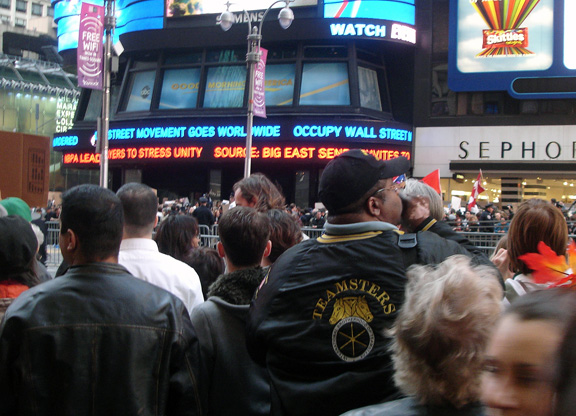
Here are some pix. It was hard to get a good perspective on the crowd from ground level, but it seemed to stretch for blocks, with people lining both sides of the Crossroads of the World.
A guy in a Teamster jacket attracted some press attention (“so you’re not all hippies,” asked the reporter). Beyond, the news zipper reports that “Occupy Wall Street Movement Goes Worldwide.”
The proceedings enjoyed a visit not only from the Comics Convention folks, but also the Z O M B I E C O N n y c crew:

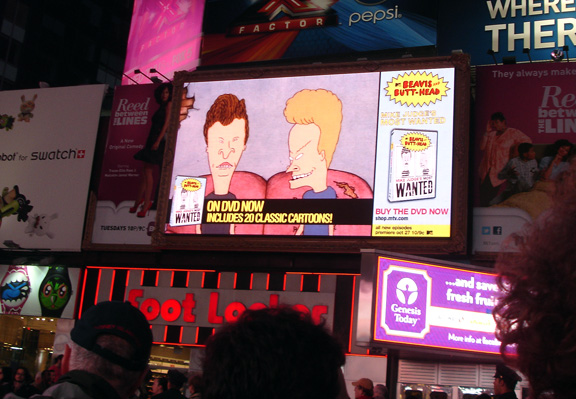
Meanwhile, Beavis & Butt-head look on:
And over on 8th Ave., a delegation of 99%-ers visit Danny Meyer’s Shake Shack—where we repaired soon after young Ivan began chanting: “The people, united, will now have dinner.’

We had to get home to put our 5-year-old to bed, so we missed the part where the NYPD reportedly started arresting people. There sure were a lot of cops on the scene. Next up: Washington Square Park? That’s a city park that closes at 1 AM, so the police will have a challenge on their hands.
On the Fed (from my book Wall Street
This is the section on the Federal Reserve from my book Wall Street: How It Works and for Whom (Verso, 1997). The complete text can be downloaded here. It’s a little out of date—the Fed is more open now than it was 15 years ago, at least superficially—but it’s still fundamentally right. Two quick updates: 1) The Fed now releases summaries of its policy decisions right after the FOMC meeting. They’re somewhat sanitized, but still informative. 2) The annual profit it turns over to the Treasury has more recently been around $25 billion. Last year, it was twice that—they made money on all the crappy securities they bought during the financial crisis.
The most important government agency in the realm of money is undoubtedly the Federal Reserve. If something as decentered as a financial system has a center, it’s the central bank, and since the dollar remains the world’s central currency, the Fed is the most important of all central banks. All eyes are on it, and the tone of both financial and real business is heavily dependent on its stance. When a central bank is in an expansive mood, finance bubbles; when it’s tight, things sag.
The Federal Reserve is a study in how money and the monied constitute themselves politically. Ironically, though it’s now an anathema to populists of the left and right, its creation perversely fulfilled one of the demands of 19th century populists: for an “elastic” currency — one administered by the government that could provide emergency credit when a financial implosion seemed imminent — as an alternative to the inflexibility of the gold standard. Instead of becoming the flexible, even indulgent institution the populists dreamed of, the Fed quickly evolved into Wall Street’s very own fourth branch of government (Greider 1987, chap. 8).
Despite a couple of attempts in the early and mid-19th century to create an American central bank, they were allowed to die because of Jeffersonian–Jacksonian objections to concentrated financial power. That left the anarchic, volatile U.S. financial system without any kind of lender of last resort, but in booms all kinds of funny money passed.
Canonically, it was the panic of 1907 that led to the Fed’s creation. In the frequent panics of the late 19th century, a cabal of New York bankers would typically band together to organize lifeboat operations in emergencies; in the panic of 1895, J.P. Morgan and his cronies bailed out the U.S. Treasury itself with an emergency loan of gold. The panic of 1907, however, proved too much for these private arrangements; that time, the Treasury had to be called in to bail out the cabal. After that brush with disaster, Wall Street and its friends in Washington came around to thinking that the U.S. could go no longer without a central bank (ibid., chap. 9; Carosso 1987, pp. 535–549).
Gabriel Kolko (1963) traced the loss of the Wall Street circle’s power to several things — the aging of personalities like Morgan and Stillman (the Rockefeller representative); the growth of the economy and financial markets, and the evolution of financial centers outside New York; and the shift of industry towards internal finance, which lessened Wall Street’s influence. The loss of raw financial power, however, was compensated for by the creation of the Fed, an institution that has been dominated by Wall Street since its birth in 1913. To Kolko, the Fed was an example of an interest group using the state to reverse its fading market fortunes. This line resonates in populist discourse today.
That canonical story, however, doesn’t comport with the convincing evidence massed by James Livingston (1986). To Livingston, the struggle for a U.S. central bank had a much longer history, and one central to the creation of the modern corporate–Wall Street ruling class beginning in the 1890s. Livingston showed that the campaign for a more rational system of money and credit was not a movement of Wall Street vs. industry or regional finance, but a broad movement of elite bankers and the managers of the new corporations as well as academics and business journalists. The emergence of the Fed was the culmination of attempts to define a standard of value that began in the 1890s with the emergence of the modern professionally managed corporation owned not by its managers but by dispersed public shareholders.
Though the U.S. had become a national market deeply involved in global trade and finance in the decades following the Civil War, in the early 1890s it was still dominated by small producers and banks. As any Marxian or Keynesian crisis theorist can tell you, the separation of purchase and sale is one of the great flashpoints of capitalism; an expected sale that goes unmade can drive a capitalist under, and unravel a chain of financial commitments. Multiply that by a thousand or two and you have great potential for mischief. This is one reason the last third of the 19th century was characterized by violent booms and busts, in nearly equal measure, since almost half the period was one of panic and depression. In panics, the thousands of decentralized banks would hoard reserves, thus starving the system for liquidity precisely at the moment it was most badly needed. But the up cycles were also extraordinary, powered by loose credit and kinky currencies (like privately issued banknotes). There was no central standard of value, unlike the way we think of assets of all kinds, from cash to inverse floaters, as denominated in the same fundamental unit, the dollar. “Progressive” corporate thought, which had mastered the rhetoric of modernization, wanted a central bank that would control inflationary finance on the upswing — which in the mind of larger interests, meant keeping small operators from “overinvesting” and laying the groundwork for a deflationary panic — and extend crucial support in a crunch.
Trusts were one attempt by leading industrialists and bankers to manage the system’s instabilities, but those were prohibited by the Sherman Act of 1890. The corporation, argued Livingston, was a response to the outlawing of trusts. By internalizing lots of the the competitive system’s gaps — by bringing more transactions within the same institutional walls — corporations greatly stabilized the economy.
With the emergence of the modern firm at the turn of the century came a broader rethink of the business system. Writing in 1905, Charles Conant, a celebrity banker–intellectual, explicitly cited Marx (and anticipated Keynes) in emphasizing that the presence of money as a store of value, the possibility of keeping wealth in financial form rather than spending it promptly on commodities, always introduces the possibility of crisis. In other words, the possibility asserted by Marx but denied by classical economics, the possibility of an excess of capital lacking a profitable investment outlet, and an excess of goods that couldn’t be sold profitably on the open market, had proved all too real in practice. A system for regulating credit was essential — one that while operating through the state would be taken out of politics; the regulation of money and credit would be turned over to “experts,” that is, creditors, industrialists, and technocrats who thought like them.
The struggle around the definition of money, Livingston showed, marked the emergence of corporate and Wall Street bigwigs as a true ruling class: energized, confident, highly conscious of its mission — capable of promoting its case to a broader public using PR and friendly expertise, and to Congress with deft lobbying. Universities became rich sources of expertise for the new class, and they endowed institutes and foundations to act as a marketing and distribution mechanism for the new ideas.
The fight for sound money was also consciously exapnsive, even imperial; the economic theory of the day held that chronic oversupplies of capital and goods could be alleviated by conquering foreign markets. Big business managers with global ambitions wanted their bankers to be international, and wanted the dollar to be firm against the British pound rather than a junk currency. They wanted their paper accepted in London money markets in dollars, not pounds, and to do that required a central bank to anchor the U.S. financial system. They were also tired of the federal state being weak and small.
The panic of 1907, rather than being the catalyst it’s sometimes presented as, was taken as the “evidence that validated conclusions [the corporate–financial establishment] had already reached” (Livingston 1986, p. 172). The elite had been agitating for sterner money for a decade. The PR campaign heated up, as did the political campaign; in 1908, Congress formed a monetary commission led by the blue-chip Senator Nelson Aldrich, and the next year, the Wall Stree Journal ran a 14-part editorial on its front page arguing the case for a central bank, written by Conant. This institution would regulate “the ebb and flow of capital,” and stabilize the economy. Among the elite there was a great loss of faith in the self-regulating powers of the free market; a central bank was just the sort of expert and dispassionate intervention required to brake its frequent tendency towards derailment.
This history helps explain the essential absence of a finance–industry split, minor family quarrels excepted, over central bank policy in the U.S. and elswhere. There was remarkable regional and sectoral agreement on the need to rationalize the banking system, both for reasons of stabilizing the economy and to promote overseas commercial and imperial interests.
This history also helps explain populist thinking in the U.S. today, with a similar analysis often shared by left and right, greens and libertarians. Their opposition to central banks, centralizing corporations, and global entaglements in favor of a decentered, small-scale system reflects the historical processes by which these modern institutions formed each other. They typically forget the volatile, panic-ridden history of the late 19th century in their dreams of simpler times.
From its founding, the Fed has consisted of twelve district banks scattered around the country — a concession to the decentralized traditions of American finance and politics — and a central governing board in Washington. The district Federal Reserve banks are technically owned by the private banks in their regions, which choose six of each district bank’s nine directors. Of the New York district’s nine serving in 1996, three were bankers (from the Bank of New York, and smallish banks on Long Island and in Buffalo); two were CEOs of giant companies (AT&T and Pfizer). The balance: conservative New York City teachers’ union leader, Sandra Feldman; private investor John Whitehead, formerly of Goldman, Sachs and the Carter cabinet; investment banker Pete Peterson of The Blackstone Group, formerly of the Nixon administration, and sworn enemy of Social Security; and the head of a giant pension fund, Thomas Jones of TIAA–CREF. Recent alums include the CEO of a large insurance company, a small business-owner, and the head of an elite foundation. Of all these, only two were outside the Big Business/Big Finance orbit — three if you’re generous, and want to count the foundation executive, but foundations have big financial holdings, and are politically and socially intimate with the corporate class. So while the Federal Reserve System is technically an agency of the federal government, an important part of the system is directly owned and controlled by private interests.
Despite the original decentralizing intent of the district structure, power quickly gravitated toward two centers — Washington, where the Fed is headquartered, and New York, the site of the most important of the regional banks because of its location just blocks from Wall Street. Day-to-day monetary policy is carried out, based on broad instructions from Washington, at the New York Fed’s trading desk. The system’s executive body is a Board of Governors, consisting of seven members nominated by the President and confirmed by the Senate, who serve for a term of fourteen years. That long term is supposed to insulate the governors from political pressures; in reality, it insulates them almost completely from anything like democratic accountability. From the seven board members, the President nominates, subject to Senate confirmation, a chair and a vice chair, who serve four-year terms. The board has in practice been pretty well dominated by the chair; after leaving the vice-chairship in 1996, Alan Blinder complained publicly about his difficulty in even getting information out of the staff economists. From the chair down to the vice presidents and directors of the district banks, the Fed’s senior staff is overwhelmingly male, white and privileged (Mfume 1993).
Unlike ordinary government agencies, the Fed is entirely self-financing; it need never go to Congress, hat in hand. Almost all its income comes from its portfolio of nearly $400 billion in U.S. Treasury securities. It’s not a difficult trick to build up a huge piggy bank when you can buy bonds with money you create out of thin air, as the Fed does. In fact, at the end of every year, the Fed returns a profit of $15–20 billion to the Treasury — after deducting, of course, what it considers to be reasonable expenses. Salaries are far more generous, and working conditions far more comfortable, than in more mundane branches of government — and there’s not much that mere civilians can do to challenge its definition of reasonableness.
Monetary policy is set by a Federal Open Market Committee (FOMC), which consists of the seven governors plus five of the district bank presidents, who serve in rotation —five of the twelve votes are cast by the heads of institutions owned by commercial banks, a very strange feature in a nominally democratic government. Imagine the outcry if almost half the seats on the National Labor Relations Board were reserved for staunch unionists.
The FOMC meets in secret every five to eight weeks to set the tone of monetary policy — restrictive, accommodative or neutral, in Fed jargon. Until very recently, the committee didn’t announce policy decisions until six to eight weeks after they’d been made. In a departure from almost eighty years of history, the sequence of tightenings started in February 1994 were announced immediately, a frank attempt to steal some of the populist reformers’ thunder. Until early 1995, those reformers were led by Texas Rep. Henry Gonzalez, who spent his few years as chair of the House Banking Committee deliciously torturing the Fed in every way possible. The threat of subpoenas from Gonzalez caused a sudden bout of recovered memory syndrome at the Fed; for 17 years, it had denied that it even took detailed minutes at FOMC meetings; in fact, it had been taping and transcribing them all along. The Republican takeover of Congress in 1994, however, ended Gonzalez’ reign of terror.
Still, despite this whiff of glasnost, the Fed remains an intensely secretive institution. This opaqueness has spawned an entire Fed-watching industry, a trade reminiscent of Kremlinology, in which every institutional twitch is scrutinized for clues to policy changes. One of the sacred moments in Wall Street life is “Fed time,” just before noon every day, when the central bank intervenes or doesn’t intervene in the market (by buying Treasury securities in the open market to inject liquidity into the banking system, or selling them to drain liquidity). In the days before the Fed announced policy changes immediately, these interventions or their lack — whether they were more or less generous than Fed watchers had been expecting — were read as signs of a possible change in policy. Fed watchers, many of them recent alumni of the central bank, “earn” salaries well into the six figures for such work; greater openness at the Fed would reduce their importance, if not put them out of business, a rare form of unemployment that would be entirely welcome. The Fed also manipulates the media ably; reporters, eager for a leak from a central bank insider, will print anything whispered in their ears, whether or not it’s true — leaks sometimes designed to mislead or enlighten the markets, and other times the product of some internal struggle.
Even though FOMC members would no doubt invent all sorts of clever euphemisms to express the dangers of excessively low unemployment, televising the FOMC’s proceedings on C-SPAN would still provide an enlightening glimpse into the mentality of power.
Jacobin OWS correction
Bluestockings is at 172 Allen St, not 72 as I said earlier. 172! At least I got the time right: it’s at 7.
Jacobin event tonight in NYC
A reminder—I’m part of a panel organized by the excellent posse at Jacobin on Occupy Wall Street, along with Jodi Dean, Malcolm Harris, Natasha Lennard, and Chris Maisano.
Bluestockings
172 Allen St (Stanton–Rivington)
Manhattan
7 PM
Likely to be crowded, and Bluestockings is small—so get there early!
On OWS and the Fed
[I haven’t been posting my radio commentaries here in a while. Here’s some of October 8’s.]
Rethinking OWS
Turning to larger issues, not only does Occupy Wall Street continue, it’s grown in numbers and prominence—several major unions marched in solidarity earlier this week in Lower Manhattan—and it’s spreading around the country. It’s focusing attention on issues of inequality and exploitation in a way we haven’t seen in ages. And Democratic politicians are looking pressured to say sympathetic things—though I suspect they’re just looking to take advantage of the thing for their own electoral reasons. But, as my wife Liza Featherstone remarked the other night, at no time in her life (she’s 42) have politicians felt compelled to co-opt a movement on the left. This is extremely good news.
I’ve also rethought some of my earlier skepticism about where all this will lead. Last week, after professing my love for the protesters—a love that has only deepened—I said that they need to develop some organization and demands. On further reflection, I don’t think that’s their job as a group. Some of the individuals may do that—who knows what kinds of contacts and networks are developing and where they will go. But I think they’re now doing what they’re best at: getting a wide variety of people to think and talk about the disastrous state of the U.S. economy and our aspirations for making it better. Organization and program can be left to others. I’m full of ideas, for example, though I’m not so organized. Unions are showing signs of political life they haven’t shown in living memory. I don’t trust what Democrats are doing with this movement—even supposed good guys like Van Jones. But if they’re forced to tax millionaires to fund a jobs program, or at least say they’re into that idea, then something’s moving.
I’m also proud that my hometown is inspiring people across the country and around the world. It’s been a long time since the city of JP Morgan and Michael Bloomberg have done that. Like I said last week, who knows where this will lead—but so far, it’s leading to some good places.
On the Federal Reserve
I have noticed some strange, Ron Paul-ish stuff about the Federal Reserve around Occupy Wall Street. I do want to file a complaint about that.
The Federal Reserve is admittedly manna for conspiracists. It’s a fairly opaque institution that does work for the big guys. But it’s not their puppet exactly. A friend who spent many years at the New York branch of the Fed once told me that within the institution, the thinking is that bankers are short-sighted critters who come and go but the Fed has to do the long-term thinking for the ruling class. So it has more autonomy than the popular tales allow.
The founding of the Fed is also a great subject of mythmaking—like secret meetings involving more than a few Jews. (The conspiratorial mindset often overlaps with anti-Semitic stories about rootless cosmopolitans, their greed and scheming.) There were some secret meetings, but the creation of a central bank was a major project of the U.S. elite for decades around the turn of the 19th century into the 20th. There’s a great book on that topic by James Livingston that I urge anyone interested in the topic to read. It was a long, complex campaign, and not the task of a secret train ride to a remote island.
Although the Fed does put U.S. interests first, it is internationally minded, and consults constantly with its foreign counterparts. This is also rich soil for conspiratorial thinking—that, plus, of course the Jews. (Greenspan. Bernanke. You’d almost forget that 1980s Fed chair Paul Volcker’s middle name is Adolph.) You know the story—dastardly plots involving foreign financiers (with names like Rothschild) whose victims are good patriotic Americans. As anyone who watches the Fed closely, like me, could tell you, that’s just not the case.
And it’s tempting to see this body as controlling everything—it’s complicated and messy to think about how financial markets work, and the Fed’s relationship to those markets. Much easier to think of the Fed controlling everything. But in fact the Fed sometimes reacts to the markets, sometimes leads them, and on occasion fights with them.
In the 1980s, the Federal Reserve under Paul Volcker ran a very tight ship. It deliberately provoked a deep recession in 1981-82 by driving up interest rates toward 20% to scare the pants of the working class. It was a very successful class war from above that led to a massive upward redistribution of income. More recently, the Fed handed out massive amounts of money—I’m not citing actual figures since they’re vague and mind-boggling, but they’re very big—with no strings attached to major banks. Something like this was necessary to keep everything from going down the drain, but it didn’t have to be done so secretly and with no accountability. Banks were basically given blank checks to restore the status quo ante bustum. That’s terrible. You could say the same for the TARP bailout—massive giveaways with no accountability or restrictions. This is all odious.
But more recently, Fed chair Ben Bernanke has been about the only major policymaker in the world pushing for more stimulus for the U.S. economy. He’s not a partisan of austerity, like the Republicans or much of the pundit class. For this he’s earned some criticisms on the right. The right would be happy to let things go down to prove a point. They think we need a “purgation.” I was recently on a panel with a Fed-hating libertarian who invoked the concept of “purgatory,” as if we’ve all sinned. But that would create far more misery than we know now.
There’s a video (#OWS Protester Nails It! Federal Reserve) of an Occupy Wall Street protester calling for an end to the Fed and urging a vote for Ron Paul. It, and the comments, are straight out of the right-wing critique of the Fed. I’ve seen signs calling for that around the occupation. This is bad news. Ron Paul has a coherent political philosophy. He’s a libertarian. He may hate imperial war, but he also hates Social Security and Medicare. The reason he wants to end the Fed is that he wants to get the state out of the money business and return to a 19th century gold standard. A gold standard is painfully austere. The gold supply increases by less than 2% a year. That means tremendous pressure on average incomes. It’s great if you’re a big bondholder, but hell if you’re a regular person. When we were on a gold standard in the 19th century we had frequent panics, crises, and depressions. Almost half of the last three decades of the 19th century was spent in recession or depression. It put both rural farmers and urban workers through the wringer.
We need to democratize the Fed, open it up, and subject money to more humane and less upper-class-friendly regulation. But let’s not sign on with Ron Paul, please. And let’s not join with the simple-minded right-wing critique that blames all of capitalism’s systemic problems on government institutions.


 LBO News from Doug Henwood