
Rational markets (cont.)
So stock investors around the world panic on the S&P downgrade of the U.S. Treasury. And where do said investors flee for the proverbial “safe haven”? U.S. Treasury bonds, up almost 2 points on the day.
S&P: foreign agents
So the lead analyst on the S&P downgrade of the U.S. Treasury is based in…Toronto! What, they were afraid to have an American do the work?
And you can download the report from S&P’s “BlobServer.” I’m not kidding.

More on all this in the imminently forthcoming LBO #133.
CBC show
Listen to me and a non-frothing right-winger (ah, Canadians, so temperate!):
The Sunday Edition. “To help us unpack all that, I am joined this morning by two seasoned observers of matters fiscal and economic. In Ottawa, Jack Mintz, former chairman and chief executive of the C.D. Howe Institute and currently the Palmer Chair in Public Policy at the University of Calgary. And in New York, Doug Henwood, editor and publisher of the Left Business Observer.”
Me on the CBC, Sunday
I’m scheduled to be on Sunday Edition on CBC Radio One this Sunday, discussing the debt melodrama with Jack Mintz of the C.D. Howe Institute, a right-wing think tank. Recorded it this afternoon. Canadian right-wingers just don’t seem as rabid as ours do.
Wild budget math
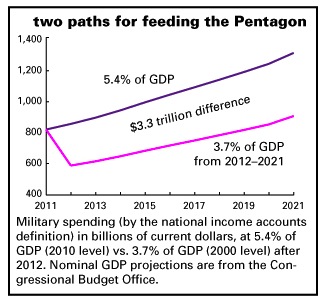
In 2000, we spent 3.7% of GDP on the military. The Pentagon didn’t have to hold bake sales. We’re now spending 5.4%. Merely going back to 2000 would save 1.7% of GDP, or $255 billion. If over the next decade we spent 3.7% of GDP instead of 5.4%, we’d save $3.6 trillion. That’s close to what many of the deficit hawks are aiming for. Let the Bush tax cuts expire and bump up the top rate a few points and everyone could have free child care and free college tuition!
Of course to do that would be unAmerican.
Heritage Foundation: severely truth-challenged
I usually shy away from mocking the right—it’s too easy, it’s overdone by liberals, and it’s often a gateway to apologetics for the Democrats. But this is a doozy.
In an effort to prove that Obamacare is responsible for the recent weakening in the economic recovery, James Sherk of the Heritage Foundation presents this graph:
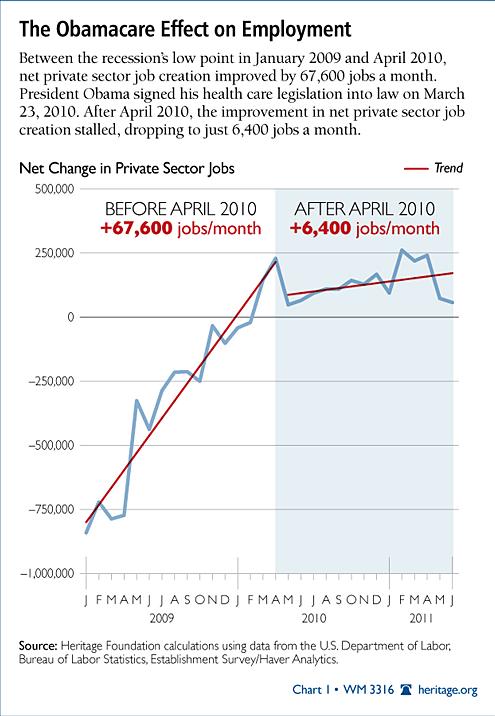
Seems odd, doesn’t it, that the average of the first segment, January 2009–March 2010, is +67,600 a month when the graph is below 0 for almost the whole time? Well, yes it is. The actual average change in private sector employment for that period is a decline of 327,000 a month, almost 400,000 below what Heritage says is the average. The average gain for the second period, from April 2010–June 2011, is 136,000 a month, almost 130,000 above what Heritage says it is.
It looks like what Sherk did was to take the slopes of the two trendlines and compare them. But for the first period, there was only one month of actual job gain—the last month, March 2010. Sherk’s trendlines are telling you we went from deep job losses in early 2009 to modest job gains starting in early 2010, and have more or less stayed there since. Which, if you were a Dem propagandist, you could use to sell Obamacare, not damn it. Of course, Obamacare—a mostly terrible thing—has almost nothing to do with these employment trends, but then again, Heritage seems to have only an accidental relationship to truth.
It will be interesting to do a similar graph in a year or two with the passage of the debt deal as the dividing point. Fiscal tightening in an already slowing economy is not a good idea, but don’t expect the Heritage Foundation to say that.
Varieties of exhaustion
Having become the de facto leader of the Republican party, at least when it comes to fiscal policy, Obama is now turning—again (didn’t he do this before? I recall some nonsense about a “hard pivot”)—to job creation. And he’s going to do what needs to be done: take a bus tour of the Midwest and do a few photo ops at factories. You might think that with a stalling economy and a high unemployment rate that could start drifting higher any month now, that he might want to try something more aggressive than hopping a ’hound. But no: “Mr. Obama is unlikely to unveil any major new stimulus proposals, since he has exhausted most of the obvious policy options.”
A very obvious option would be a jobs program. But no—the de facto leader of the Republican party can’t even mention that. The best he can do is more free trade agreements and patent law reform. This guy makes you nostalgic for Bill Clinton—or at least the late 1990s. The dot.com era was nuts, but it was a helluva lot more fun than this hair shirt epoch.
Austerity = moral renovation
Writing in today’s New York Times, Jennifer Steinhauer explains the politics of the debt melodrama: the parties are “jousting over the moral high ground on imposing austerity, with seemingly none of the political or practical motivations that have historically driven legislation.” Leaving aside the fact that half of one party (the Dems) have happily embraced the premises of the other—and also leaving aside the fact that the “high ground,” moral or otherwise, hasn’t much in evidence during this idiotic fight—Steinhauer is inadvertently onto something.
Over the centuries, the period after the bursting of a bubble has often been time of self-reproach, a time of self-questioning and even self-flagellation. Those have notably been absent in the U.S. during the post-bubble periods of the early 1990s and early 2000s. Now we’re apparently getting some of it, but it’s looking like the austerity party plans to punish people other than those who profited during the bubble. Will Goldman Sachs partners be taxed to repair the damage? Heavens no: the victims of this program of moral renovation through austerity will be such notorious high livers as the poor, the chronically ill, and graduate students. Moral renovation is always more fun when you’re prescribing it for the other guy.
Oh, and apparently this is only the beginning. The austerity party is already pushing for more.
New radio product
Freshly posted to my radio archives:
July 23, 2011 James Galbraith on deficit hysteria and the single-volume collection of four books by his father, John Kenneth Galbraith, published by the Library of Amerca
July 16, 2011 Amber Hollibaugh, interim director of Queers for Economic Justice, on the limits of same-sex marriage (see here for more) • Jeff Madrick, author of The Age of Greed, on the emergence of today’s icky economic order
July 2, 2011 Christian Parenti, author of Tropic of Chaos, talks about the effects of climate change amidst state collapse, plentiful weaponry, and neoliberalism
PS: The Riksbank is right
I got a couple of emails asking me whether I agreed or disagreed with the passage from the Riksbank’s philosophy of money that I quoted yesterday. I agree. I guess that makes me a tough customer too—a hard-money Marxist, you might say.
Sweden: no paradise of monetary ease
Several people have commented that my characterization of the Swedish central bank—Sveriges Riksbank—as a pretty tough customer is wrong. They point to a rapid response to the 2008 financial crisis, more dramatic than that of the U.S. Federal Reserve.
Yes, the Bank moved quickly to counteract the implosion. It flooded the system with liquidity—and briefly resorted to negative interest rates (though this was a largely symbolic gesture, since Swedish banks rarely borrow from the Riksbank). This is exactly what a central bank should do in the midst of a crisis. It also began withdrawing stimulus in early 2009 (see p. 11 of this IMF document) and has already begun tightening to fight inflation (Minutes of the Executive Board’s monetary policy meeting on 4 July 2011.)
Sweden is in a very different situation from the U.S. It got caught up in the financial crisis mainly by a hit to exports—it’s a very trade-dependent economy. It doesn’t have all the deep structural problems of the U.S. So its recovery was relatively quick and strong. Not so the U.S. But the Fed remains indulgent, and is likely to stay that way for months to come.
Sweden had a major financial crisis and deep recession in the 1990s—but its government moved to nationalize the banking system and clean it up. It was a model of how to approach a banking disaster, but it was done mainly through fiscal mechanisms and not magic monetary interventions.
But reactions to crises weren’t what was at issue. It was whether a long-term policy of easy money is either desirable or effective. And here is what the Riksbank has to say on that topic:
It was also noted in the preparatory work on the Sveriges Riksbank Act that monetary policy cannot be used to influence real economic quantities such as growth and employment other than in the short term. A central bank thus cannot lastingly increase growth and employment by conducting systematically expansionary policy. A systematically expansionary monetary policy would lead to high inflation and probably ultimately entail a poorer development of the real economy. It is therefore neither useful nor appropriate to set lastingly high growth or high employment as targets for monetary policy. Growth and employment are determined in the long term by other factors, such as technological advances, the supply of labour and the functioning of the economy. However, monetary policy can affect the average development of the price level and thus the average inflation rate. Accordingly, the statutory and thereby overriding objective for monetary policy is to maintain price stability.
In other words, the Riksbank believes that there’s not much that monetary policy can do to affect the long-term path of an economy. It can do a lot to prevent crises from getting out of hand, but outside crisis moments, its stated responsibility under Swedish law is price stability. (By contrast, the Fed has what is usually called a dual mandate —price stability and “maximum employment.”) I’ll stick with my characterization of the Riksbank as a tough customer.
The Economist, a “newspaper,” weighs in
Although for some reason I still subscribe to the thing, I’ve mostly stopped reading The Economist. If you read a good daily newspaper or three—I know, so old-fashioned—who needs all that attitude?
I was reminded of why I don’t read the thing by reading a post from one “W.W.,” responding to the great Yglesias-Henwood debate, as excellently amended by Henry Farrell. It includes this remarkable observation:
[F]rom my point of view the problem with jobs programmes, as compared to textbook monetary policy, is not that they increase the power of labour relative to capital. It’s that they do little to sustainably increase demand for labour. And nothing reduces the power of labour relative to capital more than low demand for labour.
This reminds me of the current undergraduate habit of arguing through feelings, not evidence. Why does W.W. hold this opinion? We don’t know, but presumably we should trust him, because he writes for a very important magazine that calls itself a newspaper.
Earlier in his lighter-than-air post, W.W. doubts there’s such a thing as a “neoliberal.” I’ve long had mixed feelings about the word. But insofar as it has a definition, it means something like an intensified form of capitalism that came into prominence throughout the world in the wake of the Reagan–Thatcher–Volcker counterrevolution with the undoing of the previous Keynesian–social democratic regime. Aside from the fact that the U.S. was never much of a social democracy, my reservation about the word is that it is a weak synonym for capitalism. The undoing of buffers against the harshness of the labor market is significant, but we’re basically talking about a system where 80–90% of the population in the richer countries lives has minimal savings and so essentially from one paycheck to the the next. In more social democratic regimes, this discipline is somewhat muted. But in many, if not most, richer countries, these buffers have been weakened.
But W.W.’s definitional confusion is a mere scenic overview on the way to this conclusion:
Liberal and social-democratic political theory both are marked by a peculiar hopeful naivete about the possibility of one day arriving at some sort of ideal self-equilibrating politico-economic system. But it’s never going to happen. Until the heat of all creation is spread evenly over the whole cold void, everything always will be unbalanced. Here in the hot human world, it’s certain that sooner or later someone will invent or say something that will make comrades enemies and enemies friends. All we can do is our best for now. If sound technocratic, monetary policy (or neoliberalism, whatever that comes to) is the best we can do for now, it doesn’t matter that it generates no long-run self-sustaining political constituency. Nothing does. So, for now, we should try to sustain it.
You’re going to die, but that’s no reason to stop eating.
My god. Who said anything about an ideology leading to some kind of self-sustaining institutionalization. Farrell’s point is that good politics (or bad politics, for that matter) requires some sort of “organized collective action.” There’s nothing automatic about it. Left neoliberals—by which Farrell et al mean the likes of Yglesias, who seem to want a somewhat more humane social order, but are rather confused about how to get there—seem to think that all we need is a better set of technocrats to take us there. Wall Street and the Fortune 500 have a very well organized and impressively sustainable set of institutions—among them The Economist.
Apparently W.W. doesn’t see himself as part of that machinery. But isn’t that hegemony for you? When you’re a comfortable cog, it all looks natural to you. Which, I suppose, is why he ends his post with a metaphor out of nature, not society.
Yglesias & neoliberalism
Matthew Yglesias regrets that his original commentary on monetary policy, and my disagreement with it, got hijacked by Henry Farrell and turned into an analysis of the limits of neoliberalism. (I also stand corrected that Yglesias hasn’t written in favor of a jobs program in the past—apparently he has, though there was no evidence of it in the piece I responded to.) I like what Farrell has to say, and agree with him: there’s a kind of liberal, or neoliberal technocratic approach to politics that boils down to, as Adolph Reed once put it, let’s just get all the smart people together on the Vineyard and we can solve everything. As much as I admire John Maynard Keynes, you could say something similar about his approach to politics.
Farrell writes:
I see Doug and others as arguing that successful political change requires large scale organized collective action, and that this in turn requires the correction of major power imbalances (e.g. between labor and capital). They’re also arguing that neo-liberal policies at best tend not to help correct these imbalances, and they seem to me to have a pretty good case. Even if left-leaning neo-liberals are right to claim that technocratic solutions and market mechanisms can work to relieve disparities etc, it’s hard for me to see how left-leaning neo-liberalism can generate any self-sustaining politics.
I dig absolutely, as Leonard Bernstein put it in a somewhat different context (though it was part of a conversation about achieving full employment).
But I want to focus on a smaller point, Yglesias’ strange claim:
I think that better monetary policy, though hardly the solution to all of America’s ills, could do a lot to reduce unemployment. His view seems to be not just that a more thorough economic restructuring would be desirable, but that it’s strictlynecessary to achieve recovery. In my view, that’s factually mistaken. Better monetary policy over the past several years would, I believe, have produced a much shallower and shorter recession….
I really don’t know what he expected the Fed to do. Just before the Lehman crisis, the Fed held about $900 billion in assets. (See first column, here.) Within weeks, it held over $2 trillion. Now, it’s close to $3 trillion. They bought all kinds of stuff, guaranteed trillions more. They cut interest rates to zero and made it clear they’d stay there for a long time. They did it in a secretive and unaccountable way, but they can hardly be accused of passivity. Would it have made a big difference if they’d said, “Gosh, we wish inflation would rise to 3%”?
What would have made a big difference is if we had a bigger, longer-term stimulus and growth package centered around a jobs program and infrastructure spending, without all the tax breaks. I understand that getting that through Congress—even the old, pre-November 2010 model—would have been nearly impossible, but that’s another story. A story that would take us back to Henry Farrell’s point about the need for a self-sustaining movement.


 LBO News from Doug Henwood

