In this article from LBO #128 (yes, it’s posted quickly to the web, but that doesn’t happen often, so you really should subscribe if you don’t), I talk about the lust that some people—within Wall Street, the Federal Reserve, and the world of punditry—have for getting the federal deficit down. Contrary to this I argued that this is really the wrong time to start thinking about that—we still need the short-term kick of deficit spending to help get the economy off the mat, and then over the longer term we need to rethink our economic model. But I do want to take a look at the evidence that deficit hawks use to scare people into the need for austerity: projections for the growth in federal debt over the next seven decades.
(Quick definitional housekeeping. The deficit is the difference between what the government takes in and what it spends. To make up the difference, the government has to borrow, which adds to its total debt outstanding. In the jargon of the trade, the deficit is a flow and debt is a stock.)
Seven decades is a really long time to do forecasting over, since the economics profession isn’t really all that good at forecasting next year. But you do have to think about these things, if only to do some half-rational planning. People who worry about pools of red ink say that countries face the risk of debt crisis when their total debt reaches somewhere around 100% of their GDP. There’s nothing magical about this, but let’s just assume that this is more or less correct for a moment. On the Congressional Budget Office’s projection, which I characterized as hysterical without much elaboration in the original article, the U.S. won’t reach that point until 2074. Yet scaremongers are using that possibility as an argument for hacking away at Social Security and Medicare starting sometime in the next few years.
But what about those projections? Why did I call them hysterical? Becase, for one reason, they assume that starting about 10 years from now, the U.S. will settle into a period of profound economic stagnation. To put a number on it, they project that from around 2020 through 2084, GDP growth will average 2% a year. To underscore the point, that’s over a period of 64 years—enough for a person born at the beginning of that period to reach very close to today’s retirement age by the end. How weak is 2% growth? It’s only a little over half the 3.7% average that prevailed from 1870 through 2009. There have only been a few brief periods in U.S. history when trend growth was this low—the 1930s and around about now, in fact. And that’s about it.
For the full historical perspective, see the graphs below. The top graph shows yearly GDP growth from 1870 through 2009 and the CBO’s projections for 2010–2084. The heavy line shows the underlying trend using a statistical technique called a Hodrick–Prescott (HP) filter. It’s sort of a high-tech average. Note that the projected 2020–2084 trendline is lower than just about every period in the long sweep of history. The next graph does the same, but with per capita figures. The results are very similar: the projected average of 1.2% (using population assumptions detailed in a moment), vs. a long-term historical average of 2.1%. And the trend is lower than almost every bygone period. And the bottom graph isolates the HP trends to emphasize just how at odds with the historical record the CBO’s projections are.
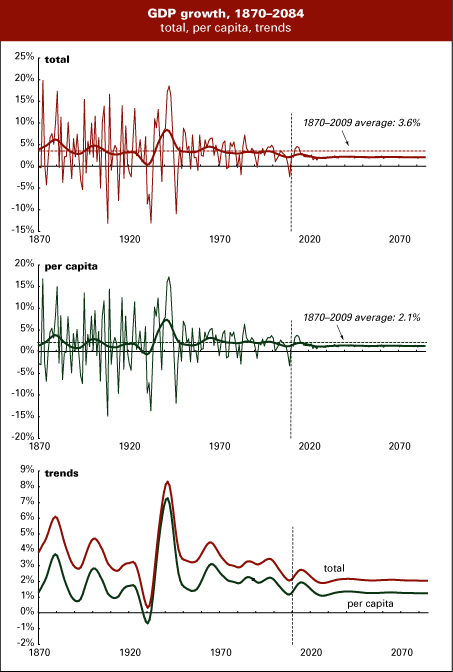
How do they come up with these numbers? I asked the CBO for clarification, but they haven’t responded. But asking around yields something like this. Over the long term, economic growth is a function of labor force growth and the productivity of that labor—how much workers can produce in an hour or year of work. The CBO apparently assumes that the labor force will grow very slowly—around 0.3–0.4% a year. That’s less than half the current rate, and about half the rate that the Census Bureau projects the population will grow in the coming decades. If that’s true, the share of the adult population working will shrink to levels we haven’t seen since, well maybe forever, and certainly in modern times. At the same time, they’re assuming record-low growth in productivity, probably around 1.5%, which is something like a third below the long-term average, and well below the rate clocked in the much maligned 1970s.
These assumptions are very similar to those underlying projections that the Social Security system will go broke. But if the economy grows at something closer to its long-term average, then that won’t happen. And the massive growth in debt won’t happen either, because the government will collect more in taxes than it would if we were locked in a semipermanent slump.
So what’s going on here? Is the CBO pushing these strange projections to promote an austerity agenda—cutting social spending and privatizing Social Security? Or are they really serious that a seventy-year near-depression awaits us? Inquiring minds want to know.
 LBO News from Doug Henwood
Leave a Comment
Posted on August 22, 2010 by Doug Henwood
Radio commentary, August 21, 2010
[Since today’s show was unusually filled with material —a rerun of the Diane Ravitch interview that first ran last April—I kept the introductory comments short. But I did want to get this on the record, for people who think I’m something of a happy-talker.]
Evidence of an economic slowdown continues to roll in. First-time claims for unemployment insurance, filed by people who’ve just lost their jobs, have been creeping up for the last few weeks after falling for most of the year. It’s quite possible that the weak job gains of the last few months—they were weak, but at least they were gains—could turn back into losses this month or next. That would be very bad news, both as a measure of the state of that abstraction we call the economy and for the human beings involved. Unemployment causes not only impoverishment, but depression (the mental as well as the economic kind), anxiety, sickness, and—no exaggeration—early death. But our leaders are more interested in how we can balance the budget by cutting Social Security—Obama has said he’s open to “modest adjustments” to “strengthen” it, which way of saying “cuts”—than a jobs program.
And the portents for the future are looking worse, too. The weekly leading index from the Economic Cycles Research Institute, designed to forecast changes in the broad economy three to six months out, has been trending downwards since April and is now at a point where a second leg of recession is looking like a real possibility. I’ve been saying for the last few months that we were in a weak recovery that would feel to many people like we were still in recession; we may now be on the verge of something worse.
Share this:
3 Comments
Posted on August 19, 2010 by Doug Henwood
Robert Reich on Social Security: no problem
Going through past LBOs in order to put together a greatest hits anthology to be published to mark the newsletter’s 25th anniversary next year, I came across this, from issue #92, November 1999:
n.
Share this:
14 Comments
Posted on August 18, 2010 by Doug Henwood
Strike wave!
There are many ways to measure the death of organized labor as a social force in the U.S. Here’s what might be the most objective one: the virtual disappearance of labor’s ultimate weapon, the strike.
The graph above shows the annual number of major strikes, as tallied by the Bureau of Labor Statistics. (The front page for all their strike/lockout stats is here: Work Stoppages Home Page.) The figure for 2010 annualizes what we’ve experienced so far this year. The little uptick, from a total of 5 in 2009 to 20 in 2010, was boosted by a strike by 15,000 public sector construction workers in Chicago in July. Their strike produced 180,000 lost workdays last month, the highest total since 600,000 in October 2008. These numbers are nothing when compared to the peak of labor’s power, from the 1950s through the 1970s, when we saw as much as 60 million lost workdays a year, or 0.4% of the total number worked economy-wide (the record, set in 1959). Heck, it’s nothing compared even to 2000’s 20 million lost days, or 0.06% of the total.
All those right-wingers who long for the good old days of the 1950s might want to reconsider.
Share this:
1 Comment
Posted on August 13, 2010 by Doug Henwood
Happy 75th, Social Security
Tomorrow marks the 75th anniversary of FDR’s signing of the bill that created Social Security. Despite—or perhaps—because of the program’s popularity and success, the austerity party has its knives out for it.
Keyed to the anniversary, the Center on Budget and Policy Priorities has published a very useful factsheet on Social Security: how it’s reduced poverty among the elderly, and how it offers quite a few services for the young.
It’s been a while since I did a piece in LBO on the preposterous assumptions behind the projections of the system’s imminent bankruptcy—I’ll be doing one very soon. In the meanwhile, here’s a link to the most recent one: Social Security: the definitive piece. The headnote has links to its three precursors; LBO has been on this case for sixteen years.
Share this:
22 Comments
Posted on August 10, 2010 by Doug Henwood
The state of WBAI (dire)
[I just sent this to Mitch Cohen, chair of the WBAI local station board, to be read at tomorrow night’s board meeting.]
To Mitch Cohen and the WBAI local station board:
I’ve been around WBAI for more than two decades. I started as a frequent interviewee on Samori Marksman’s show in 1987, moved on to regular commentaries on his show a few years later, and then began doing the Thursday editions of his Behind the News in 1995. I’ve watched the station go through considerable turmoil over the years, but the current situation has me more worried than ever. I was very relieved and hopeful when Bernard White and Co. were removed from office. But I’ve lost that feeling completely.
Our financial situation remains dire. Indeed, it’s hard to see how we can go on like this much longer. Not only are we not paying our bills, we’re dragging the whole Pacifica network deeper into the red. In this context, it’s easy to understand the temptation to offer sensational fundraising premiums to raise a lot of money quickly. But this strategy is proving disastrous.
A few words about those premiums. During the last few drives, WBAI has offered a variety of rather embarrassing videos and publications. We’ve now moved well beyond the familiar 9/11 conspiracies. Now we also have miracle cures (which, it wouldn’t surprise me, could put us at legal risk for offering, since they make claims about curing disease that, to put it gently, would be very difficult to prove), stories about chemtrails (the theory that the government, for some mysterious reason, is poisoning us by spraying chemicals from the sky), and most recently, a series of videos explaining how the Illuminati are about 90% of the way to taking everything over (it’s only a matter of time until they plant microchips in our heads and solidify a regime of total control). (Tastes of that stuff here and here.) I’m told, though I haven’t heard this stuff myself, that we’re also hawking the work of Kevin Trudeau, who’s been convicted of credit card fraud and has been fined for making false and misleading claims – and who’s been frequently sued by disgruntled customers. Of professional interest to me are stories about financiers and the Federal Reserve which have no basis in historical fact – and I say this as someone who knows more about Wall Street and central banks than anyone involved with Pacifica. Many of these narratives have deep roots in far-right politics – the Wall Street/Federal Reserve stuff has long been associated with crypto-fascist organizations like Willis Carto’s Liberty Lobby (e.g. the works of Eustace Mullins). Trudeau is a big fan of Matt Drudge and the odious Michael Savage.
None of this stuff can be taken seriously by anyone with an ongoing relationship with Planet Earth. For that reason alone, it’s a disgrace that we give it such prominence. The health claims expose us to prosecution and litigation – a legal risk we can’t possibly afford. But, that aside, airing this sort of stuff drives away sane and solvent listeners. Given the recent drop in our fulfillment rate, it seems reasonable to surmise that people who pledge on this stuff are more likely than most not to come through. So this strategy fails even on purely monetary grounds. But by driving away the audience, we’re undermining the station’s future. Do we really want to be known as the nonprofit telemarketing arm for lunatics and convicted criminals?
I’ve shared these concerns with interim program director Tony Bates and he dismisses my concerns as mere “outrage.”
We urgently need to figure out why we’ve lost listeners and how we can build the audience back up. This is not the way to go about it. It’s a guaranteed route to insolvency and ridicule.
Share this:
10 Comments
Posted on July 30, 2010 by Doug Henwood
The CBO’s deep, unappreciated gloom
In this article from LBO #128 (yes, it’s posted quickly to the web, but that doesn’t happen often, so you really should subscribe if you don’t), I talk about the lust that some people—within Wall Street, the Federal Reserve, and the world of punditry—have for getting the federal deficit down. Contrary to this I argued that this is really the wrong time to start thinking about that—we still need the short-term kick of deficit spending to help get the economy off the mat, and then over the longer term we need to rethink our economic model. But I do want to take a look at the evidence that deficit hawks use to scare people into the need for austerity: projections for the growth in federal debt over the next seven decades.
(Quick definitional housekeeping. The deficit is the difference between what the government takes in and what it spends. To make up the difference, the government has to borrow, which adds to its total debt outstanding. In the jargon of the trade, the deficit is a flow and debt is a stock.)
Seven decades is a really long time to do forecasting over, since the economics profession isn’t really all that good at forecasting next year. But you do have to think about these things, if only to do some half-rational planning. People who worry about pools of red ink say that countries face the risk of debt crisis when their total debt reaches somewhere around 100% of their GDP. There’s nothing magical about this, but let’s just assume that this is more or less correct for a moment. On the Congressional Budget Office’s projection, which I characterized as hysterical without much elaboration in the original article, the U.S. won’t reach that point until 2074. Yet scaremongers are using that possibility as an argument for hacking away at Social Security and Medicare starting sometime in the next few years.
But what about those projections? Why did I call them hysterical? Becase, for one reason, they assume that starting about 10 years from now, the U.S. will settle into a period of profound economic stagnation. To put a number on it, they project that from around 2020 through 2084, GDP growth will average 2% a year. To underscore the point, that’s over a period of 64 years—enough for a person born at the beginning of that period to reach very close to today’s retirement age by the end. How weak is 2% growth? It’s only a little over half the 3.7% average that prevailed from 1870 through 2009. There have only been a few brief periods in U.S. history when trend growth was this low—the 1930s and around about now, in fact. And that’s about it.
For the full historical perspective, see the graphs below. The top graph shows yearly GDP growth from 1870 through 2009 and the CBO’s projections for 2010–2084. The heavy line shows the underlying trend using a statistical technique called a Hodrick–Prescott (HP) filter. It’s sort of a high-tech average. Note that the projected 2020–2084 trendline is lower than just about every period in the long sweep of history. The next graph does the same, but with per capita figures. The results are very similar: the projected average of 1.2% (using population assumptions detailed in a moment), vs. a long-term historical average of 2.1%. And the trend is lower than almost every bygone period. And the bottom graph isolates the HP trends to emphasize just how at odds with the historical record the CBO’s projections are.
How do they come up with these numbers? I asked the CBO for clarification, but they haven’t responded. But asking around yields something like this. Over the long term, economic growth is a function of labor force growth and the productivity of that labor—how much workers can produce in an hour or year of work. The CBO apparently assumes that the labor force will grow very slowly—around 0.3–0.4% a year. That’s less than half the current rate, and about half the rate that the Census Bureau projects the population will grow in the coming decades. If that’s true, the share of the adult population working will shrink to levels we haven’t seen since, well maybe forever, and certainly in modern times. At the same time, they’re assuming record-low growth in productivity, probably around 1.5%, which is something like a third below the long-term average, and well below the rate clocked in the much maligned 1970s.
These assumptions are very similar to those underlying projections that the Social Security system will go broke. But if the economy grows at something closer to its long-term average, then that won’t happen. And the massive growth in debt won’t happen either, because the government will collect more in taxes than it would if we were locked in a semipermanent slump.
So what’s going on here? Is the CBO pushing these strange projections to promote an austerity agenda—cutting social spending and privatizing Social Security? Or are they really serious that a seventy-year near-depression awaits us? Inquiring minds want to know.
Share this:
Leave a Comment
Posted on July 29, 2010 by Doug Henwood
Jonesing for a slump
The Bullet reprints the lead piece from LBO #128: “Jonesing for a slump: austerity in the face of weakness”
Share this:
3 Comments
Posted on July 28, 2010 by Doug Henwood
Annoying autoresponse
I emailed Random House publicity to see if I could set something up with Gary Shteyngart, who sounds pretty interesting. This is the autoresponse I got:
And they don’t even sign it “Love.”
Share this:
2 Comments
Posted on July 22, 2010 by Doug Henwood
LBO 128 out
LBO #128—just emailed to electronic subscribers, and on press for the print audience.
Contents:
•Austerity in the face of weakness
•Andy Stern, stocks, and Social Security
•the energy picture: how the U.S. stacks up (badly), and how we’re doing on renewables (badly)
• The Nation moves its money
• localism in Portland
If you don’t already subscribe, please do: LBO subscription info. Paid subscriptions help keep the free stuff (this, radio show) going.
Share this:
1 Comment
Posted on July 16, 2010 by Doug Henwood
Radio commentary, July 15, 2010
burstlet fades
It’s now becoming quite obvious that the burst of strength in the first quarter of the year has given way to something much less yeasty. The rate of job growth has slowed dramatically, and the retail sales report released earlier in the week revealed that Americans just haven’t been spending money in the last few months with the vigor they showed in the winter and early spring. I’m not at all surprised by this development—this is what recoveries from financial crises look like. And the Federal Reserve has now come around to believing that the economy’s slowing down. That hasn’t stopped some of its more hawkish elements from advocating for an interest rate increase. But I don’t think they’re going to get their way anytime soon.
Dodd-Frank
[This was written before Goldman got fined, as the FT couldn’t resist calling it in a headline, an amount equal to five days trading revenues and had to admit to nothing of consequence. It’s stunning how little the greatest financial crisis and worst recession in 80 years has changed things.]
So the Senate passed the financial regulation bill on Thursday afternoon, sending it along to the White House for the president’s signature. It would be an exaggeration to call it nothing, but it would also be an exaggeration to call it a major transformation of the financial landscape.
The bill (text here)is named after Connecticut Senator Christopher Dodd, whose state is home to a good deal of the hedge fund industry, and Massachusetts Representative Barney Frank, whose state is home to a number of large mutual fund and money management firms. While Dodd–Frank will change the way Wall Street does business to some extent, bankers headed off the biggest threats, and security analysts estimate that the hit to profits will be less than 10%. Banks will be required to boost their capital—though this is part of a broader international effort coordinated through the Bank for International Settlements. One point: the capital requirements mandated (capital in this sense meaning a wad of hard cash that isn’t borrowed and therefore is free to tap into in a crisis) in this bill are in the range possessed by Lehman Bros. before it went under. So clearly that’s not much of a guarantee of anything.
Some other features. Banks will be forced to stop trading on their own account (the so-called Volcker Rule, named after former Fed chair Paul Volcker), and will also be required to spin off part of their derivatives business into separately capitalized subsidiaries. These moves put something of a firewall between those dangerous activities and a federal safety net. But regulators will have to devise specific rules based on the legislation, an activity in which bank lobbyists will no doubt figure prominently. And the rules won’t go into full effect for four to five years. The hodge-podge of regulators—the Fed, the Securities and Exchange Commission, the Commodity Futures Trading Commission, the Comptroller of the Currency, just to name a few—will be left largely intact, though they will be encouraged to consult more closely. That is less than Bush’s Treasury Secretary Henry Paulson wanted to do: in a Treasury paper issued late in his term, Paulson proposed creating a single overarching regulatory authority. Insurance will still be regulated at the state, and not the federal, level—a rare thing among the “advanced” countries, and a guarantee that regulation will continue to be fragmented and weak.
Bank regulators will be given the power to wind down large, system-threatening institutions before they go under instead of during or after their failure. But a $19 billion levy on the banks to prepay the costs of such resolutions was dropped—the same day that the House killed an effort to extend unemployment benefits, amidst the worst outbreak of long-term unemployment since the 1930s. Dropped as well was Obama’s original proposal for an independent and powerful consumer financial protection agency; instead, a new body will be created inside the Fed, an institution not previously known for its attentiveness in protecting consumers from hungry bankers. The original consumer agency was one of the few “progressive” elements in the Obama administration’s original finreg proposal—but they never fought hard for it, and so it was easily killed by industry lobbyists.
comforting anxious capital
Soon after the House passed the bill the other week, Treasury Secretary Timothy Geithner went on Lawrence Kudlow’s TV show to correct the perception, common in the so-called business community, that the administration is anti-business. The choice of outlet is interesting: Kudlow, a former Reagan administration budget official, is a militant supply sider and all-around right-winger with a one-dimensional worldview. Geithner appealed to that dimensional singularity by assuring Kudlow and his CNBC audience that the administration plans to keep a lid on the favorable tax treatment of capital gains and dividends, and emphasizing that “this president understands deeply that governments don’t create jobs, businesses create jobs.” The administration has a “pro-growth agenda,” which is a phrase that Kudlow loves to use himself. But despite all these efforts to placate capital, capital remains fairly hostile to the administration and its modest regulatory efforts—which will, no doubt, prompt further efforts by Obama & Co. to placate business, efforts that will never satisfy, and will so have to be repeated. And repeated.
Share this:
2 Comments
Posted on July 16, 2010 by Doug Henwood
Welcome back…
…to me, that is. I’ve neglected this thing for too long. Back, and in size.
Share this:
3 Comments
Posted on June 29, 2010 by Doug Henwood
Misquoted by a(n alleged) spy!
Weird story about the alleged Russian spy network—it’s a long road from working on behalf of “The Internationale” to working for the land of Gazprom. And from a personal POV, it’s odder still that one of the spies misquoted me! In this article, Vicky Pelaez attributed a rather incredible accounting of the productivity of federal prison labor to me—though I never wrote these things and am skeptical that they are actually true:
Politico’s Ben Smith writes up this instance of her journalistic malfeasance here.
Share this:
4 Comments
Posted on May 18, 2010 by Doug Henwood
Recessions & politics (cont.)
Hans Peter Grüner has posted the paper that he and Markus Brückner wrote about the electoral effects of economic recessions to his website: here.
It makes eminent psychological sense that a crisis might lead people toward conservative responses—a feeling of impending scarcity encourages selfishness, not generosity. It’s been ages since I read Erik Erikson, but as I recall the identity crisis, it leads the sufferer back to remembered moments of security and happiness, not toward an uncertain transformative future. That helps explain why immigrants are so often the target in an economic crisis: it’s not just about labor market competition (and some of the most xenophobic are those who experience no labor market competition with immigrants), but a fear of the foreign amidst a passionate reversion to the familiar.
More on the immigrant angle: further evidence that feelings about immigration are driven more by “cultural” than narrowly economic concerns can be found in this paper by David Card, Christian Dustmann, and Ian Preston. Among other things they find that some of the most passionately anti-immigrant people are retirees, who of course have no labor market competition issues. Christians are more opposed to immigration than non-Christians, and there’s a lot of anxiety about heathen nonwhites polluting native cultures.
Share this:
Leave a Comment
Posted on May 17, 2010 by Doug Henwood
Fresh LBO website content
Freshly posted to the LBO website:
• How to learn nothing from crisis: careening back to the status quo ante bustum, a well-received piece from #125.
• Contents of #126: suboptimal disillusionment • c’mon, Slavoj, tell us the secret! • Greece and the EU crisis • recovery, now what? • CPI-Elderly • buying green makes you nasty. Here’s a little taste of each.
If you like what you see and want to keep it coming, instead of adding another victim to the Great Periodical Die-Off, then please subscribe if you don’t already. And if you do, please give a gift, or hit the donate button to the right.
Share this:
14 Comments
Posted on May 17, 2010 by Doug Henwood
Recessions: better for right than left
For a long time, I’ve been critical of the left-wing penchant for economic crisis. Many radicals have fantasized that a serious recession—or depression—would lead to mass radicalization, as scales simultaneously fell from millions of pairs of eyes and the imperative of transcending capitalism became self-evidently obvious. I’ve long thought that was nonsense, and now there’s empirical support for my position.
In his column today, Paul Krugman cites research by Markus Brückner and Hans Peter Grüner showing that recessions boost the vote for extreme right-wing and nationalist parties. As Krugman argues, this helps explain the rise of the Tea Partiers and other strange life forms on the right. Of course, such critters are never far from the surface in American political life—but they do seem more salient these days.
Krugman’s little summary was tantalizing, so I tracked down the original. (The paper is here; a summary, here.) Brückner and Grüner looked at 16 European countries (Krugman wrongly implies that they also looked at the U.S., but they didn’t) from 1970 to 2002. They found that for every percentage point decline in GDP growth over two quarters, support for the far right rises by 0.136 percentage points. Though the finding is statistically significant, it’s not electorally so—that’s a pretty small effect. From their work, Brückner and Grüner estimate that even a sustained three-point decline in the growth rate might produce no more than a three-point gain in the far right’s electoral share.
The original paper said nothing about far left parties, so I wrote the authors to ask them if they’d looked into that angle. Grüner responded by sending an updated version of the paper that did. (It’s not up on the web yet, but should be very soon. I’ll post the link here when it is.) They find no significant effect of a growth slowdown on the vote share of communist parties. Brückner and Grüner speculate that a major selling point of far-right parties is “nontraditional” redistribution—not so much from rich to poor, but away from ethnic, occupational, or regional minorities. They don’t say why the appeal of “traditional” redistribution—from rich to poor—might not reflect the business cycle.
Whatever the reason, recessions are not good for the left and are good for the right. A major exception, of course, was the U.S. in the 1930s, but that one took the unemployment rate up to 25%. And that Great Depression didn’t do much for the left in Europe. So please, let’s put this one away and stop hoping for the worst.
Share this:
Pages
Like what you see?
To get lbo-news by email, subscribe here:
Archives
Pages
Subscribe to LBO News via email
share it
Like what you see?
Archives