
New radio product
Freshly posted to my radio archives:
back after KPFA fundraising hiatus—if you like this show, please support the station now! and mention Behind the News if you do—there’s a best of BtN premium, consisting of 26 of my best interviews of the last decade, available for a pledge of $75
Gary Weiss, author of Ayn Rand Nation, on her cult and influence • Adolph Reed on Black History Month, the return of the ghoulish Charles Murray, and politics in gloomy times
Austerity & bankers’ coups: the NYC precedent
With the displacement of Greece’s elected government by Eurocrats acting in the interest of the country’s creditors, I thought this would be a good time to reprise the section of my 1997 book Wall Street that covers the New York City fiscal crisis of 1975, which was something of a dress rehearsal for the neoliberal austerity agenda that would go global in the 1980s. Certain celebrity academics are constantly cited for making this argument, but I was there first. You can download Wall Street for free by clicking here: Wall Street.
This chapter, and this book, has mainly been about the private sector, but it would be incomplete to finish a chapter on “governance” without looking at the relations between Wall Street and government, not only in the U.S., but on a world scale.
One advantage that Wall Street has in public economic debate, aside of course from its immense wealth and power, is that it’s one of the few institutions that look at the economy as a whole. American economic policymaking is, like all the other kinds, largely the result of a clash of interest groups, with every trade association pleading its own special case. Wall Streeters care, or presume to care, about how all the pieces come together into a macroeconomy. The broadest policy techniques—fiscal and monetary policy—are what Wall Street is all about. For some reason, intellectuals like the editors of the New York Review of Books and the Atlantic have decided that investment bankers like Felix Rohatyn and Peter Peterson have thoughts worth reading in essay form. Not surprisingly, both utter a message of austerity—the first with a liberal, and the second with a conservative, spin—hidden behind a rhetoric of economic necessity. These banker–philosophes, creatures of the most overpaid branch of business enterprise, are miraculously presented as disinterested policy analysts.
Wall Street’s power becomes especially visible during fiscal crises, domestic and international. On a world scale, the international debt crisis of the 1980s seemed for a while like it might bring down the global financial system, but as it often does, finance was able to turn a crisis to its own advantage.
While easy access to commercial bank loans in the 1970s and early 1980s allowed countries some freedom in designing their economic policies (much of it misused, some of it not), the outbreak of the debt crisis in 1982 changed everything. In the words of Jerome I. Levinson (1992), a former official of the Inter-American Development Bank:
[To] the U.S. Treasury staff…the debt crisis afforded an unparalleled opportunity to achieve, in the debtor countries, the structural reforms favored by the Reagan administration. The core of these reforms was a commitment on the part of the debtor countries to reduce the role of the public sector as a vehicle for economic and social development and rely more on market forces and private enterprise, domestic and foreign.
Levinson’s analysis is seconded by Sir William Ryrie (1992), executive vice president of the International Finance Corporation, the World Bank’s private sector arm. “The debt crisis could be seen as a blessing in disguise,” he said, though admittedly the disguise “was a heavy one.” It forced the end to “bankrupt” strategies like import substitution and protectionism, which hoped, by restricting imports, to nurture the development of domestic industries. “Much of the private capital that is once again flowing to Latin America is capital invested abroad during the run-up to the debt crisis. As much as 40–50 cents of ever dollar borrowed during the 1970s and early 1980s…may have been invested abroad. This money is now coming back on a significant scale, especially in Mexico and Argentina.” In other words, much of the borrowed money was skimmed by ruling elites, parked profitably in the Cayman Islands and Zürich, and Third World governments were left with the bill. When the policy environment changed, some of the money came back home — often to buy newly privatized state assets for a song.
That millions suffered to service these debts seems to matter little to Ryrie. Desperate Southern governments had little choice but to yield to Northern bankers and bureaucrats. Import substitution was dropped, state enterprises were privatized, and borders made porous to foreign investment. After Ryrie’s celebrated capital inflow, Mexico suffered another debt crisis in 1994 and 1995, which was “solved” using U.S. government and IMF guarantees to bail out Wall Street banks and their clients, and creating a deep depression; to make the debts good, Mexicans would have to suffer. Once again, a dire financial/fiscal crisis—the insolvency of an overindebted Mexican government—was used to further a capital-friendly economic agenda.
These fortunate uses of crisis first appeared in their modern form during New York City’s bankruptcy workout of 1975. This is no place to review the whole crisis; let it just be said that suddenly the city found its bankers no longer willing to roll over old debt and extend fresh credits. The city, broke, could not pay. In the name of fiscal rectitude, public services were cut and real fiscal power was turned over to two state agencies, the Municipal Assistance Corp. (MAC, chaired by Rohatyn), and the Emergency Financial Control Board, since made permanent with the Emergency dropped from its name. Aside from the most routine municipal functions, the city no longer governed itself; a committee of bankers and their delegates did, Rohatyn first among them. Rohatyn, who would later criticize Reaganism for being too harsh, was the director of its dress rehearsal in New York City. Public services were cut, workers laid off, and the physical and social infrastructure left to rot. But the bonds, thank god, were paid, though not without a little melodrama, gimmickry, and delay (Lichten 1986, chap. 6).
The city was admittedly borrowing irresponsibly—though the lenders, it must be said, were lending irresponsibly as well. When a bubble is building, neither side has an incentive to stop its inflation. But when it broke, all the pain of adjustment fell on the citizen–debtors. The pattern would be repeated in the Third World debt crisis, in many U.S. cities over the next 20 years, and, most recently, with the federal budget.
Obviously the bankers have the advantage in a debt crisis; they hold the key to the release of the next post-crisis round of finance. Anyone who wants to borrow again, and that includes nearly everyone, must go along. But that’s not their only advantage. The sources of their power were cited by Jac Friedgut of Citibank (ibid., p. 192):
We [the banks] had two advantages [over the unions]…. One is that since we were dealing on our home turf in terms of finances, we knew basically what we were talking about, and we knew and had a better idea what it takes to reopen the market or sell this bond or that bond…. The second advantage is that we do have a certain noblesse oblige or tight and firm discipline. So that we could marshal our forces, and when we spoke to the city or the unions we could speak as one voice…. Once a certain basic process has been established that’s an environment in which our intellectual leadership…can be tolerated or recognized…we’re able to get things effected.
It’s plain from Friedgut’s remarkably candid language that to counter this, one needs expertise, discipline, and the nerve and organization to challenge the “intellectual leadership” of such supremely self-interested parties. According to the union boss Victor Gotbaum (in an interview with Robert Fitch, which Fitch relayed to me), the unions’ main expert at the time, Jack Bigel, didn’t understand the budgetary issues at all, and deferred to Rohatyn, whom he trusted to do the right thing. For the services rendered to municipal labor, the once-Communist Bigel was paid some $750,000 a year, enough to buy himself a posh Fifth Avenue duplex (Zweig 1996). Gotbaum became a close friend of Felix Rohatyn. Politically, the unions were weak, divided, self-protective, unimaginative, and with no political ties to ordinary New Yorkers. It’s easy to see why the bankers won.
What was at stake in New York was no mere bond market concern. In a classic 1976 New York Times op-ed piece, L.D. Solomon, then publisher of New York Affairs, wrote: “Whether or not the promises…of the 1960’s can be rolled back…without violent social upheaval is being tested in New York City…. If New York is able to offer reduced social services without civil disorder, it will prove that it can be done in the most difficult environment in the nation.” Thankfully, Solomon concluded, “the poor have a great capcity for hardship” (quoted in Henwood 1991).
Behind a “fiscal crisis” lurked an entire class agenda, and one that has been quite successfully prosecuted in subsequent crises for the next two decades. But since these are fought on the bankers’ terrain, using their language, they instantly win the political advantage, as nonbankers retreat in confusion, despair, or boredom in the face of all those damned numbers.
How to stop worrying about class
Today’s New York Times contains a fine example of how ideology works at the high end: report information that might trouble the established order, but conclude on a tranquilizing note that allows the comfortable reader to turn the page (or click “close tab”) without changing his or her worldview. Both functions are important. Outlets like the Times do report tons of important stuff that one would be hard-pressed to learn otherwise. But, as Alexander Cockburn put it long ago, a primary function of the bourgeois press is reassurance.
The piece by Sabrina Tavernise, “Education Gap Grows Between Rich and Poor, Studies Show,” shows that “while the achievement gap between white and black students has narrowed significantly over the past few decades, the gap between rich and poor students has grown substantially during the same period.” (The paper from which much of the data is drawn, by Stanford sociologist Sean Reardon, can be gotten here.) While it’s long been well known that parental income and education have a stronger influence on educational outcomes than schools themselves, the gap between kids from affluent and poor families is widening.
All that information, and then some, is nicely presented in the first half of the article. But the second half consists mostly of quotes from three right-wing sources: University of Chicago labor economist James Heckman; Bell Curve ghoul Charles Murray (newly famous for his cultural take on the crisis of the white working class); and Douglas Besharov, now of the Atlantic Institute but formerly of the American Enterprise Institute, where he ran the Social and Individual Responsibility Project. Heckman says the last thing we should do is give poor people more money. Murray says it has “nothing to do with money and everything to do with culture.” And Besharov chimes in with the inevitable “no easy answers,” because “no one has the slightest idea what will work.”
Nonsense. The answers are conceptually easy, though politically anything but. You take money from rich people and give it to poor people, and spend at least as much, maybe more, educating the children of the poor as you do on the children of the rich. But that might make the Times’ audience uncomfortable. Better to flatter them on their excellent parenting.
Disclosure alert: I know Sabrina Tavernise and like her a lot. I just wish she’d written this piece differently.
Reflections on the current disorder
This is the text of the talks I gave at the University of California–Riverside and UC–Irvine, January 25 and 26, 2012. Graphs were added for the bloggy version.
It’s funny. I spend most of my life writing about economics, politics, and finance, yet about the only academics who ever invite me to speak are in the humanities. Maybe that’s because I dropped out of a graduate English program and can’t do a proper vector autoregression. But you guys are more fun than a bunch of dismal scientists anyway.
I took my title, “Reflections on the Current Disorder,” from William F. Buckley, who used it as an all-purpose label for his public talks back in the 1970s. Though it might seem odd for me, a non-conservative, to borrow a title from a paragon of American conservatism—one whose memory is fading, for sure, in these days of Fox News and Newt Gingrich—I was once a fan. In fact, I was once a conservative, for a year or two in the early 1970s. I was even a member of a strange formation called the Party of the Right in my early college days, a group that opens its meetings by reciting Charles I’s execution speech, which contains the striking revelation that government is no business of the people, because “a subject and a sovereign are clean different things.” (See here and here for more.) You may think that the U.S. fought a revolution against monarchy, but nostalgias for hereditary power still exist on the American right. Feel free to bring that up next time a Republican tells you that leftists are unpatriotic elitists.
Anyway, Chairman Bill and I have different feelings about the idea of disorder, I suspect. (Though my friend Corey Robin argues in his new book, The Conservative Mind, that rightists are often revolutionary nihilists under their placid exteriors.) But the present state of the U.S. economy is a wreck. For most people these day it’s a source of misery at worst or profound uncertainty at best. I suppose there are more than a few right-wingers who have no fundamental problem with this. You never have to wait very long for some apologist to cite Joseph Schumpeter’s famous phrase “creative destruction,” a phrase that gets 1.3 million hits on Google. Also, according to Google, use of that phrase really started to take off with the onset of the neoliberal era in the early 1980s, peaking into the dot.com bubble and its immediate aftermath around 2002, and then falling slightly into 2008 (when their ngram database ends).
A major problem with the phrase, aside from its unconcern (or at least its users’ unconcern) with the human distress associated with it—not to mention its indifference to Schumpeter’s original use, a Marx-inspired view of capitalism’s eventual demise—is that not much creation has been going on lately. I’m not talking about works of art, but conventional economic innovation—which may be going on in China, but sure isn’t going on here in the USA in any quantity.
Throughout our history, this has been a brutal society, but at least it had a certain dynamism in both commerce and in culture. I don’t see much of that today. The last gasp of economic dynamism was that dot.com boom, which was often thoroughly delusional, but did have some energy to it, and did leave us some byproducts, like many miles of fiber optic cable. It also paradoxically presumed to address some concerns historically associated with the left—a flattening of hierarchies, the provision of meaningful work, the erasure of borders, and even peace, love, and understanding. Of course it did all that firmly within a capitalist paradigm, but it did have an embryonic aspect about it, if only in fantasy. No longer. Our most recent bubble built a lot of subdivisions in exurban Las Vegas, with no payoff either in the productive or phantasmic realms. There might be some payoff were the homeless and underhoused allowed to move into the empty dwellings, but that’s not the way the USA works—though the Occupy movement seems to be nudging things in that direction.
So where are we, political economy-wise. Here are our coordinates in vulgar business-cycle terms. The Great Recession officially ended more than two and a half years ago, and to most people it doesn’t feel like much of a recovery.
savage recession…
It was an awful recession. GDP, your orthodox economist’s favorite measure, contracted by over 4%, more than twice post-World War II recession average. The downturn officially lasted six quarters, a year and a half, two quarters longer than the average. Employment, the measure that matters most to regular people, fell by over 5%, almost twice the post-World War II average—and then fell by another 1% after the recession ended.
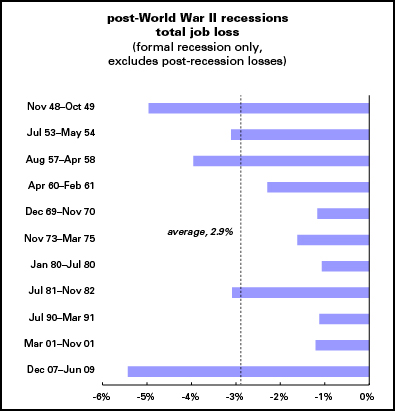
The reason that it doesn’t feel to many people like the recession never ended is that it’s been the weakest recovery since modern GDP numbers begin in 1929 and modern labor market numbers in 1939. As of the most recent quarter, the third of 2011, GDP, that most fetishized of all indicators, has only regained its pre-recession high; based on historical averages, it “should” be about 10% above. Total wage and salary income is about 2% below its pre-recession high; normally, it’d be up 13%. Ah, but profits! Corporate profits are up over 80% from their recession low; normally they’d be up about 50%. Profits are up nearly ten times as much as wages—the average in a recovery would be less than three times. Corporations are flush with cash—they’re spending some of it abroad and distributing some of it to their shareholders and executives. What they’re not doing is investing or hiring here.
The labor market, which is what most people depend on for their material welfare (about 80% of the population couldn’t live more than a few months without a paycheck at best), is a mess. We lost nearly 9 million jobs in the recession (actually we continued to lose jobs after the recession ended, well over a million of them) and have regained well under a third of them. In a normal post-World War II recovery, we would have regained those job losses in less than a year and would now be well ahead of the pre-recession high. If this were that elusive normal recovery, nearly 7 million more people would be employed now than are.
Yes, the unemployment rate has come down—in part because of the modest recovery we’ve experienced, but also because enormous numbers of people have dropped out of the labor force. If you’re not actively looking for work, you’re not counted as unemployed; if you haven’t looked for a job in the last year, you’re not even counted as “discouraged,” the official label for that brand of labor-market detachment. The share of the adult population working for pay, the so-called employment/population ratio, is exactly where it was when employment bottomed out in February 2010. It’s below where it was when the recession ended. It’s well below its all-time peak in 2000–2001. Over the long haul, the employment/pop ratio had risen steadily into that millennial peak, mainly because of the entry of women into the paid labor force. The male ratio had already been in a mild but steady decline since the end of World War II but its fall was more than offset by the rise in the female ratio.

The ratios for both sexes plunged during the recession, men’s worse than women’s, and have basically just stabilized over the last couple of years. Men have actually done a little better than women—the result, I suspect, of a surprisingly decent recovery in manufacturing employment (dispoportionately good for men) and the shrinkage in government employment (bad for women). The overall employment/population ratio is back where it was in 1983, meaning that the entire employment expansion of the 1980s and 1990s has been reversed.
At recent rates of job creation, it would take about five years to recover the jobs we lost, and that’s not allowing for population growth. If the population continues to grow at recent rates, it would take well over eight years.
Sad to say, none of this is really a surprise. the economy and job market are following the script of a post-financial-crisis recession almost perfectly: they take years to recover from.
…after a weak expansion
But, as they say on TV, that’s not all. The 2002–2007 expansion was the weakest one in modern history. Jobs were created at a rate that was about a third the average of the post-World War II expansion. The combination of that tepid expansion, which was preceded by a long period of job market weakness, and the Great Recession, meant that employment from late 2009 through late 2011 was actually lower than it was ten years ealier—2% lower at its worst Since the 1930s, there had never been a period in which employment in the U.S. contracted over the course of a decade. The worst previous ten-year reading since the 1930s was a gain of 22% over ten years. We’re now recovered to where we’re not quite 1% above where we were ten years ago. That contrast is really striking: 22% previous worst, vs. an actual decline of about 3%.Back in the 1990s, cheerleaders used to love to talk about the Great American Job Machine. That machine has clearly popped a few gaskets.

origins
So how’d we get into this mess? We all know the story of the proximate causes of the economic crisis—a housing bubble enabled by not merely massive applications of credit, but credit packaged in unimaginably complex and obscure forms and a dispersion of responsibility that comes with securitization. There was a synergy of troublemaking here. Mortgage debt, after rising gently through the 1980s and 1990s, exploded after 2000. We know that lending standards deteriorated, to where the only requirement for getting a loan was having a pulse—and I bet you could even find some exceptions to that rule. (Some of that credit laxity may be coming back—my kid got a credit card solicitation a couple of months ago, well before his sixth birthday.) Downpayments became optional. The habit of packaging mortgages into bonds and selling them to distant investors removed any incentive for the original lender to scrutinize the creditworthiness of borrowers—and allowed trouble to proliferate around the world when things went bad.
My use of the word “bond” in the last sentence is as quaint as downpayment became, because the finest minds of Wall Street assembled all manner of mortgages into complex derivatives that no one, even some of the people who sold them, could understand. (Ok, “no one” is an exaggeration. I think the actual count of people who undersood these derivatives was in the hundreds.) Investors had absolutely no idea what horrors were hidden in the structured products they bought, even though many came with a Aaa ratiing. Either the rating agencies didn’t know what they were grading or didn’t care—the issuers of the dodgy securities were the one who were paying their fees; as one rater put it in a famous email, they’d rate things put together by cows. Of course they weren’t put together by cows—the were put together by investment bankers, who are far more dangerous.
further back
All this is true. But it’s a mistake to look only at that part of the story. Today’s crisis also has a prehistory going back to the problems of the 1970s and the neoliberal prescription for fixing those problems.
The “problem” of the 1970s was, of course, stagflation—stag as in stagnation, and flation as in inflation. The stag part is actually rather misleading; the expansion of the Carter expansion saw job growth four times as rapid as that of the George W. Bush expansion, and GDP growth half again as high. For the whole decade, GDP growth in the 1970s was also half again as high as so far in the 2000s—but such a comparison for employment is near impossible, since job growth in this decade is close to 0.
Note that job growth was far stronger relative to GDP growth in the Carter years than the W years. That gives a hint of the contrasting class dynamics of the two eras: labor got a much bigger share of the action in the much-criticized 1970s than it has lately, which is a clue to why it’s so fashionable to make fun of the decade, aside from its strange fashions.
But the inflation part of the 1970s was important. The CPI maxed out at nearly 15% in 1980, and hit an 18% annualized rate in March of that year. Wartime inflations were common in U.S. history, but never this chronic and deteriorating sort of thing.
Inflation wasn’t just about rising prices—it was also about sagging productivity, falling profitability, limp financial markets, and, less quantifiably, a general loss of discipline in the workplace and the erosion of American power in the world. Corporate profitability, which had peaked at 11% in 1966, fell by two-thirds to under 4% in 1980. With high inflation, holding bonds became a losing proposition; Treasury bonds were nicknamed certificates of confiscation. Stocks turned in one of their worst decades ever—not as bad as the 1930s, but close.
But it wasn’t just a matter of numerical indicators. The U.S. lost the Vietnam War, and oil and other commodity exporters were jacking up prices, and the Third World was demanding redistribution on a global scale. Though it’s largely forgotten now, the working class was restive and rebellious. Formal strikes were common (as they were in the 1950s and 1960s), but so were the wildcat kind. Back in 1970, Richard Nixon called out the National Guard to deliver the mail because postal workers went on a self-organized strike (they had no union). Later in the decade, we heard a lot about the blue-collar blues, and in 1978, the appropriately named country singer Johnny Paycheck scored a hit with “Take This Job and Shove It.”
the crackdown
Obviously something had to give, and what gave was the working class, domeestically and internationally. Paul Volcker came into office in October 1979 declaring that the American standard of living had to decline, and he made it happen by driving up interest rates towards 20% and creating the deepest recession since the 1930s. (We just beat that record, but it took 30 years!) To the one-sided class war, Reagan added the ammunition of firing the air traffic controllers—the very opposite of what a Republican president had done with strikers only a decade earlier—and it was open season on organized labor. Wages and social spending were squeezed, and the deregulatory agenda that began under Carter was intensified. Abroad, Latin America was thrown into debt crisis, a crisis that for a while threatened to take down the global banking system—but instead, the problem was solved through the now-familiar neoliberal agenda of privatization and opening up to cross-border trade and financial flows. Debtor countries were forced to dismantle their nationalist–protectionist development regimes as a condition of new finance, and to open to foreign trade and capital flows.
The program was very successful. Internationally, Latin and other debtor countries were brought into the global flow of goods and money. Domestically, the recession scared the hell out of the working class; people were glad to have a job, and wouldn’t dream of telling anyone to shove it. Business became essentially free to do whatever the hell it wanted to. Profitability recovered strongly, rising throughout the 1980s and 1990s to a peak of over 8% in 1997—not quite 1966 levels, but still more than twice the trough of 15 years earlier. It took a while, but productivity finally joined in. In the military–political sphere, U.S. power was enhanced, and we kicked the Vietnam Syndrome too. Discipline problems were a thing of the past.

There were a few interruptions—a stock market crash in 1987 that looked scary for a while, a long stagnation and jobless recovery in the early 1990s, the bursting of the dot.com bubble ten years later. But all in all, the system managed to recover from, even thrive, on its troubles, and state managers perfected their bailout techniques. Of course, each bailout laid the groundwork for the next bubble, but Alan Greenspan famously said that one needn’t worry about bubbles because one can always repair the damage after the fact. He lately seems chastened on that topic.
the contradictions
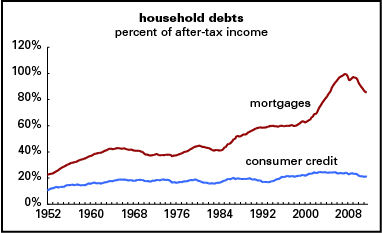
But through those bubbles, busts, and recoveries, one constant persisted. A system dependent on high levels of mass consumption has a hard time living with a prolonged wage squeeze. I mean that not only in the economic sense, but also a political/cultural one. American life is very insecure and volatile, and the ability to buy lots of gadgets assuages that to a considerable degree. Mass consumption staves off what could be a serious legitimation cdrisis. For the last few decades, the economic and political contradiction has been managed, if not resolved (not that it could ever be) through the liberal use of debt—credit cards at first, and then mortgages from the mid-1990s onward. The explosion in household credit —from 65% of disposable income in 1983 to 135% at the 2007 peak (most of it from mortgages, by the way)—is what made the booms and bubbles of the last three decades possible. This is especially true of the 2001–2007 expansion, which featured the slowest employment and aggregate wage growth of any cycle since numbers the numbers begin in 1929. Without the massive cashing in on appreciating home equity—Americans withdrew several trillion dollars worth of home equity during the decade of boom, all of it borrowed against rising house values that would soon go into reverse, and spent much of it—consumption would have languished and the home improvement business would have gone under (since home improvements during the bubble were financed almost exclusively by equity withdrawals). And since we have almost no domestic savings, much of the cash for that adventure came from abroad, from places like the People’s Bank of China.
Lest you think that this analysis, tying debt growth to increased inequality, is just the fevered product of a radical mind, let me assure you that it recently got support from a very orthodox corner. A bit over a year ago, the International Monetary Fund—normally thought of as a bastion of economic orthodoxy—published a working paper with the provocative (by IMF standards) title “Inequality, Leverage and Crises.”
In any case, in the paper, IMF economists Michael Kumhof and Romain Rancière wondered aloud whether the increase in inequality we’ve seen over the last few decades contributed anything to the causes of our economic crisis. They attempt to model, in rigorous mathematical fashion, the perception that poor and middle-income households borrowed aggressively to maintain or expand their standard of living while wages and employment were growing only weakly, at the same time that rich households had more money than they knew what to do with, so they sought profitable opportunities to lend all that spare cash to those below them on the income ladder.
Kumhof and Rancière draw parallels between the recent period and the 1920s. In both periods, the share of income claimed by the top 5% rose dramatically, and by similar magnitudes. And during the 1920s and the recent period, roughly the last 25 years, the ratio of household debt to underlying incomes doubled.
Sometimes conservatives defend income inequality in the U.S. by appeals to our instinctive but untested assumptions about mobility. That is, the alleged ability of people to raise their incomes over time, over that of their parent or their own young selves, is thought to compensate for the high levels of inequality at any one moment. But actually this excuse doesn’t hold water. The U.S. is no more mobile, and is often less so, than other rich countries; that is, people here are no more likely, and are often less likely, to surpass the income levels of their parents than they are in Western Europe. And the U.S. today is, if anything, less mobile than it was a few decades ago.
And over the last 25–30 years, nonrich households have increased their indebtedness far more than those at the top. Back in 1983, the richest 5% were significantly more indebted, measured relative to their incomes, than the bottom 95%. That position has since reversed. So almost all of the increase in U.S. debt ratios—a household debt level of not quite 70% in 1983 compared with 135% at the peak in 2007, a near-doubling—has come from the nonrich portion of the population.
At the same time, the financial sector has grown enormously (more on this in a moment). A major reason for this growth has been its arrangement of all that borrowing and lending between the capital-owning class (the top 5%) and the bottom 95%, the workers. By the way, despite the Marxish cast of these labels, they come from the IMF economists, not me.
We don’t have the same sort of detailed statistics covering the 1920s, but the broad outline is very similar: polarization offset by increased borrowing, followed by a major financial crisis.
way out
In their analysis, Kumhof and Rancière, following the argument of the IMF’s former top economist, Rajuran Rajan, “that growing income inequality [and I’m quoting them, not me] created political pressure—not to reverse that inequality, but instead to encourage easy credit to keep demand and job creation robust despite stagnating incomes.” So what is to be done in the face of this?
Kumhof and Rancière, quite plausibly, say there are only two ways of dealing with our present pickle. On the one hand, we can have an orderly debt reduction—a policy of slow and careful writeoffs and debt forgiveness rather than massive default leading to financial crisis. Well, we’ve already had some of that, and we’ve made more than a dent household debt levels, but the result has been a rather glum economy.
A second possiblity is, of course, as Kumhof and Rancière put it, “a restoration of workers’ earnings—for example, by strengthening collective bargaining rights.” That is, raise wages and strengthen union power. In the recent political environment, that looks like a tall order, but maybe things are changing.
Kumhof and Rancière acknowledge the political obstacles to the wage-raising strategy. But, as they put it in that gentle and sober way that mainstream types are fond of, “the difficulties of doing so must be weighed against the potentially disastrous consequences of further deep financial and real crises if current trends continue. Restoring equality by redistributing income from the rich to the poor would not only please the Robin Hoods of the world, but could also help save the global economy from another major crisis.” I should point out that this paper was a product of an IMF run by the French quasi-socialist, Dominique Strauss-Kahn, who ran into a bit of trouble in a New York hotel.
financial hypertrophy
I quoted that IMF paper as noting the enormous increase in the size of the financial sector. I’d like to say a few words about that. I’d thought that the financial crisis that began in 2007 and got truly awful in 2008 would put an end to the long rise of the financial sector in the U.S. economy. Maybe not lead to a major political transformation, but at least some downward adjustment to Wall Street’s enormous economic and political power.
Didn’t happen, did it? If anything, Wall Street has used the crisis if not to enhance its power at least to demonstrate it.
There are several dimensions to Wall Street’s rise to pre-eminence over the last few decades. One can simply be measured in money. For example, in almost every year since the U.S. national income accounts begin in 1929, securities and commodities brokers have been the highest-paid of almost the almost 90 industries reported by the Bureau of Economic Analysis. And the securities industry’s premium has grown enormously over time. From 1929 through 1939, it was 237% of average pay. It fell during World War II and the immediate postwar decades, at just under 180% of average pay. But with the takeoff of the bull market in 1982, the premium began to swell, crossing 300% in 1992 and 400% in 2006. It fell back some in 2008, to a mere 409%. It fell back some more in 2009 to 366%, which, though below the massive heights of a few years ago, is still higher than anything before 2004.
Or take profits. As the bull market was about to take off in 1982, the financial sector claimed 12% of pretax profits in 1982; that nearly tripled to 34% at the 2008 peak. It fell by more than half in the heat of the crisis, to 15% at the end of 2008—but it back to nearly 30%. That’s a remarkable share for a sector that employs less than 6% of the workforce.
Or take the proliferation of assets. Financial assets of all kinds—not just debt, but equities and everything else the Federal Reserve counts in its flow of funds accounts—were equal to 462% of GDP in 1982. That measure rose steadily for the next 25 years, more than doubling to a peak of 1,058% of GDP in 2007. The ratio came down a bit with the early stages of the financial crisis, but bottomed in the first quarter of 2009 and has been more or less flat ever since.

So here’s the story the numbers tell us: after a long period, mainly the Golden Age of the post-World War II decades through the 1970s, Wall Street was something of a torpid backwater. Its denizens lived well, but not large. But since then, they’ve accumulated an enormous amount of wealth.
Then there’s the issue of power. The financial sector has surprisingly little to do with raising money to finance real corporate investment. It rarely has. That’s especially true of the stock market. Even in the boomiest moments of the late 1990s dot.com bubble, IPOs—first offerings of stock to public investors—financed only a small fraction of corporate investment, about 5–6%.
Or, looked at another way, if you combine net equity offerings—which, given the heavy schedule of buybacks over the last quarter century, have been negative most of the time since 1982—takeovers (which involve the distribution of corporate cash to shareholders of the target firm), and traditional dividends into a concept I call transfers to shareholders, you see that corporations have been shoveling cash into Wall Street’s pockets at a furious pace. Back in the 1950s and 1960s, nonfinancial corporations distributed about 20% of their profits to shareholders. In the 1970s, that fell to 15%, which helped create the sour mood on Wall Street in that decade. After 1982, though, the shareholders’ share rose steadily. It came close to 100% in 1998, fell back to a mere 25% in 2002, and then soared to 126% in 2007. That means that corporations were actually borrowing to fund these transfers. It fell during the crisis, bottoming at 21% in mid-2009, but as of late last year, it was almost 70%.
Businesses do get outside financing, yes, but the most important source of that is old-style banks. So what exactly does Wall Street do? Let’s be generous and concede that it does provide some financing for investment. But an enormous apparatus of trading has grown up around it—not merely trading in certificates, but in control over entire corporations. I think it’s less fruitful to think of Wall Street as a financial intermediary than it is to think of it as an instrument for the establishment and exercise of class power. It’s the means by which an owning class forms itself, particularly the stock market. It allows the rich to own pieces of the productive assets of an entire economy. So, while at first glance, the tangential relation of Wall Street, especially the stock market, to financing real investment might make the sector seem ripe for tight regulation and heavy taxation, its centrality to the formation of ruling class power makes it a very difficult target.
the shareholder revolution
For a long while, shareholder ownership was more notional than active. After the 1929 crash, Wall Street sort of receded into the background, giving us the Golden Age of Galbraith’s managerial capitalism—when managers and technocrats ran corporations and shareholders were at most silent partners. But when economic performance faltered in the 1970s, when the Golden Age was replaced by Bronze Age of rising inflation and falling profits, Wall Street, meaning shareholders, finally asserted themselves. They unleashed what has been dubbed the shareholder revolution, demanding not only higher profits but a larger share of them. The first means by which they exercised this control was through the takeover and leveraged buyout movements of the 1980s. By loading up companies with debt, they forced managers to cut costs radically, and ship larger shares of the corporate surplus to outside investors rather than investing in the business or hiring workers. This cost-cutting mania helped drive the outsourcing movement.
The 1980s debt mania came to a bad end, as highly leveraged companies found themselves unable to cope with the early 1990s recession. So the shareholder revolution recast itself as a movement of activist pension funds, led by the California Public Employees Retirement System (CalPERS). The funds lobbied management, drew up hit lists of badly run companies, and generally pushed the idea that firms should be run for their shareholders. It had some successes. Compensation structures were rejiggered to emphasize stock over direct salaries; the idea was to get managers to think and act like shareholders, since they were materially that under the new regime.
But pension fund activism sort of petered out as the decade wore on. Managers still ran companies with the stock price in mind, but the limits to shareholder influence have come very clear since the financial crisis began. Managers have been paying themselves enormously while stock prices languished. If the stock price wasn’t cooperating, well, options could always be back-dated. The problem was especially acute in the financial sector: Bank of America, for example, bought Merrill Lynch because its former CEO, Ken Lewis, coveted the firm, and if the shareholders had any objections, he could just lie to them about how sick the brokerage firm was. It was as if the shareholder revolution hardly happened, at least in this sense. But all that money flowing from corporate treasuries into money managers’ pockets has quieted any discontent.
political coda
Wall Street demonstrated its immense political power during the financial crisis and its aftermath. Financiers may bellyache about increased regulation over the last couple of years, but the actual changes have been very minor. The major bill that changed the regulatory architecture, nicknamed Dodd–Frank, was weak tea to start with and is being watered down further as the detailed regulations required in the legislation are written.
So in return for hundreds of billions of dollars in public funds used to keep the financial system from going under, the banks will emerge from this crisis largely unscathed. One reason for this is Wall Street’s skill at lobbying, and its ability to spread huge amounts of cash around Washington. As Public Citizen documented, between 1998 and 2008, Wall Street spent $5 billion in campaign contributions and deployed 3,000 lobbyists across Capitol Hill to get its way. While $5 billion sounds like a lot, it was less than a third of the Goldman Sachs bonus pool for 2009, and spread out over a decade. Wall Street has a lot of money, and Congress can be bought on the cheap.
But, as I argued earlier, Wall Street also represents the commanding heights of the economy, the central mechanism by which ruling class economic power is formed and exercised. It’s only surprising to people who don’t understand this that Washington dances so faithfully to the bankers’ tunes.
In giving talks like this over the last few years, this is the point at which I’d moan about how in the midst of the worst sustained economic crisis in 80 years, the major political energy was coming from people with tea bags on their heads. It seemed that we needed—even in relatively mainstream terms—a serious rethink of the neoliberal economic model, and none was forthcoming. I would lament the lack of interest in doing anything serious about our economic situation, except embracing varying doses of austerity, which would only make things worse (see, for example, the periphery of Europe, which in this case includes Britain). I would worry about the inability even to admit, much less do anything, about the challenge of climate change. Then I’d move on to expressing a wish that I could detach myself from the consequences and find it all amusing, in the style of H.L. Mencken. But I couldn’t do that. Now that I’ve got a six-year-old who is growing up in this nuthouse, I’ve come to take it all more personally.
All this has changed dramatically in the last few months. Thanks to a small band of people who moved into a private park near Wall Street last September 17, political discourse and activism have taken the most hopeful turn that I can remember. I have my reservations about the ideological orientation of a lot of the Occupiers. And it’s hard to know whether this spirit will survive the winter—or the banalizing tendencies of presidential election campaigns. But I’m going to bracket that for now and admit to more than a shred of hope that things are turning in a seriously better direction. Finally.
Fresh audio product
Just posted to my radio archives (and, as always, the audio is often posted before the web page is updated, so for maximum timeliness, subscribe to the podcast—see headnote on archive for details):
January 28, 2012 Kevin Gray on South Carolina • Catherine Liu, author of American Idyll, on education, testing, anti-intellectualism, and the bogus politics of “anti-elitism”
January 21, 2012 Erin Siegal, author of Finding Fernanda, on adoption tragedies • David Cay Johnston on why Mitt is lightly taxed
Me in SoCal
I’m giving two talks in Southern California later this week (actually two versions of the same talk, “Reflections on the Current Disorder,” a title cribbed from William F. Buckley). Both are free and open to the public.
Wednesday, January 25, 3:30–5:00 PM
University of California–Riverside
CHASS INTS 1113Thursday, January 26, 4:30–6:00 PM
University of California–Irvine
1030 Humanities Gateway
I hope they won’t be too dull.
New audio product
Just posted to my radio archives:
January 14, 2012 Lane Kenworthy, author of this paper (PDF), on just how much economic growth trickles down, and why (spoiler: U.S. does very badly) • Enrique Diaz-Alvarez, chief strategist for Ebury Partners, on the eurocrisis, with an emphasis on Spain
A chat with Larry Summers (from 2000)
This is from Left Business Observer #94, May 2000.
chatting with Larry
LBO’s editor was lucky enough to run into Treasury Secretary Lawrence Summers at a party in Washington on April 15, and got to overhear some of his thoughts on the weekend’s events and even ask a few questions.
Early in the evening, surrounded by what appeared to be some loyal scribes, Summers enthused about how “proactive” the DC cops were, having arrested some 600 demonstrators, “including many of the leaders.” Summers is evidently unaware that the Direct Action Network types who constituted the hardcore of the demonstrators are resolutely anti-hierchical and don’t have leaders in the sense that he understands them. Later, as Summers was leaving, I got to ask him a few questions. Asked what he made of the crowds filling the streets, Summers, evidently forgetting his earlier enthusiasm for mass preemptive arrests, said he “admired their moral energy,” but thought their prescriptions would only make the poor poorer. When it was pointed out to him that the gap between the world’s rich and poor had been widening under the policies he and his like-minded predecessors have pursued, he claimed that this has been a great time of progress for the world’s poor. Finally, when asked if Africa was still vastly underpolluted — a reference to his infamous 1991 memo, written when he was chief economist of the World Bank, suggesting that it was — he seemed a bit startled, conceded that it was a “fair if unfriendly question,” and said that it’s been well established that he (or rather Lant Pritchett, the author of the words that went out under Summers’ name) was merely being sarcastic and not serious.
Looking at the state of the world’s poorest continent, it seems that truths are told in moments of “sarcasm” that elude the powerful in their more serious capacities.
PS: As this issue goes to press, we just learned that on Summers’ orders, former World Bank chief economist Joseph Stiglitz (LBO #93) had his consulting contract cancelled. A critical article in The New Republic, in which, among other things, Stiglitz dis’d the quality of the IMF’s staff economists, was apparently the last straw.
Larry Summers, future World Bank president?, on how Africa is vastly underpolluted
So Obama’s going to nominate Larry Summers to be president of the World Bank. Recall this passage from 1991 memo, actually written by Lant Pritchett but signed by Summers when he was the Bank’s chief economist, on how “Africa is vastly under-polluted.” The last paragraph is important, and should not be overlooked in fighting these mofos.
3. “Dirty” industries
Just between you and me, shouldn’t the World Bank be encouraging more migration of the dirty industries to the LDCs [less-developed countries]? I can think of three reasons:
1) The measurement of the costs of health impairing pollution depends on the foregone earnings from increased morbidity and mortality. From this point of view a given amount of health impairing pollution should be done in the country with the lowest cost, which will be the country with the lowest wages. I think the economic logic behind dumping a load of toxic waste in the lowest wage country is impeccable and we should face up to that.
2) The costs of pollution are likely to be non-linear as the initial increments of pollution probably have very low cost. I’ve always thought that underpopulated countries in Africa are vastly under-polluted, their air quality is probably vastly inefficiently low compared to Los Angeles or Mexico City. Only the lamentable facts that so much pollution is generated by non-tradable industries (transport, electrical generation) and that the unit transport costs of solid waste are so high prevent world welfare enhancing trade in air pollution and waste.
3) The demand for a clean environment for aesthetic and health reasons is likely to have very high income elasticity. The concern over an agent that causes a one in a million change in the odds of prostrate [sic] cancer is obviously going to be much higher in a country where people survive to got prostrate cancer than in a country where under 5 mortality is 200 per thousand. Also, much of the concern over industrial atmospheric discharge is about visibility impairing particulates. These discharges may have very little direct health impact. Clearly trade in goods that embody aesthetic pollution concerns could be welfare enhancing. While production is mobile the consumption of pretty air is a non-tradable.
The problem with the arguments against all of these proposals for more pollution in LDCs (intrinsic rights to certain goods, moral reasons, social concerns, lack of adequate markets, etc.) could be turned around and used more or less effectively against every Bank proposal for liberalization.
Engels, in 1892, explains USA 120 years later
This is worth re-reading about once every other week. From a letter written by Friedrich Engels in 1892:
There is no place yet in America for a third party, I believe. The divergence of interests even in the same class group is so great in that tremendous area that wholly different groups and interests are represented in each of the two big parties, depending on the locality, and almost each particular section of the possessing class has its representatives in each of the two parties to a very large degree, though today big industry forms the core of the Republicans on the whole, just as the big landowners of the South form that of the Democrats. The apparent haphazardness of this jumbling together is what provides the splendid soil for the corruption and the plundering of the government that flourish there so beautifully. Only when the land — the public lands — is completely in the hands of the speculators, and settlement on the land thus becomes more and more difficult or falls prey to gouging — only then, I think, will the time come, with peaceful development, for a third party. Land is the basis of speculation, and the American speculative mania and speculative opportunity are the chief levers that hold the native-born worker in bondage to the bourgeoisie. Only when there is a generation of native- born workers that cannot expect anything from speculation any more will we have a solid foothold in America. But, of course, who can count on peaceful development in America! There are economic jumps over there, like the political ones in France — to be sure, they produce the same momentary retrogressions.
The small farmer and the petty bourgeois will hardly ever succeed in forming a strong party; they consist of elements that change too rapidly — the farmer is often a migratory farmer, farming two, three, and four farms in succession in different states and territories, immigration and bankruptcy promote the change in personnel, and economic dependence upon the creditor also hampers independence — but to make up for it they are a splendid element for politicians, who speculate on their discontent in order to sell them out to one of the big parties afterward.
The tenacity of the Yankees, who are even rehashing the Greenback humbug, is a result of their theoretical backwardness and their Anglo- Saxon contempt for all theory. They are punished for this by a superstitious belief in every philosophical and economic absurdity, by religious sectarianism, and by idiotic economic experiments, out of which, however, certain bourgeois cliques profit.
NPR hack apologizes for Wall Street
For a while, I’ve been thinking about writing a piece on how NPR is more toxic than Fox News. Fox preaches to the choir. NPR, though, confuses and misinforms people who might otherwise know better. Its “liberal” reputation makes palatable a deeply orthodox message for a demographic that could be open to a more critical message.
The full critique will take some time. But a nice warm-up opportunity has just presented itself: a truly wretched piece of apologetic hackery by Adam Davidson, co-founder of NPR’s Planet Money economics reporting team, that appears in today’s New York Times magazine.
In the print edition, the thing is called “A World Without Wall Street.” For some reason, the paper’s web editors decided to call it “What Does Wall Street Do For You?” Maybe they thought that the question would draw in readers, who might find the declarative title of the print edition an appealing little fantasy and just turn the page.
Davidson concedes, with a mocking tone (that’s part of his straining at cool), that Americans have long hated Wall Street. But he rejects the usual complaints—that financiers are a bunch of bloodsucking parasites who periodically drive the real economy into a ditch—with the disclosure that finance is “a fundamentally beneficial business.” It brings together borrowers and lenders, a task that it does “extremely well”—“most of the time.”
Now I will be the first to argue that critiques of finance that let the “real” sector off the hook are incomplete, and even dangerous. (For more: “How to misunderstand money.”) The world of production can be a very nasty place. Corporations make money by paying workers less than the value of what they produce. They’re constantly maneuvering to cut costs, which means cutting pay, speeding up the line, dumping toxic waste in rivers, and a host of other familiar misdeeds. Like financiers, they’re in business to make money, and they’ll do nothing that doesn’t make money unless they’re forced to. Yes, they often provide useful products in the course of their pursuit of money. But it’s wrong to get carried away in painting them as the Good Guys, by contrast with the moneychanging Bad Guys.
But Davidson’s defense brief is incredibly wrong. I’d say “dishonest,” but I suspect he really doesn’t know better. He’s just picking this stuff out of the air. His points, in turn. Without Wall Street…
…the poor would stay poor. Without credit cards, poor people would have no money to buy stuff. Thanks to Wall Street, now they do—a contrast with benighted other countries, where they don’t. He seems to forget that the borrowers have to pay the money back, and at often usurious interest rates. Borrowing money at 18% or more is a poor substitute for a decent job and a civilized welfare state. Besides, the poor are not as well endowed with credit cards as Davidson seems to think—only 28% of the poorest fifth of the population carries a balance on its credit cards. That’s about half the share of the middle- and upper-middle income brackets. (See: FRB: 2009P SCF, especially the Excel file.)
…there would be no middle class. Davidson once again seems to think that borrowed money is the same as income. There’s no doubt that easy credit over the last 30 years has made class warfare from above more palatable, economically and politically. But neither admirable nor sustainable. Also, Davidson apparently hasn’t read up on the comparative international mobility stats (e.g.,this). He writes: “One of the most striking facts of life in countries without a modern financial system is the near total absence of upward mobility.” In fact, the U.S. has a middling-to-poor standing on mobility in the international league tables. A country like Germany, where consumer finance is relatively underdeveloped, is more mobile than the U.S. The Nordic social democracies show the most mobility of all. Oh, and student debt, now breaking the trillion dollar mark? Nothing to worry about, says Davidson: it’s “largely changed America for the better.” Actually, the rising price of higher ed is making it harder all the time for the working class to go to college. Watching millions graduate with five figures of debt into a miserable job market doesn’t evoke a better America. College should be free.
…lots of awesome things would never happen. Wall Street, because it loves risk and innovation, is responsible for all sorts of wondrous novelties, like lifesaving drugs and artisanal goat cheeses. In fact, financiers long been shy about funding risky ventures. Henry Ford couldn’t get a dime out of them when he was revolutionizing auto production. Financiers weren’t at all interested in computers from the late 1940s through the mid-1960s—the Pentagon and Census Bureau funded the industry in its early stages. Ditto the Internet, which was initially a project of the military. Basic pharmaceutical research is funded by the National Institutes of Health. Wall Street is more interested in things that have been proven. And I doubt that Goldman Sachs has much to do with funding artisanal cheese production, though its employees probably buy a lot of the stuff.
And how does Wall Street do all this? By matching investors and borrowers, of course. In fact, most corporate investment is funded internally, through profits. Very little comes from the stock market. Venture capitalists are crucial to funding startup firms, for sure, but VC is actually a relative speck on the financial landscape. Trading in existing assets, the bulk of what Wall Street does, has almost nothing to do with real activity.
But Davidson concludes with an absolution: it’s still ok to hate Wall Street. They did lots of reckless stuff during the bubble and then got bailed out. But that’s ok, really, we had no choice. And there’s not much we can do to prevent problems in the future: “regulation—no matter how well intended—cannot be trusted to rein in Wall Street.” So the real reason to hate Wall Street is that they’re indispensable.
No wonder NPR’s list of corporate sponsors takes up four pages of its Annual Report.
Lots of fresh audio product
Way behind on posting this stuff to the web. The podcasts get posted soon after—and sometimes even before—broadcast, but not always the web page.
Freshly posted (clicking on the date links will take you right there):
January 7, 2012 Michael Taft on the Irish depression • Jodi Dean, co-author of this, on the vexing question of OWS & “demands”
December 31, 2011 Christopher Jencks on inequality
December 24, 2011 Christine Ahn & Tim Shorrock on North Korea • Aaron “Zunguzungu” Bady on Occupy Oakland
December 17, 2011 Christopher Hitchens (from 2002) on Orwell • Andrew Ross on student debt repudiation (sign up or endorse here!) • Phil Mattera on job subsidies
Yglesias reflects on bubbles
Matt Yglesias is still trying to figure out the late housing bubble. His latest approach is to separate structures and land, which leads him to this conclusion:
I think it makes more sense to restrict the idea of a “bubble” to speculative asset like land (or stocks or gold or whatever) rather than to the actual building. A building boom may be (indeed probably is) in some sense “unsustainable” but when the boom collapses it’s not like an asset price bubble that leaves nothing in its wake but debt. A boom in structure building leaves you with extra structures. Whether or not this is the most useful thing to have on hand is open to debate, but it’s very much the opposite of “paper wealth” that vanishes when the boom fades. The buildings are still there, and still as useful (or useless) as they ever were.
This is not entirely wrong, but it’s not entirely right either.
While the major part of the movement in real estate value is accounted for by land, not structures, the contribution of building itself to the mid-decade expansion was prodigious. From the end of the recession in the fourth quarter of 2001 through the peak (or something close to it) of the bubble four years later, residential investment accounted for 13% of GDP growth, three times its share of GDP at the outset. Ubiquitous memes to the contrary, consumption contributed slightly less than its share (especially durable goods—so much for that boom in flat-screen TVs), as did nonresidential investment (from office buildings to capital equipment). Military spending contributed almost twice its share, but other categories of government spending were mostly in line with their averages.
In other words, residential investment—meaning the building of new houses and the renovation of old ones—was by far the leading sector in the familiar national income equation (income = consumption + investment + government + exports – imports). That’s not even counting spillovers—the boost to consumption provided by all those contractors, the demand for raw materials and equipment, and the rest. And a major reason people built and renovated so much housing is because prices were rising and were expected to continue doing so until the end of time.
Just as optimism about prices led to rampant overbuilding, now pessimism about prices is suppressing building. Residential investment is now about half its long-term average, and its failure to recover is a major factor in the broad economy’s failure to recover.
And yes, in theory all those new houses could be providing some use value—there are more than a few homeless and underhoused people in the USA who would happily move in tomorrow—but as long as people lack the money to buy or rent them (and banks are unwilling to lend the money to buy them), then they’re as good as useless. In fact, as long as they’re an overhang on the market, causing people to pull back from buying houses for fear that excess inventory will depress prices for years to come, then they’re worse than useless. Because under this delightful capitalist thing, it’s money that matters, as the great political economist Randy Newman once put it. Physical use values often take a distant back seat to the monetary imperative.
The Fed and the class struggle
Mike Konczal assembles some striking quotes from Federal Reserve transcripts showing how obsessed the monetary overlords are with keeping wages down. I won’t recycle any of the quotes—check out his post for the full flavor.
Reading these, Mike wonders what the contribution of the Fed has been to wage stagnation over the last few decades. My sense is, not much since Volcker left in 1987. There’s no doubt that the Volcker crackdown of 1979–82, with a second-wave attack in 1984–85, did cause a major shift in the relative power of capital and labor. What employers saw as a frightening insolence among the working class in the 1970s was broken by the early 1980s recession—a point that Reagan underscored by firing the air traffic controllers and replacing them. Employers got the message that it was ok to bust unions, and they did with great fervor.
The expansion that followed that recession, though marked by decent employment gains, was accompanied by a massive wave of Wall Street-led takeovers and restructurings. Mass layoffs even in relatively good times became routine. And this had an effect on worker consciousness: they’d agree to anything the boss demanded, lest the plant be closed and the work shifted elsewhere. And sometimes even if they agreed, the plant would be closed eventually anyway.
With Greenspan’s ascension to the Fed chair in 1987, the business of the central bank became less one of controlling inflation—which means constant wage vigilance—and instead one of cleaning up the messes that financiers created. Cleaning up financiers’ messes meant a bias towards low interest rates, not tightness.
Here’s a graph of the real federal funds rate since 1955. Real means the actual rate less inflation over the previous year. The federal funds rate is the interest rate that banks charge each other for overnight loans; it’s the Fed’s main policy target, and the rate under its most direct control.
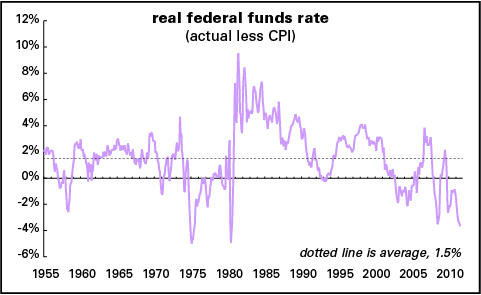
Over the long term, it’s averaged 1.5%. (That was also its average during the Golden Age, from 1955–73. Note that real fed funds stayed above the average line for almost the entire 1960–73 period, the really fat years for the American working class.) During the Volcker days, October 1979– August 1987, it averaged three times the 1.5% mean. During the Greenspan era, August 1987–January 2006, it averaged 1.6%, just 0.1 point above dotted line. There were periods of tightness, like the late 1980s and late 1990s, but they weren’t all that different from the pre-Volcker patterns.
Actually the late 1990s were the only period of sustained and broad wage growth in the last 40 years, and Greenspan let it continue because he was a true believer in the New Economy productivity revolution. With productivity growing at a 3.5% rate, and wage growth of 2.5% (including fringe benefits—and closer to 1.0% without), there was plenty of room for profits to grow too. Not only that—the working class was still afraid, which to Greenspan was a good thing:
Several years ago I suggested that worker insecurity might be an important reason for unusually damped inflation. From the early 1990s through 1996, survey results indicated that workers were becoming much more concerned about being laid off. Workers’ underlying fear of technology-driven job obsolescence, and hence willingness to stress job security over wage increases, appeared to have suppressed labor cost pressures despite a reduced unemployment rate.
At the time of that testimony, in 1999, he was worried that that effect might be ebbing, with a 4% unemployment rate. So policy was tightened—until the dot.com bubble burst. Once there was a financiers’ mess to clean up, interest rates were cut dramatically.
So I’d say that the Fed hasn’t really had to tighten to keep wages down in almost 25 years. The “real sector”—the absence of unions, the low and eroding value of the minimum wage, the threat of outsourcing, and all the other familiar weapons of the class war from above—have been doing their work for them. Should that change, the Fed will be vigilant at heading off the threat of “wage inflation”—meaning raising interest rates to jack up the unemployment rate, thereby inducing the appropriate level of worker anxiety. But right now it has its hands full trying to keep the world from falling further apart, which is why we have a real fed funds rate of around –4%.


 LBO News from Doug Henwood
15 Comments
Posted on January 6, 2012 by Doug Henwood
That jobs report
[This was my radio commentary for the January 7 show. Audio here.]
Friday morning brought the release of the employment stats (Employment Situation News Release) for December. It was a strong report, though not quite as strong as it looks on the surface. Many of the gains are likely to be reversed in January, but the trend of modest, steady improvement continues—and manufacturing had its best year since 1984.
Now some details, edited for radio. Employers added 200,000 jobs in December. Over a fifth of that gain, 42,000, came from couriers and messengers—meaning all those FedEx and UPS folks delivering holiday packages ordered from the likes of Amazon. Online retailers had a great December. Not so much for brick and mortar retailers, who’d apparently expected otherwise and hired ambitiously, adding another 28,000 to the headline figure. Given the ultimate disappointment of the holiday season, retail-store-wise, and the explicitly temporary nature of the courier jobs, these gains—which together accounted for over a third of the total—are likely to be reversed in January. What I’ve been calling the eat, drink, and get sick sector returned to its previous strength after slipping in November, as bars and restaurants and health care together added almost 50,000, a quarter of the total.
There are good jobs in health care (and also lots of not so good ones), but with an exception I’ll get to in a moment, the strongest sectors were either evanescent or low wage or both. This is hardly the bold acceleration that some insta-pundits were touting on Friday morning. Maybe they’re Democrats.
In the negative column: temp firms, where hiring is often a portent of strength to come, and government, which continues to shed workers, though now mostly at the local level (and there, mostly education—isn’t that nice?).
There was surprising strength in manufacturing, a sector where employment fell by a third between 2000 and 2010 and where the absolute number of workers employed is well below what it was in 1947, even though the labor force has tripled since then. For the year, the factory sector added almost 200,000 workers. That’s the best gain in percentage terms (using yearly averages) since 1984. More on the manufacturing revival in a minute or two.
The numbers I’ve been citing come from a survey of about 300,000 employers. There’s also a simultaneous survey of about 50,000 households. That household survey gave a less upbeat picture than its employer counterpart. It showed no change in the share of the population working. But it did show a decline in the unemployemnt rate, from 8.7% to 8.5%, the lowest level in almost three years. Hidden unemployment was also down, with the number working part time for economic reasons and those classed as not in the labor force but wanting a job both falling strongly. As a result, the broad U-6 unemployment rate, which includes them along with discouraged workers (those who’ve given up the job search as hopeless), fell 0.4 point to 15.2%, also its lowest level in almost three years.
But the unemployment rate, which is down from its recession peak of 10% in October 2009, has been flattered by what’s known in the trade as labor force withdrawal. That is, you’re not counted as unemployed if you’re not actively looking for work. Many of the unemployed have simply given up on finding work, and they’re not counted as unemployed. So even though the unemployment rate is down a point and a half from that 10% peak, the share of the adult population working for pay, the so-called employment/population ratio, is exactly the same now as it was at that peak. (See graphs appended below.) That is not what we’d see in a normal recovery. We’re still 6 million jobs below the pre-recession peak at the end of 2007. At the growth rate we’ve seen over the last six months, it would take almost four more years to recoup those losses—and that’s not allowing for population growth. We’re still in a very deep hole and emerging only very slowly.
manufacturing miracle
And now a few more words on the manufacturing revival. Friday’s Wall Street Journal had a piece (“In U.S., a Cheaper Labor Pool”) on how Caterpillar, which has been doing quite well lately, is threatening to close a plant in Canada and move operations to a low-wage site unless it gets big concessions from its union, the Canadian Auto Workers. That low-wage country its threatening to move to? The United States. The Journal also reports on other manufacturing firms moving south from Canada (but without crossing the Rio Grande): Siemens, Navistar, and Electrolux. The reason? American workers are very productive but they earn a lot less. Caterpillar claims that its workers in Illinois cost the firm less than half as much as their comrades in Ontario. Over the last decade, unit labor costs—wages and benefits paid per dollar of output—have fallen by 13% in the U.S. They rose by 2% in Germany, 15% in Korea, and 18% in Canada. When you factor in transportation and other costs, U.S. workers in some sectors are starting to become competitive with China, where wages have been rising sharply for years and workers have developed a habit of striking and ransacking the boss’s office. The trend towards bringing factory work back to the U.S. even has a name: onshoring. A revival of manufacturing would be good in many ways, but one based largely on low wages and high levels of exploitation is not something to cheer.
graphic supplement
Here are graphs showing the labor force participation rate (LFPR, the share of the adult population that’s either working or looking for work—the employed plus the unemployed), the employment/population ratio (the share of the adult population that’s working), and the unemployment rate (the share of the labor force—the employed plus the unemployed—that lacks a job and is actively looking for work) over time.
FIrst, note the long rise in the LFPR and EPR (much of it the entry of women into paid work), their peaks around 2000, and their decline since.
And here’s the unemployment rate and EPR since 2000. Note that the unemployment rate is down 1.5 points since 2009, but the EPR is basically flat. The unemployed have had a hard time finding work, and have been dropping out of the labor force in record numbers. That’s only recently showing signs of turning around.
Share this: