
Me & Graeber on the TV this weekend
A reminder: my chat with David Graeber about his new book, Book TV this weekend:
- Saturday, September 3rd at 12pm (ET)
- Saturday, September 3rd at 7pm (ET)
- Monday, September 5th at 7am (ET)
New radio product
Just added to my radio archives:
September 3, 2011 David Cay Johnston on how corps and the megarich get away with paying almost no taxes (his Reuters column on GE is here) • Adolph Reed on the Dems, the inflated threat of the Tea Party, and the diminishing usefulness of race as a political category
New radio product
Just posted to my radio archive:
August 27, 2011 Mark Brenner, director of Labor Notes, reflects on the state of labor as Labor Day approaches • Alexander Cockburn, occasional Nation columnist and co-editor of Counterpunch, on the media and the media criticism racket
Graeber & me on the TV
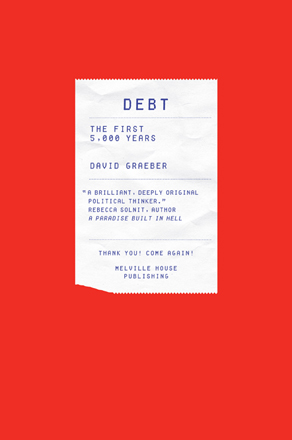
My interview of/conversation with David Graeber about his book Debt: The First 5,000 Years will be on C-SPAN 2’s BookTV on Saturday, September 3 at noon and 7 PM and again on Monday, September 5, at 7 AM.
Here’s the C-SPAN page: Debt: The First 5,000 Years – Book TV.
Obama’s “progressive base”
I just read this in a magazine: “Obama will also need a push from the progressive base that elected him in 2008….”
Wow. Sad. Give it up, guys. He’s just not that into you.
Me interviewing David Graeber
A reminder—this is tomorrow:
Debt
A Conversation with Doug Henwood and David Graeber
August 23, 7:30pm
Melville House Bookstore
145 Plymouth St, Brooklyn
Debt is now the central issue of our time: With the rise of cheap and unsustainable credit, un-repayable mortgages collapsed the world economy in 2008. In Europe, Greece, Spain, Ireland, Iceland and Portugal have pushed the European economy to a perilous point, threatening the Euro. And we’ve just lived through a debt crisis of our own, with congress nearly forcing U.S. default.
We’ll be joined by two guests to discuss the role of debt in the world economy: author and radio show host Doug Henwood, an expert on bubble economics and Wall Street, and anthropologist David Graeber, who has just published a history of debt from ancient Mesopotamia to the present day, Debt: The First 5,000 Years.
New radio product
Freshly posted to my radio archives:
August 20, 2011 Max Ajl, the Jewbonics blogger, on why Israelis are in the streets and how talk of the Occupation is not welcome • Yanis Varoufakis updates the eurocrisis as it spreads westwards
New radio product
Freshly posted to my Radio archives:
August 13, 2011 Dacher Keltner of UC–Berkeley on the psychology of class and social interactions • David Graeber, author of Debt: The First 5,000 Years, provides an anthropologist’s POV on money and debt
July 30, 2011 Joel Schalit on Brevik, the European right, its attitude towards Israel, and Israel’s own right • Brad DeLong on the political economy of austerity
The audio files are often posted far more promptly than I update the web page, so if you’re into timeliness, subscribe to the podcast!
Christian Parenti in NYC
Alas, we’ll be out of town, but everyone without an excuse must go to this:
Tropic of Chaos
Christian Parenti in conversation with Vijay Prashad and David Harvey
Sponsored by the Center for Place, Culture and Politics
Co-sponsored by the Center for Humanities at the GC and The Brecht Forum
Monday, August 29, 2011 from 7-9 pm
The James Gallery
CUNY Graduate Center
365 Fifth Avenue @ 34th Street
In Tropic of Chaos: Climate Change and the New Geography of Violence (Nation Books; July 1, 2011), award-winning writer Christian Parenti argues that the new era of climate war has begun, intertwining environmental disasters, poverty, social inequality, and violence in the Global South. Parenti, historian Vijay Prashad and Marxist scholar David Harvey will discuss the historical legacy of Cold War militarism, neoliberal economic restructuring, and the convergent onset of climate change expressed as warfare, crime, repression, state failure, and a planet in peril.
Quoted by the John Birch Society!
Yesterday, Noam Chomsky. Today, the John Birch Society! My post about the SF Fed study on how less than 3% of U.S. consumer spending is on Chinese-made products got picked up by the JBS’s The New American: Everything’s Made in China? Not Quite.
Who knew they still existed? Actually, I did, but it’s kind of easy to forget sometimes.
Chomsky cites LBO
In a recent talk he gave in Canada (Public Education Under Massive Corporate Assault), Noam Chomsky cites my LBO piece on the costs of college, and how easy it would be to make higher ed free in the USA:
Now that’s one important way to implement the policy of indoctrination of the young. People who are in a debt trap have very few options. Now that is true of social control generally; that is also a regular feature of international policy — those of you who study the IMF and the World Bank and others are well aware. As the Mexico-California example illustrates, the reasons for conscious destruction of the greatest public education system in the world are not economic. Economist Doug Henwood points out that it would be quite easy to make higher education completely free. In the U.S., it accounts for less than 2 percent of gross domestic product. The personal share of about 1 percent of gross domestic product is a third of the income of the richest 10,000 households. That’s the same as three months of Pentagon spending. It’s less than four months of wasted administrative costs of the privatized healthcare system, which is an international scandal.
It’s about twice the per capita cost of comparable countries, has some of the worst outcomes, and in fact it’s the basis for the famous deficit. If the U.S. had the same kind of healthcare system as other industrial countries, not only would there be no deficit, but there would be a surplus. However, to introduce these facts into an electoral campaign would be suicidally insane, Henwood points out. Now he’s correct. In a democracy where elections are essentially bought by concentrations of private capital, it doesn’t matter what the public wants. The public has actually been in favor of that for a long of time, but they are irrelevant in a properly run democracy.
Yup. And thanks for the mention, Noam!
Me, interviewing David Graeber
Debt
A Conversation with Doug Henwood and David Graeber
August 23, 7:30pm
Melville House Bookstore
145 Plymouth St, Brooklyn
Debt is now the central issue of our time: With the rise of cheap and unsustainable credit, un-repayable mortgages collapsed the world economy in 2008. In Europe, Greece, Spain, Ireland, Iceland and Portugal have pushed the European economy to a perilous point, threatening the Euro. And we’ve just lived through a debt crisis of our own, with congress nearly forcing U.S. default.
We’ll be joined by two guests to discuss the role of debt in the world economy: author and radio show host Doug Henwood, an expert on bubble economics and Wall Street, and anthropologist David Graeber, who has just published a history of debt from ancient Mesopotamia to the present day, Debt: The First 5,000 Years.
Bernanke the steamroller
Comment on today’s Federal Reserve policy decision today, which among other things, included the extremely unusual statement that they’re likely to leave interest rates close to 0 through mid-2013, from Ricardo Perli of ISI, a very mainstream Wall Street research operation:
For the first time in a long time, there were three dissents – Fisher (Dallas), Kocherlakota (Minneapolis), and Plosser (Philadelphia). Up to now, FOMC chairmen strived to avoid more than two dissents. The fact that this long-standing practice was disregarded means that Bernanke is becoming more determined to push through what in his view are the appropriate policy moves. We would expect the influence of the hawkish minority to diminish as a result.
Bernanke is very concerned about economic weakness and wants the Fed to do everything it can to stimulate a return to growth. The release is full of unusual mentions of their “dual mandate,” meaning boosting employment as well as keeping down inflation. This is not William Greider’s Fed.
Made in China: <3%!
Here’s something that should revise a lot of clichés, though it probably won’t: less than 3% of U.S. consumption expenditures are on goods made in China. Almost 90% are made in the USA. Of course, the domestic total is boosted by services—but even durable goods are 12% China, 67% U.S. And less than half the value of Chinese imports go to China—55% of the money spent on “Chinese” goods represent processing and other services (like distribution and retailing) provided in the U.S.
This info comes from a new paper by Galina Hale and Bart Hobijn of the San Francisco Fed. Their point was to show that Chinese inflation has minimal influence on U.S. price levels, which is persuasive. But it’s also an antidote to the widespread belief that the U.S. is hollowed out and all the action is in China. We’ve got problems, yes, but we’ve also got resources—resources we can do a lot better with than we are now.
Riots and stock values
An interesting comment from Jim Reid of Deutsche Bank in the wake of swooning stock markets and riots in London:
Although not linked to the sell-off we can’t help thinking that we live in socially volatile times generally due to economic hardship. This is something that may eventually have ramifications for Europe’s future in the years ahead. If the person on the street and voters get fed up of the Euro straight [sic] jacket then days like yesterday in financial markets could look mild.
Yup. There’s no doubt that the strength in financial markets over the last 30 years—the long bull market in stocks that ran from 1982–2000, and the bull run in bonds that continues through today—is a reflection of political quiescence, the nearly unchallenged victory of bourgeois power and ideology. If that changes because people have finally had enough, then there will be rioting on trading desks to match that in the streets.
What Reid says may—may—be more applicable to Europe. The U.S. population seems more passive, and our police, more violently repressive (a tradition that goes back to the labor violence of the late 19th century, when cops and Pinkertons killed strikers with far more abandon than their European counterparts). S&P’s opinion aside, that could give fresh meaning to the notion of U.S. Treasury securities as “safe havens” in time of crisis.


 LBO News from Doug Henwood