
More Zimbabwe solidarity
Scott McLemee asked me to circulate this, as a follow-up to this post from earlier in the week: Solidarity With Zimbabwean Political Prisoners. They’re getting screwed and they need support.
Me at Bluestockings…
…though just as supporting cast: Sasha Lilley, Greg Albo, and me, talking about Sasha’s book Capital and its Discontents: Conversations with Radical Thinkers in a Time of Tumult, a collection of her excellent interviews for Against the Grain.
Sunday, March 20, 7–9 PM
Bluestockings
172 Allen St, New York
More info here.
Me at Left Forum
I’m on three – count ’em, three! – panels at this weekend’s Left Forum:
Catastrophism and the Crisis of the Left
E. Panel Session 2—Saturday 12:00 p.m. – 1:50 p.m., W626
Sponsored by: Retort
• Doug Henwood—Left Business Observer
• Eddie Yuen—San Francisco Art Institute
• James Davis—Retort
• Ramsey Kanaan—PM Press, Retort
• Sasha Lilley—Retort, Spectre
Post-Financial Crisis: Neoliberalism and the Global Economic Recovery
O. Panel Session 7—Sunday 3:00 p.m. – 4:50 p.m., student union
• David Harvey—Anthropology, CUNY Graduate Center; Author, A Companion to Marx’s Capital
• Doug Henwood—Left Business Observer
• Mark Weisbrot—Center for Economic and Policy Research
…and, just added to the program because of the recent death of the great Bob Fitch (and not yet in the official listing):
Bob Fitch: A Retrospective
Session 6, Sunday 12-2 PM, W618
• Stephen Eric Bronner-Rutgers
• Doug Henwood—Left Business Observer
• Manny Ness-Brooklyn College
• Michael Hirsch-UFT
• Christian Parenti-journalist
• Jane LaTour-journalist
Please come!
My tribute to Bob Fitch
My tribute to Bob Fitch, who died on March 4, is now up at The Nation‘s website: “Remembering Robert Fitch.”
Solidarity with Zimbabwean political prisoners
[Scott McLemee asked me to circulate this.]
Six people in Zimbabwe are now imprisoned on charges of treason for organizing a meeting to discuss the mass movements in Tunisia and Egypt. For this “crime” they face a possible death sentence. They have been tortured and are now in solitary confinement.
An international day of action to demand their release will be held on Monday, March 21, when they are scheduled for a court hearing.
Our message is simple and urgent: We demand that the government of Zimbabwe drop all charges and release them immediately.
Plans are underway for demonstrations in a number of countries. We urge concerned people everywhere to join us in organizing meetings and demonstrations in solidarity with the prisoners. Please translate and distribute this appeal as widely as possible. Let us know know what you are doing at the contact addresses below.
The worldwide significance of the struggle to free the Zimbabwean prisoners is reflected in a recent statement of support from the Congress of South African Trade Unions. “The Egyptian and Tunisian experience have inspired many workers and poor people all over the world to stand up and demand an end to dictatorship, corruption and injustice of whatever kind.”
The arrest and prosecution of the six may seem like only the latest round of repression by Robert Mugabe’s government against opponents. But it is also an attack on the spirit of Tahrir Square, which has inspired people all over the world. The six prisoners include trade unionists, intellectuals, and activists in the struggle for women’s rights. The effort to suppress them – and even to kill them, whether by execution or through torture and denial of medical treatment while in custody – is a vicious assault on all of us.
To learn more about the six prisoners and the struggle for their release, see the website Free Them Now! and the Facebook group (open to non-Facebook users) Calling for the release of Zimbabwean Activists.
To join the March 21 actions, please send a message to both of these addresses: Zim Treason Trial and Solidarity.
Meanwhile at KPFA…
Two updates on the KPFA situation (and apologies to those of you who find Pacifica news sleep-inducing):
• A few weeks ago, I reposted the news, which I originally got from KPFA Worker, that “Amit Pendyal resigned because Pacifica executive director Arlene Engelhardt wouldn’t let him do his job.” Official circles denied this. An example of such: WBAI board chair Mitch Cohen commented, “[H]ere’s what a member of the KPFA Board just wrote to me when I inquired: ‘It’s not true. He is still on the job, despite efforts by Doug’s allies to exasperate him enough to quit….’” Now comes this oddly worded news from Engelhardt, in an email to the KPFA staff: “I received word from Amit last week that he will not be able to return as General Manager at KPFA.” Sure looks like the original report was right.
• A few months ago, Engelhardt fired the old paid Morning Show staff and replaced them with volunteers, including 9/11 Truther Peter Phillips. That saved the station about $80,000 a year. But in the recent fund drive, pledges during the morning drive time—for which the Morning Show was the anchor—were down by $139,000. Details here.
WBAI fundraiser: snake oil sells
WBAI—where I used to do my radio show until program director Tony Bates got other ideas—just finished a fundraiser. Management—meaning Bates, station manager Berthold Reimers, and local board chair Mitch Cohen—have been bragging about its success, and the station’s return to financial health. Close examination of the results make you doubt this analysis.
Management has circulated a spreadsheet showing the fundraising results by show. Here it is, for those wanting to score at home (and those are my calculations of the Null vs. ex-Null performance at the bottom of the sheet called “Details2”—the rest is the original doc):
Yes, the station surpassed its $800,000 goal, by almost $30,000. But the entire reason they did was the return of health pundit (and AIDS denialist) Gary Null. Null brought in over $300,000, or 37% of the total. They ran his show, live and reruns, for 99 hours—four full days out of twenty-two. If you turned on WBAI at any time during the marathon, you had a 1-in-6 chance of hearing the voice of this snake oil salesman, a man who was nearly killed by consuming one of his poorly manufactured supplements.
Had the time occupied by Null pulled in pledges at the average for the non-Null segments, the fundraiser would have fallen $150,000 short of its goal. And some of those non-Null segments did very poorly. The morning drive-time show, which should really pull it in because that’s when radio audiences are typically their largest, raised just $1,218 an hour, 60% less than Null and 8% below the marathon’s average. My replacement, Robert Knight, who was given four days a week between 5 and 6 PM, raised $1,434 an hour, which is what I used to raise on a bad day, and about half what I averaged. Bates had said that he wanted star power in that time slot, and it looks like he’s gotten anything but. And Bates’s own special, which was no doubt very special, raised a middling $1,575 an hour.
So while Null’s return looks to have saved WBAI’s financial ass, it’s not a sign of a healthy station that over a third of its income now comes from the frequently repeated exhortations of a man who believes that HIV doesn’t cause AIDS.
RIP, Bob Fitch
My old friend Bob Fitch died yesterday. I’m going to say more at some point, but for now, check out Josh Mason’s excellent obit: The Slack Wire: Fitch.
New radio product
Freshly posted to my radio archive:
March 5, 2011 Jodi Dean, keeper of the I Cite blog and author of Blog Theory,interviewed in December on what digital culture is doing to us, returns to tell us how events in Cairo and Madison may have changed her mind • Joel Rogers of the University of Wisconsin on that state and its labor uprising
LBO 131 out
Just out: Left Business Observer #131. Emailed to electronic subscribers, at the printer’s for the rest.
contents
banishing Marx • debt & the slump • explaining test scores • what the net is doing to us • inflation! • educating the masses • immigrants: not guilty • Scrooge goes Xmas shopping
Tastes of each here.
If you don’t subscribe yet, what’s wrong with you? Do it here!
Find out why Nobel Prize-winning economist Joseph Stiglitz looked up while reading a recent issue to decleare LBO full of “wonderful rants and some very interesting facts.”
Us on Progressive Radio
Matt Rothschild, editor of The Progressive, interviewed Liza & me when we were in Madison for his radio show. Here it is:
Sucky demo in NYC
This morning, New York City joined many other localities around the USA in mounting demonstrations in support of the Wisconsin workers. It was nothing like Madison, let me tell you.
As I noted in one of my reports from Madison last week:
A New Yorker couldn’t help but be struck by how there was no effort to keep people out of the Capitol—no metal detectors, no police lines, in fact only a handful of cops inside the building. Indeed, in New York City you can’t even get near City Hall any longer, much less just walk into the building. You’d have been cordoned off blocks away, where no one important would have to see or hear you.
The city lived up to this sad tradition. Here’s what City Hall looked like as the demo was going on—fenced in and nearly lifeless.

Down the street a bit, even City Hall Park itself—once the site of a vigorous protest culture before Giuliani shut everything down in the name of fighting terrorism—was empty.
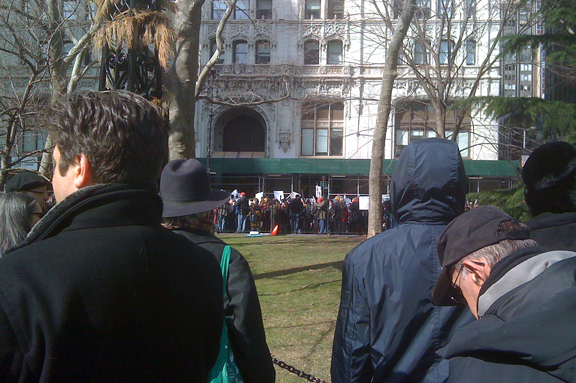
The only area open to demonstrators was the sidewalks on either side of the triangular park, safely south of City Hall itself, along Broadway and Park Row.
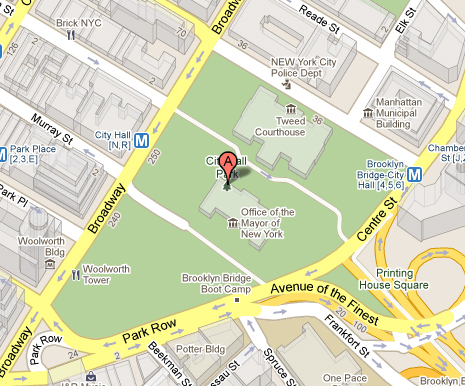
The officially sanctioned demo pen was a fenced-in area along Broadway, mostly south of Murray St. Once the area was full, cops forbade any further entry.
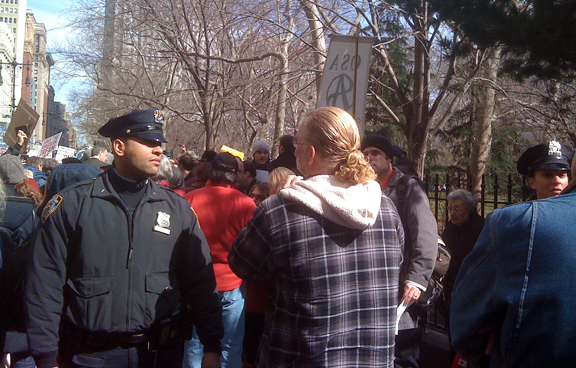
When we arrived, gasbag and tax cheat Rep. Charlie Rangel was going on about taxing the rich—not mentioning the fact that Gov. Andrew Cuomo, a fellow Democrat, was blocking the extension of a surtax on high incomes in New York, against the wishes of about two-thirds of New Yorkers. When he was done, he was succeeded at the podium by New York City Public Advocate Bill de Blasio, who took some pot shots at Scott Walker and Chris Christie—who are odious, no doubt—but again, not a word about Cuomo, who prefers laying off teachers to extending an existing tax on the rich.
(Side note: the Working Families Party, which had once agitated for the extension of the Millionaire’s Tax in New York, seems to have gone quiet over the issue—nothing on their website on the issue for more than a year. Let’s hope this is a temporary aberration, and not a sign of their subordination to Cuomo’s agenda. A query is in to WFP director Dan Cantor.)
What an ossified political culture. Penned in, to listen to politicians spew bullshit. Very different from listening to people chanting “We will fight back” inside the Wisconsin state capitol.
signage
A few of the signs. Here’s one for Camp Kinderland, an old, mostly Jewish, Commie children’s camp in the Berkshires. Among its more distinguished alumni: progressive educator Michael Klonsky, right-wing pundit Sol Stern, Nation associate publisher Peter Rothberg, and actress Marisa Tomei.

Heartwarming, but the place’s glory days are well behind it.
And this:
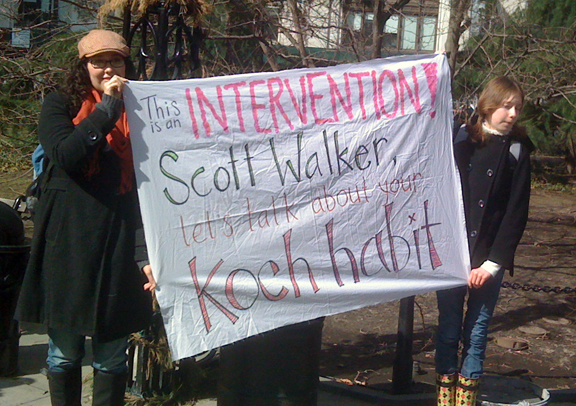
Yeah, the Koch’s are a horrorshow, but it’s not like they’re responsible for the right turn in the USA.
Curiously, unlike Madison, not a visible or audible word about Cairo.
Everyday ideology
The spelling dictionary for Adobe’s Creative Suite 5 does not recognize the names “Marx” or “Engels.”
Polarization
It’s widely believed on the American left that the Democrats have moved right and that the difference between the parties has nearly vanished. That’s a tempting POV, for sure. But it’s hard to reconcile with Congressional voting habits. Back in the 1950s and 1960s, both parties had liberal and conservative wings. Starting in the 1980s, they began to diverge, and now by one measure, they’ve never been so polarized. This is via ABC’s The Note:
“In the long march toward a more parliamentary and partisan Washington, National Journal‘s 2010 congressional vote ratings mark a new peak of polarization,” National Journal‘s Ron Brownstein writes. “For only the second time since 1982, when NJ began calculating the ratings in their current form, every Senate Democrat compiled a voting record more liberal than every Senate Republican—and every Senate Republican compiled a voting record more conservative than every Senate Democrat. Even Nebraska’s Ben Nelson, the most conservative Democrat in the rankings, produced an overall voting record slightly to the left of the most moderate Republicans last year: Ohio’s George Voinovich and Maine’s Susan Collins and Olympia Snowe. The Senate had been that divided only once before, in 1999. But the overall level of congressional polarization last year was the highest the index has recorded, because the House was much more divided in 2010 than it was in 1999. Back then, more than half of the chamber’s members compiled voting records between the most liberal Republican and the most conservative Democrat. In 2010, however, the overlap between the parties in the House was less than in any previous index.” NationalJournal.com’s full Vote Ratings.
What to make of this? What to make of the fact that Dem leader Harry Reid’s voting record ties him with the nominal socialist Bernie Sanders to put them both among the most liberal members of the Senate? Politics certainly doesn’t feel polarized—there looks to be a suffocating consensus in favor of the status quo. Is it that one party is insanely right wing and the other is just tepidly so? Is that what polarization looks like?


Leave a Comment
Posted on March 5, 2011 by Doug Henwood
Radio commentary, March 5, 2011
[The Dean and Rogers interviews referred to below are part of this show. The version of these comments delivered on that show, however, don’t include the analysis of the February employment report, which was written just for this “blog.”]
contribute to KPFA
It’s been a while since I’ve done this—it’s good to be back. Because of some traveling, work deadlines, and other scheduling conflicts, I wasn’t able to do any fundraising stints here as I usually do. I regret that—I wish I could have done my part to beef up KPFA’s cash flow. I will do this bit—if you pledged, please send in your cash. If you didn’t pledge, you can always do so on the web at KPFA.org. All you wonderful people who listen to this show and want to keep it here, please head over to your computer or deploy your smartphone and do just that. Thank you.
February’s job market
The economic recovery, such as it is, has been chugging along during my hiatus.
February’s employment report was solid, with no serious sub-surface blemishes. It featured the strongest headline gain in nine months and the lowest unemployment rate in almost two years. Even so, the rate of job growth was just enough to keep up with population growth. Some details.
February’s headline gain of 192,000 was the best since May 2010. The goods sector contributed more than a third of the gain, 70,000. Manufacturing employment, which rose by 33,000 in February, is up by 112,000 over the last four months, or about 1%, the best performance over such an interval in 14 years. Private services added 152,000, with most subsectors showing gains. Government, though, was off 30,000, with federal employment unchanged, state down 12,000, and local, off 18,000. More than half the decline in state and local came from education. Austerity is really beginning to bite.
Average hourly earnings for all workers were unchanged, but the average was pulled down by an 0.8% decline in manufacturing. In private services, hourly earnings were up a more “normal” 0.2%. Yearly growth in private services is 1.9%, a very subdued number—about the same as inflation. So we’ve got employment tracking population growth and earnings tracking the CPI: these days, just staying in place looks pretty good, compared to what went before.
Those numbers come from the survey of employers. The simultaneous survey of households showed decent employment growth—but again, roughly in line with population growth. The employment/population ratio—the share of the adult population in paid employment—was unchanged for for the month. While the ratio is up 0.2 point from its November 2010 low, it’s still below where it was in September. At 58.4%, it’s more than 6 points below where it was at its all-time high in 2000, and is now about where it was in 1973.
The unemployment rate fell another 0.1 point to 8.9%, its lowest level since April 2009. “Hidden” unemployment also fell, with the broad U-6 rate (which accounts for those working part-time who want full-time work and those who’ve given up the job search as hopeless) down 0.2 point to 15.9%, also its lowest since April 2009. It’s still very high, though—nearly twice what it was in early 2007.
The Bureau of Labor Statistics publishes data on the flow of people in and out of employment every month (see here). They don’t get much attention, but they tell a dramatic story. Just 16.5% of January’s unemployed found a job in February, down from 17.2% the previous month, and close to an all-time low for the series (which begins in 1990). The share moving from outside the labor force and into employment was unchanged at 4.2%. An enormous number of the unemployed have simply been giving up and dropping out of the labor force: the share of the unemployed dropping out of the labor force has exceeded those finding work for two years. Much of the recent drop in unemployment comes not from the jobless finding work, but from a slowdown in the rate of job loss, now at its lowest level since early 2008.
So we’ll need to do a lot better than this to make a serious dent in unemployment. And while it’s nice to see a continuing decline in job loss, it’d be even nicer to see a serious pickup in hiring.
stimulus response
I doubt we’d be in this weak recovery were it not for all the fiscal and monetary stimulus we’ve received over the last couple of years. Fresh proof of this comes from the Congressional Budget Office (CBO), which is out with its latest estimates of the effects of the stimulus package—officially the American Reinvestment and Recovery Act (ARRA)—on employment and incomes.
For the fourth quarter of 2010, the CBO estimates that ARRA:
These are substantial numbers. Take GDP. The midpoint of the estimate is 2.3%. Real GDP is up 4.5% from its 2009 low. In other words, the StimPak accounts for about half the growth. Or employment. It’s up only a little over a million from its low; it would still be in the red without ARRA. And if you add 1.3 points to the December unemployment rate (which is what you should use, and not something more recent, since the CBO is talking about the fourth quarter of 2010), it would be 10.7%, above its worst level of 10.1% in October 2009.
Of course, the stimulus is fading and the austerity party is getting the upper hand. That, and $100 oil, could make us nostalgic for early 2011.
oil bubble
Speaking of $100 oil, why is its price, along with most other commodities skyrocketing? There are several reasons. One is demand from China—which means, of course, partly China’s internal needs and partly what it needs to satisfy the rest of the world’s lust for its exports. Another is the uprisings across the Middle East: turmoil is always worrisome to oil traders, especially if it leads to the replacement of imperial stooges with more complex political figures. And third is the huge flow of speculative cash—from hedge funds and the like—into commodity funds.
Let’s look at oil more closely. Reasons one and three above—China and speculative hot money—sound like a trip back to the great commodity run-up of 2002–2008, which took the price of oil up seven-fold, from under $20 a barrel to over $140. Back then, though, the U.S. and other First World economies were decently strong; now they’re not—much of the real demand is coming from Asia (excluding Japan) and nowhere else. Then, OPEC’s spare capacity was tight, not much more than a million barrels a day (compared with world demand of about 90 million); now it’s almost five times that. A supply cushion in excess of 5% is nothing to sneeze at.
Surely, there’s reason for oil traders to be nervous about supply interruptions with governments falling and/or teetering across the world’s Oil Belt. But prices had already risen before Tunisia led the region into open revolt. The political jitters added maybe ten bucks to the price—what about the previous fifty?
After the bubble burst in 2008, prices quickly sank below $40—and then began rising, even though the world was in recession. Prices rose steadily through 2008 and stabilized around $75–80 during most of 2010. But late in the year, prices rose again, breaking $90 at year-end, despite a weak economic recovery in much of the rich world.
No doubt some people, including many listners to this show, will say that peak oil is kicking in. But the long-term supply/demand balance hardly changed between February 2009, when oil was $40 a barrel, and December 2010, when it was $90. Markets are awful at pricing the long-term anyway; in almost any instrument you look at, from interest rate futures to inflation expectations to stock prices, prices are almost always driven by the present and recent past and have little or no predictive value.
So it looks like hot money has been a major force in driving prices higher. This is a mixed blessing. Since we can’t pass a carbon tax, higher market prices will encourage conservation and doom SUV sales. But since most Americans have little choice but to drive everywhere, high gas prices are going to hurt, and the last thing the working class needs now is more hurt. And oil prices north of $100 are almost certain to weaken further and already weak economy.
Enough for now about oil. There’s one commodity group where the spike in prices has been deadly—food. There are some real-world reasons for higher prices: rising demand for more and fancier foods coming from China (of course), and crop failures, often the result of a climate driven mad by all that oil we’ve already burned. But again, the hot money has greatly amplified these real-world concerns. For the billion or two of the world’s people living on the margins, higher food prices can mean starvation.
So why is all that hot money chasing commodities? Because the money’s managers think the world is on the verge of another great inflation, like the 1970s. And when that happens, the reflex is to buy tangible goods, not financial assets. Why, with half the world’s economy barely off the mat, should we worry about inflation? Because fiscal and monetary policy, especially in the U.S., has been stimulative.
Actually, over the last 20–25 years, commodity prices have had little effect on general inflation. They did in the 1970s, but, traders’ anxieties to the contrary, this is no longer the 1970s. In recent history, commodity price spikes have remained largely confined to the commodities themselves. And the last few run-ups in oil prices have led to recessions, not great inflations.
So, given the spike in oil prices and the move towards austerity, the economic outlook is not encouraging.
Wisconsin, collective bargaining
Later in the show, we’ll hear from Joel Rogers of the University of Wisconsin on some of the longer-term background to the labor eruption in his home state. But I do want to say a few things before we get to that.
It’s been a very pleasant surprise reading the polls on the confrontation in Wisconsin. A reminder to those of you who might not be following this intensely. The new governor, a right-wing Republican named Scott Walker, has proposed dealing with the state’s budget problems—which are serious, but far from drastic—by not merely forcing state workers to contribute more to their pension and health benefits (a polite way of saying taking a wage cut), but by essentially destroying their unions. The workers have agreed to the pay cuts, but that’s no enough. Walker wants to break their unions. He made it clear during a prank call with someone he believed to be the right-wing billionaire David Koch, but who was actually a reporter for the Buffalo Beast, that he wanted to duplicate Ronald Reagan’s firing of the air traffic controllers in August 1981, just eight months into his presidency, a move that signaled open season on unions. Before that, it was considered bad form to fire strikers and replace them with permanent scabs. Reagan changed all that, and every CEO in the USA took the cue.
Walker wants to do the same for public sector unions. As we will hear Joel Rogers say shortly, this isn’t just about saving money—it’s about eliminating an important source of financial and organizational support to the Democratic Party. Unions spend scores of millions in every election cycle, and send their members out to campaign and round up voters on election day, and get little or nothing in return for all their efforts. This is one of the tragedies of American politics: organized labor has to choose between a party that tolerates their presence but basically ignores their interests, and one that wants to destroy them. Some choice, eh?
I happened to be in Madison to give some talks at the University of Wisconsin when the demonstrations at the state capitol began. They were remarkable—populous and lively, not the thinly attended, dispirited affairs you often see (which is what I saw in a demonstration of support for the Wisconsin workers in New York last weekend—that, and not a word about Democratic governor Andrew Cuomo’s own lust to fire teachers and cut taxes on the rich).
I was afraid that the labor upsurge in Wisconsin wouldn’t find much support in the broader population. And I figured that the Republicans would be successful in mobilizing resentment against the pay, benefits, and security enjoyed by public sector workers. Mark Ames has written some terrific stuff on resentment as a political force in the USA—in this case, the thinking would, “If I don’t have those things, they shouldn’t either,” and not, “Why can’t all workers have those things?”
But so far, it hasn’t worked out that way. Polls by Gallup and the New York Times show strong support, in the two-to-one range, for collective bargaining rights. But “collective bargaining rights” seems to be a magic phrase, much more so than the word “union.” Support for unions is much lower. The New York Times poll found twice as many Americans believing that unions have too much power as believe they have too little. Since unions have almost no power in this country today, I’m not sure what to make of that, but that’s what the poll says.
But as you’ll hear Joel Rogers say, while unions aren’t popular, apparently people think there’s something un-American about telling workers that they can’t have a union if they want one. But a Pew poll using the somewhat toxic words “public employee unions” still found their supporters outnumbering Gov. Walker’s by a 42–31 margin.
The New York Times poll also found strong opposition to cutting the pay and benefits of public employees. I’m guessing that there’s been some success in positioning public employees as good guys—teachers and firefighters and the like—and not slackers or corpulent labor bureaucrats. Anyway, this is all very good news.
Also, considering some of the points made in the interview with Jodi Dean we’ll hear shortly, I want to underscore the importance of organizaiton in making these things happen, whether in Cairo or Madison. It’s gotten very fashionable on the left over the last couple of decades to celebrate flat networks and ad hoc coalitions and to hold organizations like unions in disdain. God knows there’s lots to criticize in the American labor movement; I’ve done plenty of it over the years. But the Wisconsin fightback is evidence of the good they can do when they put their minds to it. There can never be any better politics in this country until there’s a rebirth of the labor movement.
And a few points of factual background to the Rogers interview. Rogers mentions that Wisconsin is the most manufacturing-intensive state in the country. Here’s a measure of that: nearly 16% of Wisconsin workers are employed in manufacturing, nearly twice the national average of 9%. Indiana is just a hair behind Wisconsin in the national rankings, but then the manufacturing share starts falling quickly. The classic factory states, like Michigan and Ohio, are nearly 4 percentage points behind Wisconsin; they’ve been hammered by the carnage in the auto sector. California’s share is right at the national average, 9%. New York’s is way below, at just above 5%.
Oh, and Wisconsin’s unemployment rate is nearly 2 points below the national average—7.5% vs. 9.4% in December. That’s not the lowest in the country, but the state is still doing a lot better than California, at 12.5%.
Share this: