
The Whole Foods brouhaha
So apparently a lot of high-minded liberals are annoyed by the reactionary WSJ op-ed written by Whole Foods CEO John Mackey. Mackey is afraid that Obamacare will take us further down the Road to Serfdom. The money quote: “The last thing our country needs is a massive new health care entitlement that will create hundreds of billions of dollars of new unfunded deficits and move us much closer to a government takeover of our health care system.”
HuffPo and Daily Kos types are doing what they do best: furiously venting in comments sections and vowing a boycott. The boycott probably an empty threat—so far, the stock market, for what it’s worth, seems to think so. But the suddenness of this attack of righteous indignation is a little strange. Mackey has long been rabidly anti-union; he once famously compared organized labor to herpes.
But the outrage is only a little strange. The NPR demographic that is the Whole Foods base has never been fond of unions. Yet you do have to wonder if the venters have any idea what’s actually in the awful health care reform bills circulating around Congress. They’re probably just outraged that Mackey’s dissing a Democrat. And we all know how much better Dems are than Republicans. Republicans are just so icky.
Liza Featherstone, counseling editrix
In LBO news—actual news related to Left Business Observer, a newsletter—Liza Featherstone has been appointed counseling editrix of the publication. Her responsibilities will include tightening and buffing the prose and disciplining the recalcitrant and tardy publication into a schedule. The masthead of #120, now in production, will reflect this change.
The staff of LBO is very excited about this development.
Radio commentary, August 8, 2009
[WBAI is fundraising this week and next. My fundraiser is next week—be sure to pledge during my slot, details to follow!—and I was pre-empted on August 6. My KPFA show for August 8 is mostly a rerun, but it did contain this fresh commentary.]
If you’re an American taxpayer, you’re an owner of AIG, the failed insurance company. According to a piece in Thursday’s Wall Street Journal (which did the research itself—God, I’m going to miss newspapers), AIG and the Federal Reserve, a branch of the U.S. government, will be paying Wall Street investment banks—familiar names like Morgan Stanley, Deutsche Bank, and, of course, Goldman Sachs—around $1 billion in fees to break the company into pieces and sell them off. More public money going to investment banks to break up a corpse that was done in because of lax regulation.
I hate to keep rubbing this in, but if this is change we can believe in, then I’m Marie, Queen of Romania.
And how about that cash for clunkers program? Almost everyone purports to hate governmment spending, but if it involves a $4,500 subsidy to buy a new car, well that’s ok! Estimates are that the first installment of the program, which cost $1 billion, moved about 180,000 units off dealers’ lots, and stimulated fresh orders from carmakers. Presumably another $2 billion, the amount of a second installement that Congress passed quicker than you can say “Free Money!,” will move twice that many. To what effect?
Not much, probably. First of all, it’s quite likely that some large but unquantifable prooportion of these sales were just moved forward from future months. But aside from the economic stimulus, getting old gas guzzlers off the road and replacing them with fresh, fuel-efficient vehicles is supposed to be good for the environment. Well, barely, if at all. According to estimates by the Associated Press, the first installment of the program is likely to save altogether the equivalent of an hour’s greenhouse gas emissions by the U.S. And that doesn’t adjust for the fact that making new cars emits a lot of greenhouse gasses into the atmosphere. It may take five or more years of post-clunker lower emissions to make up for that effect.
How will our cash-strapped leaders pay for Cash for Clunkers, the sequel? By raiding the funds for a new Energy Department loan guarantee program designed to stimulate innovative clean energy technologies. Created as part of the stimulus package, that $6 bilion program will now be a $4 billion program. So they’re diverting funds from something with considerable economic and environmental promise to finance something of dubious value. More change we can believe in!
And finally, some comments on the July U.S. employment report, released on Friday morning. It may seem a little odd to take the loss of a quarter of a million jobs last month as good news, but this is the best employment report we’ve seen in nearly a year. About half the 247,000 decline was in goods production, with construction leading the way, and manufacturing not far behind. The other half was in private services, with retail leading the way down. About the only plus signs were in health care, as usual, and leisure and hospitality rose by 9,000, thanks to performing arts and spectator sports and amusements, gambling, and recreation (suggesting that people are seeking diversion from their woes?).
Despite the improvement in July’s tone, longer-term measures still look dreadful. We’ve lost almost 7 million jobs since the recession began in December 2007, almost 6 million of those over the last year. In percentage terms, we’ve lost one and a half times as many jobs in this downturn as we did in the 1981-82 affair, which is widely regarded as the worst in modern times. Yes, the rate of deterioration in the yearly measures is slowing, but we’re not yet seeing less negative annual numbers (or, to put it more geekily, we’re not yet in the realm of the positive second derivative).
Those figures come from a huge survey of employers. The Bureau of Labor Statistics does a simultaneous huge monthly survey of households as well. That looked pretty bad. While the unemployment rate fell by 0.1 point to 9.4%, the first decline since April 2008, it looks like a lot of people have given up the job search as hopeless, meaning they’re no longer counted as officially unemployed. And the ranks of the unemployed are increasingly dominated by people who’ve been jobless for half a year or more—people whose prospects for re-employment in the future are usually quite damaged by these long spells outside the labor force.
So while there are some signs that the recession is drawing to a close—an impression confirmed by the drop in first-time claims for unemployment insurance last week—the job market is still awful, and the recovery that’s likely to follow the end of the recession sometime later this year will almost certainly be very weak and not very joyful. The U.S. economy has some serious structural problems that aren’t even being discussed, much less addressed.
Christian Parenti interviews me…
…for the Brooklyn Rail – on the bubble, the bust, the state of the American ruling class, and what comes next: Ka-Pow! Bang! Crash!
Bayard Rustin on the moon landing
Since this is the 40th anniversary of the first moon landing, I thought I’d share this historically rich experience. A good friend of mine from 6th grade through early college was the son of a union president. The union had a training center down in Maryland, which included some posh vacation facilities for the leadership (or misleadership, as they’d say in Workers Vanguard). My friend, his family, and several others of us all watched the TV coverage together in one of the posh outposts.
Among the guests was Bayard Rustin. (The union leadership gets points for not subscribing to the homophobic exclusion that Rustin suffered—though they were united in their anti-Communism.) When Armstrong uttered his banal aphorism upon landing, there was much disappointment all around. Rustin offered a constructive alternative: “He should have just farted.”
WBAI election: signatures needed
[An email sent to Jews for Racial and Economic Justice by Esther Kaplan and Marilyn Neimark. I don’t know these candidates personally, but I do know Esther & Marilyn, and if the candidates are ok by them then they’re ok by me. If you’re in NYC and can stop by Tuesday afternoon, please do.]
Dear JFREJers,
We’re writing to enlist your support for some important changes that are in the works at WBAI, where JFREJ’s radio program, Beyond the Pale, has been broadcasting weekly for over 13 years.
WBAI is currently engaged in elections for the Local Station Board (LSB) and we at Beyond the Pale are asking for your help in nominating a list of independent candidates. The LSB makes recommendations to the Pacifica Executive Director for the hiring and firing of each station’s General Manager; approves the station’s annual budget; and ensures that the programming at each station conforms to the mission of Pacifica. In addition, each LSB gets to elect 4 directors to the national board, which is responsible for the governance of the network.
Why is this election so critical? For years, WBAI’s LSB has been paralyzed by factional conflicts. In the meantime, day-to-day operations at the station have suffered from management neglect so grave — including nonpayment of rent on the building and the transmitter — that the future of the station was put in jeopardy. At last, the Pacifica national board has stepped in, removed both the General Manager and the Program Director, and with the help of an interim General Manager and other staff from Pacifica are putting the station back on track. We now need a functioning, conscientious LSB to ensure that these promising developments come to fruition and take a progressive direction — and that’s where JFREJ members come in.
We are very pleased that at least a few staffers and community members who are independent of any factions or slates have decided to run, and so we very much urge you to take some time out of your day to sign their petitions. To be on the ballot, a candidate must submit a petition signed by at least 15 WBAI dues-paying members by midnight on July 14. If you’re not yet a WBAI member, it’s not too late to join! (See below.) We will have nominating petitions available at Esther Kaplan’s office (at The Nation Institute, 116 East 16th Street, 8th floor) this Tuesday, July 14. Please come by between 6 and 8 p.m. to enjoy some refreshments and add your signature.
The candidates are:
Member candidates (only dues-paying members may sign)*:
David Barreda is a photographer, videographer, and multimedia producer who has worked for the Miami Herald, the Rocky Mountain News, and the San Jose Mercury News, among other publications. His independent projects have treated such topics as immigrant agricultural workers and Andean religion. Born in Peru and raised on a farm in Vermont, he has a long-standing commitment to environmentalism and sustainable agriculture.
Chude Mondlane is a singer and community activist who is on the staff of Communications Workers of America Local 1180, one of New York City’s most progressive labor unions, where among other duties she writes for the union newspaper. The daughter of Eduardo Mondlane, a leader of Mozambique’s independence movement, and a long-time touring musician, she recently initiated a cultural exchange program between high school students from New York City and Mozambique.
Staff candidates (only paid or unpaid WBAI staff may sign):
K.E. Feldman is the newest contributor to WBAI’s program Beyond the Pale. She is also a producer for WNYC’s Brian Lehrer Show and has worked in independent documentary film. She was previously the host and producer of YouthCast, an alt.npr podcast from the Public Radio Exchange.
If you would like to sign a petition but can’t come by on Tuesday, please email Esther at estherkaplan@gmail.com and arrange an alternative time to stop by.
Yours,
Esther Kaplan and Marilyn Kleinberg Neimark
*To be a member, you must have contributed at least $25 to WBAI between July 16, 2008 and July 15, 2009. If you haven’t done so yet, just go to http://www.wbai.org before midnight July 15 and make a donation via PayPal.
Radio commentary, July 2, 2009
Gotta keep these opening comments short, since there’s a lot of interview material ahead.
Because Friday is a holiday, we got the June employment report a day earlier than usual, and the news wasn’t very good. So much for last month’s hint of an improving trend. There’s almost nothing encouraging buried in the innards of this month’s report.
June’s headline job loss of 467,000 looks “good” only in comparison to the awful numbers we saw earlier this year and late last. But it’s still quite bad. Losses were widespread through the major econmic sectors, with manufacturing and construction down hard once again, but with major service sectors like retail and finance also taking significan hits. Health care was up, but a lot less than we’re used to seeing from that usually indefatigable sector. Even government lost jobs, though most of that from the layoff of temporary Census workers. I saw one of those a few weeks ago strolling through my neighborhood neighborhood with a handheld device, checking addresses in preparation for mailing out the forms next year.
The yearly loss in overall employment in percentage terms is the worst since 1958; the loss in private services, the worst ever. We’ve lost 6.5 million jobs since the recession began in December 2007, and the employment level is now below the peak reached in 2001. We’ve never seen a recession completely undo the job gains of the previous expansion. But those gains were extremely feeble. Employment growth so far this decade has averaged 0.1% a year; since the end of World War II, we’ve never seen a decade in which growth averaged less than 1.9%. The share of the adult population working, which had gone seriously into reverse last year, is now back to 1984 levels. The unemployment rate rose 0.1 point to 9.5%, a modest increase by recent standards, but it’s now at its highest level since 1983.
Thursday’s morning’s unemployment claims figures, both for people filing for the first time after losing their jobs and for those continuing to draw benefits, were mildly encouraging. But there’s still little serious sign of an end to misery in the job market.
Not on Wall Street, though! Today’s Wall Street Journal reports that big pay packages are back. One happy banker exclaimed that it’s like 2007 all over again. I hope they’re courteous enough to send a thank you card to Barack Obama, without whom this could not have happened.
Hipster irony breaks new ground!
Spotted on Metropolitan Ave, Williamsburg, Brooklyn:
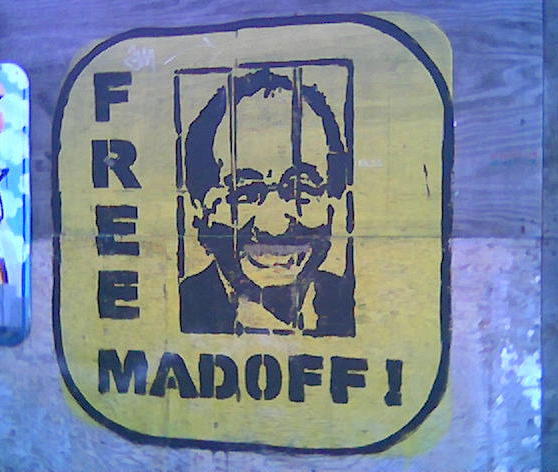
Liberate the expropriators?
June 25 radio show posted
June 25 radio show posted to archives. Alyssa Katz, author of Our Lot, on the homeownership fetish and the housing bubble/bust • Liza Featherstone (author of this article, and, it should be disclosed, wife/beloved of the host) and Adolph Reed on the burdens of college tuition and how the problem can be solved by making it free.
Radio commentary, June 25, 2009
In the economic news, the mixed bag theme continues. On Thursday morning, the Labor Department reported reported some deterioration in the unemployment claims figures, contrary to a recent trend of improvement. First-time claims, filed by people who’ve just lost their jobs, rose by 15,000, to where they were about a month ago. The four-week average, a better way to look at this often volatile series, rose by 1,000. The year-to-year change in this series, which as I’ve been emphasizing here for some time has proved an excellent guide to the end of recessions, is still in a downtrend. But this surprising uptick isn’t a good sign. Neither is the 29,000 increase in the number of continuing claims—that is, the number of people still drawing benefits. Most of last week’s sharp decline is still intact, but this increase is also unwelcome news. These weekly figures are very hard to adjust for seasonal variation, and are also pretty noisy, so it’d be too much to say that the slight improvement in the job market has gone into reverse. But this is worrisome, and bears close watching.
On Wednesday, the Federal Reserve decided to keep interest rates unchanged, with its target for the rate under the Fed’s most direct control, the federal funds rate, still effectively zero. The statement reporting the decision, while noting some slowing in the rate of economic decline—less bad news, but still not good news—still characterized the U.S. economy as “weak” and likely to stay that way “for a time.” They also expect inflation to remain subdued, and anticipate that they will keep interest rates at “exceptionally low levels…for an extended period.” Because they removed some end-of-the-worldish language they’d used in previous statements, some people in the financial markets took this as a hawkish statement suggestive of a tightening soon, but that strikes me as demented. The economy remains very fragile, and the Fed knows it and will remain indulgent for as long as they can.
Since we’ll be discussing housing in a few minutes, some words on the state of that market. Sales of existing houses rose modestly in May, while sales of new houses fell. Since the market for existing houses is four or five times as big as the new house market, the overall conclusion was slightly upbeat—but the levels of both are still down from a year ago. There’s little doubt that sales of foreclosed properties are lifting the sales of existing houses, which isn’t really a sign of returning health. The average new house that sold in May had been on the market for almost a year, more than twice the long-term average, and an all-time record. Prices are also looking weak, with the average existing house price off 16% from May 2008, up slightly from April’s all-time low. The new house market showed a little more lift, with prices down just 3% from a year earlier, compared with almost 14% in April—but sales are down over 30% from a year earlier. So, on balance, the familiar theme: some less bad news, but not yet good news.
One bit of good news, though: sales of durable goods, items designed to last three years or more, rose almost 2% in May—and for capital goods (meaning the machines that businesses invest in, which are the principal motor of long-term economic growth), rose almost 5%. Additionally, the Kansas City Fed’s surve of manufacturing in its neighborhood was up for the first time since August. Maybe the bloodletting in manufacturing is coming to an end. Maybe.
And the Economic Cycles Research Institute’s weekly leading index, designed to forecast changes in the broad economy three to six months out, continues its improvement, suggesting that we could be exiting the recession by fall. That doesn’t mean that happy days are here again, but it does mean that this is not 1931 all over again.
Turning to the outside world, 40 of the world’s governments convenining under the auspices of the Organization for Economic Cooperation and Development, the Paris-based think tank and chat shop dominated by the rich countries, agreed that what they’re calling “green growth” is the way out of the economic crisis. The 40 countries represented account for about 80% of world economic activity, and included, aside from the rich countries of the North, the so-called BRICs, Brazil, Russia, India, and China. The OECD’s secretary general, Angel Gurría of Mexico, said that participants “have made a solemn pledge to promote environmentally friendly green growth policies in favour of sustainable economic growth based on low carbon energy use,” Two cliches come to mind on reading this: “let’s hope so,” and “we’ll see.” This meeting was in part preparation for the UN climate change conference to be held in Cophenhagen in December; you do have to wonder whether the pretty words will translate into any actual commitments. Changing the prevailing discourse from going green as a cost, in narrowly economic terms, to a potential benefit, would make a big difference, especially in a time of recession when it’s tempting to cut corners.
And finally, a rather telling quote from conservative Democratic Senator Ben Nelson of Nebraska. Explaining why he was opposed to the so-called public option—including in a health insurance overhaul a government-run scheme open to all, which is about all that’s left of any half-“progressive” position in Obama’s Washington—Nelson said: “It would be too attractive and would hurt the private insurance plans.” Well, yeah. Let’s hurt those private plans so bad they die, eh?
Radio commentary, May 23, 2009
[WBAI’s still fundraising; if you haven’t, please think of donating here, specifying Behind the News as your favorite show. Management changes at the station are the most hopeful thing that’s happened there in years. This week’s show ran only on KPFA, thus the Saturday date. Full audio of show here.]
Mostly a mixed bag of economic news lately.
First-time claims for unemployment insurance fell by 12,000 last week, but the count of those continuing to draw benefits, which comes with a week’s delay, rose by 75,000. This continues the pattern we’ve been seeing recently, which suggests that the pace of job loss continues to slow, but hiring has yet to pick up.
In other labor market news, it’s not often appreciated how the monthly job gain or loss figures are merely the rather placid-seeming surface of a very turbulent underlying reality. That is, the monthly gain or loss of a few hundred thousand si the product of millions of job gains and losses. The Bureau of Labor Statistics surveys this every quarter. Early in the week, we learned that in the third quarter, there were 6.8 million new jobs created and 7.7 million destroyed, for a loss of over 900,000. That net loss was the product of over 14 million gross gains an losses—a furious pace of turnover, though actually rather modest by historical standards.. Though there was little change from the previous quarter in the number of jobs destroyed, there was a 400,000 decrease in the number created. It’s reassuring that the rate of job loss didn’t accelerate, but the rate of hiring has to pick up if the job market is ever going to recover.
Leading indexes—indicators that have a pretty good record in calling turns in the economy three to six months out—continue to report some cheering news, though. The Economic Cycles Research Institute’s weekly index rose last week for the fifth consecutive week, and it’s now 3% higher than where it was six months ago. That may not sound like much, but we haven’t seen anything that good in almost three years. The less sensitive, though still highly respectable, monthly leading index from the Conference Board rose 1% from March to April, its best showing since the economy took a turn for the worse last fall. So, this gives us reason to hope that not only has the economic slide slowed down, but we might even start seeing some positive numbers in the fall.
A money manager from BlackRock was quoted by Bloomberg—the financial wire service, not New York City’s mayor—the other day saying that “We need good numbers as opposed to less-bad numbers.” Exactly. We’ve been getting the less bad; let’s hope some better ones are on the way.
That aside, I’m sticking to my prediction that the job market will be the last to get the good news, should we start seeing some of that in a few months. My guess is that the unemployment rate will top out slightly north of 10%, and we’re going to lose something like another 2 million jobs. Then the job market will start turning around, though slowly. Perhaps very slowly.
Speaking of BlackRock, as I did just a moment ago, all the government’s efforts to rescue the financial system still have a bad odor about them. There’s the problem that I’ve pointed to many times that the government has hired advisors like BlackRock on how to handle toxic assets—at the same time that firms like BlackRock and their clients own very similar toxic assets. The polite way the New York Times, which I feel a little guilty about making fun of given its dwindling life expectancy, would describe this relationship as “raising questions.” It doesn’t really raise questions—it screams profound conflict of interest. But if there’s ever doubt about the class nature of the state, especially its executive branch, moments like these clarify things immensely. No, the relationship doesn’t raise questions. It answers them, if anyone’s asking.
But we’ve been there before. In the realm of new news, it’s looking like the FDIC is selling off banks to the usual gang of sharpies at fire sale prices. (And in what follows, I should say I’m drawing on a piece by Robert Cyran on the financial website breakingviews.com.) One problem is that the FDIC is underfinanced and overworked. It’s being called on to fund high-profile bailouts of name-brand banks, as well as more routine rescues of institutions no one within a 50 mile radius of their headquarters is likely to have heard of. An example of the first was the January sale of IndyMac to a consortium of private equity, or PE, firms. And now it’s selling Florida’s BankUnited to a PE syndicate including such stars of the field as Wilbur Ross, Carlyle Group, Blackstone, and Centerbridge.
(A quick parenthetical definition of private equity: PE funds are large pools of capital contributed by big institutions and rich individuals, devoted mainly to taking over companies, cutting costs, taking out as much cash as they can get away with, and ultimately selling the firms off to someone else, like another company or to public stock investors. They’re supposed to “unlock hidden value” or some such, but mostly they seem like asset strippers crossed with alchemists. The managers of PE firms make lots of money for themselves; it’s not clear how much they make for their outside investors.)
The terms of the BankUnited sale are very favorable to the PE firms. They’ll get almost $13 billion in troubled assets for just $900 million. And the FDIC will assume almost $5 billion in the bank’s losses. Most of the bank’s assets are in wretched subprime loans in South Florida, some of the most toxic assets of all. Still, it looks like the PE guys are buying the assets for less than 30 cents on the dollar, with not all that much downside risk. Yes, the FDIC is very short of funds. But, really, this is not the way to turn the page on the Second Gilded Age. It’s to write a new chapter—in a different style from what went before, but with the narrative still distinctly recognizable.
And there’s more. A Bloomberg analysis—again, the news service, not the billionaire mayor—shows that the banks that are looking to buy their way out of the Troubled Assets Relief Program, so they can get out from those onerous pay restrictions and all that public scrutiny, may do so at very favorable prices, if the first such transaction is any kind of model. When the government provided the TARP funds, it did so by buying warrants on the banks. (Warrants are rights to buy stock at some time in the future. If the stock’s price rose, the gov could have made some money as the value of the warrants rose in tandem. But warrants grant no voting rights, which is what the gov wanted. Fear of nationalization, you know.) To get out of the TARP, it has to buy back that stock, with the approval of the Treasury. Old National Bancorp, an Indiana institution, gave the Treasury $1.2 million to buy back its stock. Private analyses suggest that the price should have been five times higher, based on standard, first-year MBA financial formulas. If that sort of pricing prevails for other banks interested in freeing themselves of The Man, the gov will be shortchanged by about $10 billion, according to Bloomberg. That would give the banks about 80% of the profits the Treasury could have claimed, should this kind of pricing be a model. There’s no reason for this at all except kindness to the banks. None.
Raises questions, eh?
Support WBAI, and my show
WBAI is fundraising, and I’m doing my major stint from 4-6 tomorrow (Thursday). If you like the show, and you’ve got some spare change, please make a pledge during my time slot.
I’ve got some good news about WBAI, for a change. The station was been under a mix of toxic and ineffectual leadership since the death of Samori Marksman in 1999. Morale sank, listenership dwindled, the airwaves were filled with drivel, and fundraising sagged badly. The station fell months behind on studio and transmitter rent. It was years behind on its payments to Pacifica, the network that owns the license, and threatened to drag the whole five-station network down.
Finally, Pacifica’s new executive director, Grace Aaron, decided it was time to intervene. She fired the station manager, Tony Riddle, a likable fellow who nonetheless did next to nothing, and suspended and banned from the air the dreadful program director, Bernard White. White’s politics are a crude sort of black nationalism, and he’s been surrounded by a gang of acolytes calling itself the Justice and Unity Coalition (JUC), who’ve dismissed any criticism of White’s disastrous reign as racist. (Among its many offenses, the JUC is in tight with the Workers World Party.) White and some of his JUC cronies denounced their critics as “pieces of fecal matter” and “CIA agents” on the air. Aaron decided there’d been enough of this, and has essentially taken control of the station. The JUC hacks are on the run, and it’s a beautiful sight.
Enough internal politics. The bottom line is that this is the most hopeful thing that’s happened at WBAI in at least a decade and there’s a real chance of turning the thing around. Which is why I feel much more enthusiastic about fundraising tomorrow, and why I can urge everyone reading this to contribute generously. You can pledge online—and be sure to mention “Behind the News” as your favorite show—but it’d be best if you called in a pledge during my time slot, between 4 and 6 PM Thursday, NYC time, and tell them how much you’d like to hear more. Assuming you would, of course. The pledge line is 212-209-2950.


 LBO News from Doug Henwood
7 Comments
Posted on August 15, 2009 by Doug Henwood
Radio commentary, August 15, 2009
On Wednesday, the Federal Reserve completed its regular policy-setting meeting, an event that happens every six weeks or so. The communiqué they issued after this one contained few surprises. They see the economy as leveling out, and the financial markets in an improving trend, but prosperity as anything but around the corner. More precisely, they expect economic activity “to remain weak for a time,” and anticipate that they will continue to engineer a regime of “exceptionally low,” in their phrase, interest rates. They see the risks of inflation as very low too—unlike a lot of Wall Street hawks, who are convinced, wrongly in my view, that all this government largesse will stoke the inflationary fires. (The wrongness of this was brought home by Friday’s report on the consumer price index for July, which showed prices outside energy to be almost flat.) The Fed will continue to buy up mortgage bonds—they’re now the major funder of mortgage lending in the U.S. economy, through such purchases, but they will phase out their purchases of U.S. Treasury bonds by October. That’s a month later than originally expected, but it’s still the beginning of something like the end of their extraordinary interventions in the markets that have gone on for two years now.
As regular listeners know, my view of the state of the U.S. economy is pretty similar to the Fed’s. Economist Ed McKelvey of Goldman Sachs—regular listeners also know that I’ve been pretty critical critical of Goldman’s tightness with the U.S. government, and their ability to use that relationship to make lots and lots of money, but their economists are first rate and always worth listening to—put it nicely the other day when he said that while the economy is stabilizing, it remains “vertically challenged.” Or, it’s stopped falling, but shows no signs yet of getting up.
The once indefatigable American consumer, for example, is still looking pretty tired now. On Thursday, we learned that retail sales excluding autos fell for the fifth straight month in July. The cash-for-clunkers program, that horrendous boondoggle, did stimulate some car sales, but most other categories were down. Most analysts, including me, had been expecting no change or a slight increase. The rate of decline has slowed markedly from last year’s record-breaking collapse, but we’re not seeing anything like a recovery yet.
Whenever I say things like that, I’m caught in a dilemma. Consumer spending is at the heart of our economic set-up, but in a rational world, the economy wouldn’t be so dependent on a frenzied pace of consumption. So on the one hand, I’m hoping for recovery, but on the other, I’m hoping for a long-term transformation. I don’t know how to resolve that contradiction. If you’ve got any ideas, please let me know!
In other news, we learned that bankruptcy filings by individuals rose by over 15% in the second quarter compared to the first, and by businesses, almost 12%. Personal bankruptcies are in a strong uptrend again. Filings soared in the run-up to the tightening of the bankruptcy code in 2006, as people rushed to beat th deadline, and then fell back sharply. But they started rising again almost immediately. Almost 5 out of every 1000 people filed for bankruptcy in the second quarter of 2009. That’s well below the peak of almost 9 per 1000 in the last quarter of 2005, in the last-minute filing rush, but it’s above the level we saw at anytime before 1997. The rise in bankruptcies—which, aside from being a major trauma for the people involved, can also be seen as a symptom of general debt distress and economic strain—over the last few decades is an amazing thing. In 1950, only about 2 people in 10,000 filed for bankruptcy. That rose some as the years went on, but we didn’t see 1 per 1000 until 1973. By 1990, it was almost 3 per 1000. It broke 5 per 1000 in 1997, then fell back some as the economy boomed. It rose again starting after the 2000 stock market bust and 2001 recession, peaking in 2005 just before the barbaric bankruptcy reform took effect. And, now it’s spiking again. Business bankruptcies, which were largely unaffected by the change in the law, are on track to come in at the highest level since the mid-1980s and early 1990s.
Early in the week, the Bureau of Labor Statistics reported that labor productivity—output per workhour—rose at a 6.4% annual rate in the second quarter, an extremely strong performance. Unit labor costs—how much employers have to pay workers per unit of output—fell by an also extraordinary 5.8%. To use the old Marxist language, these figures show that employers are coping with the recession by increasing the rate of exploitation: laying off workers and squeezing the remaining ones harder than ever. Over the long term, productivity can only grow if firms invest in equipment, which they’re not doing now. But in the short term, they can speed up the line and make one person do the job of two. And surviving workers won’t complain because they’re scared of losing their own job.
The level of fear was well measured in a recent Gallup poll, which found 31% of workers worried about being laid off, twice the 2008 level in this yearly poll, and easily the highest share since they started asking the question in 1997. Actually, this isn’t that much of a surprise. What is a surprise in the history of responses to this question is that even in relatively good times, 15–20% of workers are scared of losing their jobs. That state of fear, no doubt, brings a smile to the lips of employers—but it’s a helluva way to run a society.
And, finally, though the U.S. economy is likely to show some positive growth numbers by year-end, in an amazing development, it’s looking like the economies of Europe are doing even better. France and Germany are reporting modest growth for the second quarter, while we’re still contracting. This is a remarkable turnabout from the days when Americans routinely mocked the sluggishness of Europe and celebrated the alleged dynamism of the USA. Maybe, as a friend of mine pointed out, having a financial system that’s regulated to minimize bubbles and a fiscal system that provides generous support to people out of work really does have some economic benefits, aside from being more humane.
Share this: