
Everyday ideology
The spelling dictionary for Adobe’s Creative Suite 5 does not recognize the names “Marx” or “Engels.”
Polarization
It’s widely believed on the American left that the Democrats have moved right and that the difference between the parties has nearly vanished. That’s a tempting POV, for sure. But it’s hard to reconcile with Congressional voting habits. Back in the 1950s and 1960s, both parties had liberal and conservative wings. Starting in the 1980s, they began to diverge, and now by one measure, they’ve never been so polarized. This is via ABC’s The Note:
“In the long march toward a more parliamentary and partisan Washington, National Journal‘s 2010 congressional vote ratings mark a new peak of polarization,” National Journal‘s Ron Brownstein writes. “For only the second time since 1982, when NJ began calculating the ratings in their current form, every Senate Democrat compiled a voting record more liberal than every Senate Republican—and every Senate Republican compiled a voting record more conservative than every Senate Democrat. Even Nebraska’s Ben Nelson, the most conservative Democrat in the rankings, produced an overall voting record slightly to the left of the most moderate Republicans last year: Ohio’s George Voinovich and Maine’s Susan Collins and Olympia Snowe. The Senate had been that divided only once before, in 1999. But the overall level of congressional polarization last year was the highest the index has recorded, because the House was much more divided in 2010 than it was in 1999. Back then, more than half of the chamber’s members compiled voting records between the most liberal Republican and the most conservative Democrat. In 2010, however, the overlap between the parties in the House was less than in any previous index.” NationalJournal.com’s full Vote Ratings.
What to make of this? What to make of the fact that Dem leader Harry Reid’s voting record ties him with the nominal socialist Bernie Sanders to put them both among the most liberal members of the Senate? Politics certainly doesn’t feel polarized—there looks to be a suffocating consensus in favor of the status quo. Is it that one party is insanely right wing and the other is just tepidly so? Is that what polarization looks like?
Andy Stern: I ran out of “Andy Stern ideas”
But he still thinks that it’s time to drop the class struggle unionism (where’s that, anyway?) and enter into partnerships with employers—employers who want to see unions disappear. What a sad and silly man.
Ezra Klein – Andy Stern: ‘It may not end beautifully in Wisconsin.’
In the ’30s, people didn’t want us to exist. We had to do sit-down strikes and various other things. We had socialist and communist tendencies. We grew up, to speak in Marxist terms, in a world with a lot more class struggle. And there still obviously are differences between people, but it’s not viewed through that light anymore. There’s a difference between saying corporations can be greedy and Citizens United is a bad decision and real class struggle. We have this anti-employer, they’re going to kill us we need to kill them first, mentality. We’ve done a very bad job, for instance, making alliances with small businesses.
We need an ideology based around working with employers to build skills in our workers, to train them for success. That message and approach can attract different people than the “we need to stand up for the working class!” approach. That approach is about conflict, and a lot of people don’t want more conflict. I remember that the first contract I ever negotiated with the state of Pennsylvania, I said, “no contract, no work.” That’s what I thought you did. And now I wonder, what was that about? I was just copying an older culture.
StimPak still stimulating
The Congressional Budget Office (CBO) is out with its latest estimates of the effects of the stimulus package—officially the American Reinvestment and Recovery Act (ARRA)—on employment and incomes. For the fourth quarter of 2010, the CBO estimates that ARRA:
- raised real GDP by 1.1–3.5%
- lowered the unemployment rate by 0.7–1.9 points
- increased the number of people employed by 1.3–3.5 million
- increased the number of full-time equivalent jobs by 1.8–5.0 million above what would have happened without ARRA
These are substantial numbers. Take GDP. The midpoint of the estimate is 2.3%. Real GDP is up 4.5% from its 2009 low. In other words, the StimPak accounts for about half the growth. Or employment. It’s up only a little over a million from its low; it would still be in the red without ARRA. And if you add 1.3 points to the December unemployment rate, it would be 10.7%, above its worst level of 10.1% in October 2009.
Of course, the stimulus is fading and the austerity party is getting the upper hand. That, and $100 oil, could make us nostalgic for early 2011.
Wisconsin poll: encouraging
Ok, Greenberg Quinlan Rosner is a Democratic firm, and they did the poll for the AFL-CIO, but still, they’re reputable and smart and their findings are a pleasant surprise:
- 41% of Wisconsin voters approve of Gov. Scott Walker, and 51% disapprove, a gap of –10. Strongly approve less strongly disapprove is even worse for Walker, at –12.
- Walker’s net favorable of –10 is exactly reversed for the legislature’s Dems, who are 10 points in the positive column. Unions are even better liked: 53% favorable, 31% unfavorable, for a net of +22. The Tea Party is in the red, though, at –8 (31% favorable/39% unfav).
- Walker’s agenda: 43% approve, 52% disapprove, which nets to –8 (must be a rounding thing).
- Protesters at the state capitol are even more popular than the unions, at a net of +30 (62% approve/31% disapprove). Public employees are at +43 (67%/24%).
- If unions offer givebacks on pay and beenfits, 74% say their collective bargaining rights should be preserved vs. 21% who say no, a net of 53 in favor of collective bargaining.
- Respondents lean center–right: just 15% call themselves liberal, vs. 38% moderate and 40% conservative.
From GQR’s summary:
Voters in Wisconsin strongly agree with the working families at the state capitol and oppose Governor Scott Walker’s anti-worker agenda. Moreover, since the protests began, Governor Walker has seen real erosion in his standing, with a majority expressing disapproval of his job performance and disagreement with his agenda. Strong majorities disagree with eliminating collective bargaining for public employees and believe that if workers agree to concessions on pensions and healthcare benefits that the Governor should drop his plan to eliminate collective bargaining.
More Wisconsin
Back in Brooklyn now, but I did want to tie up a few loose ends and post some pix from yesterday’s scene at the Wisconsin State Capitol.
First, a couple of comments, then some pix.
- It looks like much of the Wisconsin budget shortfall came from some spending initiatives and tax breaks pushed through by Walker and the Republican-dominated legislature: an economic development fund, health savings accounts, and tax breaks for employers. In any case, what Walker sees as a $137 million deficit, and the state’s independent fiscal auditor sees as a $56 million surplus (here), is pretty small change in a budget of over $13 billion—hardly the justification of action this drastic.
- I had a couple of conversations with Joel Rogers, a professor of law, political science, public affairs, and sociology at the University of Wisconsin. To outsiders, it’s mysterious that the same state could have spawned Joe McCarthy and Robert LaFolette, or Scott Walker and Russ Feingold. Rogers explained that politics in Wisconsin has historically been driven by an alliance of industrial workers and capital-intensive dairy farmers on the left, opposed on the right by a mainly Catholic rural population. They’re pretty evenly divided, thus the contrasting figures and tight elections.
- Rogers also sees Walker’s attack on the public employee unions as part of a nationally coordinated Republican strategy to remove the unions as major financial and organizational supports for Democratic candidates. Some of the wavering Republican legislators in Madison got calls from Karl Rove and people speaking on his behalf. Such is politics in the USA (and this is me speaking, not Rogers) that the unions have a choice only between supporting a party that does little for them when in office and one that would destroy them.
Ok, now some pix.
There was lots of commentary on how Gov. Scott Walker dropped out of college—Marquette, to be precise—where he’d had a C average.

Also some comments on his name. People were lining up to photograph this mobile art installation:

Walker’s bill to strip most public employees of collective bargaining rights exempts police and firefighters—a “thank you,” you might guess, to the endorsements of his campaign that came from the unions representing state troopers as well as Milwaukee’s cops and firefighters. So there was much cheering when a number of firefighters came out in support of the demonstrators.

Support came from a number of private sector unions, too.

In stark contrast with your modern style of demonstration, in which cops keep demonstrators far from their intended targets, once again, protesters were all over the Capitol.

This was the only visible evidence of support for Walker—two signs on a house next to our hotel. That was it—no gaggle of counter-demonstrators holding placards in defense of “taxpayer rights” or any such nonsense.

The night before, someone in the house was practicing some rock ’n’ roll drumming inside. Must have been some sort of Ted Nugent-style libertarian.
Wisconsin erupts
By some strange but excellent coincidence, our visit to Madison coincided with a tremendous series of demonstrations against Gov. Scott Walker’s plans to destroy public employee unions in the state, and no doubt inspire other governors to do the same. Wisconsin, it should be noted, was the first state to recognize the right of public employees to bargain collectively; Walker wants to make it a leader in reversing that history.
Liza & I dropped by today’s protest at the state Capitol—one that we’re told was far larger than yesterday’s, which is said to have attracted 10,000. It was incredibly spirited, but, since this is Wisconsin, rather polite. Here’s what the approach to the Capitol from State St. looked like.

There were lots of kids, from young ones like these to high school students. Madison schools were closed today because the teachers all called in sick.
Here’s that same side of the Capitol, a little closer-up.

There were lots of comparisons of Walker to Hosni Mubarak. It’s quite wonderful to see the spirit of Cairo hitting the American heartland. CNN’s Candy Crowley introduced a report on the demo by saying, “This isn’t the Middle East. It’s downtown Madison, Wisconsin.”
On the other side of the Capitol, a long line of demonstrators were entering the building, ready to mount what one Republican legislator called a “citizen filibuster.” Here’s what it looked like a bit inside the entrance.
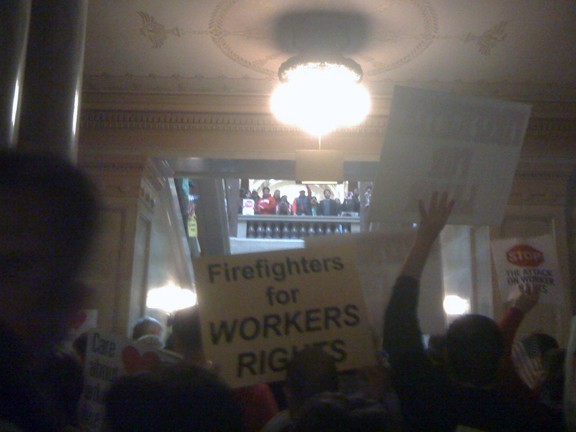
A New Yorker couldn’t help but be struck by how there was no effort to keep people out of the Capitol—no metal detectors, no police lines, in fact only a handful of cops inside the building. Indeed, in New York City you can’t even get near City Hall any longer, much less just walk into the building. You’d have been cordoned off blocks away, where no one important would have to see or hear you.
Here’s what it sounded like inside the Capitol:
Walking back to our hotel, to meet up with Matt Rothschild of The Progressive magazine so he could interview us for his radio show (here’s his take on Walker and the fightback), we ran into these folks, with a curious homemade contraption (“You can do anything with duct tape,” said one).

It all felt a bit like Seattle in late 1999—though I sure hope this movement has more legs than that one turned out to have.
The Republicans have majorities in both houses of the Wisconsin legislature, and are likely to get what they want. It’s clear that he’s using a budget crisis to break the unions and to remove them as a political force in the state. As in most states, the unions are major supporters of Democrats—who keep writing checks and getting out the vote despite the fact that Dems actually do little for them once they’re in office. (In fact, Walker’s Dem opponent did his share of union-bashing during the campaign.) It may be that had Walker not gone for such a maximalist agenda, this sort of protest might not have happened. Other governors may take note and opt instead for the death by a thousand cuts instead of one giant machete chop. But of course, it’s not just Republicans. Democratic govs like Jerry Brown and Andrew Cuomo also have it out for public sector workers, since, as everyone knows, you just can’t tax the fatcats these days. And you do have to wonder how aggressive unions in California and New York will be in protesting Democratic governors.
All that aside, this was cheering, inspiring stuff. Let’s hope that these protests marked the moment when Americans shed their quiescence and decided to fight the austerity party,
A visit to Madison
Liza, Ivan, and I will be traveling to Madison, for several talks at the University of Wisconsin. I’m talking Tuesday at 4; Liza, Wednesday at 4; both of us, Thursday at 12:20. Details:
“The Crisis is Over: What Next?” (Doug Henwood)
Tuesday, February 15, 2011, 4pm, 206 Ingraham Hall
“Behind the Mirror: Focus Groups and What they Reveal” (Liza Featherstone)
Wednesday, February 16, 2011, 4pm, 8417 Social Science
Open Seminar for Students, Faculty, and Public
Thursday, February 17, 2011, 12:20 pm, 8108 Social Science
Chaos at KPFA
Having left behind the insanity at WBAI, where they’re now raising money off the loopy conspiracy documentary Zeitgeist (featuring, among others, the LaRouchie 9/11 conspiracist Webster Tarpley), I’m now confronted with the continuing chaos and decay at KPFA.
The latest: newly installed station manager Amit Pendyal resigned because Pacifica executive director Arlene Engelhardt wouldn’t let him do his job. By all appearances, Engelhardt is in way over her head, and is acting like a tinpot dictator in the name of “grassroots” and “community”—which in practice means amateurish crap that no one wants to listen to.
Celebrating Reagan
If you’re sick of all the encomia to Ronnie on the 100th anniversary of his birth, check this out: http://www.leftbusinessobserver.com/RonaldReagan.mp3. It’s by the Swedish band Charta77. I recorded it ages ago from Pat Duncan’s old show on WFMU.
New radio product
Freshly posted to my radio archives:
February 5, 2011 Lance Lochner, author of this NBER paper, on the social returns to education (lower crime, better health) • Vijay Prashad of Trinity College on the Egyptian revolution
Whew!
Those market worries about Egypt yesterday? History! The Financial Times reports that “Investors return to risk as Egypt fears ease.” Today is, as they say, a “risk-on” day.
Why are market participants seen as rational evaluators of anything? My five-year-old is more emotionally stable than your average trader.
Egypt: the nub of the issue
Headline from this morning‘s DealBook, the M&A newsletter from the New York Times, edited by Andrew Ross Sorkin:
Will Egypt Crisis Hurt Deal-Making?
Isn’t that the first question that leapt to your mind too?


 LBO News from Doug Henwood
2 Comments
Posted on February 4, 2011 by Doug Henwood
Radio commentary, February 5, 2010
January employment: droopy
A few words on the employment report for January. As I always point out when doing these reviews, the monthly employment release from the Bureau of Labor Statistics is based on two very large surveys, one of 300,000 employers, called the establishment survey, and one of 60,000 households. For more, see here.) And as I often point out when doing these reviews, the numbers are not cooked, as many conspiratorial sorts want to believe. You might take issue with some of their definitions, particularly of unemployment, but the work is done by serious, honest people who want to tell the truth. Indeed, one of the more curious features of American life is that we have an excellent statistical apparatus that tells us reams about this society, a lot of it disgraceful, but almost no one seems to care. As Poe demonstrated in “The Purloined Letter,” the best place to hide something is often in the open.
Now to the numbers. There was an unusually large divergence between the two employment surveys this month, with the establishment survey looking rather weak, and the household survey rather strong. The truth is probably somewhere in between. Weather was awful in January, but it explains only part of the weakness in the headline payroll number.
Total employment rose by just 36,000, only about a quarter of the recent average. But, stunningly, manufacturing was up an 49,000. We haven’t seen a rise of that magnitude in percentage terms since 1990 (leaving aside the effects of an auto strike in 1998). Private services were up just 32,000. Several important service sectors shed jobs, and many turned in perfomances well below recent trends. The recently mighty “eat, drink, and get sick” subsectors—health care and bars and resturants, who’ve been going like gangbusters, added just 6,000, a fifth their recent average.
Average hourly earnings were up the most in nearly two years. The combination of weak job gains and strong wage gains has some Wall Street types worried about a return to stagflation—but I think the stag part is far more of a risk than the flation part. With the job market as weak as it is, the likelihood of a burst of wage growth seems very remote. And the growth in earnings, aside from January, has been very weak lately.
The household numbers were considerably stronger. Total employment rose by a very strong 589,000. At the same time, the ranks of the unemployed fell by 590,000. That took the unemployment rate down by 0.4 point to 9.0%, its lowest level since May 2009. That definition of unemployment requires that people be actively looking for work. The broad U-6 rate, as it’s called, which includes people who want full-time work but can only find part-time as well as those who’ve given up the job search as hopeless, fell a sharp 0.6 point to 16.1%, its lowest level since April 2009. It’s still very very high, but it’s down nearly a point and a half since late 2009.
So, the job market continues to improve slowly, but is still quite bad. There are about five unemployed people for every reported job opening, not far from an all-time high. Federal Reserve chair Ben Bernanke gave a speech the other day in which he said that he suspected that the unemployment rate will stay quite high for a long time, and he’s almost certainly right.
Share this: